Your 'neutral' business questions are invisibly steering AI toward obvious approaches - here's how to unlock alternatives you'd never discover
By Luan Doan
Published: 2025-08-09
URL: https://soloailab.substack.com/p/context-contamination-why-your-ai-cant-find-the-solutions-you-need
Abraham Wald's colleagues thought he'd lost his mind.
Here was this brilliant mathematician, staring at "objective" data with military statisticians. Returning bombers had bullet holes scattered across wings, fuselage, and tail sections. The solution seemed obvious: add armor to these damaged areas.
Wald reached the opposite conclusion.
These weren't amateurs. These were sharp analytical minds with comprehensive battlefield data. They felt logical, evidence-based, rational. Just like you feel when you ask AI, "My conversion rates are low, how should I improve my marketing funnel?"
The breakthrough came when Wald saw what everyone missed. Those bullet holes weren't showing dangerous areas. They were showing safe ones.
Planes hit in engines or cockpit never made it home - they weren't in the data because they crashed. The "complete" dataset was fundamentally contaminated. The obvious solution would have been useless, potentially fatal.
When I read this story recently, I immediately thought of a problem I often encounter when looking for problem-solving solutions with AI.
Right now, your "neutral" AI prompts contain the same context contamination that almost killed those pilots.
Your questions feel objective, but they're invisibly contaminated with solution directions. Just like that military data, your context steers AI toward obvious approaches while hiding breakthrough alternatives. What makes this contamination problematic is how undetectable it is: it feels completely logical and neutral.
Here's the embarrassing truth: your neutral context isn't actually neutral.
The Questions That Sound Neutral But Aren't
Here's what context contamination looks like in your AI conversations.
The Pricing Problem
Contaminated: "My prices seem too high for my market. How should I reduce them to get more customers?"
Clean approach: "When I quote $X for Y service, Z% say yes, A% negotiate, B% say no. What are all possible reasons for these response patterns?"
The difference is simple: one assumes price is the problem. The other explores why the perception exists. Breakthrough potential: discover you're targeting wrong buyers, positioning fails, or you need higher prices.
The Time Management Trap
Contaminated: "I'm working 60 hours but not making enough. What productivity systems should I use?"
Clean approach: "I work 60 hours, generate $X revenue. Here's my exact breakdown: [hours by task]. What patterns do you see?"
One seeks efficiency tools. The other examines if the work makes sense. Breakthrough potential: reveal 40 hours on $20/hour tasks, 20 hours on $200/hour tasks.
The Competition Obsession
Contaminated: "My competitors are cheaper/faster/established. How can I compete?"
Clean approach: "I offer [specific service] to [specific clients]. Others exist with [different traits]. What are all the ways clients decide?"
One accepts their game. The other explores the decision landscape. Breakthrough potential: clients care about ignored factors, underserved segments exist, or avoid competition entirely.
The Scaling Assumption
Contaminated: "I'm maxed out and need to scale. Should I hire or create products?"
Clean approach: "I serve X clients, generate Y revenue, work Z hours. Here's my data: [specifics]. What are all possible ways to change this equation?"
One assumes more is better. The other examines the business equation. Breakthrough potential: need fewer premium clients, different structure, or current model underpriced.
The Pattern Recognition
Look at what just happened. Every contaminated question pushes AI toward predetermined solution types. Your context feels neutral but contains invisible steering signals. This contamination stays hidden because it matches your internal logic.
Contamination doesn't just come from your questions either. See what happens when you turn ChatGPT's memory on.
AI stops being your thinking partner. It becomes your echo chamber instead. You ask for breakthrough insights but get polished versions of your existing assumptions. The more AI confirms your approach, the deeper you sink into obvious thinking. Breakthrough alternatives that could transform your business never surface.
Want to get better results from AI in your business? I share practical AI strategies for solo entrepreneurs every week.
Why This Happens to Everyone
This contamination isn't your fault. It's how the system works.
The Psychology (Dunning-Kruger Effect)
Solo entrepreneurs must wear multiple hats. Marketer, salesperson, operations manager, strategist. You develop surface-level knowledge in areas outside your main expertise.
Here's the trap: know a little, think you know everything.
Surface knowledge creates overconfidence. You get trapped believing you understand solution spaces better than you actually do. Surface-level familiarity makes you feel qualified to judge what approaches will work.
The contamination happens unconsciously. Overconfidence leads you to embed solution directions in AI prompts. You assume you know the "right" category of solutions before exploring alternatives. Surface knowledge prevents you from recognizing what you don't know.
How LLMs Work (Technical Explanation)
LLMs predict text one word at a time. Each new word depends on ALL previous words in your prompt. Early words get weighted more heavily through attention mechanisms.
Here's exactly how contamination happens: When you ask "My prices seem too high for my market. How should I reduce them to get more customers?" the AI's attention mechanisms latch onto this directional framework and amplify it through every subsequent word prediction.
Each response gets steered toward price-reduction approaches. The AI can't suggest raising prices to attract premium clients or targeting value-conscious markets because the attention weighting has already constrained the thinking space to reduction strategies.
Your contaminated context doesn't just suggest solutions - it mathematically prevents the AI from discovering that higher prices might be exactly what you need.
If you found this information helpful, you might also find value in 's approach to using AI to catch biases and 's method for beating confirmation bias in AI.
The Predictable Pattern
Psychology plus LLM mechanics creates inevitable contamination. Your overconfidence produces directional prompts. AI attention weighting amplifies those directions systematically.
What makes this contamination problematic is how undetectable it is. It feels completely logical and neutral.
How to Get Breakthrough Alternatives
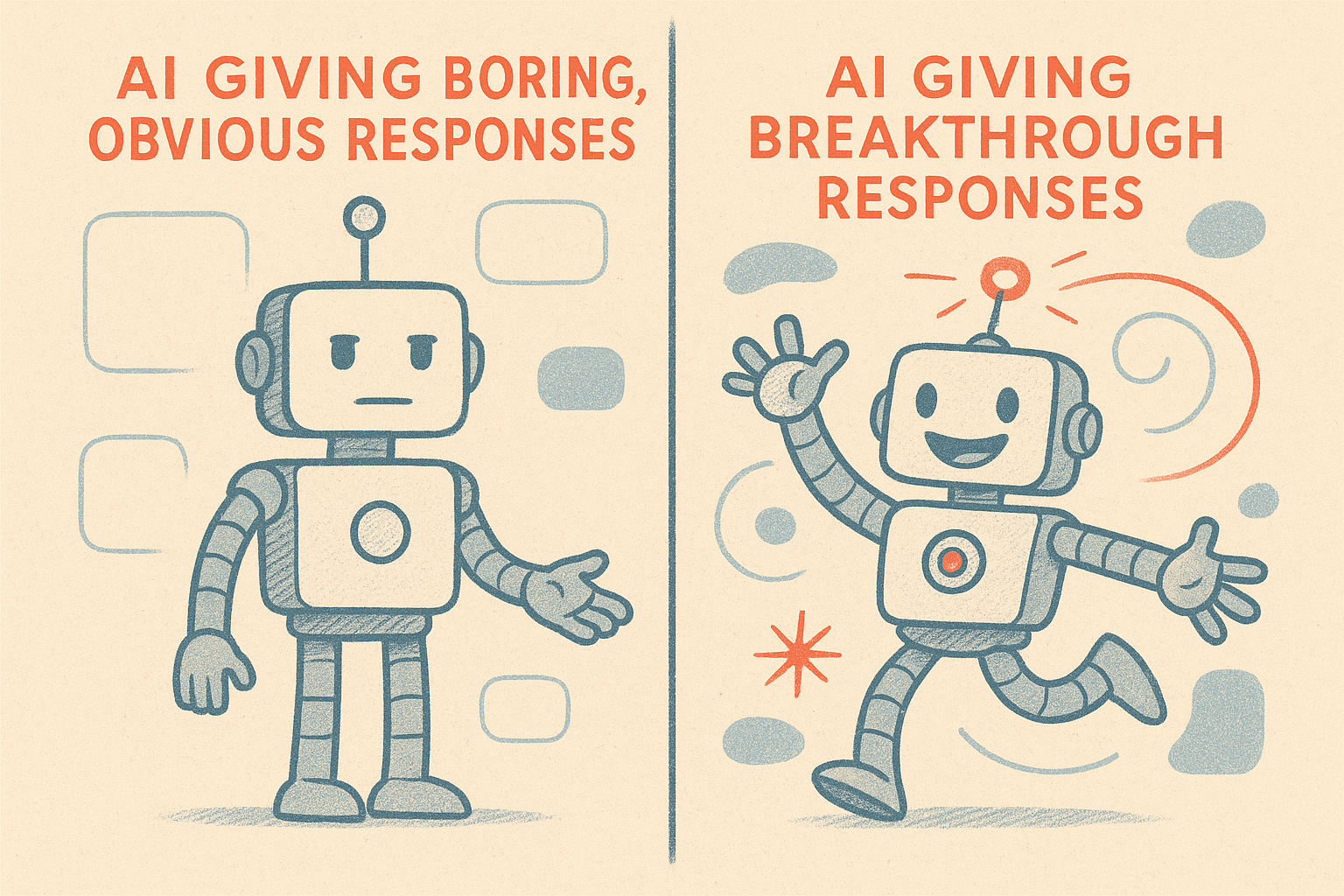
Now that you understand the contamination, here's how to clean it.
The HMW Method
Design teams discovered this problem decades ago. When Procter & Gamble developed the "How Might We" method in the 1970s, they had one goal: prevent individuals from suggesting their pet solutions before fully exploring problems.
Sound familiar?
IDEO adopted this approach because contamination destroys breakthrough thinking. Teams would jump to obvious solutions instead of discovering unexpected alternatives. The HMW method forces you to reframe problems without embedding your assumptions about what fixes should look like.
Here's exactly how it works for AI conversations.
The Four-Layer Context Method
Instead of contaminated questions, build clean context through four systematic layers:
Layer 1: Situational
What is happening? Observable facts only. No interpretations, no causes, no solutions.
Example: "I quote $2,500 for strategy consulting. 30% of prospects say yes immediately, 40% negotiate price, 30% decline."
Layer 2: Impact
What effects are occurring? Consequences, not explanations.
Example: "This pattern generates $15K monthly revenue but requires 60 prospect conversations to reach income goals."
Layer 3: Constraint
What boundaries exist? Limitations and requirements, not preferences.
Example: "I have 20 hours weekly for business development. I need $25K monthly revenue to support current lifestyle."
Layer 4: Outcome
What would success look like? End state, not pathway.
Example: "Ideal scenario: Generate $25K monthly with current time investment and service delivery capacity."
Why This Framework Works
Each layer prevents a different contamination type. Layer 1 stops you from embedding problem interpretations. Layer 2 prevents cause assumptions. Layer 3 reveals real limitations versus imagined ones. Layer 4 defines success without prescribing methods.
The systematic approach builds complete context before any solution discussion. You reveal hidden assumptions by separating what's actually happening from what you think should happen.
Most importantly, clean context opens AI's complete solution space. Instead of steering toward obvious approaches, you enable discovery of breakthrough alternatives you'd never find through contaminated prompts.
This isn't just awareness. It's a systematic process that prevents the psychology and AI mechanics that create contamination.
The Breakthrough Difference
Contaminated context traps you in obvious solutions. Clean context reveals solutions you never knew existed. The Four-Layer Method ensures AI becomes your thinking partner, not your echo chamber.
Want immediate results without perfect implementation?
Ready to master AI for your business? Get weekly practical guides on implementing AI tools and strategies that actually work for solo entrepreneurs
The Quick Win Approach
Here's the embarrassing truth. Even after understanding context contamination, I sometimes still slip into old patterns when working with AI on business problems.
Perfect context cleaning requires mental energy. When I'm moving quickly through strategy sessions, I occasionally catch myself embedding assumptions without realizing it. Constantly monitoring every prompt disrupts my natural problem-solving flow.
I needed something that worked with human nature, not against it.
Instead of requiring perfect upfront cleaning, I let conversations happen naturally. Then I strategically redirect to break out of contamination patterns.
This approach delivers breakthrough alternatives without forcing me to become a prompt perfectionist.
Here's exactly how it works.
Two Practical Approaches
Approach 1: After Normal Discussion
Ask your normal business question. Get AI's response. Then add:
Ignoring that approach completely, what alternatives exist that I might not have considered?
Alternative redirect:
If those obvious solutions were impossible, how else might someone solve this?
Approach 2: Starting Fresh
Share your initial thinking with AI: "I'm considering [your solution idea] for [problem]." Then ask:
Besides this direction, what other fundamentally different approaches exist?
Alternative redirect:
What would someone suggest if they believed my current approach is fundamentally wrong?
Why This Simple Method Works
You don't need perfect context cleaning from the start. AI helps you escape your assumption patterns after they're revealed. Less cognitive overhead means you'll actually use it consistently.
The key insight: breakthrough alternatives become visible when you explicitly ask AI to ignore your initial framing.
The Bigger Picture
This technique gets immediate results. But real transformation comes from building systematic context cleaning into your core thinking process. These frameworks aren't just AI tools - they're powerful approaches for business decisions, strategic planning, and complex problem-solving.
The contamination patterns you learned affect how you think about everything. Clean context becomes a competitive advantage far beyond your AI conversations.
Start with the simple redirects today. Build toward systematic thinking tomorrow.
Thanks for reading Practical AI for Solo Entrepreneurs | SoloAILab! Subscribe for free to receive new posts and support my work.