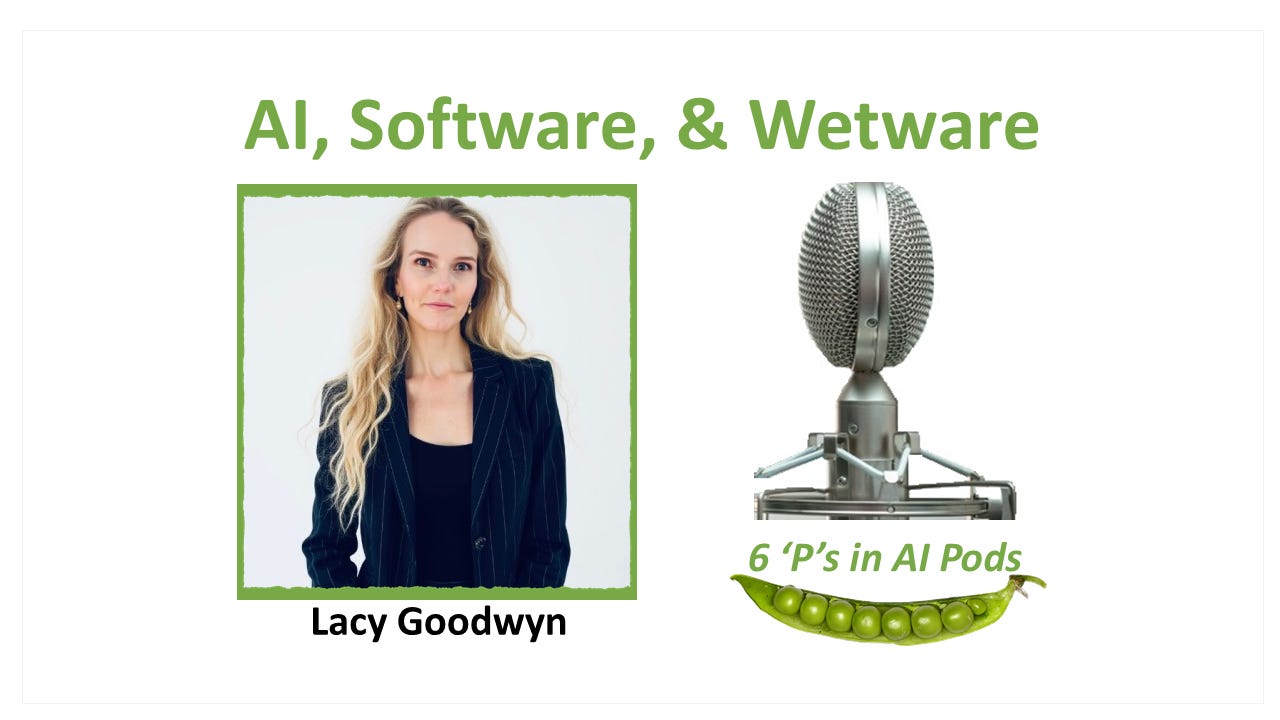
Written interview with USA-based founder and AI & design consultant Lacy Goodwyn on WYN, BAWAI, her stories of using AI, and how she feels about AI using people's data and works
By Karen Smiley
Published: 2026-11-05
URL: https://sixpeas.substack.com/p/aisw-135-ai-software-wetware-lacy-goodwyn-bawai-usa
Introduction - Lacy Goodwyn
🫛 This edition of AI, Software, and Wetware features a written interview on ethical AI with Lacy Goodwyn, the 🇺🇸 USA-based founder of WYN, and the author of **. We discuss:
-
Her ‘scribble’ path from studio art into tech startup product management
-
Why she sees helping women in AI through BAWAI as paying it forward
-
Using AI to help her prepare her personalized BAWAI interviews
-
The duality around supporting the 3Cs of creative rights and pushing companies toward consent and credit precisely because AI “isn’t going anywhere, and the people who made it possible deserve better than to be erased by it.”
-
Advocating that the women with reservations about AI are the ones who are most needed “in the room” for shaping AI
and more. Check it out, and let us know what you think!
Reading time estimate: 15-20 min.
This post is part of our AI6P interview series on “AI, Software, and Wetware”. Our guests share their experiences with using AI, and how they feel about AI using their data and works. (This is a written interview; read-aloud is available in Substack. If it doesn’t fit in your email client, click HERE to read the whole post online.)
Note: In this article series, “AI” means artificial intelligence and spans classical statistical methods, data analytics, machine learning, generative AI, and other non-generative AI. See this Glossary and “AI Fundamentals #01: What is Artificial Intelligence?” for reference.
Interview - Lacy Goodwyn ()
Karen: I am delighted to welcome Lacy Goodwyn from the USA as my guest today on “AI, Software, and Wetware”! Lacy, thank you so much for joining me on this interview. Please tell us about yourself, who you are, and what you do.
Lacy: I’m Lacy Goodwyn, founder of Badass Women in AI (BAWAI) and the person behind WYN, my D.C.-based AI and design consulting practice. My path here was not a straight line, which is a generous way of describing what was closer to a scribble. I studied studio art, spent four years in New York’s jewelry and design world, then moved to San Francisco with a lot of hope and no actual plan. I needed a job and landed a role as an executive assistant at a tech startup. Somehow that turned into more than a decade in Bay Area tech, including five years at Coinbase, where I started as an executive assistant in 2018 and left as a product manager. IPO and all.
Karen: That’s an impressive scribble path!
Lacy: Yes, I worked my butt off, but I didn’t get there alone, and I’d never pretend to. I owe so much to the women who opened doors for me along the way, especially at Coinbase. These women taught me the power of women helping women, and I like to think BAWAI is me paying that forward.
Karen: I love hearing that you connected with other women who advocated for you. And it’s awesome that you are helping other women now.
Lacy: Being a woman in tech is lonely. Starting your own company, lonelier. Building in AI, lonelier still. On the surface, yes, BAWAI is about women in AI, and getting more of us into that room is critical. What’s underneath, though, is simpler and bigger: making women feel less alone, in whatever they’re carrying. The two connect in a way I love: when a woman hears another woman in AI moving through the same doubt she’s facing, she feels less alone, and starts to believe there’s room for her here too. That’s how the space fills. Connection first, more women building as a result.
Karen: What is your level of experience with AI, ML, and analytics? Have you used it professionally or personally, or studied the technology?
Lacy: I use AI heavily, every single day, whether I’m putting it to work for clients, running BAWAI, or talking myself off a ledge at 11pm about whether the slate-blue vanity I just bought wrecked the whole Ralph Lauren vibe I’m going for in my new bedroom. Even as an avid user, someone who’s in this space for a living, I still feel like I have so much to learn. The technology moves so fast that some days I have no idea what I’m doing, and it can be overwhelming.
I also want to note that while I may know my way around AI decently well, I am by no means one of its builders. I think it’s important to make that distinction, because the women who are building are so few. Fewer than 14% of senior AI roles are held by women. I want to make sure they get the credit they deserve, and that a lot more women end up building alongside them. This is critical to ensuring the technology accounts for our perspective.
Karen: Can you share a specific story on how you have used a tool that included AI or ML features? What are your thoughts on how the AI features [of those tools] worked for you, or didn’t? What went well and what didn’t go so well?
Reference for this question: “But I don’t use AI”: 8 Sets of Examples of Everyday AI, Everywhere
Lacy: Like I mentioned, I use AI to help me run BAWAI, and a good example is how I build my spotlight questions. Normally I meet with the spotlightee first, then combine our conversation with my own research to shape a list of really personalized questions. For my most recent spotlight, I tried something new. Given how present ** is online and how busy she is, I wanted to see if I could eliminate as much of the initial legwork as possible. So with her approval, I pulled in Claude to gather everything she’d already shared publicly and build her questions from there.
It worked really well, and it did exactly what I’d hoped: it saved her real time and effort. The asterisk, though, is everything that came before it. The months of rapport and trust I’d already built with her are what made any of it possible, and that is exactly what these tools can’t replace, and what I’d never want them to. AI can gather the facts, and it’ll confidently make a few up while it’s at it, which is why I check every single one. What it can’t do is earn someone’s trust, or sit with her in the moment she feels safe enough to say what she’s scared to say out loud. That part is sacred to me, and it will always be human. Badass Women in AI10/28 Spotlight: Alyssa Fu Ward, Founder of The HART StudioImage created by BAWAI, based on an original drawing by 𝙰𝚕𝚢𝚜𝚜𝚊 𝙵𝚞 𝚆𝚊𝚛𝚍, 𝙿𝚑𝙳 🍊…Read more8 days ago · 42 likes · 29 comments · Badass Women in AI 💄 and 𝙰𝚕𝚢𝚜𝚜𝚊 𝙵𝚞 𝚆𝚊𝚛𝚍, 𝙿𝚑𝙳 🍊
Karen: If you have avoided using AI-based tools for some things (or anything), can you share an example of when, and why you chose not to use AI?
Lacy: This is the question I circled the longest. There’s a known scrutiny on women who use AI, sharper still for those of us with ADHD, as if the first even footing we’ve ever had must mean we’re cheating. It’s real enough that I feel it even when I know better.
So here it goes. AI is like a gift from god. There’s finally a way to quiet the chaotic overwhelm that is my brain, so if anything, I’m holding on for dear life, not avoiding it 😂. The real question for me isn’t if or when I avoid it, it’s how I ensure that, as much as I lean on it, it stays a collaborator and never the one in the driver’s seat.
Take my BAWAI spotlight series, for example. Control matters most here, because I’m holding a real woman’s story. What ends up on the page isn’t just my voice, it’s hers, and hers comes first, which is the whole point of BAWAI, to let these women be heard exactly as they are. It all comes down to the rawest moments, the line that catches in your throat, the moment a reader sees herself in this woman. Not because they make a piece land, but because she entrusted it to me, and I want to do her justice. I lean on AI the whole way through, even here, but as a partner, writing with me, never for me.
Karen: A common and growing concern nowadays is where AI and ML systems get the data and content they train on. They often use data that users put into online systems or publish online. And companies are not always transparent about how they intend to use our data when we sign up.
How do you feel about companies using data and content for training their AI/ML systems and tools? Should ethical AI tool companies be required to get Consent from (and Credit & Compensate) people whose data they want to use for training? (the “3Cs Rule”)
Lacy: Two truths at once. The concerns around creative consent and data privacy are legitimate. I’ve written about them publicly, and a rule like the 3Cs, consent, credit, and compensation, is the right spirit. This isn’t hypothetical either. There are already over 140 lawsuits from creators whose work was used to train these models without their consent. My whole world, BAWAI most of all, is about people getting the credit for their work and being seen for it, so “we scraped it from the internet” being treated as a loophole doesn’t sit right with me.
At the same time, AI is here to stay, and I’m not interested in pretending we can wish it away. So my answer isn’t to reject it or worship it. It’s build it right. Push companies toward consent and credit precisely because this isn’t going anywhere, and the people who made it possible deserve better than to be erased by it.
“This is the biggest reason I want more women in the room, including the ones who are wary of AI, maybe especially them. The people with real ethical concerns are exactly the ones who will push for consent, for guardrails, for building this responsibly. You can’t fix from the outside what you’re not in the room to shape. So if you’ve looked at AI and hesitated, your concerns don’t disqualify you. They’re the qualification. We need you in here.” - Lacy Goodwyn
Karen: As a user of AI-based tools, do you feel like the tool providers have been transparent about sharing where the data used for the AI models came from, and whether the original creators of the data consented to its use?
Lacy: No. As a user I usually can’t tell where any of this came from, and when there is disclosure, it’s buried where no normal person will ever read it. Here’s what worries me: something like 84% of people say they’re worried about their personal data going public through these tools, and a large share are still typing confidential information into them anyway. Women especially are being told to upload their writing, their photos, their ideas, with no real understanding of where any of it goes. I build with AI but I’m not training the models, so I’m downstream, trusting providers I can’t audit, same as everyone. I hold the companies with the most power and information to the highest bar here, and right now they are not clearing it.
Karen: As consumers and members of the public, our personal data or content has probably been used by an AI-based tool or system. Do you know of any cases that you could share (without disclosing sensitive personal information, of course)?
Lacy: One that applies to almost everyone I know: I’m active on LinkedIn, and in 2024 LinkedIn began using member content to train its AI, opted in by default. So my posts, my writing, my profile were almost certainly part of that. I found out the way most people did, after the fact, not because anyone asked me first. That’s what bothers me. It isn’t only that my data was used. It’s that I was never really given the choice.
Karen: Have you taken advantage of the opt-outs LinkedIn offered after the fact? Or did you figure that the horse was long gone, and no point in closing the barn door? Or some other thoughts?
Lacy: No, I haven’t. By the time LinkedIn offered an opt-out, my content was already used, so part of me figured it was already too late to matter, and the rest of me just didn’t prioritize it. Even caring about this as much as I do, I can’t chase down every buried setting on every platform. Which is kind of the point: if someone who does this for a living can’t keep up, the “just opt out” model is broken. The burden shouldn’t be on us to keep finding the switch. It should be on the platforms to ask first.
Karen: Do you know of any company you gave your data or content to that made you aware that they might use your info for training AI/ML?
Lacy: If you write on Substack, you’ve probably watched this one play out, and it still isn’t over. That’s part of why it gets under my skin. In July, Substack rolled out an AI-detection tool called Pangram that scans writers’ work to flag whether it’s “AI-generated,” with no warning. The thought of a machine scanning a woman’s story she trusted me to tell and scoring it in public feels like a violation. She never agreed to it, and neither did I.
You can opt out, but they make you work for it. One post at a time, buried at the bottom of the publish screen, with no single switch to shut it off for good. Another writer posted a ready-made objection anyone could send to Substack’s privacy team, so I sent it. The first response I got was a straight-up no. So I wrote back and asked them to explain why. The next thing I knew, a second email landed, this time from their Standards and Enforcement team, quietly saying yes. No explanation, no in-between. The no just turned into a yes. Funnily enough, I was deep in the comments of your Pangram opt-out post, Karen, when it finally came through, and you were the one who flagged the catch: the approval doesn’t mean it’s actually off. You were right, by the way. I may have it "off" in writing, but I still have to switch the toggle every time I post. A choice you have to dig for, fight for, and still do yourself isn’t much of a choice.
It gets even worse. This past October, Substack added labels. Now, I love a good label, on a pantry jar, a storage bin, a drawer in my kitchen. A public verdict on a woman’s writing, human or not, stamped on before anyone reads a line? That one I can’t stand. It’s the whole reason I built BAWAI, because women are tired of being reduced to a label. On top of that, the tool doing the stamping isn’t even reliable. It brands real, human writing as fake, and does it with total certainty.
Underneath all of it is the same thing. Being scanned and judged without consent, on the most human work I do, by a system I was never asked to join. Not me, and not the women who put their stories in my hands.
Karen: Has a company’s use of your personal data and content created any specific issues for you, such as privacy, phishing, or loss of income? If so, can you give an example?
Lacy: Not yet, and I'm knocking on every piece of wood in reach as I say that. Nothing I can trace to a single moment, at least, which is either good luck or just how this kind of harm works: it rarely leaves a clean trail. That "not yet," though, carries a lot of weight. Ask me again in a year.
Karen: Public distrust of AI and tech companies has been growing. What do you think is THE most important thing that AI companies need to do to earn and keep your trust? Do you have specific ideas on how they can do that?
Lacy: If I have to pick one: stop treating people as the product without telling them. Earn trust the way humans do, be honest before you have to be, not after you’re caught. Karen, you said it better than I could in your own piece: “forcing concerned women to override their moral compasses to use AI isn’t the answer.” The answer is fixing the reasons their compass went up to begin with. Same with trust. Tell me what you’re taking, ask first, and give me a real choice, not a toggle buried three menus deep. Opt-in by default, plain-language terms a normal person can actually read, and a clear way to see and delete what you hold on me.
I run a practice that puts real-world impact over complexity for its own sake , and I'd tell any AI company the same: trust comes from respecting the human on the other end, not the size of your model.
Karen: Thank you for making the time for this interview, Lacy! Is there anything else you’d like to share with our audience?
Lacy: Just this. If you’re a woman reading this and you feel behind on AI, you’re not. Women make up only about 22% of the global AI workforce, and the number actually building the tools is far smaller, so if the room feels empty, it’s not in your head. But women aren’t opting out. The door is being held shut. That’s a systems problem, not a you problem.
So if you’ve looked at AI and hung back, whether it’s the ethics, the access, or a space that made you feel stupid for asking a basic question, I get it, and I promise we’re not all like that. Your concerns belong in the room where this gets built, not outside it. That’s the whole reason I built Badass Women in AI. We just surpassed 1500 subscribers, and women are still writing in to tell me they feel a little less alone. I’m not in this fight alone either. Every week I get to spotlight another woman already building what we’re told we can’t. Come find us at Badass Women in AI on Substack. We’re here to help ❤️💄.
Interview References and LinksBadass Women in AIReese Witherspoon Isn't the Problem with Women and AI. The System Is.Before diving in, I want to acknowledge some of the women who’ve brought really thoughtful perspectives to this conversation — Abi Awomosu, Nicolle Weeks, Whitney A. Foster, and AI Meets Girlboss. I’ve learned a lot from reading your work and I’m excited to add my thoughts…Read more5 months ago · 46 likes · 27 comments · Badass Women in AI
WYN Consulting
Lacy Goodwyn on LinkedIn
Lacy Goodwyn on Substack () Badass Women in AISpotlighting the women quietly shaping how we build with AI — engineers, designers, founders, and the ones figuring it out as they go.
About this interview series and newsletter
This post is part of our AI6P interview series on “AI, Software, and Wetware”. It showcases how real people around the world are using their wetware (brains and human intelligence) with AI-based software tools, or are being affected by AI.
And we’re all being affected by AI nowadays in our daily lives, perhaps more than we realize. For some examples, see post “But I Don’t Use AI”:
We want to hear from a diverse pool of people worldwide in a variety of roles. (No technical experience with AI is required.) If you’re interested in being a featured interview guest, anonymous or with credit, please check out our guest FAQ and get in touch!
6 ‘P’s in AI Pods (AI6P) is a 100% human-authored, 100% reader-supported publication. (No ads, no affiliate links, no paywalls on new posts). All new posts are FREE to read and listen to.
Thank you for being a subscriber - I appreciate your support for ethical AI! You can manage your subscription here.
Series Credits and References
Disclaimer: This content is for informational purposes only and does not and should not be considered professional advice. Information is believed to be current at the time of publication but may become outdated. Please verify details before relying on it. All works, downloads, and services provided through 6 'P's in AI Pods (AI6P) publication are subject to the Publisher Terms available here. By using this content you agree to the Publisher Terms.
Microphone photo by Michal Czyz on Unsplash (contact Michal Czyz on LinkedIn)
Credit to CIPRI (Cultural Intellectual Property Rights Initiative®) for their “3Cs' Rule: Consent. Credit. Compensation©.”
Credit to * for the “Created With Human Intelligence” badge we use to reflect our commitment* that content in these interviews will be human-created:
If you enjoyed this interview, my guest and I would love to have your support via a heart, share, restack, or Note! (One-time tips or voluntary donations via paid subscription are always welcome and appreciated, too 😊)