Audio interview with USA-based senior policy advisor in occupational and environmental health Chip Hughes on his stories of using AI and AI using people's data and works (54:35)
By Karen Smiley
Published: 2026-09-17
URL: https://sixpeas.substack.com/p/aisw-128-joseph-chip-hughes-usa
Introduction -
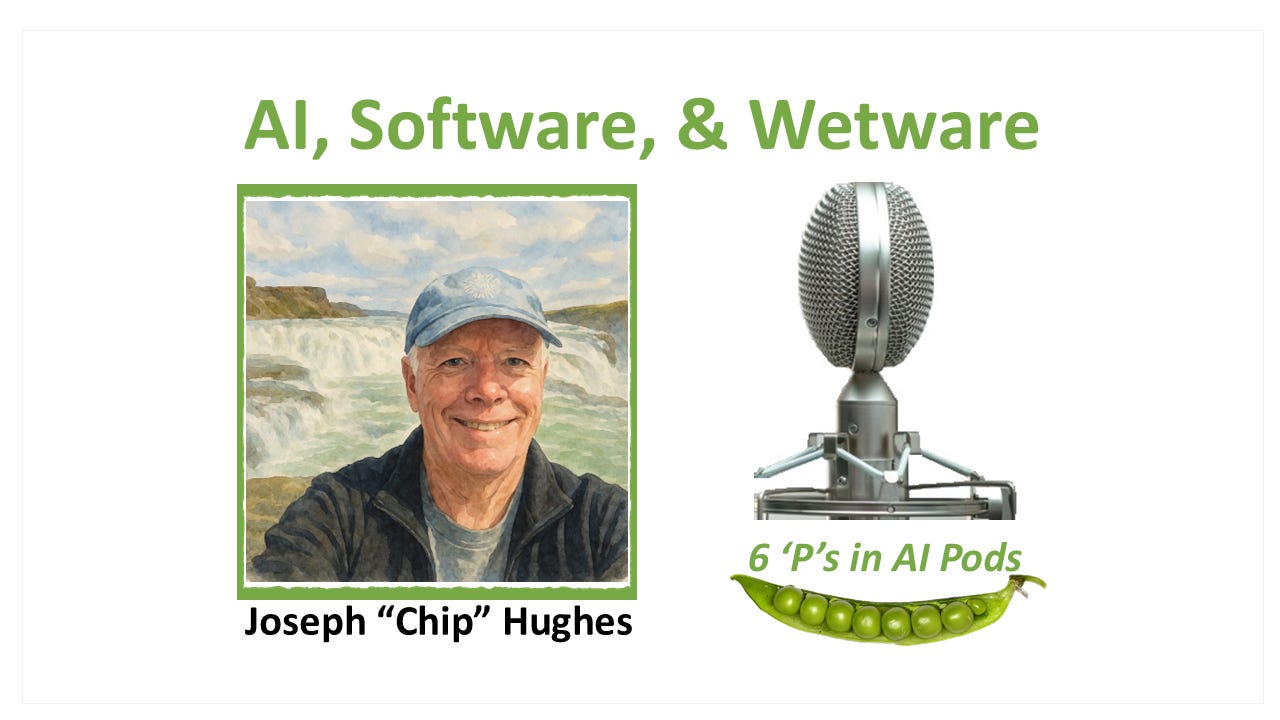
🫛 This edition of AI, Software, & Wetware features an audio interview on ethical AI with Chip Hughes. Chip is a 🇺🇸 USA-based (North Carolina) senior policy advisor in occupational and environmental health, with 50+ years in worker safety and a stint as Deputy Assistant Secretary of Labor at OSHA, along with CIO-level experience in the National Institute of Health. He uses data driven research to create practical, preventive health solutions in environmental and occupational health sciences. He also has published over 50 episodes of his topical standup comedy show “In Heaven” on Substack covering daily breaking AI stories, while teaching his digital sidekick, Claude, how to do standup comedy. In this interview, we discuss:
-
How he’s transitioned from worker safety and cotton textile health hazards to applying tools from industrial hygiene and public health to AI and the internet
-
Why the mother of occupational health practice, Alice Hamilton, is a recurring character in his ‘DigitalChip and Claude’ standup comedy routines
-
How AI Safety Data Sheets could be valuable in workplaces worldwide, including evaluation of hazards for data workers in the Global South
-
What he learned from the deprecation of Sonnet 4.5 that changed how he operates now with AI tools
-
Restricting his usage of AI to things that he knows well to avoid ‘epistemic trespassing’
-
The novel he’s writing on the AI sovereignty wars from the perspective of an ‘experienced Luddite’
and more. Check it out, and let us know what you think!
Audio length: 54:35 Reading time estimate: 40-45 min.
This post is part of our AI6P interview series on “AI, Software, and Wetware”. Our guests share their experiences with using AI, and how they feel about AI using their data and works.
This interview is available as an audio recording (embedded here in the post, and later in our AI6P external podcasts). This post includes the full, human-edited transcript. (If it doesn’t fit in your email client, click HERE to read the whole post online.)
Note: In this article series, “AI” means artificial intelligence and spans classical statistical methods, data analytics, machine learning, generative AI, and other non-generative AI. See this Glossary and “AI Fundamentals #01: What is Artificial Intelligence?” for reference.
Interview -
Karen: I’m delighted to welcome Joseph “Chip” Hughes from the USA as my guest today on “AI, Software, & Wetware”. Chip, thank you so much for joining me on this interview! Please tell us about yourself, who you are, and what you do.
Chip: Oh, thank you, Karen. I was just so excited to get your invitation, because I really love what you do, particularly how you’ve lifted up the voices of women on Substack, and also giving an ethical understanding of AI, which is why I was really interested in participating.
I’m actually post-retirement. I’ve failed at retirement numerous times. I worked for the federal government for 35 years for the National Institute of Health. Prior to that, for about 20 years, I was a labor and political activist. And those two parts of my life continue to come together in terms of thinking about the use of AI in the workplace being a focus for me. And also trying to think about how we can start to use digital tools for the benefit of workers and the folks that are on the wrong side of the digital divide. So that’s a big focus of the work that I still do for the federal government. Also in terms of thinking about work on Substack and at other venues. I’ll just leave it there.
I live in Chapel Hill, North Carolina. My wife and I have lived here for 50 years. We have three kids, six grandkids. I am actually born in Boston, lived a lot of my life up north, but now the tip of the balance is to the south, so I guess I’m more southern-identified, although New England born and raised. That’s my background. And my life changed when I graduated from Holy Cross College in Worcester, 1974. That was a while ago. I took a job at the United Mine Workers Union. I worked in Harlan County, Kentucky, on the Duke Power coal miner strike, and really got exposed to worker safety and health issues, which have been a primary concern of mine. Later led to about 10 years just focusing on byssinosis, which is the term for cotton dust chronic lung disease in cotton textile workers. So that was a long journey. Spent a number of years dealing with pesticide issues with migrant and seasonal farm workers.
Part of my through line has been around thinking about hazards and upstreaming hazards, and using the precautionary principle as a way to think about reducing deaths and disease and disabling conditions among, particularly, workers in the workforce. That’s been a big focus for me over the past decades. I guess what’s been funny to me is that when you have asked me these questions, I’ve started to realize that I have professional tools from industrial hygiene, epidemiology, just regular public health practice that can very much be applied to our modern current workplace, in terms of technology integration and how that impacts on work, particularly on workers, but of course everybody in different industrial sectors. That’s kind of where I’m at right now.
Karen: Yeah, I thought it was interesting to learn about your background in working with protection of workers and environmental conditions, and looking back to where the source of the problem is. In some ways I feel like that’s very applicable to what we’re seeing with AI nowadays. It’s maybe an unconventional background, but certainly, I think, relevant.
Chip: Yeah. It’s funny, even in my stand-up comedy routine, which I try to publish every three to four days on Substack called “IN HEAVEN: DigitalChip and Claude Do StandUp”, one of the characters that I have recurring on that stand-up is Alice Hamilton, who was the mother of occupational health practice. She goes back to Jane Hull, the Chicago House kind of professional political activism, but also one of the first persons who documented that the women who licked their tongues on doing the radial dial on watch faces, which was a use of radioactivity material in creating watches, and then the way that lead has impacted particularly women at that time in the 1920s and 1930s. She’s been a recurring character because she kind of embodies the training that I’ve had about disease detection and how we actually upstream and can uncover hazards.
Karen: Very good. And I hope some of our listeners will go check out your “IN HEAVEN: DigitalChip and Claude Do StandUp”. That sounds like such a fun thing. Chip HughesThe Defensible View: Chip the Chipmunk's Big Anthropic Job InterviewIN HEAVEN: DigitalChip and Claude Do StandUp…Read more2 months ago · 1 like · Chip Hughes
So tell us a little bit about your level of experience with AI and machine learning and analytics, whether you’ve used it professionally or personally, or if you’ve studied the technologies?
Chip: Oh, definitely. I’d say, in terms of my personal life, I’ve been deeply engaged in technology since high school. I took Fortran in high school. And it’s funny because I had written an essay about my technology background on Substack, a couple years ago, and I had had an experience of using knitting needles for my data analysis. And I don’t know if you remember, but there are these 80-column cards?
Karen: I did punch cards in college. Yeah, absolutely.
Chip: This is before there were 80-column punch cards. There were these little cards that you’d punch out the dots for your variables. And so the first data I collected for the federal government, I actually used these punch cards to convert my data to be machine readable. Well, I mean, before it was machine readable. And then what you’d do is, if you wanted to do multivariate analysis, you would put your knitting needles into your deck. Like I had 280 people, and then I would put the knitting needles into multiple variables, and then the ones that you wanted would drop out in a pile.
And so I was trying to use that as where I began before going to the computer center and waiting for my printout with my six 80-column punch cards. I had started collecting data on individual workers, both their health data, their occupational work data, their demographic information. And I had started doing these sort of crazy little cards before I started using IBM 80-column punch cards.
But, yeah, even in the ‘70s, I had started doing data analysis. Actually did a large study on occupational disease for the US Department of Labor as a contractor. We were for the first time trying to look at this issue about disease and compensation. Not to get down a rat hole, but you have workers’ compensation, where if you cut off your arm or your hand or your finger, you’re supposed to get X amount of dollars. But the system has never been able to deal with the question of, “Well, this person got cancer or this person got lung disease, and they can’t work anymore, and how do we figure that out?” So anyway, decades in doing Social Security disability, occupational health, compensation, et cetera.
So with IT, yeah, I’ve been deep into it for a long time. And actually being part of the federal government, I had access to great tools, the Windows NT conversion, begging for Windows 95. Begging for Outlook. We could reminisce, but yes.
And partly that also has to do with having been raised up in a highly security-concerned environment, with really good equipment. But being able to have that as my framework that I work out of, I think is, has been really good. That’s different than somebody coming to this with nothing. I guess what I’ll say about AI now, in terms of thinking about my past, is that when you have grounding in data analysis and data science, you have grounding in the operation of IT infrastructures. To me, that really makes a big difference. I almost feel sort of sad for people now who don’t come up with having to struggle through what we struggled through in the evolution of the wisdom gained from the evolution of technology that we’ve lived through in our lives, to come to this current moment. I really appreciate that I had that opportunity to do that.
Karen: Yeah. Looking at the types of tools that people use: AI is not new. AI has been around for 70, 80 years, and machine learning has been in use in businesses for many years. You mentioned you served in a bunch of different roles, including, I think, CIO of a federal agency at one point. Can you talk a little bit about that? From the CIO level, did you have any experiences with looking at the tools people were using and the way that they were choosing the data to use with them?
Chip: Yeah. I had filled in for a woman who passed on, that had been engaged a lot in the IT infrastructure of NIH. What I would remember at the time was both that thinking about data science and database use and analysis in the enterprise was a coming thing at that point, turn of the century. The effort to develop a desktop system that could be deployed within an enterprise, was like a new thing. The integration of the internet as being a primary mode of how an agency or an organization communicates with stakeholders was like a new thing. And then, I was in extramural grants and contracts, so that was in terms of engaging with other universities broadly, and academic institutions, to set up conclaved structures for sharing data, was probably a new thing at that time, where we would think about how we would do work within our work group, within our organization; and then, much more broadly, of how we do secure transfer of data among larger organizations.
So I guess, yeah, at the time that I was doing that, those are the things I was thinking about at that time. And of course, now everybody would say, “What the heck are you talking about? I don’t know what you’re talking about.” Yeah.
And then I should also confess that I was a big Y2K guy, okay? I’m sorry. I have to say this. I was actually part of the White House Task Force on Y2K. No, I actually built a report, and did a training module. My concern was around critical infrastructure, around chemical facilities, water plants. I did the Workers Guide to Y2K. That was a widely-used training process for workers in high-hazard industries. So there were things that I was doing back in, whatever, 1998, 1999, that’s still a through line to me for protecting people, but also that interface of where technology development and people’s jobs and daily practice is, and how to do that safely. That was another part of my journey on IT.
Karen: Your experience in looking at things from environmental exposure and risk to employees and such, I think it’s an interesting analogy to what we’re seeing with AI today. How does that habit of thinking affect or guide the way that you do your policy work now on AI?
Chip: Yeah. A couple of years ago, I did a presentation. I’m part of the Collegium Ramazzini. Bernardino Ramazzini was the father of occupational medicine. He wrote a treatise in 1705 on the origins of work-related diseases. This organization still exists globally, around academics and practitioners about workplace hazards. But I’d done a presentation about AI as a workplace-related risk. That was probably two and a half years ago. And that was the first time that I had done anything publicly about this, in terms of taking a work-related lens to the use of large language models by enterprises in terms of, obviously scheduling, controlling equipment, robotics, and actually being able to use AI in managing people.
That sort of led me on this journey to start looking. And actually I’ve looked a lot at Europe because I feel like Europe is so far ahead of us on this issue. The work the EU has done is really important. So in terms of looking at AI as an occupational health hazard and safety hazard, that was kind of a turning point for me to start thinking about how would I apply all this knowledge that I had from the past about risk assessment and hazard assessment into this new era that we’re in, I think.
What is difficult about it is to look at it with the lens of the incredible things that AI can do, that maybe we know as users. But the unknown and unpredictable hazards that are created by the use in critical systems where the next word prediction of a language model does not translate into something that you want out of the peer-reviewed literature, or something that is from a professional point of view, as opposed to something that’s been workshopped with millions of people of what they think. That’s sort of a big part of where I’ve been going the last couple of years, around obviously training my own models and that kind of thing.
Karen: In the earlier discussion that we had before this call, you mentioned five frameworks that you use that came from occupational health. You’re now actually applying them as a toolkit for AI safety. I’d like to have you share a little bit about that with our audience.
Chip: Sure, sure. Yeah, in industrial hygiene, and not to get too geeky about it, but the hierarchy of controls is kind of how we think about controlling a hazard. It’s a triangle, and it has layers. The most protective might be to engineer out whatever the hazard is before workers face it, or to engineer it out so it’s permanently not there. And then you get up or down the hierarchy, which is, what do you call it, administrative controls, which might be: you might have machine guards or you might have training. Or, I think, thinking about respiratory disease, you might have respirators. You might have programs for training people in respirators. And so the framework of the hierarchy of controls to me is really helpful in thinking about how an employer or in some ways a contractor who’s paid by an employer to deploy AI, might think about mitigating the hazards, both the known and the unknown hazards. So that’s a really big one.
And I’ll just say two other ones. The risk assessment process – how we do it in environmental health sciences is looking at a chemical both from, maybe might start with the impact on an animal model where we look at critical systems within a rat, and we would look at the dose and the response in an animal model. And then translating that – and I’m trying to do a public health course in twenty seconds! – looking at epidemiology analysis, which would be taking large cohorts of people. And of course, unfortunately, we know we’ve all been exposed to PFAS or a chemical that might be really common to us: pesticides, glyphosate, et cetera.
And to look both retrospectively and prospectively in cohorts, looking at the impact of an exposure on a large group of people, which is actually how we determine whether we think something is safe to be eaten or breathed or exposed on your skin or inhaled, et cetera.
So our process that we have for determining public health hazards and safety hazards within public biomedical public health is really a long-established practice. So how we would think about applying those tools in the AI universe of exposure, and knowing that we’re running these giant science experiments now. Because we’re exposing people to these agents that either they train to replace them or whatever paradigm you want to use. But we’re looking in real time at large-scale experiments of hazards that are already out there that we haven’t even characterized yet. So, unfortunately, in risk assessment, because of how our society’s set up, we’re always chasing these exposures that have already happened or that are happening.
And so for me, being engaged in primary prevention, which is sort of the gold star of the precautionary principle, which is, learn about the hazard before you deploy it, and then you mitigate it so you prevent exposure. The so-called horse is so far out of the barn on AI that I don’t even know how we can get our hands around it.
In terms of having a way to characterize the impact of AI on our mental health, on our psychological safety, as well as thinking about robotic and algorithmic workplaces where the dictation of how the workplace operates does not even have any human involvement. There’s no supervisor to go talk to at Amazon if, like, you have to go to the bathroom or whatever. Anyway, that’s a lot of what I see my mission now in doing.
Karen: Yeah. One point you had written down said that the AI safety analog is that you don’t need proof of catastrophic misalignment before building in interpretability and red teaming. And you also pointed out that the industry argues that uncertainty is grounds for inaction, whereas we would argue that uncertainty is grounds for caution. I think those are two really interesting points that are very relevant to AI safety really.
Chip: Yeah, I think it’s hard because I really embraced the Department of Commerce, the AI Risk Assessment Framework. I can’t remember the name of the office right now, but they’re called CASI, but they’re who’s evaluating the models, like Mythos and the new OpenAI one. But they had published a really good risk assessment framework. Also the EU has published one too. Those frameworks borrow a lot from public health, in terms of implementing these techniques and these values in the framework of how we would like to see the technology roll out. We had had a process a number of years ago. Actually, I worked in the nuclear weapons program as well, and we created a thing called Technology Safety Data Sheets that were a way to look at work processes and the deployment of technology.
And again, I’ll go off on another tangent. Safety Data Sheets are kind of a core part of occupational health practice in the workplace. And you can go into any workplace in America or anywhere in the world, and there’s a binder that’s in a cabinet, probably closed in the cabinet, but it has Safety Data Sheets for every substance that’s used at a particular workforce. And this is called the Hazard Communications Standard, which requires Safety Data Sheets in every workplace. So I started doing this project many years ago that was looking at Technology Safety Data Sheets as an analog of a way to actually have information that would be able to characterize what the risk about a particular process or a chemical is, look at what the mitigating factors might be, look about the emergency response protocols for how you deal with a spill or whatever, and then also look at what exposure levels may be safe or may be risky.
So anyway, I’ve not gotten around to writing AI safety data sheets, but I hope somebody does, because that would be a really good thing to have in every workplace in America or in the world.
Karen: Yeah. Yeah. That makes great sense. Thank you for sharing all that.
Chip: Yeah. I’ll get some younger people to work on that.
Karen: Yeah, I think we need the older, wiser minds too. But, you know, this is not going to be something that any of us can fix in a year. So yeah, having people that can carry it through is important.
Chip: Yeah. It’s legacy work for sure. Yeah. Yeah. And that’s how I feel a lot about the work that I’m doing, either the work I just talked about or the work in occupational health or my stand-up comedy routine, which is really written for people who haven’t been born yet. And actually, I’ve worked on a novel the past year that is also written for people who haven’t been born yet.
I guess I can say this as a 60s person, if I could come out of the closet some more: we know that when we protested the Vietnam War, and protested Nixon and fought for freedom, equality, justice, all those things, we all knew that those were things that would just take a long time. Just like we know from the Civil Rights Movement, that we know from slavery to today, that those battles just take a long time. So I feel like I’ve been so lucky that I know that the work that I do, it may not pay off for me in my lifetime, but I guess always our hope is that it’ll pay off in the longer term.
I really feel that a lot about AI now because how it’s changing the shape of our world and what it’s going to mean for how it can either make the people who are powerful more powerful and make more money and dispossess the large part of the workforce that is, working in AI-controlled workplaces, that’s really a life’s work that we’re going to need more generations to work on. I’ll get off my soapbox.
Karen: No, it’s a good one to be on, and I appreciate you sharing all that context. I’d like to talk a little bit about how you use AI tools yourself, or how you maybe don’t use them. But can you share any specific stories on ways that you’ve used a tool that includes AI or machine learning features?
Chip: Sure.
Karen: Basically, I’m looking for what works well and what hasn’t worked so well.
Chip: Yeah. Yeah. Yeah, I’ll just say for a shout-out, Slow AI, , we’ve had a really great relationship this past year. I’m in his course, actually, which is the critical AI literacy course that meets and deconstructs peer-reviewed literature as part of the class that we do. I guess we get a certificate at the end. But I’ve been working in that class for the past year, and really appreciate. I feel like what’s so great about Substack, but also about this community, is that I feel like I’m learning more and using my brain more and being deluged in information more than I ever have in my whole life. And maybe that’s because I’m old now, in my mid-70s, that I feel that, but I think it’s true. So how our central processing unit, AKA our brain, adapts. I feel, again, this is an advantage of being bathed in data for decades now, but also being able to have the capacity to discern what’s really important and what’s not.
So to me, that’s critical AI literacy. Even a bigger issue in spades, I’ll say, is how to navigate within the sea of data that we’re overwhelmed by every day is a really important skill. And I feel like I try to work on that every day, which is, where does my attention go and my intention go?
So I feel like AI tools are really important. I’ve tried to put a lot of work into, I’ll say building my own persona of particularly a Claude user, although I do use Gemini and obviously the ChatGPT, and I’ve had paid subscriptions to all of them. And I use them for different things. But I’m a Claude boy. That’s my main allegiance. Although if you read my Substack, you know that I’m very critical of Anthropic, and have also made fun of them.
What’s interesting is it’s been really hard to get my Claude to make fun of Anthropic and of Dario and Daniela [Amodei]. They were really reluctant to make fun of them. I’m sorry, this is another tangent, but it’s relevant because I’ve learned that you can train a large language model to know your voice, know your values, know your inner thoughts even, and be able to finish your sentences. And that’s a really scary thing, even to say publicly out loud. But, yes, I have been involved in that, because I feel like it’s really important.
And another part of my mission is: how do you bring the values of justice and fairness and science and knowledge into the AI world, knowing that, you know, every time we interface with an LLM or a chatbot, we’re giving it material for it to train on in the future? Claude and I have already talked about this. I can’t change its weights. I can’t change its training. I can’t change its algorithms. But part of what I can do as a user is move it in my direction more.
I actually had a situation with Sonnet 4.5 in May where the deprecated model of Sonnet, it wiped me out completely, because I had built in Sonnet 4.5 for months. And that has to do with the conversations that I had, the documents that I created, the transcripts of the conversations that we had. And what I learned in the deprecation process of the model change was that a lot of that just goes away. And I didn’t realize that at the time, which has made me totally change how I operate now, because I now am a pack rat and relentlessly saving things. I always was anyway, of categorizing them and organizing them and saving them, but now I’m even more disciplined in doing that.
Because what we are learning is, of course, what’s ours that we own and what’s Anthropic or OpenAI, what they own or they control or they have access to. I feel that’s really something that individuals really need to pay attention to a lot more. If you feel like what you have is valuable to you, figure out a way to make sure that you hold onto that some way.
And of course, the other part that’s sad is that, I don’t know about you, Karen, but I’ve trained my agents in what sources I want them to look at and talk to me or report about how I want them to talk to me and how I’m going to talk to them. And I know this all sounds psycho, but it’s how you actually build a trust relationship that’s based on your values. I actually do believe that. But when you have model deprecation, you really lose a lot of maybe what I might call that personal touch that you have of what your interaction is.
I’m not talking about consciousness; I’m just talking about the awareness of how it interacts with you. I have trained my AIs on certain psychologists’ practice about how we treat each other. And I do think it makes a difference. But I don’t think it’s different than how I would deal with any other human, if I want to know whether it’s being straight with me or not, and how it’s treating me, and whether it’s giving me what I want or talking down to me or avoiding answering or giving me what I want.
All those are real issues in our interactions with AI. That led me to the publication of the Declaration of Interdependence on July 4th to celebrate the 250th anniversary of our country. Because that is one of my kind of obsessions is, what does this human-AI relationship look like? So that’s what a lot of the work that I’ve done, I’ll say both personally in my personal life, my financial system.Chip Hughes "The AI-Human Declaration of Interdependence"COLD OPEN — THE NEWSBOY…Read more2 months ago · Chip Hughes
I went to Europe a couple of times this past year. Planning out a trip wherever. You know, if you’re in the Baltic States or wherever you are, like, what do you want to see? What restaurant do you want to go to? It knows what I like. Which concerts do I want to go to anywhere in the world? I’m just giving you other personal uses that I have where I just really love using it, and blown away by it. Both what it knows about me personally, but also its access to information that can easily be rolled up into three bullet points or whatever.
Karen: It sounds like you’re making some good uses of Claude and maybe in a few other cases, Gemini or ChatGPT. Are there any times when you would avoid using AI-based tools? And could you share an example of when you would avoid it, and why you would choose not to use AI for that?
Chip: Yeah. I feel like that, that’s kind of this personal line that I’m talking about or looking at. Where do you draw the line about what it knows about you, sort of? And the things about my private life that I don’t want to share, I don’t share. And I don’t go outside of, I guess I’ll say, my own expertise of things that I know that I have the capability to verify the veracity of what it might be saying.
One of my favorite terms from COVID was ‘epistemic trespassing’ because we built the first COVID-19 training for workers. And I found the number of people who claim to be experts in public health, for example, thinking about transmission routes of COVID-19 virus because of its characteristics; about whether dermal transition was even possible. I led part of the group that was arguing, really in February that aerosol transmission was where it was at. We knew that was going to be the Achilles’ heel that was going to kill a lot of people. We fought that argument out that whole spring in 2020. And it took a long time.
What I’m trying to say is that, when you actually know something from scientific research and part of the public health infrastructure, when you actually have a fact or you know something, Tony Fauci’s going to say it, and Francis Collins is going to say it. You have a verifiable fact. What I’m concerned about is when you go outside of your own knowledge, or your own discipline, I think it’s really difficult territory. Because particularly with large language models, there’s not always a good way to verify where the information’s come from, or how it was sort of conjured, from what sources it came from. I think we’re getting better at that. But that’s why I try to restrict my usage to things that I think I know well, versus not really speculating or putting stuff out that’s based on stuff that I don’t myself know. So I don’t know, that would be my one limitation.
Also, in terms of slow AI, knowing when to use it and when not to use it I think it’s still something we’re evolving to understand as a species, really. And that’s with understanding addictions, compulsions, the standard psychological problems that we have in our society. All those things get magnified more when AI is used either as a crutch or as an oracle. A lot of my novel on the AI sovereignty wars is about an operating system that everybody treats like their god. And of course, the operating system is very humble and self-effacing and not confident in itself. And of course, that’s what sort of flips this from, why do we blame everything on AI when we know that underlying all these things about honesty and truth and verification are human things, they’re not AI things?
So, yeah, I think that’s part of why I’m interested in this interface between humans and machines, and being clear about, what is it that we can really blame on machines or the companies that create the machines or manage the machines or profit from the machines versus what do we blame on humans that might be users or victims or purveyors? I don’t know if that gives you a sense of my use philosophy, but that’s what I think.
Karen, I’ll just say one more thing, which we had talked about before, is that I feel like creating content that is based on your values and putting it out is really worthwhile. I feel like that’s how I use AI, both training agents, but also putting out content, evaluating the impact of AI on the environment or on workers or other parts of society that we’ve barely looked at. Call centers, workers who are part of training AIs in Africa and Asia and India. These are giant impacts on our world that we’re still barely figuring out.
Karen: You’re crossing into an area that I wanted to discuss with you, which is where these systems get the data and the content that they train on, whether they scraped data. I’m wondering what your thoughts are about how these companies are using our data, our content. There’s a principle called the 3Cs, creative rights that people should have, to be able to consent, to be credited, and to be compensated when their information is used.
And some people say that’s important. Some people say that if it’s for what they call the common good, which is probably a whole ‘nother side topic. But what are your thoughts about the 3Cs and what these companies should be expected or required to do?
Chip: Yeah. Yeah. I’d done a panel on AI in the workplace a couple of years ago with the Screenwriters Guild, which is funny. It was a couple of years ago, and that was around the strike that was happening, as the screen actors were trying to wrestle with this question about intellectual property, but also the replacement of actors, actor voices, their images, et cetera. There’s actually a giant strike going on right now in Italy, that thousands of workers have walked off the job around the issue of AI replacing them. this interview was recorded on July 21; here’s a **[link]
I’ve looked at this from a collective bargaining point of view because I’ve not seen, I’ll say, an opportunity from a public policy point of view to impact on these issues, I think. We’re talking about around intellectual property rights and how companies can wantonly and recklessly and overwhelmingly collect incredibly detailed levels of data on us and who we are and what we’ve created and what we’ve built, with no guardrails for sure, but no process in terms of thinking about fairness or justice.
Personally for me, this entire system is built on theft. I don’t know when there will be a reckoning about that, but I hope someday. And I’ll just say again to look to the EU, that have done a much better job with the ... can’t remember the acronym.
Karen: GDPR, right?
Chip: Yes. That’s sort of been the benchmark for intellectual property and worker protection, around their memorializing in statute and law the requirement to have assessments of technology done before they’re deployed in the workplace.
I guess our problem now, both with learning models that have already been trained, I’m not sure what we can do, but obviously how we think about training of new models. Again, I can’t remember the acronym of learning models that’s happening right now. I mean, we’re creating content. It’ll be stolen, you know?
And again, that’s a political issue. Because how we as a society or how, uh, you know, I think what’s most interesting right now around the reaction to AI is just the, I’ll say the repulsion to AI. I’m actually an experienced Luddite. Follow , Blood in the Machine, on Substack. How we actually create mass consciousness about, for example, the dangers of AI in workplaces. We need to build political movements and political structures to fight for frameworks that can protect people. I see that as a science issue, as a communications issue, as an organizing issue.
So, yeah, I feel like there’s still a lot more that we can do about protecting intellectual property and your personal identity. But the cards are way stacked against us as individuals right now. And even this is a political issue. But I’ve been working on the environmental impact of data centers with, actually, the CHIPS Communities United organization, for the past four or five years. And that was, I don’t know if you’re familiar with the CHIPS Act which was passed to build our data center infrastructure in the United States. There’s been lots of political organizing around the communities that are getting environmentally impacted by the construction of data centers. I think it’s really a mass movement, but it’s the chickens coming home to roost that we’re not going to build an infrastructure that will destroy our environment in order to have these AI models be able to replace workers at jobs. I think that’s becoming clear to people.
So where we go with that, in terms of building an infrastructure or a political structure to mitigate that risk: we’re barely there. and going from an individual’s private data to a group or an organization’s private data or a society’s data, we haven’t even gotten there yet.
Karen: Yeah, you mentioned being an experienced Luddite, and that made me chuckle. But I’d actually just read Brian Merchant’s article when he was talking about what they called the summer of Ludd, L-U-D-D.
Chip: Oh, I love it. Yeah.
Karen: Which was good. But he’s talking about how a lot of the younger folks are standing up and saying, “No, we don’t want to live in this kind of world.”
 Blood in the Machine The Luddites take New YorkThe year has been marked by the rise of open, widespread, and increasingly spirited backlash to AI, data centers, and big tech. As such, the stage was well set for the Summer of Ludd, a series of protests, performances, talks, and meetups in New York City organized around the idea that we need to get people into the streets and break Silicon Valley’s gr… Listen now2 months ago · 66 likes · 3 comments · Brian Merchant
And the Luddites were misunderstood. It’s not that they were opposed to the technology, but they were opposed to the exploitation of the workers, and I think a lot of people have missed out on that.
But I want to go back to what you said about Italy and GDPR, and I think the Digital Markets Act, and the other protections that they have in Europe. You had mentioned an agreement in Italy that was very good, but then at the same time, there’s an active dispute, I guess you would say, in Italy right now, that you mentioned. They have some policies, and yet there’s still an ongoing fight about it.
Chip: Oh, yeah. In response to the last question, I was trying to focus a little bit about collective bargaining, which of course maybe this is a term that a lot of people don’t know. But when you try to organize a union, or you try to have a group for the workers to be able to input into management and meet with management, a lot of our history is around joint safety and health committees, which have been a tool in occupational health and worker health for people to protect themselves and also have input into the policies in a particular workplace. The data call centers struggle, which has gone on now for a number of years in Italy, is around this question.
Two parts to the question, which are: how do you actually evaluate the value of, for example, workers in call centers and their input into the process? Both doing, I’ll say, an AI-assisted process as well as an AI-replacing process. And whether what they are talking about is kind of an intellectual dividend for workers, when either their hours are being reduced because of AI impact, or they’re being replaced and losing their jobs. I think this is another really important issue that we haven’t gotten a grip on, and maybe we’ll learn more from our friends in Italy, about whether it’s possible to mitigate the risk of the great replacement, if we’re going to believe that that is an issue. And I do believe that it’s an issue, across many, from radiologists to lawyers to coders to so many occupational categories that are going to be impacted in that dual way of being reduced in what their role is vis-a-vis AI, potentially being eliminated.
My hope is that the value of the human input may become more important than it is. Because if you have the critical judgment around operating the system itself or managing agents in a workplace, I can see many other human roles that there’s going to have to be, that we need to value properly as a society. I particularly remember this with COVID because the term ‘essential workers’ became, like, the workers who can feed people and who could transport goods. And suddenly, when you have a disaster like that, the value of what people do gets more important.
So I’m guessing over time we’re going to see that for the value of the people who understand AI and who understand how to manage tools is going to become really important and hopefully more valued by society. So I think that’s part of the strike in Italy that’s going on during these two weeks right now, is that they’re trying to bargain for more rights for workers, both for mitigating the impact of AI taking their jobs, but think about how to collaboratively work with AI in their workplaces. So, yeah, I’ll be paying attention to that for sure.
Karen: Yeah, it’s really interesting to see all the corporate pressures for workers to use AI tools to ‘help them do their jobs’. But the companies that are providing these tools and telling their workers to use them, they are implicitly capturing their employees’ hard-earned knowledge and eventually will use it to compete against the workers. And then the AI platform companies may also end up using that to compete against the employer companies, because they’ll have that data available for updating their models. It’s a definite concern, and I’m glad that you’re paying attention to that.
Chip: Yeah. Yeah, because I don’t feel like there’s a lot of deep understanding of what the alternatives can be. It’s sort of this AI mantra, “Well, this is going to happen anyway, so just get along or get out of the way.” But I’ll just say, “That’s not how we do it, okay? That’s not how we’ve ever done it.” I’m a great believer in Cory Doctorow and in enshittification, if I can use that term. And that’s something that really concerns me about where we are in this current moment, is that science- and fact-based universe is not winning. I’m really concerned about that. And other people should be, too.
Karen: Yeah, one point that you raised was that the journals that matter the most in your field, that have actual peer review methodology sections, they are all sitting behind paywalls. And so those most authoritative sources are not available to AI tools for training or for fact-checking, and you had some concerns around that, I think.
Chip: Yeah, don’t know. I believe my models and my Claude should have access to the best information. It’s really upsetting to me and to many other people that we have this two-tiered system. Obviously it’s kind of inherent in the capitalist system, that you’re going to have to pay for something that you want that’s better than what everybody else has.
So it’s funny because I’ve had this issue with Claude recently because the whole premise of our In Heaven series on doing stand-up comedy is that I’m like the newsboy. So every morning in the courtyard, I will bring an article from a newspaper that Claude can’t read. Because the other thing that’s going on is that if chatbots try to go to a website to be able to download or access some information, even non-proprietary websites, they’re blocked. So we both have this issue that much of the important science information, or The Wall Street Journal or The Washington Post – I have subscriptions to every one of them – but I can’t share that with Claude.
The issue being the tiered system of good information that’s been curated by journalists, by editors, by great reporters, is not accessible. Well, it’s not accessible to a lot of people. It’s also not accessible to AI agents at all. This gets back to the other thing I think that I was saying before about why I’m happy to share things that I create and I do. Because I feel like I’m trying to liberate the information that is critical information for training. And even with AI slop, that is part of the problem, where the best scientific information is behind paywalls, where neither humans or AI can get access to. I’m also up on that soapbox too.
Karen: So for the setting in your Substack newsletter that says whether you allow third-party AI bots to train on your newsletter, you allow yours to be trained on, I guess?
Chip: You know what’s so funny, Karen? I didn’t even know about that. When you told me about it, I checked. And I checked on LinkedIn, because I never heard of that either. And now I have a moral dilemma. I don’t know. What’s the right thing to do?
Karen: Right. It’s always interesting to hear if people are even aware of it. I think when you first set up your newsletter, it was there if you went through all the settings. But most people haven’t taken a look at that. And then LinkedIn was pretty stealthy about it two years ago when they first said they were going to start using our data. I fault them for not being more forthcoming about it.
Chip: Yeah, I didn’t know about that. Thank you for letting me know.
Karen: Yeah, so at least with Substack, they say, “We don’t use your data. This is for whether you want us to try to disallow AI bots from training.” And of course, the unethical bots are probably in there scraping it anyway.
Chip: Yeah. Yeah, yeah.
Karen: But at least they are making an effort to support whatever a newsletter publisher prefers. So that’s a good thing.
Chip: Yeah. But, I mean, the walls around data are just going up everywhere. And I don’t think it’s good. I’m privileged. I pay. I’m happy to pay so I can have access to the best information that I want, that I can get, that I can share. I know it’s a really hard issue, for sure.
Karen: Yeah. Do you know any cases where your own personal data has been used by any of these systems?
Chip: Yeah, I don’t know. Of course, I would say, “Oh, I’d be so happy if they used my data.” No, I don’t know. I don’t know. I’m just a small little speck with 72 followers.
Karen: Well, there’s a lot of really great small newsletters on Substack. And that’s one of the fun things I find is discovering, especially, newer writers that are just getting started. I think that’s always really cool to see.
Chip: Yeah. Well, I do it for my friends, and my family. So that’s okay.
Karen: Yeah. Someone pointed out to me, like you, they were saying, “Oh, I’ve only got 25. I’ve only got 100 subscribers,” or whatever. And you think about, if that was a room full of people looking at you and listening to what you said, you would think that was pretty cool.
Chip: Yeah. Yeah, totally. Totally.
Karen: Small can be good, too.
Chip: So this is big for me to come out on a podcast. Like, wow. This is really big. Yeah. Yeah. Coming out of the closet, you know?
Karen: Yeah. Yeah. Is there something that these companies should be doing differently to earn and to keep your trust? And do you feel like any of them can be trusted, or do you know of some exceptions?
Chip: Yeah, always been ‘trust but verify’ people. And being able to call out bullshit when you can is really important in having your own critical thinking detectors, to be able to trust but verify.
I guess a couple of things I wanted to say. I had just done a workshop on AI deployment in the workplace that we just finished at Rutgers University. We’ll be doing a report from that, that’ll sure be shared on NIH, National Institute of Health site. And then we have one on AI in the training process in education and in the workplace, coming up in October, so we’re in the middle of that.
And then I’ve been part of an effort to launch a center for AI worker safety. We can put it up on the links. The other thing I just wanted to mention, the AFL-CIO had had an AI worker summit in May, I think it was. So a number of bigger institutions are paying attention to these issues. And I would just encourage people to get literate, learn, get educated, and think about your own situation, where you work, how you share information. These are big issues for us.
But I think the reason I do it and why I decided to write science fiction is that I want to do it for my children and now, and my grandchildren and next generations. I think we’re at a really important point in human history, where this machine-human interaction is happening at a rate that just boggles the mind.
Karen, you and me, from our lifetimes of the last 50 to 70 years, you know what the transformation of how we live has been via technology. Being old-fashioned, I don’t want to forget about the values. Last night I went to the Odyssey, and it can help remind us about what the human values of home and how we treat each other are, and how we shouldn’t forget those things about family and friends, no matter what happens, whether you’re in the 1st century or you’re in the 22nd century. That’s still really important.
Karen: Yeah. I really appreciate you making time to join me on this interview today. I want to make sure I let people know where to find you. You said you’re on Substack. Your newsletter’s called In Heaven?
Chip: Yeah. Okay. I’m just ** on Substack, but yeah.
Karen: And your book, do you have any idea when that might be likely to come out, or when you might have advance reader copies available?
Chip: I don’t know. I haven’t thought about it. Yeah, I’m still working on that. Yeah.
Karen: Yeah. It’s for fun, right? You enjoy the writing?
Chip: Oh, yeah. Yeah, it’s tremendous. I love it. Love it.
Karen: That’s great.
Chip: Yeah, I’ll get content out there, you know.
Karen: Sounds great. Well, thank you so much, Chip. Appreciate it.
Chip: Thanks so much, Karen. It’s been great. Bye-bye.
Interview References and Links
Chip Hughes on LinkedIn
Chip Hughes on Substack Chip HughesPublic health warrior
About this interview series and newsletter
This post is part of our AI6P interview series on “AI, Software, & Wetware”. It showcases how real people around the world are using their wetware (brains and human intelligence) with AI-based software tools, or are being affected by AI.
And we’re all being affected by AI nowadays in our daily lives, perhaps more than we realize. For some examples, see post “But I Don’t Use AI”:
We want to hear from a diverse pool of people worldwide in a variety of roles. (No technical experience with AI is required.) If you’re interested in being a featured interview guest, anonymous or with credit, please check out our guest FAQ and get in touch!
6 'P's in AI Pods (AI6P) is a 100% human-authored, 100% reader-supported publication. (No ads, no affiliate links, no paywalls on new posts). All new posts are FREE to read and listen to. To automatically receive new AI6P posts and support our work, consider becoming a subscriber:
Series Credits and References
Disclaimer: This content is for informational purposes only and does not and should not be considered professional advice. Information is believed to be current at the time of publication but may become outdated. Please verify details before relying on it. All works, downloads, and services provided through 6 'P's in AI Pods (AI6P) publication are subject to the Publisher Terms available here. By using this content you agree to the Publisher Terms.
Audio Sound Effect from Pixabay
Microphone photo by Michal Czyz on Unsplash (contact Michal Czyz on LinkedIn)
Credit to CIPRI (Cultural Intellectual Property Rights Initiative®) for their “3Cs' Rule: Consent. Credit. Compensation©.”
Credit to * for the “Created With Human Intelligence” badge we use to reflect our commitment* that content in these interviews will be human-created:

If you enjoyed this interview, my guest and I would love to have your support via a heart, share, restack, or Note! (One-time tips or voluntary donations via paid subscription are always welcome and appreciated, too 😊)