Written interview with Spain-based lead software developer Marcos F. Lobo on his stories of using AI and how he feels about AI using people's data and works
By Karen Smiley
Published: 2026-05-14
URL: https://sixpeas.substack.com/p/aisw-110-ai-software-wetware-marcos-f-lobo-spain
Introduction -
🫛 This edition of AI, Software, and Wetware features a written interview on ethical AI with Marcos F. Lobo, a 🇪🇸 Spain-based lead software developer and the author of and . We discuss:
- his experiences with AI agents at work and ChatGPT Free at home
- why he doesn’t trust AI coding assistants with generating tests for his products
- anonymizing his code before he puts it into a generative AI tool
and more. Check it out, and let us know what you think!
This post is part of our AI6P interview series on “AI, Software, and Wetware”. Our guests share their experiences with using AI, and how they feel about AI using their data and works.
This is a written interview; read-aloud is available in Substack. If it doesn’t fit in your email client, click HERE to read the whole post online.
##### Note: In this article series, “AI” means artificial intelligence and spans classical statistical methods, data analytics, machine learning, generative AI, and other non-generative AI. See this Glossary and “AI Fundamentals #01: What is Artificial Intelligence?” for reference.
Interview -
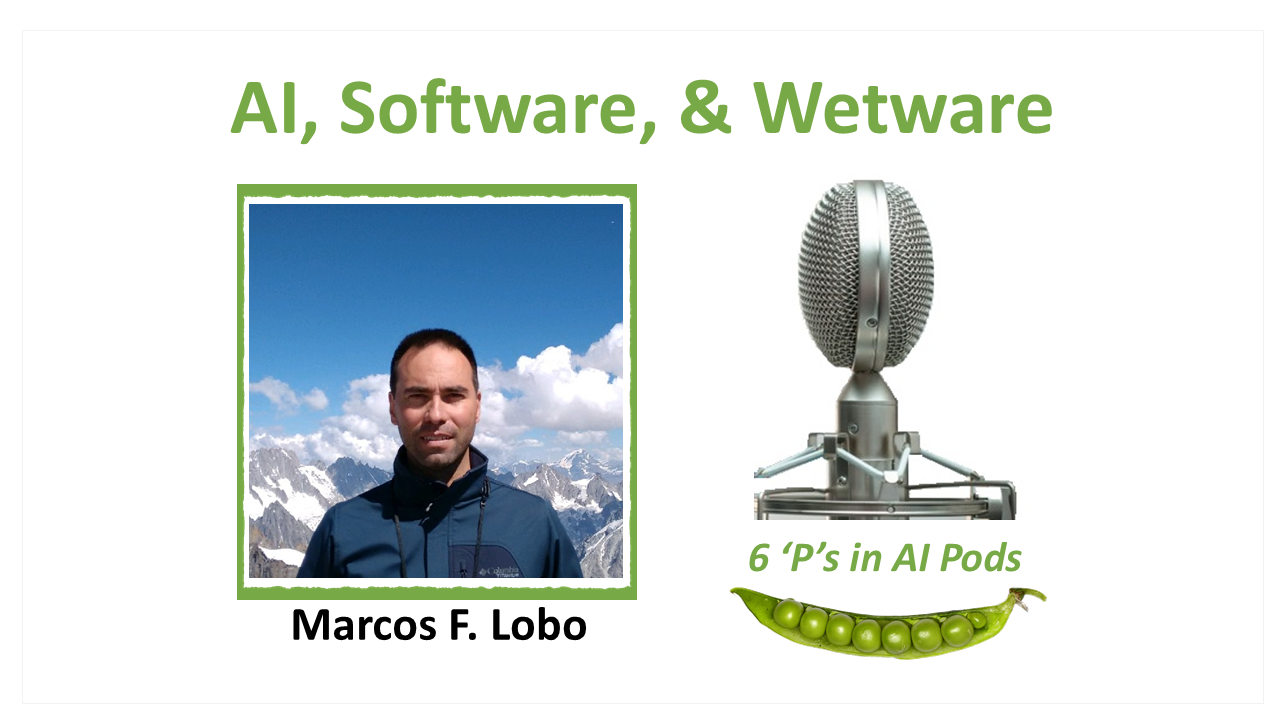
Karen: I’m delighted to welcome Marcos F. Lobo from Spain as my guest for “AI, Software, and Wetware”. Marcos, thank you so much for joining me for this interview! Please tell us about yourself, who you are, and what you do.
Marcos: I’m Marcos, Senior Software Engineer and Tech Lead. I’m from a small region in the north of Spain, Asturias, and I’ve been working in software for 20 years. After working 3 years at CERN, nowadays I’m working as Tech Lead in a product company delivering a SaaS platform based in microservices and event-driven architectures. As part of that, I enjoy having calm weekends, outside of my job, and practicing snowboarding and surfing in my home region.
Karen: What is your level of experience with AI, ML, and analytics? Have you used it professionally or personally, or studied the technology?
Marcos: I’m an advanced user focused on AI Agents assistance for coding. Before the explosion of the ChatGPT, I knew about AI what I learned during my Computer Science and Master’s degree.
Nowadays, I´m using an AI Agent embedded into my IDE (IntelliJ or Visual Studio Code) for coding. Also, in the last month, I’ve been using Claude Code in the command line and I think it’s where I will move next. I’m using AI Agents and Skills at work, in my position as Senior Software Engineer and Tech Lead.
Karen: Thank you for sharing that. Do you use any AI-based tools in your life outside of work? Either by choice, or by having them part of our day-to-day lives?
Marcos: I use ChatGPT Free on web through my laptop. No app installed on my phone.
Karen: Can you share a specific story on how you have used a tool that included AI or ML features? What are your thoughts on how the AI features of those tools worked for you, or didn’t? What went well and what didn’t go so well?
Marcos: At the very beginning using AI for coding, when the “tab, tab, tab” was the way with AI, I was implementing a Topology for a Kafka Stream application. I created the acceptance tests to ensure I set the right behavior. From there, I wrote a prompt (took me 5 minutes) where I concreted the use cases I was covering in my test, with examples, and I asked to implement the Topology. I was pleasantly surprised by the behavior of the AI Agent because the implementation was really good.
Also, I recently wrote an entire article about my approach working with AI in my newsletter about applied AI into the developer world. See “From AGENTS.md to sub-agents: structure and best practices”. Nowadays (April 2026), I’m able to implement full features inside of a specific microservice leveraging the AGENT.md framework together with Skills.
Embedded post: https://ainativecompass.substack.com/p/from-agentesmd-to-sub-agents-structure
Karen: You mentioned previously that you found ChatGPT Free works better for your needs than the paid version of GitHub Copilot Business. Could you elaborate on this story? What feature were you trying to write acceptance tests for, and what happened when you tried using AI for it?
Marcos: When I validate that my business logic is well implemented. I could use AI for this, but I prefer to rely on my own acceptance tests. And I speak from experience. At first, this was one of the uses I gave to AI … until it gave me a scare, and I haven’t trusted it since.
Karen: If you have avoided using AI-based tools for some things (or anything), can you share an example of when, and why you chose not to use AI?
Marcos: I’m very skeptical with all generative AI tools about video and voice replication. For example, there are tools that can be trained with your voice and then make translations to different languages. Also, there are tools that are able to produce a video in which you are making a speech that you never did. I don’t know what the companies behind those tools could make with my face and voice.
Karen: Deep fakes are definitely a growing problem.
Marcos: And I’m not using those tools for generating content in different languages. Even though nowadays the AI-assisted coding is much better than 1 year ago, I don’t trust them to implement the tests, but only the implementation. Me, as developer, I’m the owner of the code, and so I have to ensure that the tests define the right solution, agreed with the Product team. I don’t want to take the risk of some hallucination from the AI and implement the wrong logic, based on a wrong test.
Karen: That’s wise.
A common and growing concern nowadays is where AI and ML systems get the data and content they train on. They often use data that users put into online systems or publish online. And companies are not always transparent about how they intend to use our data when we sign up.
How do you feel about companies using data and content for training their AI/ML systems and tools? Should ethical AI tool companies be required to get Consent from (and Credit & Compensate) people whose data they want to use for training? (the “3Cs Rule”)
Marcos: I introduced this in the previous question. This is a very interesting point. I don’t feel very good about the more sensitive data (in my opinion) like my voice or my face.
Yes, I agree that companies should require consent and make an ethical usage in case I consent.
Karen: A lot of people agree with you about being careful with personal biometrics. Have you encountered any public or private services in Spain that use biometrics?
Marcos: Not coming to my mind right now.
Karen: As a user of AI-based tools, do you feel like the tool providers have been transparent about sharing where the data used for the AI models came from, and whether the original creators of the data consented to its use?
Marcos: I don’t have visibility on that, to be fair. I mean, they are not transparent because they do not explain too much if they do something else with the usage we do of their tools, or at least that’s my perception.
Karen: That’s a good point, Marcos - companies that choose to adopt an AI tool may do that ‘due diligence’ but not share their findings with employees.
Do you have any concerns about the questions or code you put into ChatGPT Free, whatever you type into it, being used as additional training data?
Marcos: Yes, that’s why, when I use ChatGPT Free, I “anonymize” the code before paste it there. Now, at work I am using the AI Agents from the paid account, and (in theory) the code should not be leaked to the public.
Karen: As consumers and members of the public, our personal data or content has probably been used by an AI-based tool or system. Do you know of any cases that you could share (without disclosing sensitive personal information, of course)?
Marcos: I’m not aware of any cases.
Karen: Okay. Do you know of any company you gave your data or content to that made you aware that they might use your info for training AI/ML? Or have you ever been surprised by finding out that a company was using your info for AI? It’s often buried in the license terms and conditions (T&Cs), and sometimes those are changed after the fact. If so, did you feel like you had a real choice about opting out, or about declining the changed T&Cs? How do you feel about how your info was handled?
Marcos: Yes, I’ve been surprised. In my case it was with Substack. They enabled a “AI training consent” by default in my settings without telling me. When I figured it out, I disabled it.
Karen: Yes, it was disappointing that Substack’s default was to opt us in for allowing AI tools to train on our content. I changed my settings too. I am not sure if that is still the default for new newsletters? I did look into it when I discovered this, and that setting is mostly for controlling whether third parties are allowed to scrape our content for training. Many of the AI scraping bots respect the setting, although some do not.
Has a company’s use of your personal data and content created any specific issues for you, such as privacy, phishing, or loss of income? If so, can you give an example?
Marcos: No issues.
Karen: Good 🙂
Public distrust of AI and tech companies has been growing. What do you think is THE most important thing that AI companies need to do to earn and keep your trust? Do you have specific ideas on how they can do that?
Marcos: I have to say: they cannot be trusted. Mainly, because I feel they are not transparent enough about how they ensure what they do with our code and input in their tools.
Karen: Thank you so much for making time for this interview, Marcos. Is there anything else you’d like to share with our audience?
Marcos: I will start bringing new things into my main newsletter, Optimist Engineer, so, stay tuned!
Interview References and Links
Marcos F. Lobo on Bluesky
Marcos Fermín Lobo on LinkedIn
“How to use AI in software development” (translation link)
[ The Optimist Engineer
Experiences, learnings, and inspiration about Software Engineering, Technical Leadership, and Technical Growth, with a bit of optimism. Interesting for Tech Leads and software makers from Startups to medium-sized companies.
By Marcos F. Lobo 🗻🧭](https://newsletter.optimistengineer.com?utmsource=substack&utmcampaign=publicationembed&utmmedium=web)
[ AI Native Compass
From Cloud Native to AI Native
By Marcos F. Lobo 🗻🧭](https://ainativecompass.substack.com?utmsource=substack&utmcampaign=publicationembed&utmmedium=web)
About this interview series and newsletter
This post is part of our AI6P interview series on “AI, Software, and Wetware”.
It showcases how real people around the world are using their wetware (brains and human intelligence) with AI-based software tools, or are being affected by AI.
And we’re all being affected by AI nowadays in our daily lives, perhaps more than we realize. For some examples, see post “But I Don’t Use AI”:
We want to hear from a diverse pool of people worldwide in a variety of roles. (No technical experience with AI is required.) If you’re interested in being a featured interview guest, anonymous or with credit, please check out our guest FAQ and get in touch!
6 'P's in AI Pods (AI6P) is a 100% human-authored, 100% reader-supported publication. (No ads, no affiliate links, no paywalls on new posts).
All new posts are FREE to read and listen to. To automatically receive new AI6P posts and support our work, consider becoming a subscriber:
Series Credits and References
##### Disclaimer: This content is for informational purposes only and does not and should not be considered professional advice. Information is believed to be current at the time of publication but may become outdated. Please verify details before relying on it. All works, downloads, and services provided through 6 'P's in AI Pods (AI6P) publication are subject to the Publisher Terms available here. By using this content you agree to the Publisher Terms.
Microphone photo by Michal Czyz on Unsplash (contact Michal Czyz on LinkedIn)
Credit to CIPRI (Cultural Intellectual Property Rights Initiative®) for their “3Cs' Rule: Consent. Credit. Compensation©.”
Credit to for the “Created With Human Intelligence” badge we use to reflect our commitment that content in these interviews will be human-created:

If you enjoyed this interview, my guest and I would love to have your support via a heart, share, restack, or Note! (One-time tips or voluntary donations via paid subscription are always welcome and appreciated, too 😊)