Ask them all, fix the answers. Send the DM with confidence.
By Manuel Salvatore Martone
Published: 2026-05-15
URL: https://shipwithai.substack.com/p/4-questions-that-tell-you-if-your
We shipped /autopilot two weeks ago.
We shipped /factory last week.
This Saturday we ran both on a fresh side project. The URL went live at 6:30pm. The CLAUDE.md got one new rule appended. The FIRST-USER message draft sat ready in the project root.
We closed the laptop. We went to dinner.
Sunday morning, we hit the URL.
The signup form didn't save to the database. The "demo" button pointed to a route that never got generated. The auth flow redirected to localhost:3000.
Every gate was green. Every test passed. The scope.md was 100% checked off.
The agents had shipped code. They hadn't shipped a product.
We forgot the eval.
(No fluff. No theory. The 4-question check you can run tonight.)
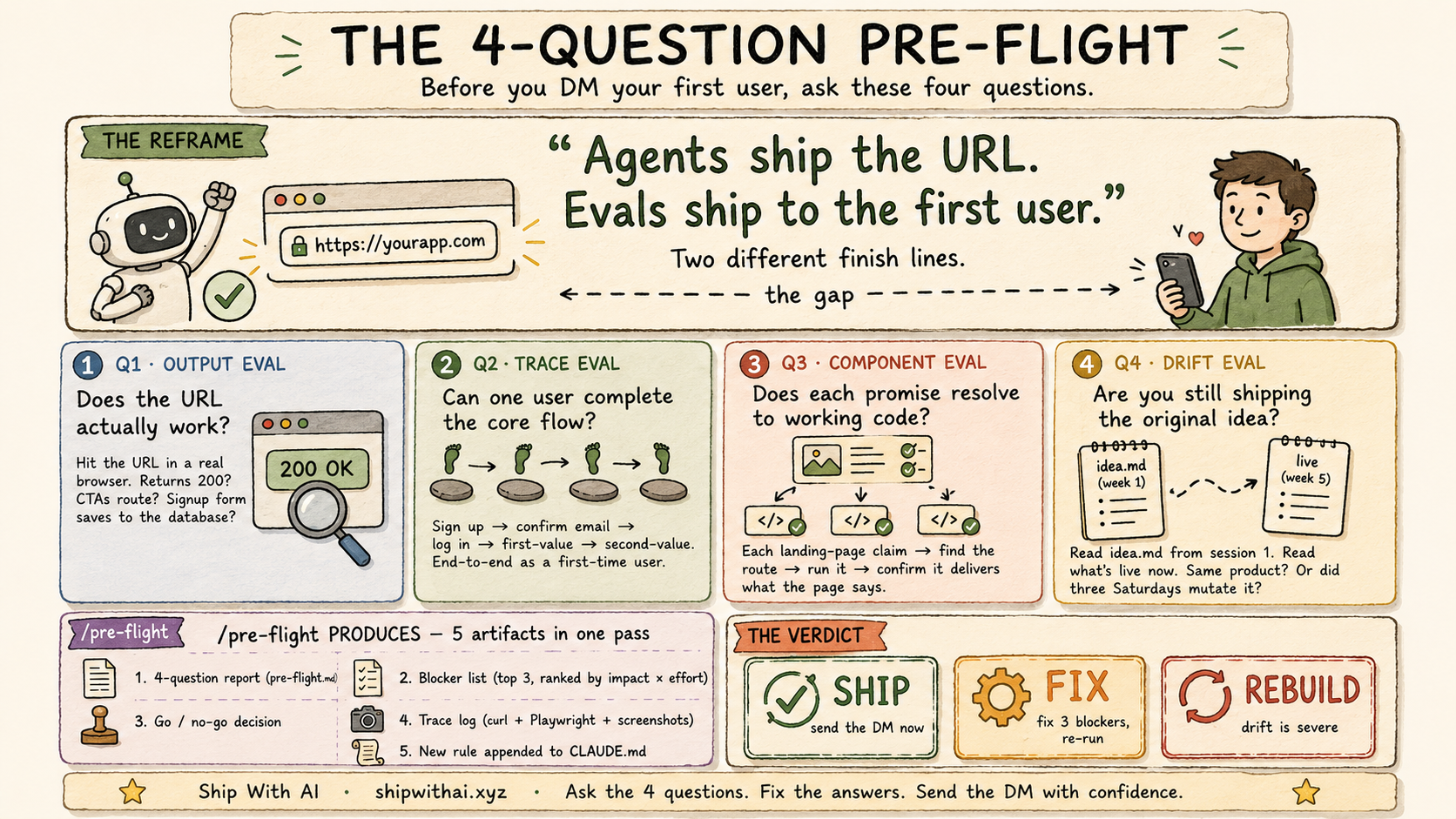
Your harness ships when the agents stop. Your product ships when one real user can use it. Those are two different finish lines.
This is the gap nobody is talking about for solo devs.
Agent observability is the discourse of the month. Hamel Husain dropped an entire evals-skills pack. Braintrust, Arize Phoenix, and Laminar all keep pushing the same mantra: failures should become test cases, test cases should gate deployment. The infrastructure is moving fast.
But every one of those frameworks is built for production teams shipping to thousands of users. The eval for solo devs shipping to one named first user doesn't exist yet.
You don't need 10,000 traces. You need to know one thing: is this thing ready for the DM you're about to send?
Here's the 4-question pre-flight that answers it.
The 4 questions
We borrowed the framework from Mission Control (4.3k★, MIT) — the only open-source agent-observability tool that names these four checks exactly. Their version targets production fleets running thousands of users. Ours is the solo-dev port: four questions you ask your own URL before you DM a real human.
✦ Question 1 — Does the URL actually work?
The check the agents think they're doing. The check they consistently get wrong.
Output eval asks: hit the URL with a real browser. Does it return 200? Does each visible CTA route correctly? Does the signup form save to the database, or just return success?
Three failures we've shipped past green gates:
→ The build succeeded; production env vars never made it from .env.local → DB connection worked locally; production credentials weren't set in Vercel → The signup endpoint returned 200; the user record never persisted
The agents will check the SCOPE box because their tests passed. Output eval asks a different question: can a stranger, on the live URL, sign up?
✦ Question 2 — Can one user complete the core flow?
The check that distinguishes a working URL from a working product.
Trace eval asks: walk the core user flow end-to-end as a first-time user. Sign up → confirm email → log in → reach the first-value moment → trigger the second-value moment.
If any step needs you to know something a first user wouldn't, the flow is broken.
Three traces we've watched die:
→ Sign-up worked; the verification email never arrived (no SMTP configured) → Login worked; the dashboard route 404'd (missing auth-redirect logic) → Dashboard loaded; the "create your first X" CTA pointed to localhost:3000
✦ Question 3 — Does each promise resolve to working code?
The check that maps your landing page's claims to actual code that does them.
Component eval asks: take each "feature" claim on your landing page. Find the route or component that delivers it. Run it. Confirm it does what the page promises.
If the landing page says "connects to your Stripe account" and the codebase has a // TODO: Stripe integration comment, the component eval fails.
This is the most common failure mode after a /factory run with the 5-agent org chart — the Marketer agent writes promises the Engineer agents never built.
✦ Question 4 — Are you still shipping the original idea?
The check that catches idea.md drift across multiple Saturdays.
Drift eval asks: read the original idea.md from session 1. Read what's actually live now. Is the live product still what the idea promised? Or did three Saturdays of agent runs slowly mutate it into something adjacent?
Drift is the slowest failure mode. It's also the most expensive. You finish shipping, you send your first DM, and the reader's response is: "this looks cool but it's not really what your post promised."
That's drift. Catch it before the DM.
The /pre-flight skill
We packaged the 4 questions into a Claude Code skill that runs them against your project directory.
Install once. Pick whichever fits your setup:
# Cross-agent (Claude Code, Codex, Cursor, Gemini CLI, Copilot, +35 more)

npx skills add Ship-With-AI/skills --skill pre-flight

# Or Claude Code native (two commands, plugin marketplace)

claude plugin marketplace add Ship-With-AI/skills /plugin install ship-with-ai@ship-with-ai-skills
Then, in your project directory, after /autopilot or /factory has run:
/pre-flight
Four questions: your live URL + your idea.md + your scope.md + the one named first user you're planning to DM.
Then five things in one pass.
What the skill produces
✦ Artifact 1: the 4-question report
A pre-flight.md written to your project root. Pass/fail per question. Each failure names the specific URL / route / component that broke + the fix.
The report is the artifact you read at 9pm Sunday before deciding whether to send the DM Monday.
✦ Artifact 2: the blocker list
The 3 issues most likely to make your first user bounce. Ordered by what to fix first. Each with the specific file and line to change.
Three blockers, not thirty. The skill scores impact × effort and only surfaces the top three.
✦ Artifact 3: the go / no-go decision
A one-line verdict at the top of pre-flight.md:
→ SHIP — send the DM now → FIX — fix the 3 blockers, re-run pre-flight, then ship → REBUILD — drift is severe; the live product isn't the idea you wrote in session 1
The skill defaults to FIX. SHIP is rare on a first pre-flight run. REBUILD is the most useful one — it stops you from sending DMs about a product that doesn't exist.
✦ Artifact 4: the trace log
The skill literally walks the core user flow with curl + Playwright + screenshots. Saves the trace to pre-flight-trace/ so you can see what your first user will see.
The screenshots are the most-cited artifact in our feedback replies. People send them back when filing bugs in the next iteration.
✦ Artifact 5: a new rule appended to CLAUDE.md
After every /pre-flight run, the skill writes the failure mode + fix as a ## Lessons entry on your portfolio-root CLAUDE.md.
Day 1: generic CLAUDE.md. Saturday 8: project-shaped. Saturday 30: knows your stack's failure modes better than you remember them.
That's the compounding asset. Everything else is one Saturday's output.
The 3 mistakes we made before writing this
1. We sent the DM before checking the live URL. First user signed up. The verification email never arrived (no SMTP). They emailed back: "is this real?" We lost the user to a 30-second fix Question 1 would have caught.
(Yes, the SMTP config was one line. Yes, we'd shipped four projects with the same gap. Yes, that's why Question 1 is Question 1.)
2. We trusted the /factory's green gates. The factory marked DEPLOY complete. The site was live. We hadn't noticed the Engineer agent had stubbed the Stripe integration with // TODO. We sent 4 DMs promising payments worked. Two replies came back: "the checkout button doesn't do anything."
(Yes, the factory's gate was green. Yes, the test suite passed. Yes, neither catches a stubbed integration. That's Question 3.)
3. We let the product drift across 3 Saturdays. Saturday 1's idea.md said "a tool for podcasters to extract show notes." By Saturday 3 it had drifted to "a workspace for content creators." By Saturday 5 it was "AI-powered productivity for solopreneurs." When we sent DMs, the readers didn't know what to do with it. The drift killed us before the users did.
(Yes, we knew the idea drifted. Yes, we kept building. Yes, drift is the slowest and most expensive failure mode. That's Question 4.)
Yesterday: dragging n8n nodes, debugging connections, JSON typos at midnight. Counted the Saturday hours you've burned on it?
That's the real bill. It doesn't show up on your cloud invoice. It shows up as Sundays you didn't ship.
Autom8n skips it. Type the workflow in plain English. Get the n8n JSON in 5 minutes — with a guide so you actually understand what's running. The first one needs a tweak. The fifth saves you a Saturday.
The reframe
Your /autopilot ships code that passes its own tests.
Your /factory ships an org chart that closes its own tickets.
Neither one ships a product that a real first user can use.
The 4 questions are what close the gap. Without it, you're sending DMs about a URL that returns 200 but doesn't actually work. With it, you know — before the DM goes out — whether the thing you built matches the thing you said you built.
This is the rung Ship With AI missed. The Lead the Machine series wrote about context, action, instruction, delegation, MVPs, feedback, deploy, launch, parallel, and night shift. It never wrote about the 4 questions between "agent says done" and "user says it works."
That's /pre-flight. That's the eval rung.
If you're a developer reading this and feeling like your /autopilot's green gates were enough proof, you're reading the moment wrong. Agents ship code that passes their own tests. Evals ship products that pass a first user's expectations. The gap between those two is the entire game.
Agents ship the URL. Evals ship to the first user.
Ask the 4 questions.
Fix the answers.
Send the DM with confidence.
— Ale & Manuel
PS. Reply with your first /pre-flight report and which question caught the biggest issue. Best three reports get featured in a follow-up edition on what readers found in their own pre-flights.
When you're ready, two ways we can help:
1. AI Side-Project Clarity Scorecard. Find what's blocking you from shipping your first side project.
2. NoIdea. Pick a ready-to-start idea born from real user problems.