Train your agent. Set it free. Ship while you sleep.
By Alessandro Magionami
Published: 2026-05-01
URL: https://shipwithai.substack.com/p/how-to-build-the-harness-that-ships
Hey there,
We closed the laptop at 6pm last Saturday. By 9pm, Claude had shipped our latest side project.
Live URL. Drafted intro message to one named first user. One new rule appended to the project’s CLAUDE.md.
Every developer we know starts the same Saturday from scratch — re-deciding the stack, re-scaffolding auth, re-arguing about NextAuth vs. Lucia. By 2pm they’ve made fifteen small decisions and shipped nothing the user can touch.
Three weekends later, the repo joins the four others in their ~/projects folder.
Same shape every project. Different idea. Different stack. Same dead repo.
Here’s what we figured out.
The problem isn’t your AI. It’s the missing harness around it.
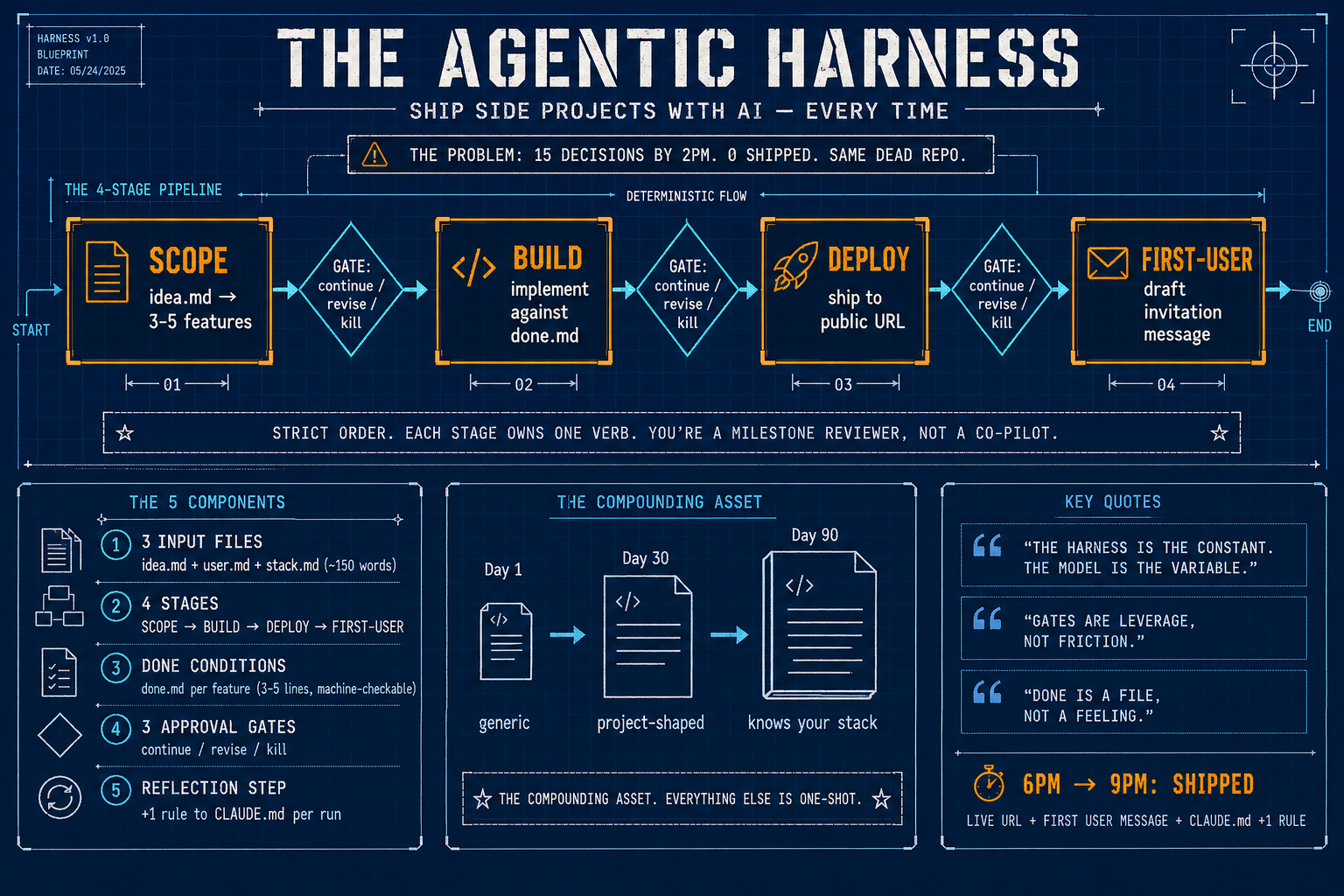
An agentic harness is the deterministic shape around your AI. The model fills in the intelligence. You own the structure. Same workflow, every project, every time.
Once you have it wired, your fifth side project starts at session 4, not session 1.
This isn’t Twitter hype. It’s a 5-file setup we’ll walk you through right now — and once you have it wired, it ships every side project the same way.
(No fluff. No theory. Steps you can run tonight.)
Yesterday, building an n8n workflow meant opening the docs, dragging nodes, debugging connections, and hoping it would work.
Today it means: describing what you want in plain English and getting a complete, ready-to-deploy workflow in minutes, with a full guide so you actually understand what’s running.
Autom8n just went live.
The gap between “I have an automation idea” and “it’s running in production” just got a lot smaller.
What you actually need
Five things. That’s it.
→ 3 input files in your project root (idea + user + stack) → 4 named stages (SCOPE → BUILD → DEPLOY → FIRST-USER) → A done.md per feature (machine-checkable acceptance criteria) → 3 approval gates between stages (continue / revise / kill) → A reflection step that grows your CLAUDE.md by 1 rule per run
That’s the harness. Everything else is plumbing.
How to wire it
1. The 3 input files
Drop these in your project root:
idea.md— what you’re building, in 3 sentences
user.md— who it’s for, what they currently do, what would make them switch
stack.md— your defaults (language, framework, deploy target)
Total: ~150 words. The agent reads all three before any work. Every. Time.
If the agent can’t tell what to build from these, neither can you.
2. The 4 stages
Strict order. Each stage owns one verb:
→ SCOPE — turn idea.md into 3-5 features → BUILD — implement them → DEPLOY — ship to a public URL → FIRST-USER — draft the message inviting your one named user
The agent moves through these. You don’t drift between them.
3. The done conditions
Every stage gets a done.md. 3 to 5 lines. Machine-checkable.
- The user can sign up with email

- The dashboard loads in under 2 seconds

- The deploy URL returns 200
The agent reads this before starting and checks it before claiming done.
No more “polishing.” No more “what about edge case X.” Done is a file, not a feeling.
4. The 3 gates
Between each stage, the agent shows you what it built and waits.
You say one word: continue / revise / kill.
That’s the entire human-in-the-loop. You’re a milestone reviewer, not a co-pilot. The agent does the work between gates without checking in.
5. The reflection step
After every run, the agent appends 1 rule to your CLAUDE.md.
The prompt:
What went wrong this run? Output one rule we could add to CLAUDE.md so this never happens again.
Day 1: generic CLAUDE.md. Day 30: project-shaped. Day 90: knows your stack better than you remember it.
Mitchell Hashimoto on this:
Every time the agent makes a mistake, you take the time to engineer a solution such that the agent never makes that mistake again.
That’s the whole harness.
The tool we use: Archon
You can wire these 5 things into Claude Code subagents, n8n, or raw bash. We use Archon — open-source, MIT, built around exactly this pattern. 19.5k★ and shipping fast.
Their tagline is the post’s whole thesis, written by someone else first:
The workflow defines the phases, validation gates, and artifacts. The AI fills in the intelligence at each step, but the structure is deterministic and owned by you.
3 commands to install. 1 YAML file. Run it.
# .archon/workflows/ship-side-project.yaml

name: ship-side-project description: 4 stages, 3 approval gates, 1 reflection rule per run. interactive: true nodes:

- id: scope

prompt: | Read idea.md, user.md, stack.md. Output 3-5 features as scope.md (ordered by dependency). Write a done.md per feature with 3-5 machine-checkable acceptance lines.

- id: scope-gate

depends_on: [scope] approval: message: "Review scope.md and the per-feature done.md files. Approve to continue."

- id: build

depends_on: [scope-gate] loop: prompt: | Read scope.md. Implement the next unfinished feature against its done.md. Run lint and tests before claiming done. Mark complete in scope.md. When all features pass their done.md, output: <promise>COMPLETE</promise> until: COMPLETE max_iterations: 10 fresh_context: true

- id: build-gate

depends_on: [build] approval: message: "Review the working features. Approve to continue."

- id: deploy

depends_on: [build-gate] bash: "vercel deploy --prod"

- id: deploy-gate

depends_on: [deploy] approval: message: "Verify the live URL returns 200. Approve to continue."

- id: first-user

depends_on: [deploy-gate] prompt: "Read user.md. Draft the invitation message to the named first user."

- id: patch

depends_on: [first-user] prompt: | What went wrong this run? Output one rule for CLAUDE.md so this never happens again. Append under ## Lessons. Phrase as a positive directive.
Run it with one command:
archon workflow run ship-side-project "ship my bedtime story generator"
Then walk away. The agent walks SCOPE → scope-gate → BUILD (loops until every feature passes its done.md) → build-gate → DEPLOY → deploy-gate → FIRST-USER → patch. You approve at the three gates from your phone if you want — Archon pauses each approval: node and waits for /workflow approve <run-id> (or rejects with feedback).
We closed our laptop at 6pm last Saturday. Live URL at 9pm. CLAUDE.md one rule longer in the morning.
(Yes, the rule was “always run lint before declaring build done.” Yes, that’s embarrassing to add at session 8. Yes, it’s in CLAUDE.md now and we’ll never argue with Claude about it again.)
The /autopilot skill
We packaged the whole 5-file harness into a Claude Code skill.
Install once:
Then, in any project (or fresh empty directory):
/autopilot
Three questions: the idea + your one first user + your stack defaults.
Then five things in one pass.
What the skill produces
✦ Artifact 1: idea.md / user.md / stack.md
Three files written to your project root, ~150 words total. From your three answers. The agent reads all three before any work.
Without these, you’re back to re-explaining your project to Claude every Saturday.
✦ Artifact 2: a done.md per feature
The SCOPE stage produces 3-5 features. The skill writes a done.md for each, with 3-5 machine-checkable acceptance lines.
The agent reads this before starting and checks it before claiming done. Scope creep stops here.
✦ Artifact 3: Archon installed + workflow wired
The skill installs Archon if you don’t already have it, then drops the canonical 4-stage workflow YAML into .archon/workflows/. You don’t need to learn Archon — the skill wires it for you.
Their thesis is the post’s thesis: the structure is deterministic and owned by you.
✦ Artifact 4: three approval gates ready to fire
Between SCOPE → BUILD, BUILD → DEPLOY, and DEPLOY → FIRST-USER. At each gate the agent shows you what it built and waits for continue / revise / kill from your phone, terminal, or wherever.
That’s the entire human-in-the-loop. You’re a milestone reviewer, not a co-pilot.
✦ Artifact 5: one new rule in your CLAUDE.md
After the run, the skill reads the patch output and appends it to your CLAUDE.md under a ## Lessons section.
Day 1 your CLAUDE.md is generic. Day 30 it’s project-shaped. Day 90 it knows your stack better than you remember it.
That’s the compounding asset. Everything else is one-shot.
The 4 mistakes we made (so you don’t have to)
1. We let the agent rewrite the harness. Every “let me clean this up” suggestion drifted our workflow back into improvisation. The harness is the constant. The model is the variable. Don’t let them swap roles.
2. We removed the gates “to move faster.” Twice. Both times the agent shipped scope we would’ve killed at the SCOPE gate. Cleanup took longer than the gate would have. Gates are leverage, not friction.
3. We skipped done.md on small features. The agent doesn’t “figure it out.” It polishes. 4x build time vs writing 5 acceptance lines. Always write done.md.
4. We skipped the reflection step. CLAUDE.md stayed generic for weeks. Same arguments every Saturday. Don’t skip it — it’s the highest-leverage minute of the entire workflow.
The reframe
You don’t have a side-project problem. You have a pipeline problem.
Build the pipeline once. Ship side projects forever.
If you’re a developer reading this and feeling nervous about agents shipping without you, you’re reading the moment wrong. Developers who own the harness are about to have the best decade of their careers. Models just got smart. Harnesses just got valuable.
Stop improvising your pipeline.
Start running it.
Now go build.
— Ale & Manuel
PS. Reply and tell us what shipped. We want to see the live URLs. Best three get featured in a follow-up.
And whenever you are ready, there are 2 ways I can help you:
*1. AI Side-Project Clarity Scorecard (Discover what’s blocking you from shipping your first side-project)
- NoIdea (Pick a ready-to-start idea created from real user problems)*