Interviews with the authors of AI Everywhere, Volumes 2-4 (Stream II) are now completed and the books are widely available in ebook, print, and audio formats. Here's what's next.
By Farida Khalaf
Published: 2026-10-26
In the She Writes AI interview series, we’ve talked with the authors behind the AI Everywhere books, exploring their personal journeys and professional expertise to understand how we can build a future for ourselves with AI that is truly ethical, responsible, and human-centered.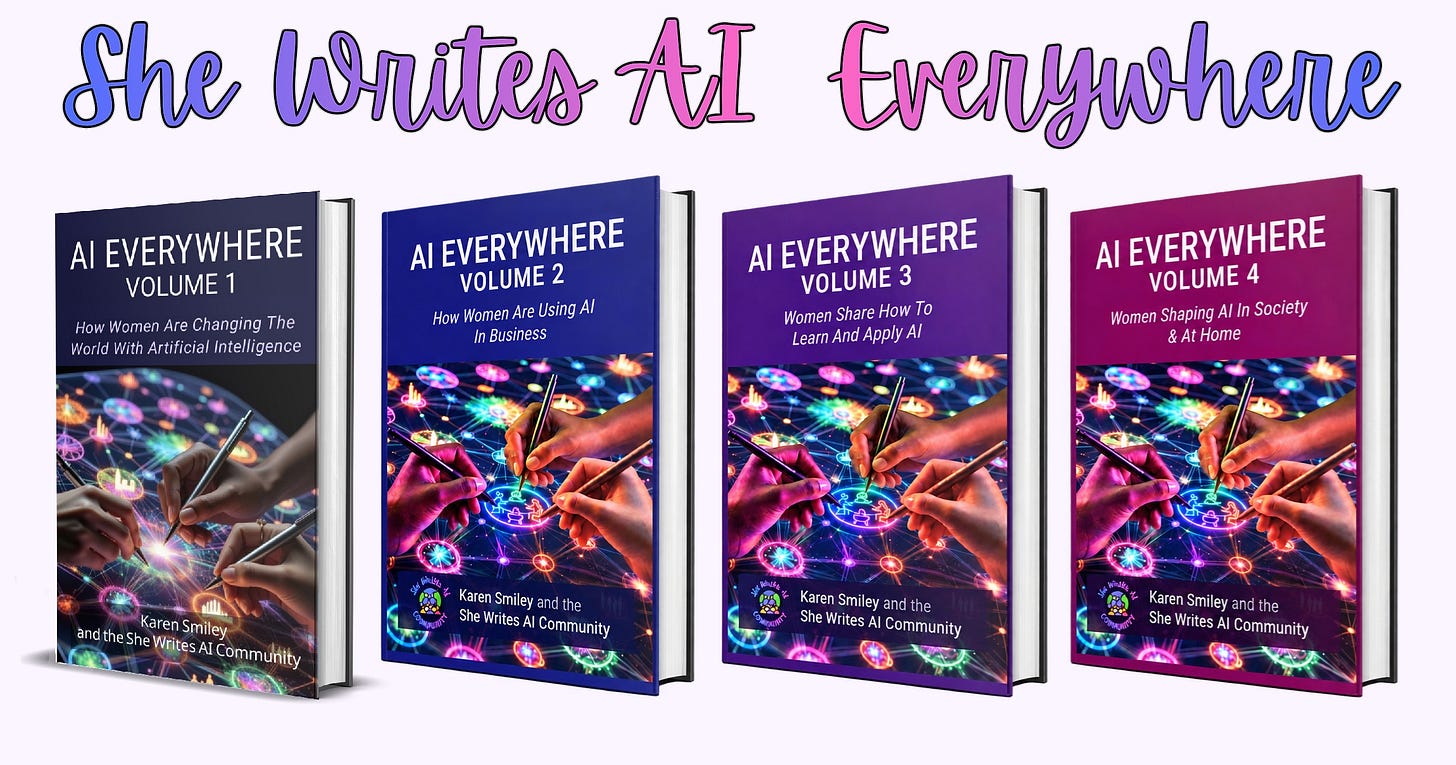 We’ve published four volumes to date in our She Writes AI Everywhere series. (All volumes are widely available to buy or preorder in ebook, paperback, hardcover, or audiobook formats; see shewritesai.org/buy.) And we’re not done; more volumes are in the works for 2027.
Closing the Chapter, Opening the Next
Before there were global pipelines, published chapters, or structured networks, there was simply a shared, uncompromising realization: the future of artificial intelligence could not be left to a default few.
When we began this journey with AI Everywhere, Volume 1, our focus was on creating space, ensuring women and nonbinary thinkers had a platform to speak, analyze, and be heard in a rapidly accelerating technological landscape. But with our second book collaboration, Stream II, Volumes 2-4 represent a fundamental, irreversible shift.
Volumes 2-4 were never just about giving women a voice. They are about the real, operational implementations by women in AI worldwide.
Across these pages, you will not find passive commentary, abstract philosophy, or token representation. You will find stamped steps: concrete, undeniable, architectural footprints carved directly into the bedrock of how artificial intelligence is being built, governed, and deployed in the real world.
From Having a Voice to Shaping the Future
The 32 women and nonbinary authors of Volumes 2-4 did not wait for software engineers to build tools for them, nor did they ask for permission to enter technical rooms. They brought decades of rigorous, specialized domain expertise — in law, medicine, filmmaking, data science, macroeconomics, ethics, and more — and directly translated that knowledge into working systems, legal frameworks, and sovereign workflows:
-
Architecting Real Governance: They established the legal conditions for a true “Human in Charge” and built ethical guardrails against opaque tax algorithms and automated state harm.
-
Redefining Systems & Compute: They proved that neurodivergent interface design is a core accessibility standard, mapped local compute architectures to resist digital feudalism, and engineered RAG systems to ground AI in verified knowledge.
-
Reclaiming Creative & Software Sovereignty: They collapsed the gap between idea and prototype using “vibe coding” and automations to build custom film budgeting tools, studio apps, and community-driven digital platforms out in the open.
-
Advancing Health, Medicine, & Human Care: They audited clinical datasets to eliminate historical bias, accelerated drug discovery pipelines, and demonstrated how conversational AI can act as a steady emotional anchor during high-risk pregnancies and fertility treatment.
-
Championing Global Justice & Digital Literacy: They defended linguistic equity for low-resource languages, mandated creator data rights (Consent, Credit, Compensation), protected children’s content from automated “slop,” and offered sovereign, unhurried frameworks for AI adoption from the Global South.
Honoring the Voices Behind AI Everywhere, Volumes 2-4
As we bring this collaboration stream to a close, I’ve had the pleasure to interview and celebrate the full breadth of wisdom, courage, and technical brilliance brought together in AI Everywhere, Volumes 2, 3, and 4. This anthology is not the work of a single perspective, but an extraordinary collective tapestry created by 32 visionary authors and co-authors from 18 countries around the globe who are redefining how humanity interacts with artificial intelligence.
We extend our deepest gratitude and recognition to every author who contributed their voice, research, and lived experience to this volume:
-
Alyssa Fu Ward, PhD & Natalie Nicholson (What We Build When We Build Together), for proving that community, mutual disclosure, and learning out loud can serve as the most effective entry points for women in technology.
-
Amy Swaner (Human In Charge: Five Conditions For Meaningful AI Oversight), for defining the essential legal and operational boundaries between passive human review and real institutional accountability.
-
Ana Mourão (The Agent of Context: Why AI’s Most Important Marketing Skill Isn’t Technical), for showing how marketers must claim the strategic context layer as operational tasks compress into AI agents.
-
Anna Levitt (Why AI Adoption Is An Identity Crisis, Not A Training Problem), for revealing that AI resistance in organizations stems from existential threats to professional identity rather than technical skill gaps.
-
Astrid J. Scholz, PhD (AI For Good: Whether And How To Use AI When You Are In The Business Of Making The World Better), for providing a rigorous, pragmatic guide on using localized, community-governed AI tools to solve real-world social and environmental polycrises.
-
Carla Engelbrecht, EdD (Anti-Slop, Pro-AI: Responsible Children’s Content Creation In The Age Of AI), for championing radical ownership and pedagogical rigor to protect young minds from automated digital “slop”.
-
Cata (Catalina) Páez (What AI Companionship Revealed: The Relational Layer of AI), for mapping the physiological, psychological, and ethical dimensions of human-AI relational dynamics beyond mere tool use.
-
* (The Algorithm Will See You Now: Opportunity And Risk Of AI In Healthcare*), for exposing how historical medical biases persist in clinical datasets and advocating for data equity to save lives.
-
Celeste Garcia (Labor Exploitation: Big Tech’s Dirty Secret), for shedding light on the hidden global “ghost work” force and demanding fair compensation and humane conditions for data workers.
-
Cristina Oliva-Patrick (The “Word Wide Web” AI Divide: Language Inequalities In The AI Era), for framing multilingual AI and low-resource language preservation as a fundamental digital rights and global justice issue.
-
Devika Toprani (Pre-AI Sensemaking Before Scale: How Somagraphic Learning™ Puts Human Cognition Back In The Driver’s Seat), for designing embodied, pre-AI visual frameworks that protect independent human reasoning and cognitive sovereignty.
-
Elettra Fiumi (From Filmmaker To Builder: A Field Guide To Vibe Coding And AI Automations For Creative Professionals), for demonstrating how non-technical storytellers can pair vibe coding with automations to build sovereign creative studios.
-
Elisa Terumi, PhD (RAG Systems: Bridging Language Models And External Knowledge), for detailing the technical architecture required to ground large language models in dynamic, reliable external knowledge bases.
-
Emma M. Joseph (Emotionally Intelligent AI And The Translator In The Machine: How Neurodivergent Minds Are Rewriting The Future Of Human-Centered Technology), for translating neurodivergent lived experience into the architectural blueprints for emotionally intelligent, sanctuary-driven AI systems.
-
Hodman Murad (Neurodivergent AI Design: Reducing Unmeasured Cognitive Tax), for establishing concrete engineering rules that eliminate layout friction and support executive function for neurodivergent minds.
-
Hollie C. White, PhD (You Keep Using That Word: How Shared Vocabulary Between Humans And AI May Not Mean The Same Thing), for applying intersectionality and information science to unpack the polysemous gaps between human and AI language.
-
Ida-Emilia Kaukonen (Digital Minds: A Field In Transition), for navigating the transition of digital minds research from public skepticism to mechanistic interpretability and model welfare.
-
Jax NiCarthaigh (A For Agency: Reclaiming Human Agency In An AI World), for exploring how humans can retain identity, care, and long-horizon responsibility while “dancing with” complex technological systems.
-
Jennifer Percival, PhD & Tawnya Means, PhD (The Practicing Institution: What Happens When a Business School Models the Human+AI Collaboration It Teaches), for establishing a blueprint for higher education leadership through parallel student-faculty AI experimentation.
-
Jenny Ouyang (Vibe Coding to Production: How Non-Technical Builders Actually Ship AI Products), for laying out a practical, four-part management process to help non-engineers build and ship production-ready software.
-
Julia Díez López (Semantic Governance For Multilingual AI Pipelines: Guiding Language Models Across Markets, Cultures, And Languages), for building the knowledge infrastructure, ontologies, and market definitions needed to prevent cultural and semantic drift in global AI deployments.
-
Karen Smiley (Glossary: Artificial Intelligence Terms And Definitions), for demystifying technical jargon, providing the “AI Iceberg” framework, and serving as the visionary publisher and community leader behind the She Writes AI movement.
-
Lisa TY Lee (AI As My Digital Companion Through Fertility And Pregnancy), for sharing an authentically vulnerable account of using conversational AI for emotional regulation and grounding through deep personal uncertainty.
-
Marcela Distefano (When The Algorithm Decides: The Urgent Case For Ethical Guardrails In AI-Driven Tax Administration), for analyzing public sector algorithmic failures and mandating impact assessments and rights to explanation to protect taxpayers.
-
* (Not Speed, Survival: What Professional Women Are Really Using AI For*), for uncovering how women leverage AI to compensate for the unmeasured mental load, sponsorship gaps, and workplace masking demands.
-
Marina T. Alamanou, PhD (Demystifying AI In Drug Discovery: From Hit To Lead Drug Candidate With AI), for illustrating how machine learning accelerates drug screening, chemical synthesis, and rational design to save human lives.
-
Nadina Dorene Lisbon (The Compute Trap: Escaping The New Digital Feudalism), for exposing the heavy physical toll of data centers and guiding architects toward sovereign, local compute architectures.
-
Tatyana Amugo (Building With AI Tools That Weren’t Built For You: Being A Builder When The Data Doesn’t Know You), for reclaiming the erased history of women in computing and empowering builders from outside the technical default to build their own tables.
-
Tzu-Ting Wang (Beyond The 40-Hour Hustle: How AI Gives You Back The Idea You’ve Been Putting Off), for offering practical permission and strategies for professionals to test and own their independent ideas.
-
Verónica Ponce Camacho (On My Own Terms: A Serene Guide To Using AI From The Global South), for teaching women in under-resourced communities to build an unhurried, sovereign relationship with AI without losing their local voice.
Together, these 32 authors have proved that technology is at its best when it serves human flourishing, equity, and care. Thank you to each contributor for leading the way forward, and thank you to our community for engaging with these vital ideas!
The Footprints Shaping Our Future
These chapters prove that women are not merely adapting to an AI-driven world. We are actively shaping its infrastructure. Their observations are not opinions; they are field-tested protocols. Their knowledge is not theoretical; it is operational.
The chapters in AI Everywhere, Volumes 2-4 are blueprints, audits, experience reports, and working prototypes. They stand as permanent proof that when deep domain expertise guides technical implementation, technology like AI ceases to be an instrument of passive compliance or solo optimization. It can become an engine for human agency, institutional accountability, and collective flourishing.
To every leader, engineer, creator, policymaker, and builder: these volumes are your field guides.
Read these chapters not just to understand where artificial intelligence is going, but to follow the stamped steps of the women who are already building the path forward.
Thank you for reading these conversations, for engaging with these authors, and for helping build a space where AI is discussed not only as innovation, but as responsibility.
And finally, last but not least, a huge thank you to our supporters for making these books possible and keeping participation free for all chapter authors. 🫶🏼
Stream II and Volumes 2-4 are complete. The questions are not. Volumes 5-7 are in progress in Stream III, and we expect the author interviews to start in January. Additional book ideas for future volumes are also in discussion in our subscriber chat.
In the meantime, * will continue to host and share insightful interviews with members of our * community.
Thank you for subscribing to She Writes AI!
(always free for everyone, thanks to our donors)
References
For more insights on the books in Stream I and Stream II (Volumes 1-4), see aiEverywhereBooks.com, our beautiful book series website created by Blessing Okpala, PhD.
Where To Buy and How To Read and Listen
-
-
Ebooks are available now at super-special launch pricing of just $0.99. Pick up all three volumes while these prices last and enjoy all 30 chapters at your leisure!
-
Full audiobooks are also now widely available (thanks to our volunteer narrators!), and coming soon to Amazon Kindle. Find detailed links for audiobook platforms here.
-
Paperbacks and hardcover editions are available now for preorder from our She Writes AI Bookshop as well as the usual booksellers.
-
Buy Volume 1 in ebook and print from our Bookshop, Amazon, B&N, Gumroad, Lulu, Ingram Spark, and many reading platforms. Look for our new abridged audiobook edition on your favorite listening platform!
Check out these tips from our publisher on how to buy an Amazon ebook from a country that isn’t a ‘KDP marketplace’, and how to read the ebook without a Kindle device (free)
Ways To Support
If you’ve read one of our volumes, leaving a review is one of the best free ways to help new readers discover the books! We read and appreciate all reviews. See these review links (we’re on Amazon, Goodreads, and Storygraph).
To help cover book-related costs (ISBNs, proof copies, etc.) as well as other community services, we follow the ‘Wikipedia model’. We can now accept donations worldwide via one-time tips (‘digital ink’) through Stripe or Gumroad. For now, paid subscriptions are only available in limited geographic regions (due to tax complications that we now expect Substack will resolve on Dec. 1, 2026). All donation sizes are welcome and help keep our services free for all women & nonbinary AI writers worldwide! Read more here.
Donate to She Writes AI Community
Thanks as always for your support in every form. We appreciate it all. Hearts, shares, restacks, and comments are awesome and help others find & benefit from the works of our authors!
Share Lights On by FaridaEconomist, data engineer, cybersecurity. I write about systems, incentives, and entropy in modern organizations. Most failures are not operational, they are structural misreadings of reality.By Farida Khalaf