Written interview with lawyer & founder Amy Swaner, the author of AI Everywhere, Vol. 2, Chapter 1 - Human In Charge: Five Conditions For Meaningful AI Oversight
By Farida Khalaf
Published: 2026-10-10
URL: https://shewritesai.substack.com/p/ai-everywhere-author-interview-51-amy-swaner-farida-khalaf
Welcome to the next She Writes AI interview episode covering our second book collaboration stream for the AI Everywhere series. In this new cohort, we’re exploring the personal journeys and professional expertise of 32 authors from 18 countries worldwide who are redefining our relationships with machine intelligence. 
If you’re new to **, welcome! We’re a free, inclusive community of 780+ women and nonbinary writers in 60+ countries worldwide, with a focus on AI and data. Allies of all genders are welcome.
Learn more: About | Books | Categories | Directory | Digests | Donate | Herstory | Join | Subscribe | Updates | Welcome | World Map
For more insights from interviewer *, see her Lights On by Farida* newsletter or youtube.com/@faridakhalaf25.
About My Guests: Amy Swaner
Today I (*) am joined by , author of the inspiring chapter: Human In Charge: Five Conditions For Meaningful AI Oversight*
* is an attorney based in Iowa, founder of Lexara, LLC*, and Chief AI Officer with over 25 years of legal experience. Holding a Certified AI Governance Professional (AIGP) credential, Amy builds practical, robust frameworks that legal professionals need to deploy artificial intelligence safely and effectively without losing sleep. She teaches, writes, and creates smart tools designed to make AI accessible to the practitioners who need it most: solo practitioners and small law firm leaders.
As a self-described “AI and Data Governance nerd,” Amy is dedicated to demystifying the intersection of law, technology, and organizational governance. Through her popular newsletter, AI for Lawyers, she provides actionable insights into legal tech and AI risk management.
In her chapter, she tackles one of the most critical legal and political questions of our era: whether having a “human in the loop” actually protects people, or if it merely serves as a corporate facade for automated harm.
She offers a compelling alternative to tech's standard "solo optimization" narrative, demonstrating that community is a powerful entry point into AI for women.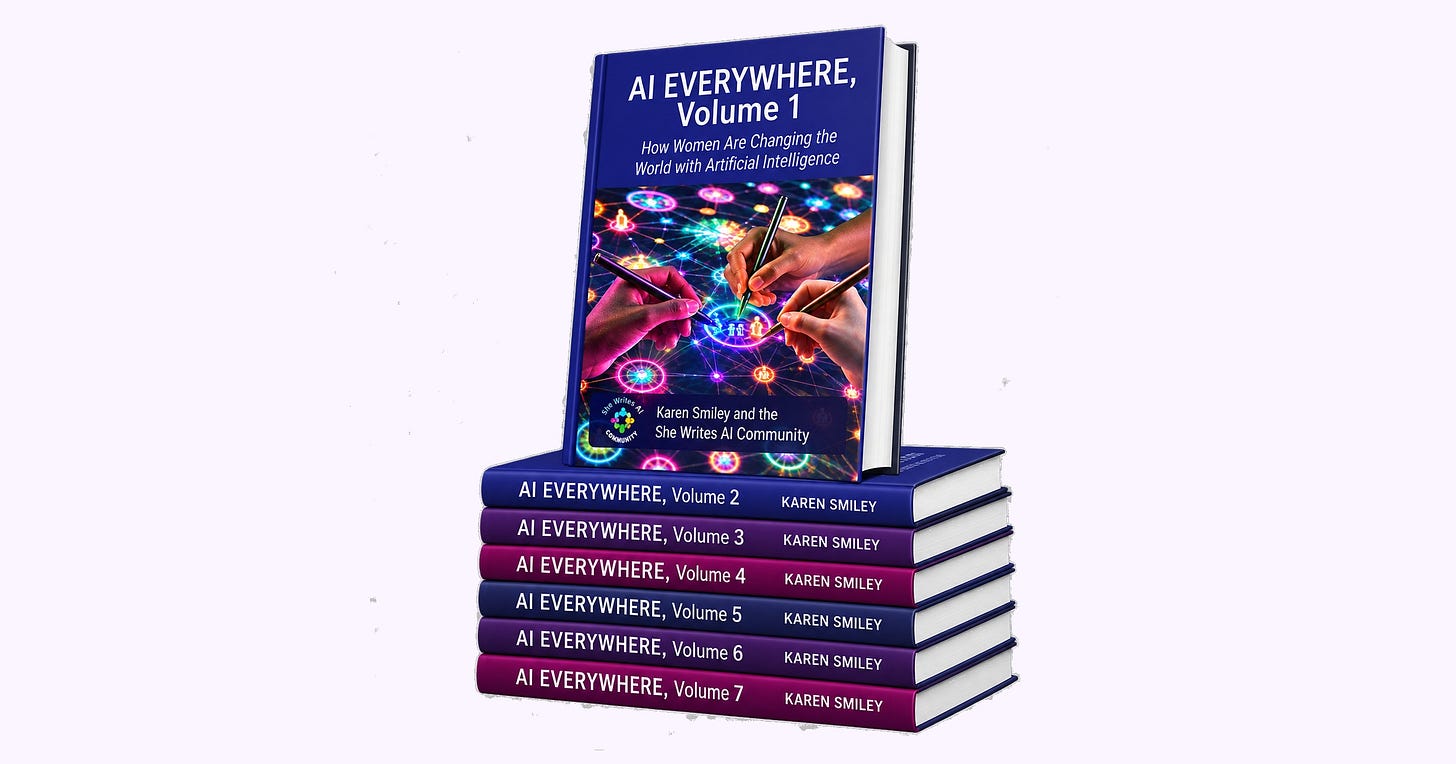 Mockup of the 7 books published and planned so far in the She Writes AI Everywhere series. Volume 1 was published in March 2026. Volumes 2-4 will be published in November 2026 and the covers will be revealed soon. Volumes 5-7 are in development.
In this interview and in her chapter, * exposes how the popular policy slogan “human in the loop”* has been stripped of its engineering origin and repurposed into a check-the-box slogan that obscures institutional failure. She analyzes landmark cases where automated workflows caused immense human suffering despite having people in the loop — including UnitedHealth’s nH Predict algorithm cutting off Medicare Advantage post-acute care for senior citizens, Michigan’s MiDAS unemployment fraud system generating ~90% error rates, and Deloitte publishing AI-generated reports containing fake court citations. Furthermore, she examines the Dutch childcare benefits scandal (Toeslagenaffaire), where algorithmic risk scoring ruined 26,000 families and brought down the national government.
To solve this governance crisis, Amy introduces the Five Conditions for a “Human in Charge”:
-
Authority to Halt: A human can stop or undo the system immediately without fear of job retaliation.
-
Accountability That Attaches: A single named individual bears real liability, backed by aligned incentives.
-
Comprehension to Govern: The responsible person thoroughly understands the model’s failure modes and warning signs.
-
Visibility into Failure: Telemetry actively surfaces uncertainty, drift, and subgroup disparities before harm compounds.
-
Recourse for the Affected: Those impacted can access a meaningful, high-uptake appeal process rather than an un-checked facade
Interview With: Amy Swaner
Below is *’s full interview response to ’s questions on their chapter: Human In Charge: Five Conditions For Meaningful AI Oversight*.
Intended Audience: This chapter is written for anyone who uses AI for more than casual, personal purposes. Patients, claimants, borrowers, employees, and defendants have the most at stake in who is in charge, while those who approve, build, counsel, or regulate AI systems decide who is in charge.
Questions:
The Oversight Gap: You argue that there is a significant difference between having a “human in the loop” and a “human in charge.” Why has the phrase “in the loop” become a way for vendors and boards to appear to govern a system without actually exercising authority?
Amy: I think it can stem from a genuine lack of understanding. When I first started learning about AI, and doing the training for my AIGP credential, having a human in the loop seemed like enough. It made sense. But it didn’t take long before I realized that a human in the loop is the equivalent of no checks, no assurances, no “kill switch.” It is woefully inadequate.
It can also stem from wanting other people to feel that sense of security, for your own benefit. But it’s a false sense of security. Just because a human theoretically knows what’s going on, that doesn’t mean they understand it, or have authority over it. It shows itself as a mere checkbox, rather than an actual check.
The Gene Lokken Case: In the tragic case of Gene Lokken, an algorithm produced a recovery timeline that overrode clinical judgment. Why do you say this illustrates that oversight is a relationship, not a design feature you can just “check the box” on?
Amy: Gene Lokken’s case had humans everywhere. Doctors, nurses, case managers, a review step. On paper, it looked great. But the case managers had no real authority. Rather than using their judgment in connection with the AI tool, they were ‘rubber-stamping’ the algorithm’s determination.
That’s why I say oversight is about people and power. You can design a review step into a system. You can’t design in a reviewer who feels free to say “the algorithm is wrong.” That depends on who the person is, what they’re allowed to do, and what happens to them when they push back. In Lokken, the humans were “in the loop” but they had no authority.
“The difference between a human in the loop and a human in charge is the difference between rule of law and rule by system.“ - Amy Swaner
The Martyrdom Trap: Regarding your first condition, Authority to Halt, you state that authority that costs a person their job is actually just “permission to be a martyr.” How can institutions move beyond “kill switches” on paper to ensure a human can actually stop a harmful system without fear of retaliation?
Amy: If using the kill switch costs you your job, nobody’s going to use it. And speed matters. AI speeds up the time and the surface area of everything. If stopping the system takes three meetings and a sign-off, the damage is done before anyone acts. Someone needs to be able to stop it at the first sign of problems. Compare the Andon system of assembling cars, started by Toyota of Japan, against the “Fordist” assembly-line exemplified by American manufacturers. Historically, if an American worker stopped the assembly line they were likely to suffer retribution, perhaps losing their job, almost regardless of the reason. So American-built cars had known problems that weren’t fixed. In contrast, the Andon system made it acceptable for anyone to stop production any time there was a chance to improve one car, or the whole system of car assembly. The Andon system routinely produced better cars, and is now more widely adopted as a superior system.
The same should be true if a human is in charge of an AI system. They should be able to stop, check on problems, and ‘retool’ if necessary.
The Accountability Name Test: You suggest that the diagnostic test for Accountability is a single name, not a committee or a council. Why does “distributed oversight”, where many hands lightly touch the steering wheel, inevitably lead to unaccountable AI failures like the MiDAS fraud detection scandal?
Amy: The proverbial ‘buck’ has to stop somewhere. That’s exactly what happened with MiDAS in Michigan. The state blamed the vendor, the vendor blamed the agency, the agency blamed the legislature, and no one was responsible. As long as there is more than one person in charge, everyone can point the finger at someone else. I still recommend Committees for AI implementation and governance at larger law firms or companies. But they are advisory. There must be a person who everyone knows is in charge of the AI tool, for good or bad.
Comprehension vs. Briefing: You mention that leaders often translate “I do not understand this” into “I have been briefed on this.” Why is it more critical for a person in charge to understand a model’s failure modes than its internal system architecture?
Amy: This is critical. No one one wants to look bad or lose face, so it is frowned upon to say “I don’t understand.” “Corporate-speak” is “I’ve been briefed on this” because it acknowledges the transfer of information. But critically, it does not signal the transfer of knowledge. It doesn’t matter if someone told you something, if you didn’t understand what they were saying.
The Deloitte Hallucination: In the 2025 Deloitte case, project managers signed off on reports with fake citations generated by AI. How does this case demonstrate the danger of treating a tool’s “plausible falsity” as if it were mere “occasional inaccuracy”?
Amy: It’s a trap for the unwary. When something looks so good, so realistic, so convincingly accurate, it’s hard to call it into question. AI tools have improved exponentially, even since I wrote this chapter, but they are still laden with plausible-looking wrong answers. There are several explanations for this, but the only fix for it is to do the hard work of double-checking everything. I used to be amazed that reasonably-intelligent lawyers would just trust the output of an LLM, without double-checking it. But it has happened so many times that it is clearly human nature to want to trust and believe. But plausible is not factual. It’s easy to understand that when Deloitte’s team saw polished, professional-looking citations, they assumed they were real.
“Authority that costs the person exercising it their job is not authority; it is permission to be a martyr.“ - Amy Swaner
Invisible Failure: Using the COMPAS risk-assessment tool as an example, you show that a system can look “accurate” in the aggregate while failing specific subgroups. Why is a system that requires an external investigation to see its own bias a failure of the “Human in Charge” standard?
Amy: In that case, each individual score looked fine. You only saw the problem when you looked at thousands of cases together. It reminds me of the saying “you can’t see the forest for the trees.” Only when you ‘zoom out’ can you see that you were in the forest the whole time. I called it invisible failure because it is impossible to spot a pattern based on one example. But one example, plus another and another, allow you to see the pattern, and only then can you see the bias.
And nobody inside the system did that. It took outside journalists. If someone outside has to tell you your system is unfair, you weren’t really in charge of it. You can’t fix what you can’t see. Whoever is responsible — not just in the loop, but responsible for the AI tool — needs to be constantly governing and assessing the tool. And these were life-changing issues that were being passed off as accurate, without sufficient supervision.
Sovereign Scale Failures: The Dutch toeslagenaffaire (childcare benefits scandal) resulted in the resignation of an entire cabinet. How does this case prove that your five conditions are not just “governance hygiene” but fundamental legal requirements for any rule-of-law state?
Amy: This was catastrophic to so many families and individuals. Those in charge were ceding their authority and their responsibility to an algorithm. But no one elected an algorithm. No one agreed to be governed by one. When a government abdicates its responsibility to an algorithm, it breaks basic promises every free country makes: treat people fairly, treat them equally, and give them a real chance to be heard. An algorithm has no reputation, cannot be held to account, or forced to pay restitution, or be jailed. And this case of the Cabinet handing over their responsibility to an algorithm, while still remaining ‘in the loop’, is the prime example of why human in the loop is not sufficient. They were not in control of the AI tool they were using.
The Ultimate Choice: Your final message is that if the “Human in Charge” standard cannot be achieved, the AI deployment should be abandoned. Why do you categorize the choice between “rule of law” and “rule by system” as a political decision rather than a technical one?
Amy: The answer is essentially in the question itself. If we are governed by a system that usurps the rule of law, there is no rule of law. Anything, any project, any implementation of an AI tool that takes over, that we do not remain in control of, is a tool that is eroding humanity, and should be abandoned.
A Word From :
It is easy to be lulled into a sense of security, to believe that our interaction with, and the plausible output of, an AI tool is making our lives easier and better. They were trained to give confident answers that people like. Confident and likeable is not the same as correct. Only if we remain in charge, in control of the AI tool, are we truly able to gauge the accuracy of the information they are providing, and the value they are bringing to our lives.
Before you bring in your next AI tool, ask five questions.
-
Who can stop it?
-
Who’s in charge of it?
-
Do they know how it fails?
-
How will we find out when it’s going wrong?
-
And is there a real appeal process?
If you can’t answer all five, you’ve got a human in the loop. You don’t have a human in charge. And for the people on the other end of that decision, that difference matters a lot.
If you want more on this, my AI for Lawyers newsletter is where you will learn more.
“A system whose value depends on most affected people not pushing back is not a system with a recourse process. It is a system with a recourse facade.” - Amy Swaner
Why This Matters
’s perspectives emphasize:
-
The “Human in the Loop” Illusion: Originating in 20th-century control engineering and military systems, “human in the loop” originally meant a system could not close without human input. In contemporary policy, it has degenerated into a vague phrase that lets vendors, regulators, and boards appear to govern a system without actually governing it.
-
Condition 1: Authority To Halt: Real oversight requires a named person who can halt a system quickly before harm compounds. If exercising that authority leads to performance reviews or termination, as seen with nurse case managers pressured by UnitedHealth’s nH Predict algorithm — it is not authority.
-
Condition 2: Accountability That Attaches: When harm occurs, accountability must attach to a named individual rather than a committee or working group. In Michigan’s MiDAS unemployment fraud scandal, automated 90%+ error rates ruined thousands of lives, yet liability dispersed across agencies, vendors, and legislatures with no single name held accountable.
-
Condition 3: Comprehension To Govern: Decision-makers do not need to understand complex mathematical weights, but they must understand failure modes. Deloitte’s Australian government report made headlines when Azure OpenAI hallucinated non-existent academic papers and court judgments because managers treated a generative LLM as if its primary failure mode were occasional inaccuracy rather than plausible falsity.
-
Condition 4: Visibility Into Failure: A system can be 95% accurate across a population while generating catastrophic error rates for specific subgroups. In the COMPAS criminal risk-assessment tool, aggregate calibration hid severe racial disparities that only external investigative journalists uncovered.
-
Condition 5: Recourse For The Affected: An appeals process used by less than 1% of affected people is a facade designed for silence, not justice. In UnitedHealth’s nH Predict deployment, models allegedly assumed only 0.2% of patients would appeal care denials, even though 9 out of 10 appeals were reversed, making low pushback the economic foundation of the deployment.
-
The Dutch Toeslagenaffaire Benchmark: When the state operates an automated system violating all five conditions, it becomes an administrative violation of foundational human rights. The Dutch tax agency’s risk-scoring model falsely accused 26,000 families of fraud over minor errors, leading to over 1,000 children placed in foster care and forcing the resignation of the entire Rutte cabinet in 2021.
Thank You, *, for delivering such an essential, rigorous, and masterclass-level framework for real AI governance! For every executive, lawyer, developer, and policymaker striving to protect human rights in an automated world, her chapter in AI Everywhere* is an indispensable blueprint for legal sanity and institutional accountability.
Amy reminds us that oversight is a relationship of power, authority, and recourse, not merely a checkbox in a software workflow. I highly recommend visiting her website at lexara.com and subscribing to her Substack newsletter, AI for Lawyers, where she continues to help legal professionals navigate AI governance with clarity and confidence. AI For LawyersThis site is for lawyers, and anyone interested in the intersection of AI and law. AI For Lawyers is a publication for the intelligent discussion of Artificial Intelligence. By Amy Swaner
And if you’re interested in more conversations like this, consider subscribing to She Writes AI. I’ll continue sharing insights from the voices shaping the future of AI, including contributors from 30 new chapters in AI Everywhere where 32 women from across five continents explore how artificial intelligence is changing the world we live in, and how we can change it for the better.
References
For more insights on the books in Stream II, see aiEverywhereBooks.com — our beautiful book series website created by **: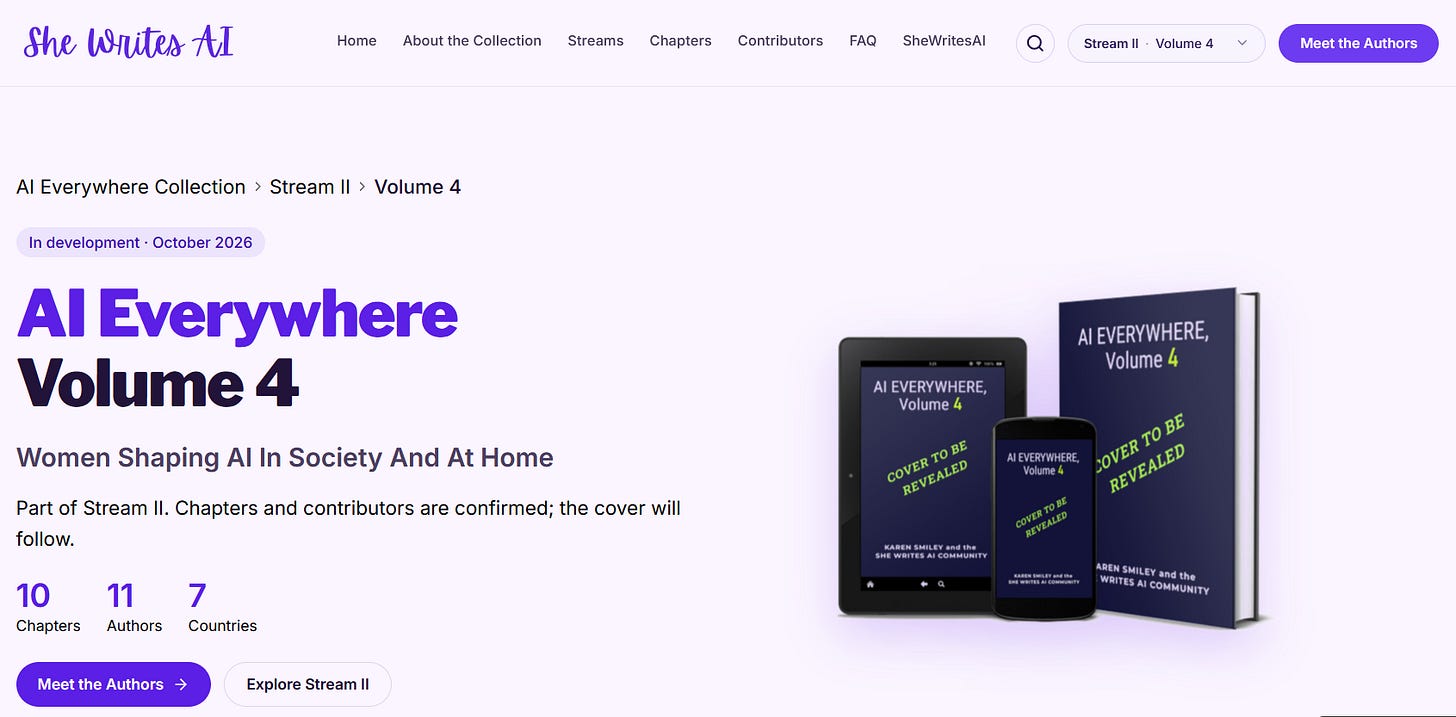
Where To Buy, How To Read and Listen, Ways To Review
-
Buy Volume 1 (now in ebook and print on Amazon, Gumroad, Lulu, Ingram Spark, and many reading platforms)
-
Tips from our publisher on how to buy an Amazon ebook from a country that isn’t a ‘KDP marketplace’, and how to read the ebook without a Kindle device (free)
-
Look for our new abridged audiobook edition!
-
Review links (we’re on Amazon, Goodreads, and Storygraph)
Ways To Support
To help cover book-related costs (ISBNs, proof copies, etc.) as well as other * community services, we follow the ‘Wikipedia model’. We can now accept donations worldwide via one-time tips (‘digital ink’) through Stripe or Gumroad. For now, paid subscriptions are only available in limited geographic regions (due to tax complications that we now expect Substack will resolve on Dec. 1, 2026). All donation sizes are welcome and help keep our services free for all women & nonbinary AI writers worldwide! Read more here*.
Donate to She Writes AI Community
Thanks as always for your support in every form. We appreciate it all. Hearts, shares, restacks, and comments are awesome!