Interview with Karen Smiley, author of AI Everywhere, Vol. 3, Ch. 10: Glossary: Artificial Intelligence Terms And Definitions, and book series coordinator
By Karen Smiley
Published: 2026-10-08
Welcome to the next She Writes AI interview episode covering our second book collaboration stream for the AI Everywhere series. In this cohort, we’re exploring the personal journeys and professional expertise of 32 authors from 18 countries worldwide who are redefining our relationships with machine intelligence. 
If you’re new to **, welcome! We’re a free, inclusive community of 780+ women and nonbinary writers in 60+ countries worldwide, with a focus on AI and data. Allies of all genders are welcome.
Learn more: About | Books | Categories | Directory | Digests | Donate | Herstory | Join | Subscribe | Updates | Welcome | World Map
For more insights from interviewer *, see her Lights On by Farida* newsletter or youtube.com/@faridakhalaf25.
About My Guest: Karen Smiley
Today I (*) am joined by , an AI leader, innovator, ethicist, data strategist, and author with over 30 years of engineering experience in software and data, during which she earned 14 granted US patents. Karen is the founder and leader of the community, an international collective of more than 780 women and nonbinary writers across 60+ countries. Based in North Carolina, USA, she hosts the popular podcast AI, Software, & Wetware (listened to in over 120 countries), authors the newsletter Everyday Ethical AI, and wrote the foundational book Everyday Ethical AI: A Guide For Families & Small Businesses. As the visionary spearheading the She Writes AI Everywhere* book series, Karen brings a deeply pragmatic, ethical, and inclusive lens to technology, dedicated to demystifying complex technical architecture for families, small businesses, and non-technical creators.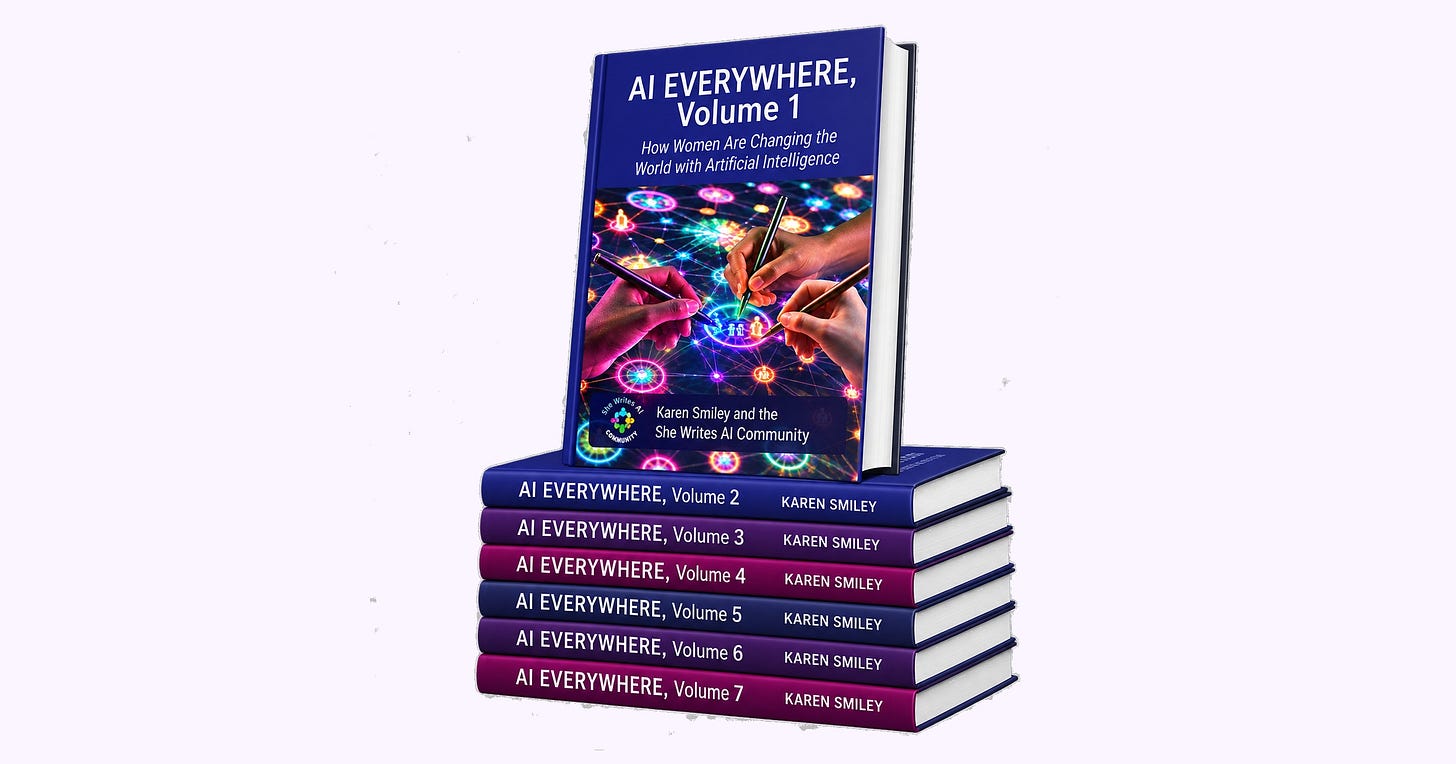 Mockup of the 7 books published and planned so far in the She Writes AI Everywhere series. Volume 1 was published in March 2026. Volumes 2-4 will be published in November 2026 and the covers will be revealed soon. Volumes 5-7 are in development.
In this foundational chapter, * provides an essential, high-level glossary and conceptual map designed to help readers cut through marketing hype and confidently navigate the technical terminology used throughout AI Everywhere. She challenges the common misconception that AI is brand new or purely generative, reminding us that AI technologies are over 80 years old and already deeply embedded in our daily lives. Using her iconic “AI Iceberg”* framework, Karen illustrates how flashy generative tools like LLMs, humanoid robots, and autonomous vehicles form only the visible peak above the waterline, while the vast majority of machine learning models (such as recommendation engines, fraud detection, and navigation algorithms) operate quietly below. Her chapter equips readers with the critical vocabulary, framework distinctions (from SLMs and RAG to AGI and synthetic data), and ethical questions required to evaluate AI tools safely and responsibly.
Interview With: Karen Smiley
Below is *’s full interview response to ’s questions on her chapter: Glossary: Artificial Intelligence Terms And Definitions.*
Intended Audience: Families, small business owners, non-technical readers, executives, writers, and practitioners who want a clear, jargon-free reference guide to understand key AI terminology, recognize everyday machine learning, and cut through hype to evaluate technology ethically.
Questions:
The 80-Year Evolution: You note that AI is over 80 years old, yet the meaning of the term has both “drifted and expanded” since it was named seven decades ago. How has the sudden visibility of ChatGPT obscured the much longer history of traditional symbolic AI and data science?
Karen: It’s not so much that ChatGPT is responsible for obscuring the longer history of AI – the longer history of AI was already obscured to most people, and it still is ;) To your point, though, people whose only knowledge of AI is about ChatGPT and Claude tend to think that generative chatbots are the sum total of “AI”, and that’s far from the case. AI has already pervaded our lives for decades, and we rely on it far more than most folks know. My 2024 article “But I Don’t Use AI” highlighted how we all use AI every day whether we want to or not, or whether we even realize it.
Not being aware of AI’s presence in our lives means that folks are not aware of the risks or opportunities it can bring. That low awareness is what concerns me. AI is just like other technologies and tools in that people deserve to know its potentials and risks, and they deserve to have good choices.
The AI Iceberg: You use the metaphor of an iceberg to describe AI technologies. Why do you believe it is dangerous for the public to focus only on what is “above the waterline” (like LLMs) while remaining unaware of the vast systems “below the waterline” that manage our social media feeds and credit scores?
Karen: Sometimes what you don’t know can hurt you. And the ramifications on how our data is used and analyzed go far beyond social media feeds and credit scores. Awareness is the first step. The iceberg visual seems to resonate with people; that’s why this diagram was in my “Everyday Ethical AI” book and it’s in our Glossary for Volume 3. My book focuses on what people need to know, and what questions to ask, about how their data is being collected and used. But the first step is realizing how pervasive AI really is in our lives.
“We don’t need to be mechanics to drive cars safely. Likewise, we shouldn’t need computer science degrees to use AI safely.” - Karen Smiley
The AI Effect: You mention the saying that “AI is whatever hasn’t been done yet”. Can you explain the “AI Effect” and why things like Optical Character Recognition (OCR), which used to be considered “magical,” are now viewed as normal software?
Karen: I like Clarke’s Third Law, by legendary sci-fi writer Arthur C. Clarke: “Any sufficiently advanced technology is indistinguishable from magic.” A lot of newer advanced AI capabilities do feel magical. But AI features that seem magical today aren’t magic; they are technology.
OCR is a good example of a technology that used to wow us. There were prizes for challenges on how to do better at machine learning tasks such as recognizing handwritten digits in images. Nowadays, we are so used to OCR that we just expect it to be there and work.
Other AI is similar. At one point, spam emails used to drown our inboxes and threatened the usefulness of our email accounts. Machine learning has now been flagging spam in our email inboxes for many years. We’ve mostly stopped thinking of spam detection as magic or impressive; we just expect it to work.
The same pattern is likely to hold on AI technologies that seem magical now. Us technology veterans are getting used to them; and our kids and grandkids will not only grow up with them, many of them will have never known a world without those technologies.
Generative vs. Analytical AI: To cut through the hype, you suggest asking if a tool is focused on analyzing what exists or creating something that didn’t exist before. Why is this simple distinction so critical for understanding the different risks and capabilities of an AI tool?
Karen: Both types of AI can produce mistakes, and those mistakes can create risks if not caught. But they produce different kinds of mistakes. And the ethical impacts are different.
The legal concerns around AI being ‘theft’ or ‘plagiarism’ tend to fall into two categories. One is copyright infringement: something that is rightfully mine was taken without permission and used in violation of my rights. That can apply to both generative and analytical AI. The other is unfair market competition. One of the biggest objections to generative AI from creative people is that not only was their work stolen and used without their permission, but the AI tools built on it are now being used to compete against them, to take away their ability to earn a living as a creator. This is much less of a concern with analytical, non-generative AI.
When I finished my draft of my Everyday Ethical AI book in August 2025, 42 lawsuits and 2 pending settlements were in progress in the USA on these concerns, plus 20 more outside the USA. Now there are over 145 major active AI lawsuits in the US alone, and even more worldwide. Edward Lee of **** tracks them at **[ChatGptIsEatingTheWorld.com**.] Some of the rulings in lawsuit outcomes to date have focused on infringement, and some on market competition.
With generative AI tools, if someone uses an image creator or LLM to produce an image or write something that the original creators earned a living doing, they are potentially depriving the creators of the right to profit from their own work. Risks of unfair market competition are much lower with analytical AI tools. Regardless, one of the key risks that many people don’t realize is that if a tool (AI or not) violates someone else’s rights or causes harm, the toolmaker doesn’t carry all of the responsibility for the negative effects. With few exceptions, the user of the tool is responsible for anything they create with it and the harms it may cause.
Another consideration is that the impact and risks can vary greatly based on practical differences in how you use generative AI tools. For instance, asking a LLM to read your essay and point out its weaknesses is very different from prompting the LLM to write an essay for you.
Another example of the difference between analytical and generative AI is in both the good they can do and the harm they can cause. Take CSAM [child sexual abuse material] or GBV [gender-based violence, including deepfakes] as examples. It makes sense to try to use analytical AI to detect potential CSAM and GBV material and remove it from circulation. But it’s absolutely horrible that awful people use polluted off-the-shelf generative AI tools or public datasets to create more CSAM and GBV. Again, the people who are prompting the AI tool to create CSAM and GBV are responsible for the harms they cause. But a publicly available tool or dataset should never have been fed CSAM and GBV content to be trained on in the first place. And the people and companies who allowed or supported it – or who tout and wink at these ‘features’ in their products – are at fault for enabling it.
Well-governed AI by responsible, ethical companies would be far less of a concern, if we had it. For the most part, we don’t. The problem is not the technology itself; it’s the lack of care and governance among many of the humans who build and sell it.
And in all of these cases, one clear risk of feeding your creative work or personal data into an AI tool is that you may be unintentionally giving the tool company the right to not only use your work and data without giving you credit or compensation, but also to use it in ways that might deeply offend you or even harm you. The pages-long terms and conditions are often written to say that you are giving your consent to this by using the AI tool. Many people argue that this isn’t meaningful informed consent, and I tend to agree with them.
This is one reason why I urge caution about feeding other people’s work into an AI tool to analyze or process. The people who created it deserve the right to not have their work digested by an AI tool to be used by that company however the company wishes. The creators have not consented to those terms and conditions, and by uploading their works to the AI tool, you are depriving them of the right to control and consent to that use of their work by the AI company. That’s fundamentally unfair. I wouldn’t want anyone doing that with my work without my consent, and I won’t do it to others. For instance, in the She Writes AI community, about 1/3 of our authors report opting to have Substack block AI bots from scraping their newsletters. Out of respect for those wishes, we don’t use AI in producing our weekly digests. It’s also one of the reasons why I reject the Pangram AI detection tool in Substack.
AGI vs. Reality: Your glossary deliberately avoids covering Artificial General Intelligence (AGI) or Super Intelligence (ASI) because they are not here yet. Why is it important for users to distinguish between the “marketing hype” of sentient machines and the reality of rule-based expert systems?
Karen: It’s just too easy for humans to get distracted by the hype about how future AI might kill us all in some dramatic fashion. Although AI clearly has its benefits, it’s also causing actual harms today to people who aren’t represented or treated fairly in the systems we have right now. And people are dying from it already, such as when their medical conditions are misdiagnosed because their gender or skin color or race or body type weren’t included accurately in the machine learning models being used. Paying attention to the AGI/ASI hype just dilutes attention away from fixing what’s already broken, and we can’t afford to keep avoiding the work of fixing it.
My advice: Be very skeptical of the hype, and always follow the money. People who stand to gain millions or billions of dollars from an IPO of their company are going to do and say what they are rewarded for doing and saying – not what’s in your or our best interests.
The Synthetic Data Solution: You discuss the use of generative AI to create synthetic data when high-quality real-world data is unavailable. What are the potential benefits, and risks, of training future AI models on data created by other AI models?
Karen: Data quality matters. There are times when synthetic data can help to improve data quality. But creating data for modeling, whether with AI or not, is like any other technical endeavor. We need to identify our assumptions, verify our sources, check our math, look for biases and gaps, and validate whether the result represents reality well enough to be useful. In that regard, using AI to generate synthetic data is no different from using a physics-based model to generate it. “Garbage in, garbage out”. But people who generate synthetic data with AI may trust the AI too much and be less aware of the importance of taking the same precautions.
There’s also an ourobouros effect identified by researchers where AI models begin to degrade as the ratio of original human-created data vs. AI-generated data drops. It’s one of the reasons big AI companies seem almost desperate lately to find new sources of fresh data to harvest.
I personally think it’s absurd and short-sighted that so many people keep assuming we can just keep throwing “more input” and more computing power at the same AI methods to get better results. We need more innovation and investment in finding more efficient models and analytical approaches, and even fresh frameworks like spatial intelligence or neurosymbolic computing. More AI researchers need to be thinking about the AI equivalents of cars and trains and airplanes for transportation, not just throwing more money into breeding faster horses.
“Cut through the hype by asking: what’s intelligent about it, and how well it solves an actual problem today.” - Karen Smiley
The “3Cs” Ethical Framework: You argue that humans who create training data are entitled to “consent/control, credit, and compensation”. In an age of massive, automated data scraping, how can a small business or an individual creator actually enforce these rights?
Karen: I want to credit CIPRI for clearly and concisely defining the “3Cs” of creative rights.
The first step in protecting our rights is to be aware of how our data is being scraped and used. Awareness is a huge challenge because many companies aren’t ethical and hide behind mountains of legalese, instead of actually explaining what data they do & don’t collect, how, and what you can do about it. And most of them only respect data rights in countries where they’re forced to. Again, I cover this in Everyday Ethical AI.
I think of it as giving people ‘AI goggles’ (and I don’t mean those stupid Meta pervert spy glasses) to protect their eyes so they can see below the waterline of the iceberg. Folks need to know what data these companies are using and how, and learn how to ask good questions before just clicking “I agree” and giving a company their data.
As one example, when the Studio Ghibli craze happened in March 2025, lots of people uploaded personal family photos into the AI tool to do this cool new thing. They may never have realized that they just gave that AI company an indefinite license to use that family photo for any purpose they wanted (such as advertising, training facial recognition, or generating new images). A more recent example is that Anthropic’s been accused of taking the content researchers have been putting into Claude for their draft papers, and using it to harvest scientific discoveries for their own ends, such as the ‘discovery’ of a new enzyme.
This risk isn’t completely new with AI; when I worked in Corporate Research, we were always cautioned by our IP lawyers about using Google or other public search engines. Why? One of the reasons: because Google could and would leverage data on public search phrases for their own purposes. And through our search terms and queries, we might inadvertently share the gist of a valuable idea that we hadn’t yet patented.
Always take a beat and think about what the tool company might do with what you’re uploading or typing in.
The Mechanic Metaphor: You state that we shouldn’t need computer science degrees to use AI safely, just as we don’t need to be mechanics to drive cars. What do you consider the “basic driver’s ed” requirements for everyday AI literacy?
Karen: One requirement is learning to ask good questions before picking up an AI tool or allowing your data, or your family’s or business’s data, to be used. This is important everywhere, but it’s especially critical in regions of the world (like most of the US) where your legal rights are limited on protecting your data and controlling consent, credit, and compensation (3Cs) for it. AI is impossible without data. The key is realizing that everything we do is data nowadays.
You’d be amazed at what your power company can deduce about patterns in your home from looking at fine-grained power usage with smart meters. They can tell when people are away on vacation, if they are running their washer and dryer more often than usual, and so much more. If you have a recent model car, it has hundreds of sensors and millions of lines of computer code that give the auto manufacturer information about you. Apps on your smartphone capture incredible amounts of data: not just who you call or text, but what you do and where you go when.
Then, when data brokers or other companies put these sources of data together, they can tell way more about us and our families than most folks can imagine. And they will use it to make money from us – not for our benefit, but for theirs; that’s what capitalism rewards them for doing. Basic defensive driving is to learn to think critically about your data and tools, and know what tradeoffs you are making if you allow these uses of your data.
The “AI Inside” Label: You warn that many products are labeled as having “AI inside” due to stakeholder pressure when they might just use pre-programmed analytics. Why is “using the right tool for the job”, even if it isn’t “sophisticated AI”, actually a sign of wise design?
Karen: Wise design starts with a solid understanding of the problem we are trying to solve before diving into solutions. Sometimes that means focusing on a decision we are trying to make. Decisions with big consequences might need more powerful, more sophisticated tools. Or they might not. A simpler statistical tool, one that lets us see clearly the rationale, the pros and cons, and the basis for the result or recommendation, may be far more effective than a fancier AI tool that’s an expensive opaque box which we don’t feel confident we can trust.
Figure out what’s important about the decision or problem, and how you will know or measure the goodness of a solution, before trying to solve it. That will help you to decide whether a tool is the right one for the job. There are always tradeoffs: faster and cheaper but less accurate; easier to use but less secure; etc. Know what’s important to the problem and to you before you dig in.
There is a saying I love in the agile product development world: “Ask yourself: what’s the simplest thing that could possibly work?” Complex solutions and tools sometimes aren’t any better than simple ones. They might cost more money or time to build or use; they might need more data or depend on data that isn’t readily available or accurate; they might run more slowly; they might be harder to understand or explain; or they could be difficult to diagnose or maintain.
A good practice is to start with something simple and measure how well it works in the ways that matter to you. Plot the data on some graphs before you throw it into a machine learning model. Then see if the simple solution supports the decision or solves the problem well enough. If you think you do need something more powerful, then try a more advanced solution, measure it too, and compare its results to the simple one before you decide whether to commit to it.
Multi-Modal Models (MMMs): As we move toward MMMs that combine text, images, and video, how does this “multi-mode” capability change the stakes for family and business safety compared to simple text-based bots?
Karen: There’s a saying — I learned it from my dad, but it’s way older than that — “Don’t believe a thing you hear or half of what you see.” It is especially pertinent with AI everywhere today when deepfakes are so prevalent. The biggest impacts I see of MMMs are that they enable creation of even more convincing deepfakes, and they can power persuasive content that can manipulate people into believing something that’s not true or shifting their beliefs and behavior in a way that doesn’t align with their core values.
Critical thinking, and learning to question before reacting, matters more today than ever. Always follow the money and the motives: ask “Who is creating, saying, or showing this, and what is their incentive to do so?”
“Humans who create the data an AI system uses are morally and ethically entitled to 'consent / control, credit, and compensation' for its use.” - Karen Smiley
A Word From to
It has been an absolute honor and a deeply enriching experience to sit down with the incredible authors featured in She Writes AI Everywhere, Volume 1, 2-4. Exploring their groundbreaking work, ranging from the physical infrastructure of compute and the relational depth of conversational AI to neurodivergent interface design, health equity, and global linguistic justice, has provided a profound masterclass in what it truly means to build a human-centered digital future. I am immensely grateful to Karen Smiley for inviting me into this movement, entrusting me to bring these vital conversations to light, and giving me the privilege to champion these brilliant voices as we share their wisdom with the world.
PS: Want to know more about the book launch? Check this article by *: From Making Space to a Growing Book Series.*
Why This Matters
’s perspective emphasizes:
-
The “AI Iceberg”: Generative AI models (LLMs, MMMs) take up most of the public spotlight above the waterline, but everyday non-generative AI, like recommendation engines, speech-to-text, anomaly detection, and route optimization, runs essential infrastructure below the waterline.
-
Cutting Through Marketing Hype: Products labeled with “AI inside” often rely on pre-programmed rules, expert systems, or basic data science analytics under the hood; recognizing the difference prevents overpaying for hype when simpler tools do the job effectively.
-
The “AI Effect”: As technologies become ubiquitous (such as Optical Character Recognition/OCR), we stop viewing them as “magical” or “AI,” giving rise to the saying that “AI is whatever hasn’t been done yet”.
-
Data Entitlement & The 3Cs: Because machine learning relies entirely on human-created data, creators are ethically entitled to Consent/Control, Credit, and Compensation for how their work is used.
-
Model Hierarchy & Efficiency: Understanding nested relationships — where Artificial Intelligence encompasses Machine Learning, Deep Learning, and specialized models like Small Language Models (SLMs) and Retrieval-Augmented Generation (RAG) — helps organizations choose faster, less expensive, and resource-efficient architectures.
Thank You, *, for providing such an accessible, empowering, and ethically grounded anchor for the entire AI Everywhere* series! For every reader overwhelmed by acronyms or trying to separate real capability from corporate spin, her chapter is an indispensable field guide for digital literacy.
Karen reminds us that technology exists to serve human needs, not the other way around. Her work urges us to ask the right questions, protect our data rights, and build a digital future rooted in ethics and inclusion. I highly recommend joining her global community at * and subscribing to her newsletters on Substack at and *.  6 'P's in AI Pods (AI6P)AI affects People & Places we care about, Products & Platforms we build & use, and Practices & Processes we use daily. Wondering how data & AI impact these 6 'P's, and how to use them ethically & wisely? The AI6P newsletter is for you! 100% human-written.By Karen Smiley
 Everyday Ethical AIGet the latest on inclusion, equality, justice, ethics, and business value. Based on Karen Smiley's 30+ years in the software industry with practical data-driven applications of AI, ML, analytics, & more. Weekly interviews at @sixpeas. 100% human-created.By Karen Smiley
And if you’re interested in more conversations like this, consider subscribing to She Writes AI. I’ll continue sharing insights from the voices shaping the future of AI, including contributors from 30 new chapters in the Stream II collaboration for AI Everywhere, where 32 women from across five continents explore how artificial intelligence is changing the world we live in, and how we can change it for the better.
References
For more insights on the books in Stream II, see aiEverywhereBooks.com, our beautiful book series website created by **: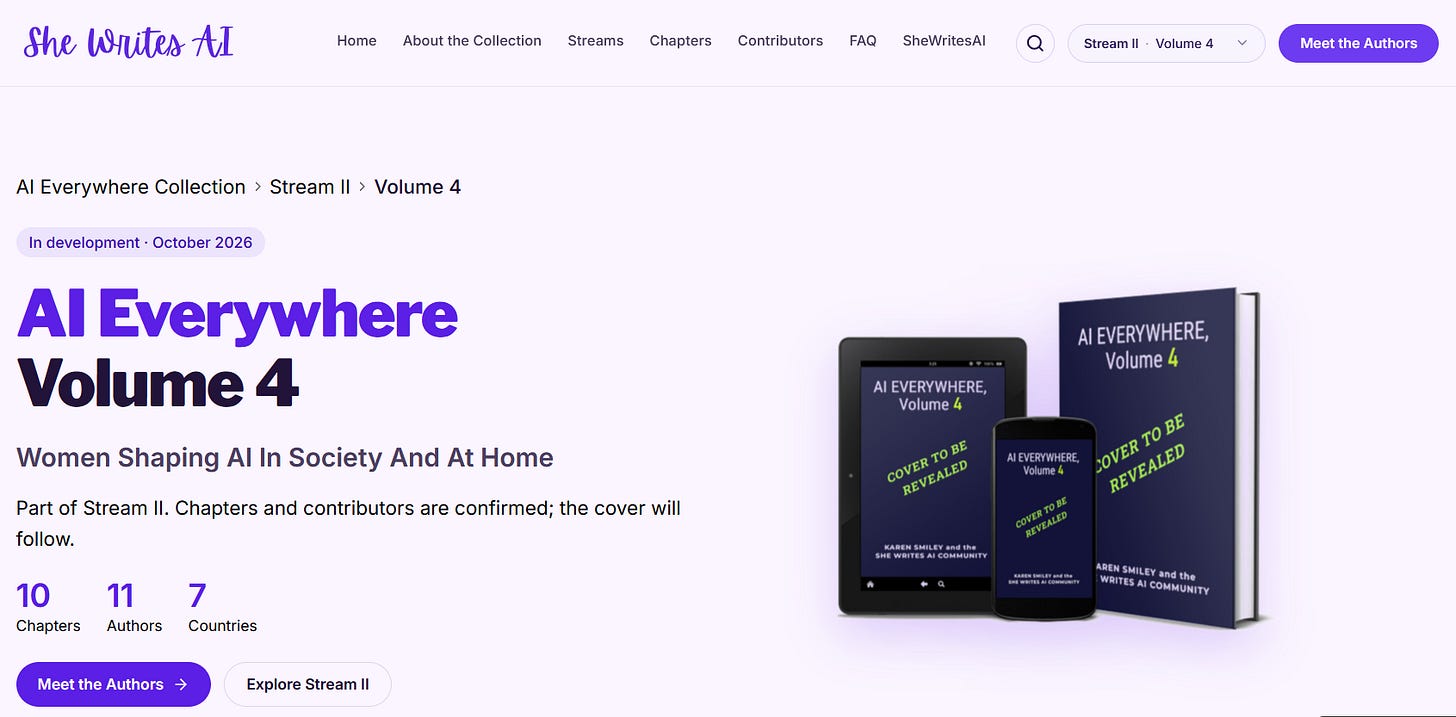
Where To Buy, How To Read and Listen, Ways To Review
-
Buy Volume 1 (now in ebook and print on Amazon, Gumroad, Lulu, Ingram Spark, and many reading platforms)
-
Tips from our publisher on how to buy an Amazon ebook from a country that isn’t a ‘KDP marketplace’, and how to read the ebook without a Kindle device (free)
-
Look for our new abridged audiobook edition!
-
Review links (we’re on Amazon, Goodreads, and Storygraph)
Ways To Support
To help cover book-related costs (ISBNs, proof copies, etc.) as well as other community services, we follow the ‘Wikipedia model’. We can now accept donations worldwide via one-time tips (‘digital ink’) through Stripe or Gumroad. For now, paid subscriptions are only available in limited geographic regions (due to tax complications that we now expect Substack will resolve on Dec. 1, 2026). All donation sizes are welcome and help keep our services free for all women & nonbinary AI writers worldwide! Read more here.
Donate to She Writes AI Community
Thanks as always for your support in every form. We appreciate it all. Hearts, shares, restacks, and comments are awesome!