Five things that actually broke in the AI systems I ship for real businesses, what each one cost and the checklist I build with now (and you need to too!).
By SheWritesAI
Published: 2026-09-25
Today’s guest post is by * Community member . She is the founder of Crework Labs, a tech startup building agentic AI systems for SMEs globally, with a simple goal: save them time and help them generate more revenue. She’s shipped 20+ production systems across industries like coaching, operations, marketing, healthcare and CPG [consumer packaged goods]. Shikshita believes there’s already enough AI theory out there, so she writes at * about implementable, step-by-step workflows that operators can easily replicate to be more efficient. Enjoy!
- Karen :)
Thank you for subscribing to She Writes AI!
(always free for everyone, thanks to our donors)
When it comes to the discourse around AI, I think we can all relate to this. The web is full of prompts, tips on how to squeeze more out of your tokens, lessons on which model is best for which task etc. And of course, attached to every one of them, the amazinggg results you are going to get once you implement them.
That has always been the deal with AI — the capabilities and the results.
We have all conveniently skipped the most important part, though: the bit between the idea and the result.The part where you spend the most time. Where things break, where your neat hypothesis falls apart, and you lose tens of hours starting over from the beginning.
I run a tech startup called Crework Labs, where I build agentic systems for SMEs. I have shipped 20+ of them across industries like coaching, operations, marketing, healthcare, and CPG, and that is where pretty much everything I have built has broken at least once. Some of them, embarrassingly, more than ten times.
So if you are building with AI, and not just reading about it, these are the five things you can and SHOULD implement, ones I wish someone had told me before I learned them the expensive way.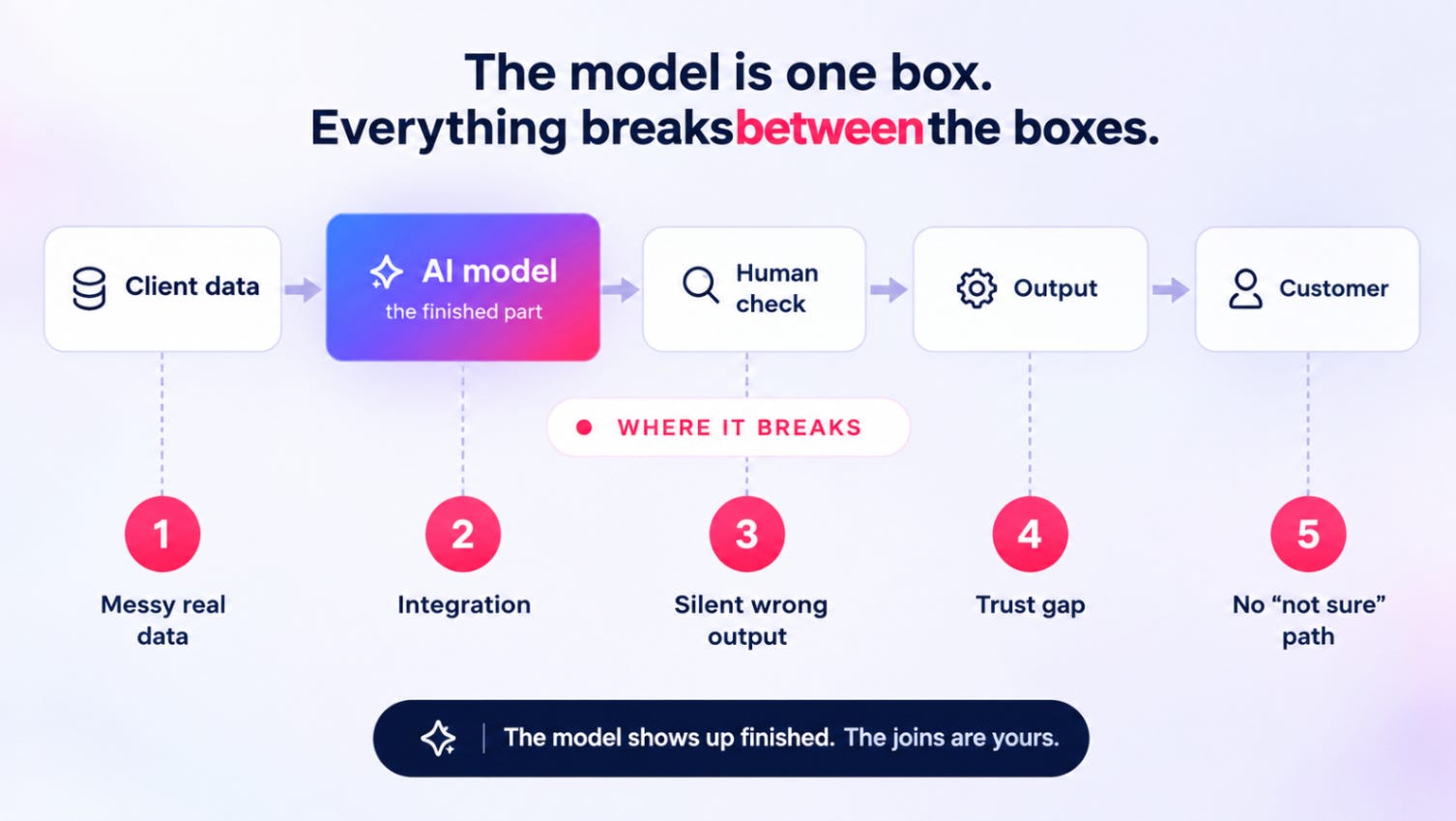 Diagram by Shikshita Juyal, created with Claude
1. I demoed on clean data. Their real list was a swamp.
It looked perfect on the demo. Real data never is.
This was a lead intelligence platform. It researched target companies and the right contacts inside them, enriched each one with the details a sales team actually needs, scored how good a fit they are and handed back a ranked list, so nobody was spending 15 hours a week digging through company websites by hand. It ran across thousands of records at a time.
I built it and demoed it on a clean sample list, and it looked brilliant. Every record came back full and scored and tidy. Easy to sign off, easy to feel good about.
Then we pointed it at the real list.
Holding companies with no real website behind them. Domains that had been dead for two years. Businesses tagged in the wrong industry back in 2021 and never corrected. The same company sitting in there three separate times under three slightly different spellings of its name. The enrichment did its best with all of it and produced confident nonsense, because that is what it was given.
On the real data, around 40 percent of the output was junk on the first run, and the team’s trust in the whole thing collapsed in about a day. Once people catch a tool being confidently wrong a few times, they stop believing the parts it got right too.
So before the rebuild, I did the thing I should have done first. I asked for their actual list, all of it, and ran the enrichment against the messiest slice on purpose, before building anything pretty on top. That dragged the holding companies and dead domains and duplicates into the open on day one, when they were cheap to handle, instead of surfacing live in front of the client. I added a confidence score to every record so a person can see which ones to trust, and a pass that catches duplicate companies before they ever reach a human. The junk rate went from around 40 percent to single digits and the trust came back, mostly because the system finally admitted when it was unsure instead of dressing up a guess.
Ask for their ugliest 20 records before you begin. Not a clean representative sample; the worst ones they have got. If they cannot even find their worst records, that is the finding, because it means someone is fixing exceptions by hand in a corner you have not looked at yet.
I built something similar for the top of the funnel too: an AI that reads every inbound lead, researches the person, and drafts a reply before it goes cold. I broke the whole workflow down here:  Idea To Impact How To Stop Losing Warm Leads to Slow Generic RepliesTLDR: Two things are killing your inbound leads right now. You're either replying hours too late while the prospect has already booked a call with someone faster, or you set up a generic autoresponder that sends the same canned reply whether someone asked about a $500 job or a $50,000 build. This article shows how to fix both: AI reads every new form su…Read morea month ago · 12 likes · Shikshita Juyal
2. The AI took two days. The integration took two months.
I priced the clever bit and gave away the hard bit.
This was a two-sided marketplace for independent beauty professionals. Clients looking for someone on one side, artists with their own schedules and specialties on the other, and the system in the middle matching a request to the right available person and getting them booked.
The intelligent part, the matching and ranking, worked in about two days. I was almost embarrassed by how quickly it came together. If the whole job had been the AI, this would have been the easiest build of my year.
It was not the whole job. It was maybe a tenth of it.
The real project was everything the matching quietly assumed already existed:
-
Payments in and payouts back out to dozens of individual artists.
-
Scheduling across people who each keep their own hours and block their own days.
-
Notifications that have to fire at exactly the right moment or the whole thing feels dead and people drop off.
-
Artist onboarding and verification so clients are not booking a stranger.
-
What happens on a no show, who gets charged, who eats the refund, how a dispute gets settled.
None of that is glamorous and all of it is the product.
I had quoted the job like the matching was the hard part, so I quoted it short. I think I said three weeks. It took closer to two months, and almost every extra week went into connecting the system to everything around it, not into the intelligence.
The lesson is not really about the build; it is about the plan. Before I quote anything now, I check what already exists on their side and whether the integration is even feasible. Do their tools have clean APIs? Webhooks? Can my system actually get the access it needs, or is half of it locked inside software nobody has admin rights to anymore? I write down every tool it has to connect to, and every human whose approval it needs to function, and I price that list. The AI is one line on it, and it is usually the cheapest one.
Your plan has to cover build plus integration; never ever focus solely on the build alone.
3. I built nothing that could catch a bad input
It gave a clean answer that was completely wrong and never said so.
This is different from a model being wrong. Here the model did its job perfectly. It was handed something it should never have trusted, and nothing in the system was watching the door.
The build was an automated proposal system for a roofing contractor. A roofing proposal is an intricate document. It holds the measurements for every section of the roof, the pitch, how many layers are coming off, the exact shingle line and underlayment the crew chose, the waste factor, the labour, the margin — all of it priced line by line off the contractor’s own rate sheet. Get one quantity wrong and the whole job is underpriced.
So the system pulled the job straight out of their CRM, took the measurements and materials the crew logged on site, mapped every line against the contractor’s pricing table, applied their waste and margin rules and produced the finished proposal. It was running a few hundred a month. Nobody was checking them by hand anymore, because the whole point was that they no longer had to.
Then two small things happened at once. A crew started logging measurements in a slightly different format, and the office added a new shingle line to the catalog that was not in the pricing map yet.
The system did not error. It just carried on making clean, professional, correct looking proposals with the wrong quantities and the wrong totals, and those went out to real customers. Around 5 proposals were sent underpriced before anyone noticed the margins on that batch looked thin.
The failure was not the AI reading the job badly. The failure was that I had built a chain where nothing between the CRM and the customer’s inbox could say “This input looks nothing like what I usually see. Stop.”
So I went back and put a layer of dumb checks around the AI, and dumb is the right word. Before a proposal generates, every material on it has to match a known line on the price sheet, or the whole thing halts and pings me. After it generates, if the total lands more than 15% outside the normal range for that kind of job, it does not send; it holds for a human to eyeball. It is not clever and it is not AI. It just refuses to let a strange input pass in silence, which was the one thing missing.
An AI step almost never fails loudly, so you have to make it. Wrap each step in cheap checks that do not depend on the AI at all, on the way in and on the way out. They turn a silent wrong answer into a loud one, and the loud ones are the only ones you catch before a customer does.
I break down the systems I build over on my newsletter Idea To Impact. The wins, the breaks like these and the exact workflows behind them. It is free; come read.
4. I built it for the person who bought it, not the person using it daily
It worked perfectly, but she never used it.
This one was an intelligence dashboard for a coach who runs a lot of clients at once. Her actual problem was time. Every week she was opening each client’s file, pulling their numbers into a spreadsheet by hand, then working out where each person was against their goals, who was slipping, who needed a nudge. Hours of it, every week, before she could even start the actual coaching. So we built a dashboard that pulled all of it automatically, ran every calculation and showed every client’s progress in one live view. On paper it took something like 7 hours a week down to a few minutes a day. It did exactly that. The math was right.
She barely opened it for weeks.
You would imagine something was broken, throwing errors. Nope. The numbers were correct. But she was walking into calls where she had to sit across from a client and stand behind those numbers, and she could not see how the dashboard had reached them. So she quietly kept her old spreadsheet and recalculated everything by hand, right next to the tool that was already doing it for her, because at least she could trust a number she had worked out herself.
The fix was not technical, and that took me a while to accept. I rebuilt the whole view around trust instead of speed. Every number now shows its working. She can tap any figure and see the raw inputs and the exact steps behind it, so nothing is a black box she has to take on faith. Then I sat with her through her first few real calls using it, so she could feel what it was like to pull up a number live and have it hold. Once she could defend a figure in front of a client without redoing it, the spreadsheet quietly disappeared.
I had built it for the outcome she asked for and forgotten to build it for the moment she would actually depend on it.
Build for the person who has to touch it every day, not the person who bought it. A number they cannot trace is a number they will quietly redo by hand, and then your system is just an expensive decoration sitting next to their real one.
Half of building well is designing the daily moment, not the demo. I do a whole issue on this, connecting Gmail and Calendar into one system I actually open every morning: Idea To Impact I Wake Up to a Full Executive Briefing Every Day. Here how.TLDR: Most of us spend 20-30 minutes every morning just figuring out what their day looks like, bouncing between Gmail, Calendar and Notion with no clear picture of what actually matters. This article shows how to set up a system that reads your inbox, preps your meetings, flags what’s on fire and logs everything into a live Notion dashboard, before you…Read more2 months ago · 5 likes · 3 comments · Shikshita Juyal
5. I never built the “not sure” path
It was sure of itself and it was wrong.
This is the flip side of number three. There the input was bad and nobody checked it. Here the input was fine. The model simply guessed, got it wrong, and handed the guess over dressed as certainty.
The build was a lead qualification agent for a pet services business. Enquiries come in through a few different channels, and the agent reads each one, works out which are real potential customers and which are noise, tags them, and routes the good ones to the owner so she only spends time on people likely to actually book.
For a while it worked well, and then it confidently got a whole batch wrong. It tagged a run of junk enquiries as hot leads and quietly binned some genuinely good ones as noise.
Because the wrong tags looked exactly as clean and certain as all the correct ones, the owner just acted on them. She chased dead ends for a few days and never saw the real customers it had thrown away. Around 5 good leads were mishandled before anyone thought to question the tags. In a business like hers, a booked client is real, countable money walking out the door.
So I built the part I had skipped, which was the whole “not sure” path. Now, anything the agent is not genuinely confident about does not get a clean tag like everything else. It drops into a small “needs a human” queue with the reason it hesitated attached, and the owner clears that little pile in a few minutes each morning. The confident, clear cases still flow straight through untouched. The shaky ones stop and wait for a person, which is exactly where they should have been going from the start.
There is a nastier lesson hiding in this one too. The more polished an output looks, the less carefully anyone reads it. Clean formatting reads as authority. I have watched people skim outputs from my own systems precisely because they looked finished and sure of themselves, which is the exact moment a confident wrong answer does its damage.
Design what the system does when it is unsure before you polish what it does when it is sure. If your only plan for a shaky answer is to send it anyway and just feel a bit less confident about it on the inside, you have not actually built that path, and it will cost you at the worst possible moment.
So what is actually going on?
The whole AI conversation is stuck at the model layer because that is the part you can see from the outside. You can benchmark a model. You cannot benchmark whether a receptionist opens a new tab at eleven on a busy Tuesday, or whether a coach trusts a number she cannot trace, or whether the real data is a swamp.
But every system I have watched fall over, fell over at a join.
-
Between the real data and the pipeline.
-
Between the output and the human who has to act on it.
-
Between what the buyer wanted and what the daily user would put up with.
-
Between the demo file and the real one.
-
Between a confident answer and a correct one.
The model shows up finished. The joins are yours.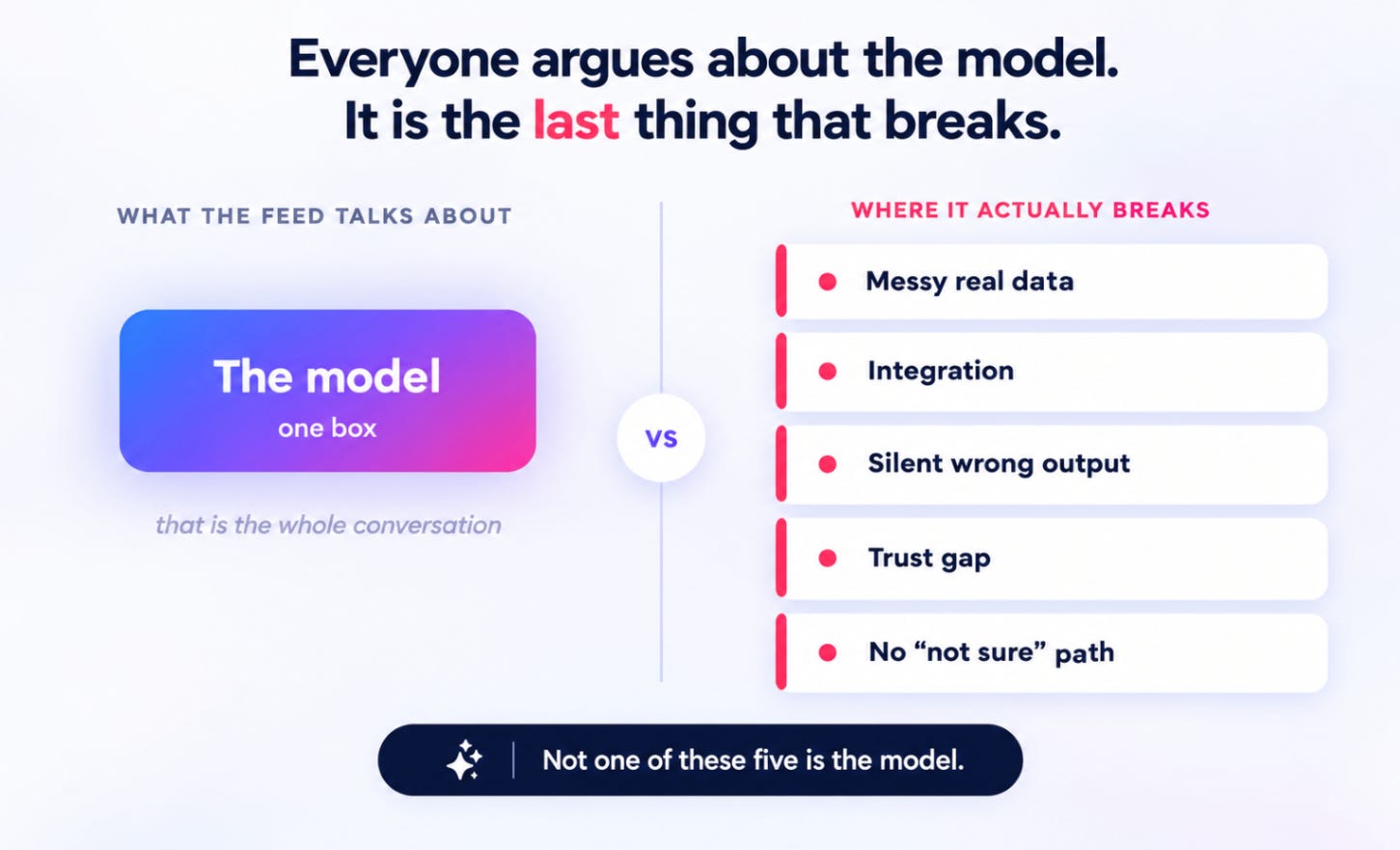 Diagram by SJ, created with Claude
If you are building anything with AI inside it right now, spend less time hunting for the perfect model, and more on those five joins. That is where it breaks, and unlike the model, nobody else is coming to fix it for you.
Finding those joins before they break is pretty much what I do at Crework. If you have got something running on live data and want a second set of eyes on where it might go wrong, that is exactly the kind of thing I look at.
-
Thank you to for sharing these five insights with us all on where practical AI-based systems can break, and what to do to prevent the breakages! For more articles like this, subscribe to her newsletter and subscribe to us here at She Writes AI: