Written author interview for AI Everywhere, Vol. 4, Chapter 4: The “Word Wide Web” AI Divide: Language Inequalities In The AI Era.
By Farida Khalaf
Published: 2026-09-15
Welcome to the next She Writes AI interview episode covering our second book collaboration stream for the AI Everywhere series. In this new cohort, we’re exploring the personal journeys and professional expertise of 32 authors from 18 countries worldwide who are redefining our relationships with machine intelligence. 
If you’re new to **, welcome! We’re a free, inclusive community of 760+ women and nonbinary writers in 60+ countries worldwide, with a focus on AI and data. Allies of all genders are welcome.
Learn more: About | Books | Categories | Directory | Digests | Donate | Herstory | Join | Subscribe | Updates | Welcome | World Map
For more insights from interviewer *, see her Lights On by Farida* newsletter or youtube.com/@faridakhalaf25.
About My Guest: Cristina Oliva-Patrick
Today I (*) am joined by Cristina Oliva-Patrick, an Equal Employment Opportunity (EEO) Specialist, AI safety advocate, and the creator of The Responsible AI Brief newsletter on Substack. Originally from Rome, Italy, but living and working in the United States for over a decade, Cristina’s work lives at the vital intersection of technology, human rights, and institutional accountability. She brings a unique perspective to the AI conversation, arguing that linguistic diversity is not just a technical challenge to be solved by engineers, but a fundamental matter of global justice*. Her central thesis is that when we train models almost exclusively in English, we don't just create less-capable systems; we actively build an exclusionary digital landscape that marginalizes billions of speakers of "low-resource" languages. Covers and subtitles for Book2 (Volume 2, Volume 3, and Volume 4) will be revealed this summer. Stay tuned!
In this interview, Cristina Oliva-Patrick explores the deep systemic barriers that define the “Word Wide Web” AI Divide. She breaks down the shift from treating language representation as a mere "market option" to recognizing it as a critical digital rights issue that affects whether individuals can access healthcare, education, and legal justice in their native tongues. Cristina highlights the hidden risks of "implicit digital erasure," where the lack of digital materials—such as text, voice recordings, and linguistic tokens, causes thousands of living languages to effectively cease to exist within AI systems. Moving beyond the limitations of English-centric models, she provides a brilliant, global tour of grassroots defiance, demonstrating how localized models like SEA-LION, decolonial startups like Lelapa AI, and community-led initiatives like Masakhane are reclaiming digital sovereignty to ensure that the future of intelligence belongs to all of humanity.
Interview With: Cristina Oliva-Patrick
Below is Cristina Oliva-Patrick’s full interview response to *’s questions on her chapter: The “Word Wide Web” AI Divide: Language Inequalities In The AI Era.*
Intended Audience: General readers will gain an understanding of why linguistic diversity in AI is a matter of global justice, and why prioritizing low-resource languages is both achievable and urgently necessary.
Questions:
The High Stakes of Translation Errors: You open your chapter with a chilling example of a woman’s domestic violence claim being denied because an AI translated “mi jefe” (father) as “my boss.” Why is the growing reliance on machine translation in critical systems like the US asylum process creating a crisis of global justice?
Cristina: This is a global justice crisis because the people most affected are already the most vulnerable: for example, refugees and asylum seekers who have no power to contest incorrect translations before it changes their life. These tools weren’t created for this kind of responsibility.
Defining the “Invisible” Languages: You define “low-resource languages” not by how many people speak them, but by their lack of digital materials, like tokens and semantic analysis. If a language doesn’t have these Natural Language Processing (NLP) tools, does it effectively “exist” within an AI system?
Cristina: Farida, exactly, it’s about whether there’s enough digital material (text, audio, data) for an AI to “learn” from. If a language doesn’t have enough digital footprint, the AI basically can’t “see” it, even if millions of people speak it every day. So yes, if a language has no digital presence, it might as well not exist, as far as an AI system is concerned.
“Without a digital footprint, a language does not exist within an AI system, no matter how many millions of people speak it.“ - Cristina Oliva-Patrick
The Basque vs. Kiswahili Paradox: You point out that Basque, with only 800,000 speakers, has six times more Wikipedia articles than Kiswahili, which is spoken by up to 150 million people. What does this tell us about the imbalance of commercial investment in AI data collection?
Cristina: This proves that which languages get invested in is where money and interest have historically flowed, and that’s mostly followed old patterns of who’s historically more represented.
The Catch-22 of AI Development: You describe a "catch-22 dilemma" where limited data discourages researchers, and fewer researchers means continued data scarcity. How can we break this cycle when computational resources and linguistic expertise are clustered in already advantaged regions?
Cristina: Unfortunately, I am not sure I have the answer to this question. The progress we do see (Masakhane, Lelapa AI, etc.) didn’t come from some government swooping in with a perfect policy fix. It came from small groups of committed people grinding away at this for years with very little funding and eventually proving it could work. If bigger funding and policy support ever show up, it’ll probably be because those grassroots efforts already proved the model works.
Localization as the Future: You argue that localization, training models specifically for a single language or region, is the future of equitable AI. How does a model like SEA-LION (Southeast Asian Languages In One Network) challenge the standard practice of imposing Western-centric models on other cultures?
Cristina: Instead of taking an AI built for English and awkwardly translating it to fit another language, you build the AI around that language from day one. SEA-LION is a great example. It was built specifically for Southeast Asian languages like Vietnamese and Thai, shaped by that region's own culture instead of forcing a Western mindset onto it. It's also open-source, so local communities can keep improving it themselves. I think that's a much better setup than communities just being handed a finished product from somewhere else.
“Learning as a First Language”: You highlight Minerva, an Italian-language model built from scratch rather than being adapted from English. Why is an AI that learns a language as its “first” language technically superior to one that treats it as a translation task?
Cristina: Minerva is another good example: an AI that was trained on Italian from the very beginning, instead of starting as an English AI and being adapted for Italian later. Because Minerva learned Italian as its native language, it’s faster, cheaper to run, and actually performs better on Italian than a lot of bigger multilingual AIs that treat Italian as an afterthought.
“I personally believe that localization should be increasingly recognized as the future of equitable AI.“ - Cristina Oliva-Patrick
Extraction vs. Sovereignty: You warn against the “lawless extraction” of linguistic data from other cultures. What does true “data sovereignty” look like, and how do we ensure communities are genuine beneficiaries rather than just sources of raw material?
Cristina: It means the community whose language is being used actually has a say in how their data gets collected, what it’s used for, and who profits from it. Historically, tech companies have just taken language data from communities (especially in poorer countries) to build products, without giving much back. Real fairness means communities are treated as partners, not just as a free source of raw material. That could look like getting a say in how the tool is designed, or actually benefiting from what gets built with their language.
The Masakhane Philosophy: The word Masakhane means “we build together.” Why is this grassroots, community-led research model more effective and ethical than top-down data collection by Big Tech?
Cristina: Instead of some faraway tech company deciding what an African language “needs” and building something for it from the outside, Masakhane is made up of over 1,000 African researchers across 30 countries who are building tools for their own languages themselves. This means the community keeps ownership of the work instead of just being a source of data for someone else’s product.
“Language in a Box”: You mention Michael Running Wolf’s idea of an offline AI device containing a voice-based curriculum for Indigenous cultures. How can AI be used as a transformational tool for language revitalization rather than just a tool for assimilation?
Cristina: Michael Running Wolf’s point is that AI isn’t magic, but it can genuinely help revive a language if it’s built alongside the community, with actual speakers helping design it, not built somewhere else and then just handed over. Does the community shape the tool, or does the tool try to shape the community? Done right, the same technology that’s been squeezing out smaller languages for years could instead help bring some of them back. Or at least that is my hope.
Linguistic Equity as a Human Right: You argue that linguistic equity in AI is inseparable from digital rights. Why must policymakers treat language coverage as a “public good” rather than a market opportunity to prevent a total loss of human cultural knowledge?
Cristina: Governments mostly react to what has profit or political pressure behind it. A language spoken by a few hundred thousand people in a country with limited resources isn’t going to be anyone’s priority unless people force it to be. For me, calling this a “human right” is a standard to hold people to. It gives advocates, journalists, and communities something to point to when they push back: “You’re denying someone healthcare or legal access because of a translation problem, and that’s a rights violation.” Real change probably comes from that kind of pressure and from grassroots groups proving these languages matter.
A Word From Cristina Oliva-Patrick
I co-wrote a piece with * and several other writers on why community has to be the foundation of AI’s future. The same principle runs through this chapter: Masakhane, Lelapa AI, SEA-LION were built by the people who’d use them. If that resonates, read our collaborative piece, “You Don’t Have to Figure This Out Alone.” * The Responsible AI BriefYou Don’t Have to Figure This Out AloneA few weeks ago I wrote about community as the first layer of AI governance, about the idea that before regulation, there are relationships, and before frameworks, there are the people willing to hold them up. Alyssa Fu Ward, PhD read it and we started an engaging conversation…Read more6 months ago · 100 likes · 88 comments · Cristina, Alyssa Fu Ward, PhD, Anna • bubble boss 🫧, Karen Brasch 🚁, Marcela Distefano, Myranda | She Loves Stats, Shi Kang'ethe, Rebecca Mbaya, and Natalie Nicholson
“The world's linguistic diversity is a record of how human beings have understood time, community, land, and everything else and this knowledge is accumulated across thousands of years and irreplaceable once lost.” - Cristina Oliva-Patrick
Why This Matters
Cristina Oliva-Patrick’s perspective emphasizes:
-
The High Cost of Translation Failures: When AI translation tools fail in high-stakes environments like the US asylum system, the results are life-altering. Systematic errors—like translating “mi jefe” (colloquially meaning “my father” in certain dialects) to “my boss” or swapping pronouns—have contributed to the denial of domestic violence claims and wrongful deportations.
-
The Inefficiency Tax on Non-English Speakers: English-centric AI models struggle with tokenization in other languages, breaking single foreign words into multiple tiny, inefficient fragments. This inefficient processing means that running queries in low-resource languages is often slower and more expensive. Native-first architectures, such as Italy’s Minerva model, demonstrate that building systems from scratch on local data yields faster, cheaper, and far more accurate outputs.
-
The “Low-Resource” Disconnect: “Low-resource” is a complex category; speaker count alone does not guarantee digital presence. For example, Basque is a language isolate with only 800,000 speakers, yet due to concentrated local investment, it has six times more Wikipedia articles than Kiswahili, which is spoken by 60 to 150 million people across East and Central Africa.
-
Data Sovereignty vs. Lawless Extraction: Developing ethical AI requires respecting data sovereignty and moving away from historical patterns of “lawless extraction” by Western tech companies. Grassroots groups like Masakhane (meaning “we build together” in isiZulu) are leading this shift by centering community-led crowdsourcing, ensuring that native speakers are active designers and beneficiaries rather than passive data sources.
-
The Urgency of Digital Archiving: With UNESCO estimating that one language becomes extinct every 14 days, AI-driven language preservation is a vital race against time. Projects like the First Languages AI Reality (FLAIR) initiative and IBM’s Nheengatu writing assistant show that offline “language-in-a-box” models and translation tools can rapidly digitize oral histories and revitalize severely endangered languages.
-
Decolonizing the Infrastructure: Startups like South Africa’s Lelapa AI are building models like InkubaLM from the ground up specifically for African languages. By avoiding English-first retrofitting, they are proving that localized, specialized AI is the most effective way to serve the world’s multilingual populations
Thank You, Cristina Oliva-Patrick, for this incredibly powerful, sobering, and necessary call to action. For every tech leader, researcher, and digital rights advocate, her chapter in AI Everywhere is the definitive blueprint for bridging the linguistic divide and building a truly inclusive future for technology.
Cristina reminds us that our languages carry thousands of years of human understanding, and letting them disappear from our tools is a loss we cannot afford. I highly recommend following her work and subscribing to her newsletter, The Responsible AI Brief, where she continues to champion human rights, institutional accountability, and AI safety on a global scale.
And if you’re interested in more conversations like this, consider subscribing to She Writes AI. I’ll continue sharing insights from the voices shaping the future of AI, including contributors from 30 new chapters in AI Everywhere where 32 women from across five continents explore how artificial intelligence is changing the world we live in, and how we can change it for the better.
References
For more insights on the books in Stream II, see aiEverywhereBooks.com — our beautiful book series website created by **: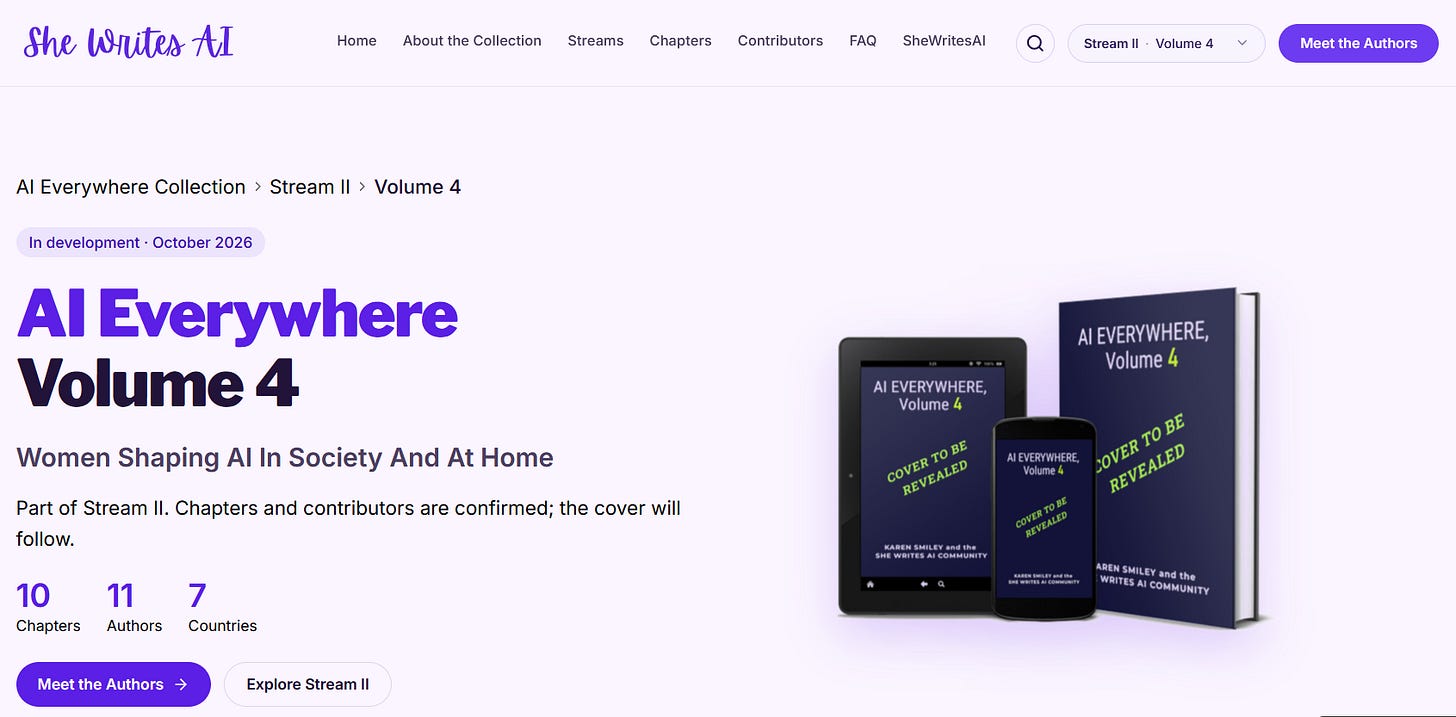
Where To Buy, How To Read and Listen, Ways To Review
-
Buy Volume 1 (now in ebook and print on Amazon, Gumroad, Lulu, Ingram Spark, and many reading platforms)
-
Tips from our publisher on how to buy an Amazon ebook from a country that isn’t a ‘KDP marketplace’, and how to read the ebook without a Kindle device (free)
-
Look for our new abridged audiobook edition!
-
Review links (we’re on Amazon, Goodreads, and Storygraph)
Ways To Support
To help cover book-related costs (ISBNs, proof copies, etc.) as well as other * community services, we follow the Wikipedia model. We are now accepting donations via paid subscriptions and can also now accept one-time tips through Stripe (‘digital ink’). All donation sizes are welcome and help keep these book authoring opportunities free for She Writes AI Community members worldwide! Patrons and Sponsors are acknowledged on our book site. Read more*.
Thanks as always for your support in every form. We appreciate it all. Hearts, shares, restacks, and comments are awesome!