Written author interview for AI Everywhere, Vol. 2, Chapter 10: Demystifying AI In Drug Discovery: From Hit To Lead Drug Candidate With AI.
By Farida Khalaf
Published: 2026-09-08
URL: https://shewritesai.substack.com/p/ai-everywhere-author-interview-42-marina-t-alamanou-farida-khalaf
Welcome to the next She Writes AI interview episode covering our second book collaboration stream for the AI Everywhere series. In this new cohort, we’re exploring the personal journeys and professional expertise of 32 authors from 18 countries worldwide who are redefining our relationships with machine intelligence. 
If you’re new to **, welcome! We’re a free, inclusive community of 760+ women and nonbinary writers in 60+ countries worldwide, with a focus on AI and data. Allies of all genders are welcome.
Learn more: About | Books | Categories | Directory | Digests | Donate | Herstory | Join | Subscribe | Updates | Welcome | World Map
For more insights from interviewer *, see her Lights On by Farida* newsletter or youtube.com/@faridakhalaf25.
About My Guest: Marina T. Alamanou
Today I (*) am joined by Marina T. Alamanou, PhD, a distinguished scientist with a PhD in Molecular and Cellular Biology and over 25 years of experience spanning academia, startups, and multinationals. Her extensive professional background includes cancer research, preclinical drug development (small molecules and peptides), cancer biomarker discovery, and the molecular diagnostics industry. She is the founder of MetaphysicalCells*, a highly-regarded newsletter exploring the intersection of science, technology, and AI-driven drug discovery. Currently based in Corfu, Greece, Marina brings a "bench-to-browser" perspective on how AI is fundamentally reshaping the pharmaceutical landscape. Covers and subtitles for Book2 (Volume 2, Volume 3, and Volume 4) will be revealed this summer. Stay tuned!
In this interview, Marina T. Alamanou, PhD explores the revolutionary role of artificial intelligence and machine learning in transforming drug development from a slow, trial-and-error process into a targeted, precision-based science. She takes us into the “vast chemical space” of over 10^60 molecules, a scale that dwarfs the number of stars in the known universe, to explain how AI enables scientists to find the “select few” candidates with life-saving potential. Marina breaks down the shift from traditional linear pipelines to closed-loop, circular processes, where AI-assisted virtual screening and retrosynthetic analysis are slashing development timelines from over a decade to just a few years.
Interview With: Marina T. Alamanou
Below is Marina T. Alamanou, PhD’s full interview response to *’s questions on her chapter: Demystifying AI In Drug Discovery: From Hit To Lead Drug Candidate With AI.*
Intended Audience: R&D professionals aiming to accelerate Drug Discovery and improve success rates in Large Pharma, Small Biotech/Startups, and Academic Labs. This includes Life Science Scientists, Biologists, Data Scientists, and Medicinal Chemists.
Foundations and Personal Identity
The Molecule-to-Star Comparison: You note that the “chemical space” contains over $10^{60}$ molecules, which is vastly larger than the approximately $10^{23}$ stars in the known universe. How does AI help scientists focus on the “known chemical space” of 100 million molecules without getting lost in the infinite possibilities?
Marina: For example, Virtual Screening and AI models can help scientists mine the known chemical space without getting lost in the noise of infinite possibilities, and predict properties like toxicity, solubility, and binding affinity. In this way, instead of testing 100 million molecules in the lab, AI can virtually simulate the interactions of the entire database, and then select the top 1000 most promising candidates to test in the lab.
A different case in this scenario is the following: if an AI model finds a molecule in the 100M database that works well but has a flaw (poor solubility), it can navigate the latent space (an internal compressed map used by AI, in this case a space with similar molecules) to find the nearest “neighbor” molecule in the database that has the desired traits but fixes the flaw.
The “In Silico” Revolution: Historically, drugs were found by chance or through physical laboratory testing. Can you explain how virtual libraries, like ZINC-22 with its 37 billion compounds, allow scientists to conduct experiments entirely on a computer before ever stepping into a lab?
Marina: Virtual libraries, like ZINC-22, allow researchers to perform computer-simulated experiments that would be physically and financially impossible in a traditional laboratory, since it would cost hundreds of billions of dollars and take decades. Instead, a virtual library like ZINC-22 compresses this into a computational funnel, allowing scientists to test the 37 billion molecules, narrow them down to 100, and only then step into the physical lab.
The computer takes the 37 billion molecules from the ZINC-22 database and attempts to “fit” them into the 3D pocket of a target protein. This is done by utilizing Molecular Docking (a physics-based simulation) and AI models trained on known chemical interactions to predict binding affinity instantly. In the end, AI and physics simulations process the entire library within days, filtering out 99.999% of the molecules that won’t bind to the target protein or are toxic, and flag the “hits” that bind tightly.
“AI transforms drug development from a slow, trial-and-error process into a targeted, precision-based science.” - Marina T. Alamanou
Slashing Development Timelines: You state that AI is cutting preclinical development from the traditional 3–4 years down to 13–18 months. What specific part of the “trial-and-error” process is being most effectively eliminated to achieve this speed?
Marina: Instead of relying on the empirical trial-and-error of synthesizing thousands of compounds to see if they bind to a target, generative AI can evaluate the vast chemical space in silico. By predicting which molecules will be effective before they are ever made, AI can prioritize only the most promising candidates for physical testing, skipping thousands of dead-end experiments of Physical Synthesis and Screening.
Traditionally, discovering that a “lead” molecule was toxic or poorly absorbed by the body was a matter of trial and error that often occurred late in the process. Hopefully, AI now integrates predictive toxicology and multi-parameter optimization, evaluating Absorption, Distribution, Metabolism, Excretion, and Toxicity (ADMET) upfront during the design phase, skipping again thousands of dead-end experiments and avoiding late-stage ADMET failures.
Finally, AI-driven models can rapidly identify and validate biological targets associated with a disease, removing the initial trial-and-error of figuring out which biological mechanism to even target, eliminating in this way target identification guesswork.
The “Closed-Loop” Process: You describe drug discovery as a “closed-loop or circular process” rather than a linear pipeline. Why is it common for “leads” to be discarded and “hits” to be revived as new information comes to light during screening?
Marina: A lead is a chemical that has already been optimized for certain properties (potency, selectivity). However, leads are frequently discarded because early optimism is often contradicted by complex biological realities. As a way of illustration, a lead may show exceptional promise in cellular assays, but can fail in animal models or human trials due to off-target effects, liver toxicity, or cardiac issues (Unforeseen Toxicity). In this case, the entire branch of the discovery tree may be discarded to avoid patient harm. Moreover, a compound must be Absorbed, Distributed, Metabolized, and Excreted effectively (ADME). A lead might bind perfectly to its target in vitro but fail in vivo because it is destroyed by stomach acid, cannot cross the blood-brain barrier, or is cleared from the body too quickly to be effective (ADME Failures). So again the entire branch of the discovery tree may be discarded.
Furthermore, what cures a disease in a genetically modified mouse may not work in a human due to species differences or the complexity of the human disease environment. If a lead fails to show efficacy in advanced models, it is discarded (Lack of Efficacy in Complex Models). Finally, a lead might be chemically unstable, impossible to synthesize in large quantities, or too expensive to manufacture (Chemistry, Manufacturing, and Controls). If the chemical pathway isn’t viable for commercial production, the lead is abandoned (Chemistry and Scalability).
A hit is a molecule identified in early screening that shows some activity against a target, but is typically unoptimized and often “messy.” Hits are frequently set aside or discarded early on, but they can be revived when the context changes.
A hit might be discarded for having low potency. However, if researchers later obtain a high-resolution 3D structure (via X-ray crystallography or Cryo-EM) showing that the hit binds to a unique, previously unknown allosteric site on the target, that “weak” hit suddenly becomes incredibly valuable as a starting point for a new class of drugs (New Structural Insights).
A hit might have been developed for a disease A and failed because it wasn’t safe enough for chronic use. Years later, researchers might discover that the same target plays a role in disease B. The old hit is “revived” for a new indication where the safety profile is acceptable or the dosing is short-term (Target Repurposing).
Moreover, a hit might have been killed because it had poor solubility (it wouldn’t dissolve in the body fluids). Advances in formulation science can bypass these physical limitations, allowing a previously “undruggable” hit to be developed into a medicine (Formulation and Delivery Breakthroughs).
Finally a hit might be discarded for hitting “too many targets” (promiscuity), which is generally viewed as a safety risk. Later, in fields like psychiatry or oncology, researchers may realize that hitting several specific targets simultaneously is actually necessary for efficacy, reviving the hit as a potential multi-targeted therapy (Polypharmacology).
Drug discovery is circular because biological systems are too complex to predict linearly. Discarding leads and reviving hits are not signs of a “broken” process, they are the essential feedback mechanisms that allow researchers to navigate a vast chemical and biological “labyrinth”, eventually converging on a molecule that is both safe and effective.
Predicting Safety with ADMET: You mention that AI tools like ADMET-AI can predict toxicity and metabolism with a 45% speed advantage. Why is it so critical to identify these safety properties early in the “hit” phase rather than later in development?
Marina: Identifying Absorption, Distribution, Metabolism, Excretion, and Toxicity (ADMET) properties during the “hit” phase, the very first stage where molecules are found to interact with a biological target, is critical for several strategic, financial, and scientific reasons.
The cost of developing a drug increases exponentially as it moves through the pipeline. If a compound is flagged as toxic or metabolically unstable by an AI model during the Hit Phase (Early), the cost of discarding it is negligible. However, discarding a compound during Lead Optimization (Mid-stage) means wasting months of medicinal chemistry effort, in vitro assays, and animal testing. And it gets even worse having a failure in a Phase II or Phase III clinical trial (Late), due to toxicity or poor pharmacokinetics (metabolism), since it can cost hundreds of millions to billions of dollars, as well as years of wasted time.
By way of illustration, if an AI predicts liver toxicity in the hit phase, the chemist can swap out a functional group or change the core ring structure. If toxicity is discovered in the “lead” or “clinical candidate” phase, the molecule’s structure is usually locked in. Attempting to fix toxicity late in the game often compromises the drug’s efficacy (the “efficacy-toxicity trade-off”), rendering the drug useless.
Removing Human Bias through Robotics: Systems like CellXpress.ai allow for 24/7 automated cell culture feeding and morphology analysis. How does removing human intervention in image analysis reduce bias and improve the accuracy of drug screening?
Marina: Systems like the CellXpress.ai Automated Cell Culture System are designed to handle complex workflows, ranging from media exchanges and cell plating to endpoint assays and complex image analysis, without manual interference. By removing human intervention from the image analysis phase of drug screening, these platforms reduce bias and improve accuracy in several critical ways by:
-
Eliminating Subjectivity and Expectation Bias. Different researchers may interpret the same ambiguous visual cues differently, leading to high inter-operator variability. Furthermore, “expectation bias” can occur if a scientist subconsciously interprets images differently based on their knowledge of which wells received the drug versus a placebo.
-
Eradication of Sampling and Temporal Bias. Automated high-content imaging systems capture and analyze comprehensive data across entire wells or plates, ensuring a much higher statistical power. And continuous, 24/7 automated monitoring captures dynamic morphological changes and precise drug-response timelines in real-time that would otherwise go unnoticed.
-
Unlocking Subtle, Multiparametric Phenotypes. AI-driven image analysis turns complex images into multiparametric data, allowing it to measure hundreds of subtle features that are invisible to human observers. This allows for the discovery of non-obvious biomarkers for drug efficacy and toxicity.
-
Enhanced Reproducibility and Standardization. By automating the entire cell culture process, platforms standardize the physical environment and the exact timing of every image capture. This drastically reduces human error and ensures that experimental results are highly reproducible across different batches and laboratories, a strict requirement for scaling high-throughput drug discovery.
"Seeking a new drug candidate in a chemical library often involves searching and wandering around in a vast chemical space... comprising more than 10^60 molecules.” - Marina T. Alamanou
Identifying “Bad Actors”: You discuss “PAINS” or nuisance compounds that create false-positive results by interfering with the testing machinery itself. How do computer vision models like Mask R-CNN or YOLO help scientists flag these “badly behaving compounds” before they waste valuable research time?
Marina: Mask R-CNN and YOLO are computer vision architectures built for pixel-level instance segmentation and real-time object detection in digital images or video streams (such as autonomous driving or cell microscopy). Both Mask R-CNN and YOLO are used in image-based screening to identify and remove background interference (e.g., staining artifacts, imaging noise, tissue fragments) from cell images, improving the accuracy of results. Mask R-CNN and YOLO can analyze microscopic images, lab-ware, and physical assays in real time. They spot chemical precipitation, cell clumping, or crystallization failures early. This lets scientists stop failed experiments fast and save time.
Background interference and PAINS (Pan-Assay Interference Compounds) both cause false or distorted results in laboratory experiments causing assay interference, but they originate from completely different sources. Background interference is an environmental or physical noise signal, whereas PAINS are specific chemical molecules that react nonspecifically with biological targets. In fact, computer vision models like Mask R-CNN and YOLO are not standard tools for flagging PAINS (Pan-Assay Interference Compounds). PAINS are usually identified via chemical graph topologies, substructure filters, or graph-based deep learning, because molecules are data structures, not visual camera images.
AlphaFold 3 and the “Pairformer”: You identify AlphaFold 3 as a state-of-the-art leap for rational drug design. Can you explain how its new “Pairformer” architecture helps predict how a drug will actually bind to protein complexes or DNA?
Marina: AlphaFold 3 represents a paradigm shift in rational drug design because it moves beyond predicting isolated protein structures to modeling the joint 3D interactions of entire biomolecular systems, including proteins, DNA, RNA, and small-molecule drugs (ligands). The core engine driving this capability is the Pairformer, a refined deep learning architecture that replaces AlphaFold 2’s “Evoformer”. By de-emphasizing large multiple sequence alignments and focusing heavily on pairwise relationships between chemical tokens (including individual atoms of small-molecule drugs and DNA nucleotides), the Pairformer efficiently maps interactions, passing them to a diffusion model to build final 3D structures. The pairformer moves beyond simple docking. It allows researchers to visualize exactly how a drug interacts with protein-DNA complexes, predict potential off-target binding, and understand the precise mechanisms of action at an atomic level, significantly accelerating the early stages of drug development.
The Challenge of Retrosynthesis: Retrosynthesis involves working backward from a target molecule to find simple starting materials. How do algorithms like Monte Carlo Tree Search (MCTS) help chemists find shorter, more valuable synthesis routes that can reduce total steps by up to 70%?
Marina: Monte Carlo Tree Search (MCTS) helps chemists find shorter synthesis routes by combining ML with random tree exploration. It maps out possible chemical reactions step-by-step from the target molecule backward. It uses a smart scoring system to pick the best reaction paths, avoiding dead ends and finding efficient routes fast.
The “Moment of Truth” in 2026: You warn against “AI-washing”, overstating AI capabilities without true operational integration. What are the most important steps a R&D leader should take to audit their data pipeline to ensure their AI initiatives don’t fail?
Marina: To ensure operational integration and honest reporting, R&D leaders should take the following steps:
-
Create a clear internal definition of what constitutes an AI/ML project versus a standard software engineering or data analytics project; and
-
Verify data provenance, eliminate target leakage, and enforce rigorous quality gates (these steps ensure data integrity, prevent false positives in high-throughput screening or generative modeling, and protect downstream clinical translation).
A Word from Marina T. Alamanou, PhD
if you are interested to learn more, follow:  MetaphysicalCellsA newsletter about Science, Technology and AI Drug Discovery. Please add “@substack.com” to your email client, so you don’t miss future issues due to aggressive spam filters.
“AI in drug discovery has moved from experimental pilot projects to core infrastructure... shifting toward an 'AI-first' design approach to accelerate early-stage drug development.“ - Marina T. Alamanou
Why This Matters
Marina T. Alamanou, PhD’s perspective emphasizes:
-
Navigating the Infinite: AI allows researchers to perform targeted “peeks” into massive virtual libraries, such as ZINC-22’s 37 billion compounds, making the exploration of nearly infinite chemical space possible in silico.
-
Accelerated Timelines: Specific AI workflows have demonstrated the ability to evaluate one million molecular compounds in approximately 11 seconds, reducing traditional 3-4 year preclinical timelines to just 13-18 months.
-
Predictive Toxicology: Advanced platforms like ADMET-AI and Beacon-1 use neural networks to provide fast, high-confidence predictions of human pharmacokinetics and safety long before a drug enters physical trials.
-
Precision Target Modeling: The release of models like AlphaFold 3 has revolutionized rational drug design by providing 50% better accuracy in predicting complex biomolecular interactions between proteins, DNA, and ligands.
-
Structural Sovereignty: Retrosynthesis tools like ChemAIRS and SYNTHIA are helping chemists bypass infeasible suggestions to find the most practical and efficient pathways to synthesize complex organic molecules.
Thank You, Marina T. Alamanou, PhD, for providing such a rigorous and essential guide to the technical and biological architecture of modern medicine. For every drug discovery professional trying to bridge the gap between “experimental pilots” and “core infrastructure,” her chapter in AI Everywhere is the definitive blueprint for the AI-first design era.
Marina reminds us that the highest-value roles in the future will sit at the AI-biology interface, where computational literacy meets deep domain expertise. Her final message is a call to scientific rigor: don’t just “AI-wash” your pipeline; audit your data and integrate AI operationally to transform fatal illnesses into manageable conditions. I personally highly recommend following her work at marinatalamanou.substack.com, where she is pioneering the study of MetaphysicalCells in a world of probabilistic science.
And if you’re interested in more conversations like this, consider subscribing to She Writes AI. I’ll continue sharing insights from the voices shaping the future of AI, including contributors from 30 new chapters in AI Everywhere where 32 women from across five continents explore how artificial intelligence is changing the world we live in, and how we can change it for the better.
References
For more insights on the books in Stream II, see aiEverywhereBooks.com — our beautiful book series website created by **: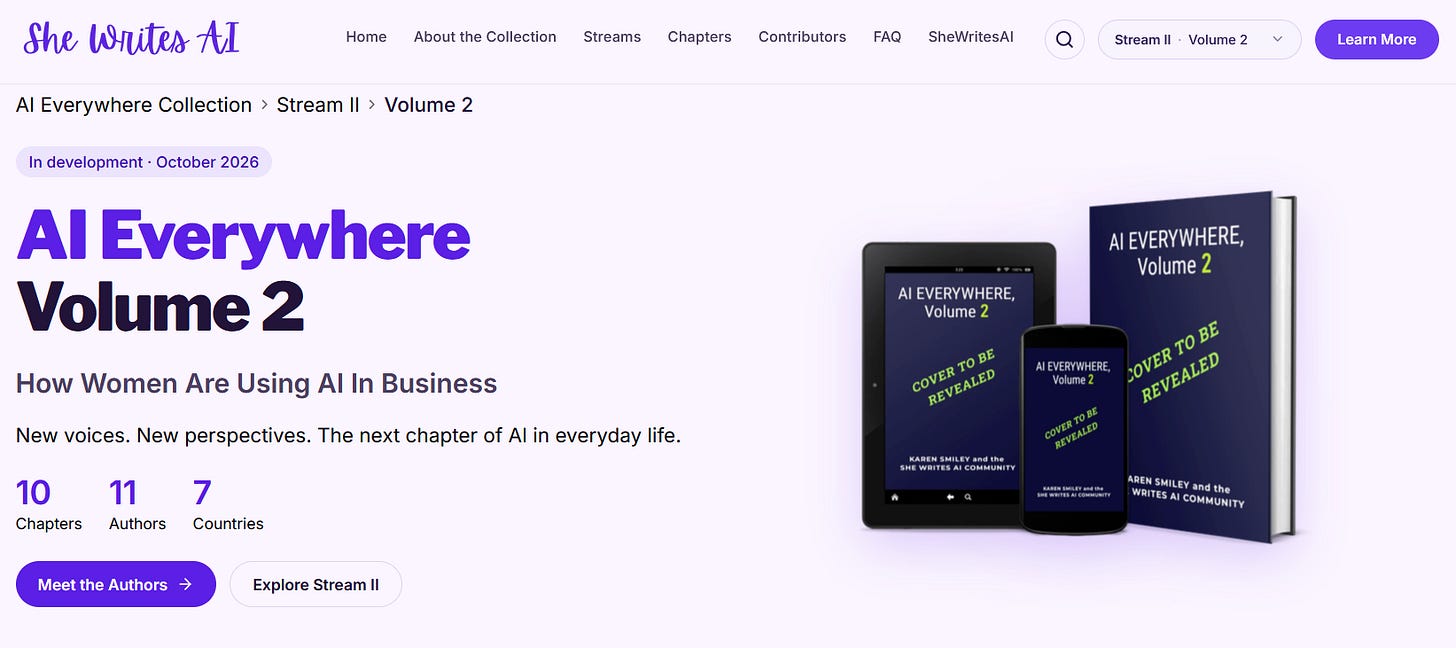
Where To Buy, How To Read and Listen, Ways To Review
-
Buy Volume 1 (now in ebook and print on Amazon, Gumroad, Lulu, Ingram Spark, and many reading platforms)
-
Tips from our publisher on how to buy an Amazon ebook from a country that isn’t a ‘KDP marketplace’, and how to read the ebook without a Kindle device (free)
-
Look for our new abridged audiobook edition!
-
Review links (we’re on Amazon, Goodreads, and Storygraph)
Ways To Support
To help cover book-related costs (ISBNs, proof copies, etc.) as well as other * community services, we follow the Wikipedia model. We are now accepting donations via paid subscriptions and can also now accept one-time tips through Stripe (‘digital ink’). All donation sizes are welcome and help keep these book authoring opportunities free for She Writes AI Community members worldwide! Patrons and Sponsors are acknowledged on our book site. Read more*.
Thanks as always for your support in every form. We appreciate it all. Hearts, shares, restacks, and comments are awesome!