She Writes AI Everywhere, Vol. 2, Ch. 11: The Practicing Institution: What Happens When A Business School Models The Human+AI Collaboration It Teaches
By Farida Khalaf
Published: 2026-08-25
Welcome to the next She Writes AI interview episode covering our second book collaboration stream for the AI Everywhere series. In this new cohort, we’re exploring the personal journeys and professional expertise of 32 authors from 18 countries worldwide who are redefining our relationships with machine intelligence. 
If you’re new to **, welcome! We’re a free, inclusive community of 760+ women and nonbinary writers in 60+ countries worldwide, with a focus on AI and data. Allies of all genders are welcome.
Learn more: About | Books | Categories | Directory | Digests | Donate | Herstory | Join | Subscribe | Updates | Welcome | World Map
For more insights from interviewer *, see her Lights On by Farida* newsletter or youtube.com/@faridakhalaf25.
About My Guests: Jennifer Percival & Tawnya Means
Today I (*) am joined by co-authors , PhD, Dean of the Schmidthorst College of Business at Bowling Green State University, and , PhD, an AI strategist and founder of Inspire Higher Ed. Together, they are challenging the standard academic response to technology with their concept of the "Practicing Institution". Their central thesis is that higher education institutions are currently facing a credibility gap: they are asking faculty to teach students how to collaborate with AI, yet the institutions themselves are not collaborating with AI in their daily operations. Drawing on Jennifer’s expertise in change management and Tawnya’s work in Human+AI collaboration frameworks, they argue that the path to true adoption is not through committees or mandates, but through leadership modeling*. Covers and subtitles for Book2 (Volume 2, Volume 3, and Volume 4) will be revealed this summer. Stay tuned!
In this interview, & explore their framework for institutional transformation through their "TuesdAI Tips" experiment, a weekly co-created initiative that reached over 2,500 students and faculty. They break down the shift from a "policy lens" (what is allowed) to a "practice lens" (what is modeled), demonstrating how a leader can use a custom AI assistant to draft high-stakes communications, study strategies, and career preparation resources. Jennifer and Tawnya highlight the hidden risks of "AI dependency" and offer a structural solution through a metacognitive reflection layer that forces users to identify exactly where the human element matters most. Their approach provides a low-friction, high-optionality roadmap for any organization looking to move from "talking about innovation" to actually practicing it.
Want to read a preview of Jennifer and Tawnya’s chapter? Volunteer as an ARC reader!
Interview With: Jennifer Percival & Tawnya Means
Below is ’s & ’s full interview response to *’s questions on their chapter: The Practicing Institution: What Happens When A Business School Models The Human+AI Collaboration It Teaches.*
Intended Audience: University administrators, deans, department chairs, and faculty leaders seeking a replicable, evidence-based approach to institutional AI adoption that starts with leadership modeling rather than top-down mandates.
Questions:
Modeling vs. Mandates: You argue that an institution cannot credibly prepare students for a Human+AI workforce if it hasn’t modeled that collaboration itself. Why is “practicing” more effective than the default response of forming committees or drafting policies?
Tawnya: Most institutions look at AI through two lenses. There’s the policy lens, which asks what do we allow, and the curriculum lens, which asks what do we teach. Both matter. Neither is enough. The lens almost everyone skips is the practice lens: what do we model?
And that’s where the credibility problem lives. You can’t ask students or faculty to build judgment about AI while your own leadership treats it as a compliance issue to be managed from a distance. Students and faculty pick up on that immediately. The medium doesn’t match the message.
So instead of writing another strategic plan, Jen started sending an email. Every Tuesday, she shared a real prompt, a real tool, a real limitation. The very first edition admitted it was a prototype and asked both students and faculty to write back about what worked and what didn’t. A governance document can’t do that. A dean who’s visibly practicing can.
I’ll say this too, and it’s something I’ve written about in the Human+AI Collaboration Chronicle: the real barrier to AI integration isn’t technical. It’s human. And policies written by people who haven’t actually used these tools tend to regulate a technology they’ve only read about. Practice first. Then write the policy.
Jennifer: Leading through action also enabled me to legitimately discuss when responses didn’t go as intended, the process of collaboration with AI to augment what I was thinking and how I presented the ideas. It also was a low stakes way to open conversation and demonstrate that it was acceptable to use GenAI tools as part of my work while also showing the importance of taking agency and responsibility for the outcome.
The TuesdAI Tips Prototype: Your weekly email series was designed as a “prototype” rather than a strategic plan. Why is consistency (every Tuesday, no exceptions) more important than providing a comprehensive AI curriculum all at once?
Jennifer: Because consistency builds a habit, and a curriculum doesn’t. Students started expecting TuesdAI Tips the way they expected their Tuesday morning class. It became part of the rhythm of the semester instead of one more thing landing on top of it.
Starting small was deliberate. We began with the smallest viable intervention we could think of: a weekly email. Not a new course, not a new requirement, not a new platform. Nobody had to change a syllabus or a grading policy for this thing to exist.
The weekly cadence also meant we could follow the actual semester. The Career Expo edition went out the week before the Career Expo. The midterm edition landed during midterms. The spring break edition told students to go rest. These were meaningful and timely creating opportunities for immediate use and impact. You can only do that kind of timing if you’re shipping every week and paying attention to what students are actually living through.
Was every edition equally strong? Probably not. That’s the tradeoff of prototyping, and we accepted it. The alternative is waiting until you have the complete plan, which in practice means never starting.
“An institution cannot credibly prepare students for a Human+AI workforce if it has not modeled what Human+AI collaboration looks like in practice.”
The Dual-Stream Design: Why was it an essential “architectural choice” to run faculty and student editions in parallel, and how does this close the “credibility gap” between administration and staff?
Jennifer: If we’d only sent a student edition, the message would have been that AI fluency is a student problem and faculty are exempt. That’s exactly backwards. You can’t ask faculty to support students in AI exploration if faculty haven’t done the exploring themselves.
So the editions ran in parallel, and faculty were also copied on the student edition. They could always see exactly what their students were being told. When students got Career Expo prep, faculty got a version asking how AI was reshaping the industries they teach about. When students got a hallucination-detection challenge for National AI Literacy Day, faculty got classroom activities on the same theme. This also enabled faculty to easily align with themes and make the entire experience an ecosystem approach. Faculty were not surprised if a student asked a question about a potential use of AI related to the week, and students could see connections to what they were learning in class with the college messaging. Same week, same goal, different work. All aligned.
We also had to respect faculty workload, which is real. The AI Literacy Day faculty edition offered three levels based on how much class time someone was willing to spend. Level one was a ten-minute AI Pulse Check, no prep required, just three questions to ask students. Level two was a thirty-minute Human vs. Machine Audit where students compared AI output to their own knowledge. Level three was a full class period building prompts together. Someone who’d never touched AI in a classroom could do level one. Someone already experimenting could go deep. Nobody was excluded, nobody was pressured, everybody was invited.
Tawnya: Here’s why this matters so much: the single biggest predictor of whether an institutional AI initiative succeeds or stalls is faculty buy-in. And buy-in doesn’t come from mandates. It comes from watching leadership do the thing first, and from being invited to explore alongside your students rather than being told to teach something the administration hasn’t tried.
The Reflection Layer: Every prompt in your series is followed by a “What to notice” section. Why is this metacognitive reflection the key to separating AI fluency from “lazy” AI dependency?
Tawnya: Without the reflection layer, a prompt library is just a shortcut collection.
The “What to notice” questions were there to build metacognition, the ability to think about your own thinking. And they were always aimed at the seam between the tool and the person. What did the AI catch that you missed? What did you have to add to make it authentically yours? Where did it sound confident and turn out to be wrong?
Take the cover letter edition after the Career Expo. The reflection questions asked: does this letter sound like it could only be for this company, or could it work anywhere? What detail from your actual conversation with the recruiter did you add that AI couldn’t have known? Notice that’s not a question about whether the output is good. It’s a question about what the student contributed.
That’s the honest answer to the dependency worry, and it’s a worry I take seriously. There’s a genuine panic right now about AI eroding learning, and I’ve written in the Chronicle about what the research actually says, because the picture is more nuanced than the headlines.  The Collaboration Chronicle: Human+AI in EducationThe Great AI Learning Panic: What Socrates Would Say About ChatGPTBefore we revolutionize education based on one brain imaging study, let's remember that humans have been panicking about new learning technologies for millennia…Read morea year ago · 10 likes · Tawnya Means
What the evidence keeps pointing to is that the outcome depends on the stance the learner takes toward the tool, not just the fact of using it. Dependency and fluency can produce the exact same artifact. The difference is whether the person can tell you what they added and why. The reflection layer forced that question every single week, and our bet was that if you ask it often enough, it becomes a habit. The real learning was never in the prompt. It was in what came after.
Jennifer: The goal wasn’t to provide a library of prompts to short-cut creative problem solving or critical thinking. The reflection component, for both faculty and students, ensured the focus remained on learning how best to work with GenAI to augment capabilities and create better outcomes but that handing over the thinking to AI would result in low quality results. This reflection also asked students to think of how what they tried with the prompt/activity could potentially translate to other areas of their work and how they could improve outcomes through the insights they gained for future projects.
Co-Creation in Public: Jennifer, you co-created every edition using a custom AI assistant designed by Tawnya. How did this process serve as your own professional development in a way that workshops rarely do?
Jennifer: Workshops are episodic. You attend, you take notes, you go back to your inbox, and two weeks later it’s gone. You likely never find the time to follow through on the idea or intention you had in the workshop.
This was different because it was real work with my name on it, every week, on a deadline. I made the commitment to the process and as a result, made the time to continue to collaborate with AI on future emails. The custom assistant Tawnya built knew the NACE competencies, our semester calendar, and the pedagogical arc from early-semester exploration to late-semester application. What it couldn’t know was what was happening on campus that particular week. What students were dealing with, what Career Services was hearing from employers, what faculty were struggling with in class. That part was mine. The assistant would structure content and draft options, and then we’d edit, challenge, and refine together.
I didn’t take a course on AI before starting this. I learned by doing it. By iterating on prompts, by seeing what produced something useful and what produced generic filler. Over a semester, that gave me the kind of working fluency that workshops promise and rarely deliver, because I was using AI for something real, with real stakes, in public, under my own signature.
Honestly, I think that’s the model for faculty development. Not just another workshop series. Give people something real to make and a reason to commit to continued learning and engagement.
Tawnya: I’d add one thing to that. There’s a really good reason that workshops alone don’t work, and I’ve written about it in the Chronicle as the curse of knowledge: the people designing AI professional development already know too much to remember what it’s like not to know. What Jen just described sidesteps that entirely. Nobody taught her AI in the abstract. She learned it inside her own real work, where her own expertise was the context. That’s the part that transfers.
NACE Competencies: You map every AI prompt to specific career readiness competencies like Critical Thinking and Teamwork. How do these design constraints ensure that AI experimentation remains grounded in what employers actually need?
Tawnya: The competency mapping was a design constraint, and constraints are what keep experimentation from turning into drift.
We worked from six: Communication, Critical Thinking, Professionalism, Career and Self-Development, Leadership, and Teamwork. The practical effect was that no prompt got into an edition just for being clever. It had to connect to something employers have told us they need. The pitch coach mapped to Communication and Professionalism. The team charter prompt mapped to Teamwork, Leadership, and Professionalism. The STAR interview builder hit Communication, Critical Thinking, and Leadership.
The labels did a second job too. They told students why the exercise mattered beyond this week’s assignment. There’s a big difference between “here’s a trick” and “here’s a skill you’re building that an employer will pay for.”
For anyone adapting this elsewhere, I’d say the specific framework matters less than having one. NACE is the natural reference point for a U.S. business school. What’s essential is that the experimentation is anchored to some articulated statement of what your graduates should be able to do. Otherwise it’s just playing with tools.
Jennifer: Linking it back to NACE competencies not only helped with the motivation of students, it also helped them with storytelling as they could see how the work they tried and outcomes they created could be showcased as skills on their resume or during an interview. This encouraged future engagement when the feedback from providing these meaningful examples was positive from employers. Students shared experiences and then others explored engaging with the recommendations in the emails. Starting small, showing the importance, and having faculty and employers reinforce impact all contributed to success.
"Consistency matters more than volume because it builds a habit. Students started expecting TuesdAI Tips the way they expected their Tuesday morning class.”
Meeting Users Where They Are: Every edition offers three levels of engagement, efficiency booster, learning partner, and career strategist. How does this tiered approach prevent advanced users from disengaging and beginners from feeling excluded?
Jennifer: Because on any given Tuesday, our students were not in one place. Some had never used these tools deliberately or were afraid to use them. Some were using them every day and wanted something harder. One prompt aimed at the middle would have lost both ends.
There are two failure modes that kill most institutional AI programming. You pitch it so basic that your advanced users disengage, or so sophisticated that your beginners feel excluded. Three options at different levels let everyone self-select without any of it feeling remedial. The framing was always the same: choose the one that matches where you are right now, or try all three.
We used the same logic with the faculty. The tiered AI Literacy Day activities meant a ten-minute version existed for anyone.
And there’s a change management point buried in there. When people choose their own entry point, engagement is a decision they made, not a compliance behavior. Nobody was assigned a level. Nobody was told they were behind. That sounds small, but it changes how the whole thing feels.
The Human “Anchor”: Regardless of the AI tool discussed, you always end with a reminder that the human stays in the lead. Why is it a “thesis” rather than a “disclaimer” to name the specific human capacities that AI cannot replicate in a given task?
Tawnya: A disclaimer is generic and lives at the bottom in small print. The anchor was specific and it was the point.
The difference is specificity. The networking edition didn’t say “remember to be human.” It named exactly what AI can’t supply in that task: genuine curiosity about someone’s career, the ability to read body language and adjust in real time, authentic enthusiasm, and the follow-through afterward. The Career Expo edition put it plainly: recruiters meet hundreds of students, and they remember the ones who are prepared, curious, and real. The rubric edition named a different set, your judgment about which feedback to take, your own voice in the analysis, your ownership of the final product.
When you name the specific capacity, a platitude becomes a work instruction. A student who reads “AI can help you rehearse the structure of the conversation, but it can’t read the room” knows exactly which job is still theirs.
And that was the thesis of the whole series, not a caveat attached to it. Human+AI collaboration means the human stays in the lead. Every edition restated that in the vocabulary of that week’s task, which is why we came to think of it as the anchor.
Change Management & Trust: During spring break, you gave students “permission to rest” and skip the AI prompt entirely. How does giving permission not to participate paradoxically increase long-term institutional engagement?
Jennifer: The spring break edition told students, in so many words: if you’re feeling burned out, skip this email and go rest. Seriously. It said they didn’t have to be productive that week and that rest was the most valuable thing they could do.
Sending that from the dean’s office, in a series about AI, was very much on purpose. It proved the series existed for students, not for our participation numbers.
My research background is in technology integration, process modeling, and change management, and that shaped this more than anything visible on the page. What that literature keeps showing is that sustainable change comes from making the desired behavior easy, visible, and voluntary before you make it expected. TuesdAI Tips made experimentation easy, here’s a prompt you can try right now. Visible, the dean does it every Tuesday. And voluntary, pick your option or skip the week.
Higher ed is littered with initiatives that had the right vision and the wrong process. Task forces that produced reports nobody read. Workshops that generated enthusiasm and no follow-through. Pilots that stayed pilots forever because nobody designed the path from experiment to infrastructure. The pathway matters as much as the destination.
And giving people permission not to participate is itself a strategy. It builds trust, it signals you’re being genuine, and, a little paradoxically, it increases engagement, because people are opting in instead of complying.
The Traveling Architecture: For administrators at institutions with different resources or cultures, which parts of your model are “local instruments” and which are the “traveling principles” that must be preserved for the system to work?
Tawnya: The local instruments are everything tied to our specific context. NACE as the competency framework. The Life Design language we used at launch because our students already knew it. The Career Expo and spring break dates that set our calendar. The particular programs and offices we referenced.
All of that should be swapped out. Implementation will look different at a community college than at a research university, different in a nursing program than in a business school, different where there’s a strong teaching center than where faculty development is decentralized.
What travels are the principles. Start with a small, consistent, visible action. Use AI to create the materials about AI, transparently, so the medium matches the message. Run parallel streams for your different audiences. Embed reflection into every interaction. Ground everything in the competencies your stakeholders actually care about. Design for optionality, not compliance. And let leadership go first.
That last one is the load-bearing wall. The barrier to institutional AI adoption isn’t technology, funding, or even faculty resistance. It’s the absence of a visible, consistent, practiced example from leadership. Faculty follow what leaders do, not what leaders say.
Strip out the local instruments and the model still works. Strip out the principles and what you’ve got left is a newsletter.
A Word from &
The most common objection we hear is that an institution should wait until it has clarity before starting. Our experience says it’s the other way around. Clarity comes from practice. It isn’t a prerequisite for it.
When an institution actually practices what it teaches, three things happen. Credibility compounds, because students and faculty can tell the difference between an institution that talks about innovation and one that does it. Institutional knowledge grows, because a semester of doing the work generates real evidence about which prompts land and where in the semester students need what.
And the culture shifts. The conversation moves from “Should we use AI?” to “How do we use AI well?” The key is a common vision about how we want to use AI and how we value the human element. This was clear in every communication that we were committed to helping everyone explore how to collaborate with AI to leverage human creativity and intelligence by leveraging AI to augment our creativity and capacity.
We’ll also be honest about what we haven’t solved. We don’t yet have comprehensive engagement data. We don’t know how many students tried the prompts or how it affected their career readiness outcomes. That’s the next phase. What we can point to is the organic signal: students replying with questions, faculty asking about classroom integration, employers asking about the initiative.
So our advice is simple. Pick one thing, put a real name on it, do it every week, and let the practice teach you what your policy should eventually say.
Featured piece for readers: For the story behind this chapter in shorter form, start with “TuesdAI Tips: How One Dean Used Human+AI Collaboration to Meet Students Where They Are”. You can follow the ongoing work in The Collaboration Chronicle: Human+AI in Education, where these questions get worked out week by week in public.
“The institution that teaches AI collaboration must also be the institution that practices it. That is the standard TuesdAI Tips was designed to meet.”
Why This Matters
& ’s perspective emphasizes:
-
Modeling Over Mandates: Change management research proves that sustainable change comes from making the desired behavior easy, visible, and voluntary; when a Dean publicly uses AI to create institutional resources, it normalizes the behavior across the culture.
-
The Metacognitive Layer: By asking “What did you have to add that AI couldn’t?”, the authors move users from AI dependency to AI fluency, ensuring the human remains the lead strategist and critical evaluator.
-
Tiered Optionality: The “TuesdAI Tips” design offers three levels of engagement, from efficiency boosters to career strategists, preventing advanced users from disengaging and beginners from feeling excluded.
-
Parallel Innovation: Running student and faculty streams in parallel solves the credibility gap, ensuring faculty are equipped with the same tools and language as their students, shifting the dynamic from “directive” to “collaborative”.
-
Context-Specific Anchoring: Every interaction is grounded in the human element; the authors identify specific human capacities, like genuine curiosity and reading body language, that AI cannot replicate, ensuring these remain the focus of professional development
Thank You, & , for this incredibly rigorous and visionary blueprint for the future of education. For every leader trying to navigate the “AI policy gap,” their chapter in AI Everywhere is the definitive guide to becoming a Practicing Institution.
Jennifer and Tawnya remind us that the goal is not to build a new curriculum, but to build a habit of experimentation that starts at the top. Their final message is a call to institutional courage: don’t just offer a workshop; pick a weekly workflow and do it with AI, transparently, for all to see. I personally highly recommend following Tawnya’s Substack, “The Collaboration Chronicle,” and Jennifer’s leadership at the Schmidthorst College of Business, where they are rewriting the rules for how an institution earns its credibility in the AI era. The Collaboration Chronicle: Human+AI in EducationDocumenting the transformation of education through thoughtful human+AI collaborationBy Tawnya Means
And if you’re interested in more conversations like this, consider subscribing to She Writes AI. I’ll continue sharing insights from the voices shaping the future of AI, including contributors from 30 new chapters in AI Everywhere where 32 women from across five continents explore how artificial intelligence is changing the world we live in, and how we can change it for the better.
References
For more insights on the book, see aiEverywhereBooks.com - our beautiful book series website created by ** (now updated with previews for book2):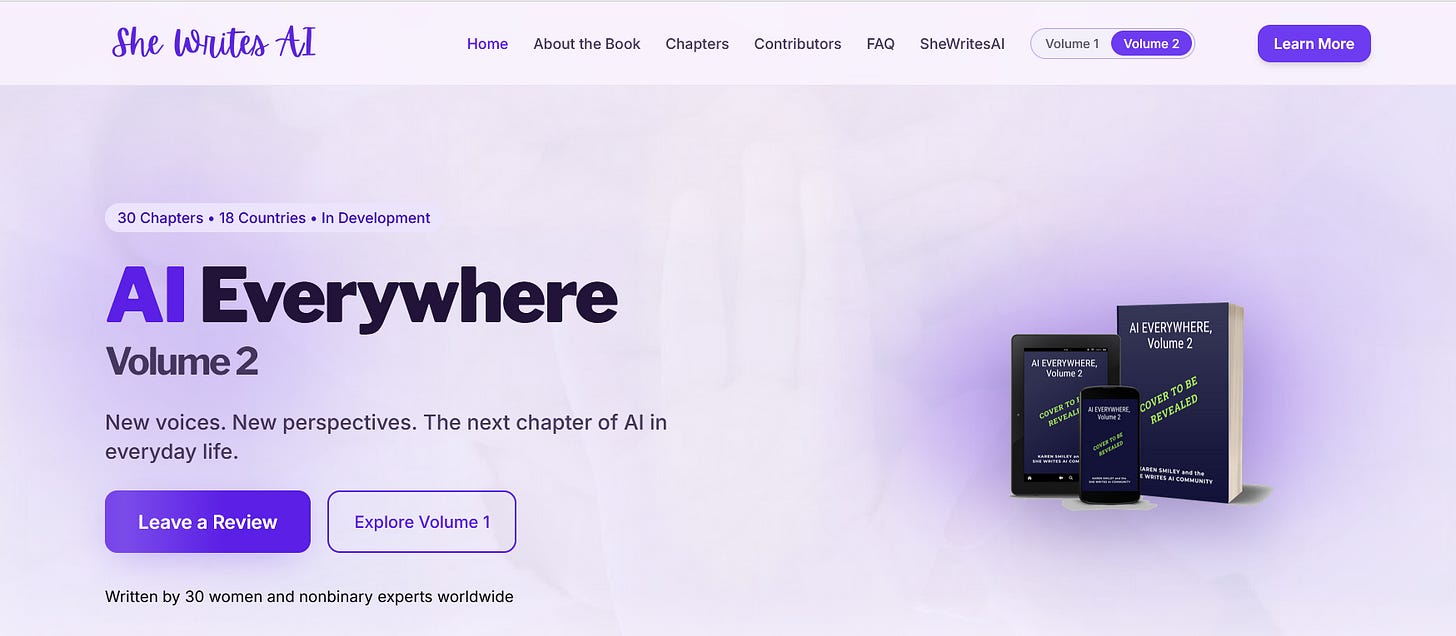
Where To Buy, How To Read and Listen, Ways To Review
-
Buy Volume 1 (now in ebook and print on Amazon, Gumroad, Lulu, Ingram Spark, and many reading platforms)
-
Tips from our publisher on how to buy an Amazon ebook from a country that isn’t a ‘KDP marketplace’, and how to read the ebook without a Kindle device (free)
-
Look for our new abridged audiobook edition!
-
Review links (we’re on Amazon, Goodreads, and Storygraph)
Ways To Support
To help cover book-related costs (ISBNs, proof copies, etc.) as well as other * community services, we follow the Wikipedia model. We are now accepting donations via paid subscriptions and can also now accept one-time tips through Stripe (‘digital ink’). All donation sizes are welcome and help keep these book authoring opportunities free for She Writes AI Community members worldwide! Patrons and Sponsors are acknowledged on our book site. Read more*.
Thanks as always for your support in every form. We appreciate it all. Hearts, shares, restacks, and comments are awesome!