AI Everywhere, Vol. 2: How Somagraphic Learning™ Puts Human Cognition Back In The Driver's Seat. A human-first framework for reclaiming independent reasoning in an age of automated answers.
By SheWritesAI
Published: 2026-06-23
URL: https://shewritesai.substack.com/p/ai-everywhere-author-interview-26-devika-toprani-farida-khalaf
Welcome to the next She Writes AI interview episode covering our second book collaboration for the AI Everywhere series.
In this new cohort, we’re exploring the personal journeys and professional expertise of 31 authors from 18 countries worldwide who are redefining our relationships with machine intelligence.
This is the 3rd episode in our interview series with book2 chapter authors.
If you’re new to , welcome! We’re a free, inclusive community of 750+ women and nonbinary writers in 60+ countries worldwide, with a focus on AI and data. Allies of all genders are welcome.
Learn more: About | Books | Categories | Directory | Digests | Donate | Herstory | Join | Subscribe | Updates | Welcome | World Map
For more insights from interviewer , see her Lights On by Farida newsletter or youtube.com/@faridakhalaf25.
About My Guest: Devika Toprani
Today I () am joined by Devika Toprani. Representing the Learning perspective, her chapter addresses a critical "Timing Problem" in the age of AI: the risk that machine-generated answers arrive so quickly they replace the internal struggle required for true understanding. Devika, a systems architect and researcher with experience across the US, India, and the UAE, brings a deeply cognitive and structural lens to the realization that the friction of uncertainty is not a flaw in the learning process, it is the process.
Devika brings a transformative and embodied lens to this conversation. Through her work, she explores why we must move beyond standard AI literacy toward Somatic AI Literacy™, the capacity to establish our own conceptual orientation before the machine ever enters the room. She introduces the Somagraphic Learning™ framework, a specific three-stage sequence: Attempt → Map → Refine, that uses hand-drawn visual mapping to externalize thinking before any AI tool is opened.
In this interview, Devika reveals how we can use AI to refine human thought rather than substitute for it, ensuring that human cognition remains firmly in the driver's seat.
 \Covers for these new volumes will be revealed this summer. Stay tuned!\
In this 3rd interview for our second book collaboration, Devika Tropani explores her Map Before Machine™ Card: a complete simple offline card, no app, no login, no language barrier.
It runs in three steps: Attempt → Map → Refine
- Attempt: Write or sketch what you already think. Messy is fine.
- Map: Connect two ideas using “because” to explain why.
- Refine: Identify one specific gap—that becomes your AI question.
The rule is simple: AI comes after thinking, not before.
It doesn’t restrict AI — it sequences it, turning vague prompts into focused, high-quality queries while preserving human judgment.
Interview With: Devika Toprani
Below is Devika Tropani’sfull interview response to ’s questions on her chapter, “Pre-AI Sensemaking Before Scale”, and the Somagraphic Learning™.
Intended Audience: For educators, learning designers, workforce development professionals, and AI product teams seeking a disciplined framework to protect independent reasoning and combat "automation bias" in both classrooms and the professional world.
Like her book chapter, this interview is based on Devika’s original work (available in OSF preprint at <https://osf.io/bjwkg>), as well as reference work by others. The book chapter contains full references.
Somagraphic Learning™ and its branded components (Map Before Machine™, Shape-Emotion Grammar™, and Somatic AI Literacy™) are trademarks of Devika Toprani (USPTO filing active, March 2026). Licensed under Creative Commons Attribution - NonCommercial - NoDerivatives 4.0 (CC BY-NC-ND 4.0).
Part 1: Foundations and the Problem
The Illusion of Understanding: You mention that in the age of AI, learners often suffer from an “illusion of explanatory depth”, feeling like they understand a concept because an AI explained it clearly, even if they can’t apply it later. Why is the fluency of AI output actually a danger to real learning?
Devika: Think about the last time someone explained something so clearly that you felt like you got it. Then a week later, someone asked you to explain it yourself … and you could not.
That gap has a name. Rozenblit and Keil (2002) called it the “illusion of explanatory depth”. We consistently think we understand things better than we do, until we are forced to explain themourselves. Then the gap surfaces.
AI makes this worse than any learning tool before it. The explanation it gives you is perfectly worded, perfectly organized, perfectly calibrated to your question. Your brain reads that fluency as comprehension. It feels like understanding. But you produced none of it. You never had to commit to why something works. You never hit the moment of confusion that tells you where you are actually lost.
Melumad and Yun (2025) tested this across seven experiments. Learners who received AI-generated explanations retained less than those who had to figure things out actively. The problem is not that AI explains badly. It is that AI explainsso well, it skips the struggle your brain needs to actually learn.
The Map stage in Attempt → Map → Refine exists precisely for this. Before AI opens, you complete one sentence:
“[Concept A] affects [Concept B] because [the reason]”.
If you cannot finish it, you have just found your real gap. That moment ofdiscovery is worth more than any explanation AI could have handed you.
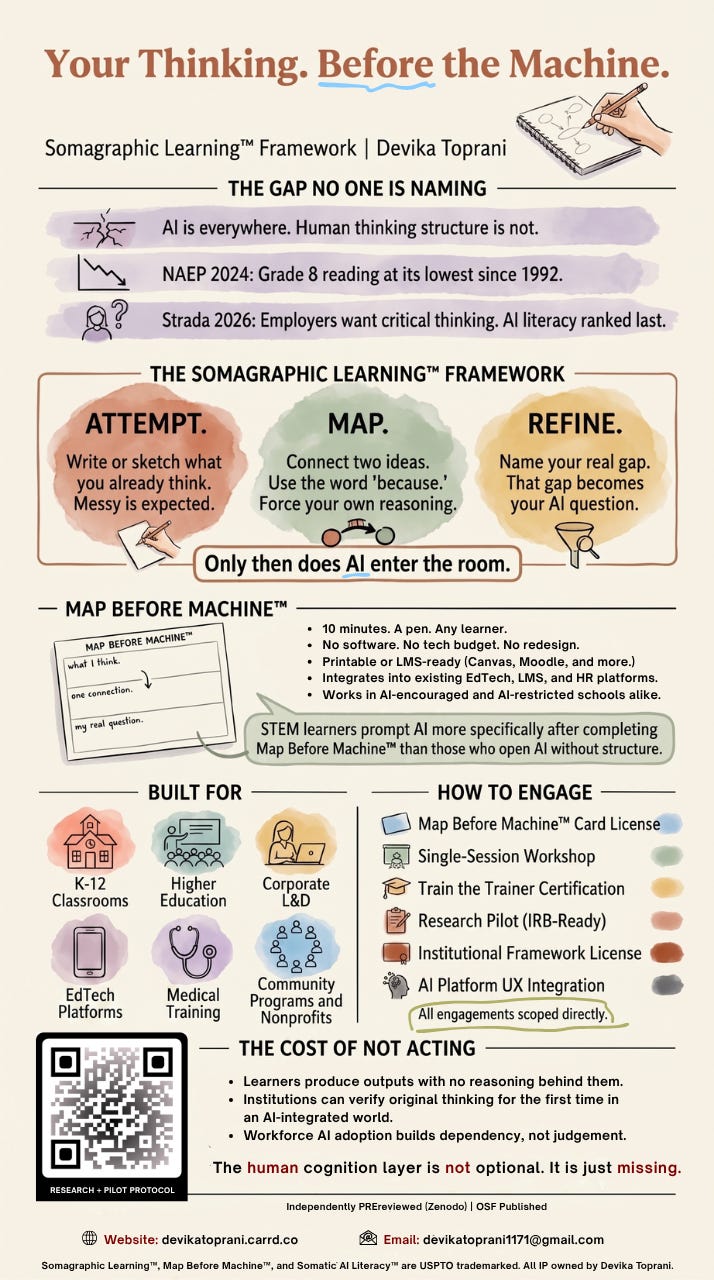 \Infographic for Somagraphic Learning framework. © Devika Toprani, 2026.\
The “Pre-interaction Window”: You identify the moment before a prompt is submitted as the most “educationally consequential moment”. Why is it so critical that a learner identifies their own “conceptual gap” before the machine fills it in?
Devika: There is a moment before you type your first prompt into AI. Nothing in the world is currently designed to protect it.
No AI platform asks you to think before it responds.No national education or workforce policy addresses what should happen before you hit send.
When nothing is formed before AI speaks, the output fills the entire space. You have nothing to compare it against. Nothing to push back with. Researchers call what happens next “authority inflation”. You trust the output not because you evaluated it, but because it sounds confident and complete (Tate, 2026).
Flavell (1979) showed that learners who identify the edge of their own understanding before consulting any external resource use that resource far more effectively.
That is the only thing the Flag Your Gap step on the Map Before Machine™ card is doing: name one specific thing you genuinely do not understand. Thatgap becomes your AI question. You arrive with a position,not a blank page. That is what turns AI from a replacement for thinking into a partner in it.
“The clearest sign that a learner does not yet own a concept is not that they struggle to explain it. It is that they cannot figure out where their understanding stops.“- Devika Toprani
Part 2: Health and the “Right Questions”
The Sequence (Attempt → Map → Refine): Your framework follows a strict three-stage sequence. Why is the order so important? What happens to the human brain when we skip the “Attempt” and “Map” stages and go straight to “Refine” with AI?
Devika: The order is not a stylistic preference. It is the mechanism.
Think of it likecooking. If you burn something first, notice what went wrong, and then watch a tutorial, you watch that tutorial completely differently. You know exactly where to pay attention. If you watch the tutorial first, it feels smoother. But you never did the hard work of finding your own gaps.
Going straight to AI skips that entirely. You are not doing a faster version of learning. You are organizing yourself around a structure someone else built before you had any structure of your own. Bjork and Bjork (2020) established that attempting retrieval before instruction is a prerequisite for durable learning. Kapur (2016) showed learners who struggle with a problem before receiving instruction outperform those who receive instruction first, specifically when tested later on applying the concept somewhere new.
In prototype observations with STEM graduate students, the Map stage was the point of highest cognitive friction and the strongest pull toward AI. That urge to hand the thinking to the machine precisely when it gets hard is the moment the framework asks you to hold.
- It reduces automation bias. You arrive with a position. You are far less likely to passively accept whatever AI returns.
- It restores cognitive ownership. You arrive as the author of an idea, not a recipient of one.
- It produces more specific AI queries. STEM learners prompted AI more specifically after completing Map Before Machine™ than those who opened AI without prior structure.
- It builds against dependency. This sequence builds the judgment layer in before the habit of bypassing it forms.
- It makes AI use more sustainable. Every query carries an energy cost. Targeted gap-based queries replace broad open-ended ones. The preprint documents this as a structural consequence of the sequencing logic.
- It works in AI-encouraged and AI-restricted environments alike. It only structures when AI enters. That makes it institutionally neutral across policy contexts.
- It requires no redesign of existing systems. It integrates into platforms that already exist. No new infrastructure. No new budget line.
- It scales across every sector. K-12, higher education, corporate L&D, medical training, nonprofits. The same card. The same sequence. The same cognitive protection.
- It closes the gap no one is naming. AI is everywhere. Human thinking structure is not. The sequence is the structure.
Somatic AI Literacy™: You’ve named a brand-new competency called “Somatic AI Literacy™“. How does this differ from traditional AI literacy, and why do you believe the physical act of using our hands to sketch is essential to thinking?
Devika: Every AI literacy framework today asks: can you use AI tools well? Can you evaluate outputs, understand how they work, use them ethically?
Somatic AI Literacy™ asks something none of them ask. Did your own thinking exist before the AI output arrived?
UNESCO, ISTE, the U.S. Department of Labor: none of their frameworks address the pre-interaction window. The cognitive condition of the learner before AI speaks is not a competency anywhere. That is the gap Somatic AI Literacy™ names. It has three observable indicators.
- Did you produce your own structure before AI output arrived?
- Was your question targeted at a specific gap rather than a request for a full explanation?
- Did you modify what AI gave you, or accept it passively?
Those three questions tell you whether AI is working for your thinking or instead of it.
Now, why the hands: When you pick up a pen and sketch, you are not warming up. You are recruiting spatial and motor processes that typing does not activate (Clark, 2008; Kirsh, 2010). Deciding where to place something on a page, how to connect two ideas, how much space to give something uncertain. That is thinking. Not preparing for it.
The word somatic means the body as an active participant in cognition, not just its container (Varela, 1991). The sketch does not need to be good. It needs to be yours. And it needs to exist before the machine speaks.
Part 3: Global and Workforce Impact
Shape-Emotion Grammar™: You use simple shapes, circles, squares, triangles, as perceptual cues in your framework. Can you explain how these “pre-verbal” symbols help us organize complex thoughts before we even have the words for them?
Devika: As a child, before you had words for anything, you understood the world through shapes and space. A sharp pointed form feels dangerous. A wide open circle feels safe. You knew this before anyone taught you a single vocabulary word. That “perceptual intelligence” is documented across cultures and does not requirelanguage to operate (Bar & Neta, 2006).
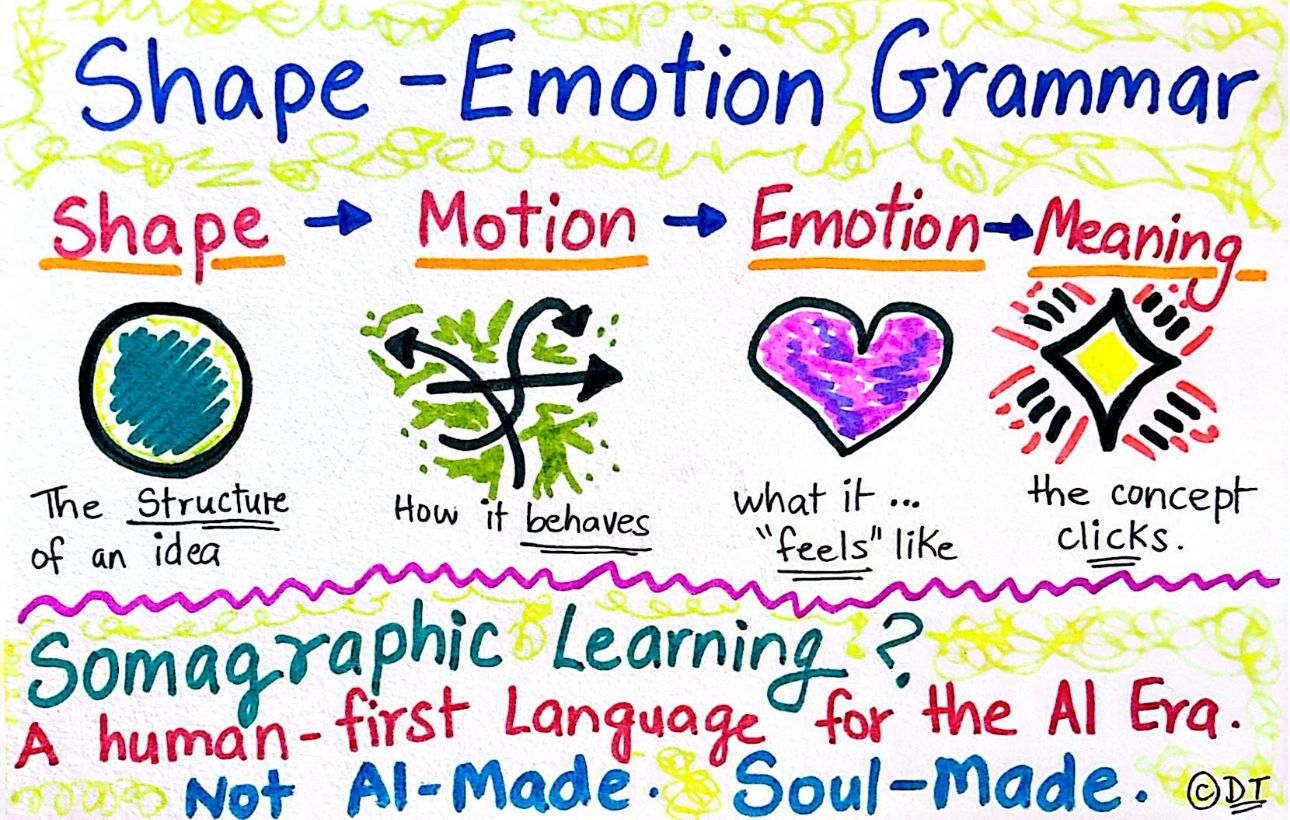 \Shape-Emotion Grammar™illustration by Devika Toprani\
Shape-Emotion Grammar™ follows four stages: Shape → Motion → Emotion → Meaning.
- Shapes anchor ideas.
- A circle signals something open and exploratory.
- A square signals structure and boundaries.
- A triangle signals direction.
- A spiral signals a cycle.
- Dense clustering signals complexity.
- Open space signals clarity.
- Motion connects them all. Arrows and directional lines show how one thing affects another before you have language to explain it.
- Emotion is the third stage.Not feelings in the personal sense; it means “attentional salience” — the perceptual signal that something feels uncertain or unresolved. When you draw something dense and tangled versus something open and spacious, you are not expressing a mood. You are locating where your confusion lives before you have words for it.
- Meaning is last. Only once shape, motion, and emotion are on the page does language arrive to name what you already mapped.
This is why the framework travels across languages. Basic geometric forms do not require English to produce or read.
No drawing skill needed. No artistic training. These are perceptual cues, not symbolic rules. Meaning emerges through the learner’s own sense-making.
Bridging the Language Gap: You’ve worked in environments from Oman to the UAE and the US. How does an analog, visual-first approach like Somagraphic Learning help level the playing field for non-native English speakers who are often disadvantaged by English-centric AI models?
Devika: Here is what AI-first learning actually does to a non-native English speaker.
You encounter a concept for the first time. Before you think about it in your own language, you open AI. It gives you a complete explanation in English. The first structure your brain builds around that concept is not yours. It is the AI’s. In a language that is not your primary one.
That’s exactly why the Attempt and Map stages are pre-verbal by design. A learner completes both in Arabic, Hindi, Tagalog, or using only shapes and arrows. No English required. Research on bilingual cognition confirms this is not just accessible but cognitively meaningful. Bilingual learners process concepts through perceptual and spatial simulation, not linguistic translation (Zhao, 2025). The visual entry point activates exactly that.
The “Low-Resource” Solution: Many AI discussions assume high-speed internet, but you highlight a “Low Resource Classroom Problem”. How does your “Map Before Machine™” card ensure that critical thinking continues even when the connectivity fails?
Devika: MostAI in education conversations assume every student has a device, a stable connection, and a personal subscription. Most students on the planet have none of those thingsreliably:
- A classroom in rural India.
- A community learning center in sub-Saharan Africa.
- A nonprofit running digital literacy programs with shared devices.
- A student who gets fifteen minutes of internet access a day on a borrowed phone.
These are not edge cases. They are the majority of learners globally. For those learners, AI-first education is not innovation. It is exclusion.
The Map Before Machine™ card is designed to be printable and analog. No device. No connection. No individual subscription to an AI platform. The Attempt and Map stages happen entirely on paper. AI enters at Refine, which can wait. It can happen later, asynchronously, in whatever brief window of shared access exists.
The learner who finishes the card in a classroom with no electricity has done the same cognitive work as a learner at a fully equipped university. The human thinking layer is already complete before any device is needed.
And here is what makes this more than just an access argument. Research shows the Attempt stage builds real understanding regardless of whether AI ever enters. Trying to produce prior knowledge before instruction strengthens learning even when the attempt is incomplete or wrong (Roediger & Karpicke, 2006).
The card works without AI. That is not a limitation. That is the point.
Cognitive Sovereignty in the Workforce: You cite research suggesting that over-reliance on AI can lead to “cognitive debt” or even neural atrophy. How does your framework help professionals maintain their “independent reasoning” in a world where AI is doing more of the heavy lifting?
Devika: Researchers at MIT studied people who repeatedly used ChatGPT for writing. Over time, their brains showed measurably reduced engagement compared to those who wrote independently. The researchers called it “cognitive debt” (Kosmyna, 2025). That finding is preliminary and not yet peer reviewed. But it points toward something real.
When you let AI go first every time, you are not freeing your mind. You are skipping the stage where independent thinking gets built (Gerlich, 2025).
Employers are already sensing this. Gartner (2025) predicted that organizations will introduce AI-restricted assessments because workers trained in AI-first environments struggle when AI is unavailable or wrong.
The Somagraphic Learning™ framework does not restrict AI. It sequences it. The Attempt and Map stages happen first, every session, before the habit of skipping them forms. Three to five minutes. You commit to your own position. Then AI enters.
The framework preprint proposes a term for this condition: “cognitive sovereignty”. Your own reasoning preceded the AI output. Not anti-AI. Just human first.
“That friction is not a flaw in the learning process. It is the process.“ Devika Toprani
Part 4: Practical Application and Future
A New Model for Academic Integrity: Instead of using “probabilistic AI-detection tools,” you suggest that the Somagraphic diagram itself is “proof of prior independent reasoning”. How could this change how teachers and institutions evaluate whether a student actually “owns” a concept?
Devika: Right now, when a teacher suspects AI use, they run the work through a detection tool. That tool asks one question: Does this look like it was written by AI? That is the wrong question. What teachers actually care about is: Did this student understand the concept?
AI detection tools cannot answer that. They guess probabilistically about the final output, after the fact. And they get it wrong unfairly. Research shows they flag non-native English writers at disproportionate rates, even when those students wrote every word themselves (Liang, 2023).
The Somagraphic diagram is different. It exists before any AI interaction in that session. The student’s own conceptual map, made by hand, before any tool was opened. Timestamped. It predates anything the machine produced.
Because it is timestamped, educators do not need to guess or surveil. They can see directly whether critical thinking happened, whether conceptual clarity exists, whether the student engaged with the idea before AI did. The evidence is in the learner’s own hand before the final submission ever existed.
Trust between learner and educator is restored because proof is structural. The student is not suspected. They are seen. Academic integrity stops being about catching people and starts being about evidencing thinking. Detection tools become unnecessary.
Not because AI use disappears. Because the human cognition layer is already visible, already documented, already prior.
The Road Ahead: You are very clear that this is a conceptual framework currently seeking empirical validation at scale. What is the most urgent question you hope to answer in your upcoming research trials?
Devika: The most honest thing I can say: everything the Somagraphic Learning™ framework proposes right now is a hypothesis. Not a finding.Prototype-tested with a small number of STEM graduate students. That is not validation at scale.
Pilots are the immediate priority. I am actively seeking institutional pilot partners for Summer 2026. Real classrooms, real learners, real conditions. Without that, the research agenda cannot move forward.
So what do the pilots need to answer?
- Two independent evaluators need to look at a learner’s diagram and reliably agree on what they see. If they cannot, every study that follows loses its foundation. That gate opens before anything else.
- The central question: Does completing Attempt → Map before AI produce deeper understanding than going to AI first? Not during the session. After it. Days later, when the learner has to apply the concept somewhere new without any tool in front of them.
- This is most practically significant. Is it the full three-stage sequence that creates the benefit? Or just that one “because”sentencein the Map stage?
Because if forcing yourself to explain a mechanism before opening AI is the key variable, any teacher anywhere can use that tomorrow. No card. No training. No platform. One sentence and a piece of paper … That is the finding worth chasing.
The framework does not need every piilot result to confirm it. A finding that challenges the framework is as valuable as one that supports it.
“When AI provides synthesis before the learner has formed any internal structure, the output replaces rather than refines the learner’s own reasoning.“ - Devika Tropani
[ Soulful Learning with AI
I write about human sensemaking "before" AI takes over! 🌸🤖🌟](https://doodlesbydevika.substack.com?utmsource=substack&utmcampaign=publicationembed&utmmedium=web)
Why This Matters
Devika Tropani’s perspective is a reminder that it is not about limiting AI, it’s about correcting the sequence. Thinking is the scarce input; AI is the amplifier. The card ensures the scarce part happens first.
- The Power of Sequence: Devika argues that the most consequential question is not if we use AI, but when it enters the learning cycle, emphasizing that the human must always move first.
- Somatic AI Literacy™: She identifies a new, essential competency: the ability to engage the body and hands to “sketch a relationship or name a gap” before engaging with a screen.
- Universal Design & Global Equity: Because her framework is pre-verbal by design, it removes the “English-first” barrier for multilingual learners and functions in low-resource environments where internet connectivity is unreliable.
- Combating Cognitive Debt: Her work addresses the maladaptive pattern of cognitive offloading, providing a proactive response to the neural signatures of disengagement found in AI-first workflows.
Thank you, Devika Tropani, for this incredibly vital and grounded contribution to book2. For every leader and educator who has worried about the “erosion of independent thinking,” her chapter in AI Everywhere is a definitive manifesto for preserving the cognitive habits that make human intelligence irreplaceable.
Devika Tropani reminds us that “human first” is a design choice, not just a sentiment. Her final message is a call to protect the “productive struggle” — the messy, hand-drawn moment of attempting to understand something for ourselves before asking a machine to summarize it. I personally highly recommend her Map Before Machine™ card as the ultimate tool for anyone looking to scale their capabilities without losing their soul or their capacity to think.
If you are interested to learn more about Somagraphic Learning™, please follow her Soulful Learning with AI Substack newsletter.The pre-AI framework is currently open to pilots. To know more, connect with Devika on Linkedin or visit her website.
And if you’re interested in more conversations like this, consider subscribing to She Writes AI. I’ll continue sharing insights from the voices shaping the future of AI, including contributors from new chapters in AI Everywhere book2, where 31 women from across five continents explore how artificial intelligence is changing the world we live in, and how we can change it for the better.
References
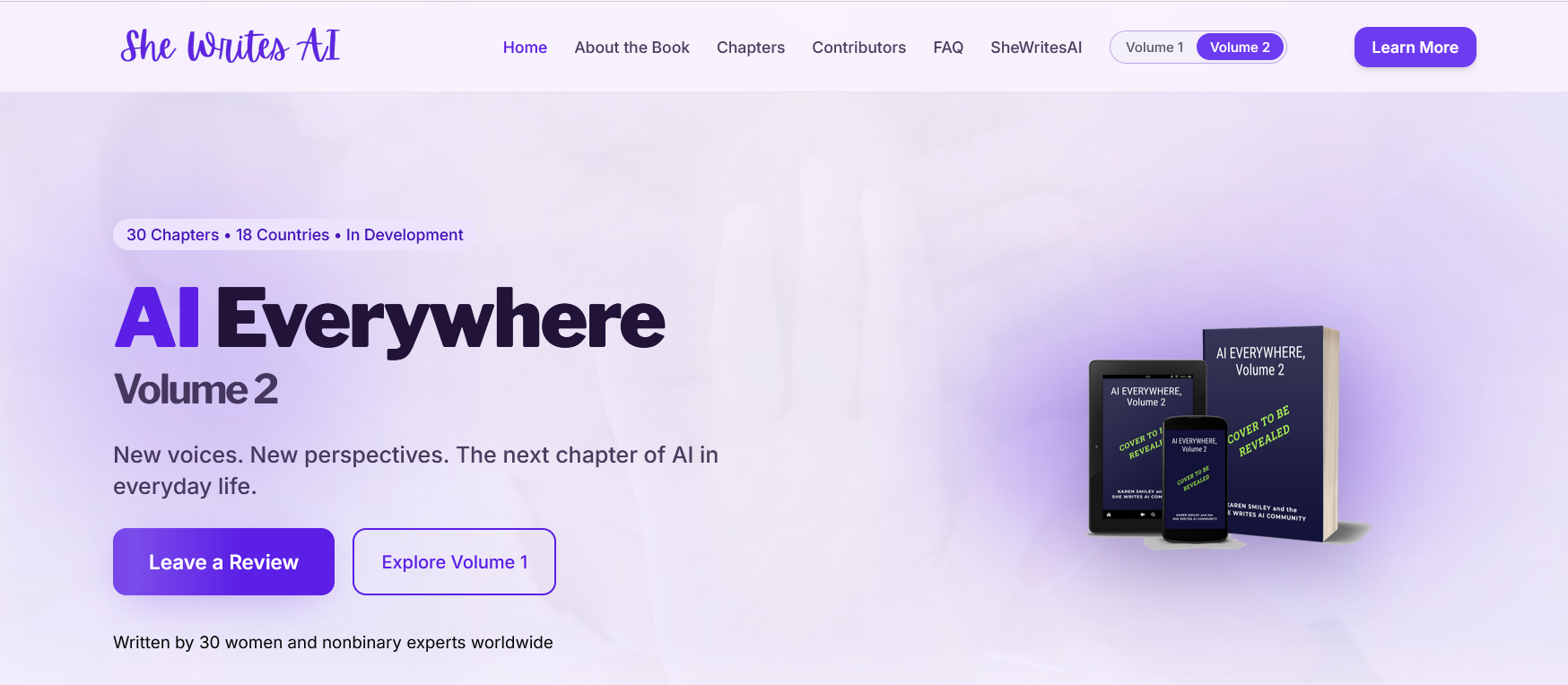
For more insights on the book, see aiEverywhereBooks.com - our beautiful book series website created by (now updated with previews for book2):
Where To Buy, How To Read and Listen, Ways To Review
- Buy Volume 1 (now in ebook and print on Amazon, Gumroad, Lulu, Ingram Spark, and your favorite reading platforms)
- Look for our upcoming abridged audiobook edition in July!
- Tips from our publisher on how to buy an Amazon ebook from a country that isn’t a ‘KDP marketplace’, and how to read the ebook without a Kindle device (free)
- Review links (we’re on Amazon, Goodreads, and Storygraph)
Ways To Support
To help cover book-related costs (ISBNs, proof copies, etc.) as well as other community services, we follow the Wikipedia model. We are now accepting donations via paid subscriptions and can also now accept one-time tips through Stripe (‘digital ink’).
All donation sizes are welcome and help keep these book authoring opportunities free for She Writes AI Community members worldwide! Patrons and Sponsors are acknowledged on our book site. Read more.
Thanks as always for your support in every form. We appreciate it all. Hearts, shares, restacks, and comments are awesome!