How to build a paid perk from writing you’ve already published.
By Shannon Bindler
Published: 2026-10-18
URL: https://shannonbindler.substack.com/p/the-paid-perk-hiding-in-your-substack
I turned my articles about paid offers into a 32-page workbook for The Flow's annual and VIP members. Here’s what’s inside, how to find the pieces in your own archive that could become a paid perk, and, below the paywall, the step-by-step build with prompts you can use.
Part One: The workbook, and where it came from
Your best paid perk might already be published. Mine was.
We spend so much time wondering what else to create for paying subscribers that we overlook what we’ve already made. Part of the problem is familiarity: we’ve lived with our ideas so long that we forget they’re new to someone else.
An article can explain an idea beautifully and still leave a reader unsure what to do with it.
Over the summer, I wrote a series of articles about paid offers. Afterward, the same question kept finding its way into my inbox, some version of Okay, but how do I actually do this for my publication?
So I built the answer.
The Flow Paid Offer Workbook is a 32-page guide that takes you from a hunch that readers might pay to an offer you can publish. Distilling three articles into something a reader could work through alone took more thinking than writing them did. Every idea needed a page, an example, and a place to answer.
The articles explained the idea. The workbook made me prove it.
What’s inside
The workbook opens with the line that started the whole series: People can love your work and still not understand why they should pay for it. The next 31 pages close that gap.
Everything is built around what I call the three Offer Types. A paid tier usually leans on one of them as its main reason to join:
Outcome Offer (help me make progress)
Information Offer (help me understand something)
Proximity Offer (give me more of you)
Here’s one page doing its job. Early on, the workbook asks you to separate four things that tend to blur together: your topic, your audience, what you deliver, and your actual offer.
Example: A writer covers visual branding with AI. Her topic is visual branding; she writes for independent writers building a publication, and she delivers tutorials and templates. A reader still can’t see why they’d pay.
The offer is the sentence that gives them a reason: Build a recognizable visual identity with AI tutorials and templates. Most vague paid tiers stop one step short.
From there, the workbook helps you answer: Why pay now? And why you? Then it maps your promise onto a real month and ends with your invitation written.
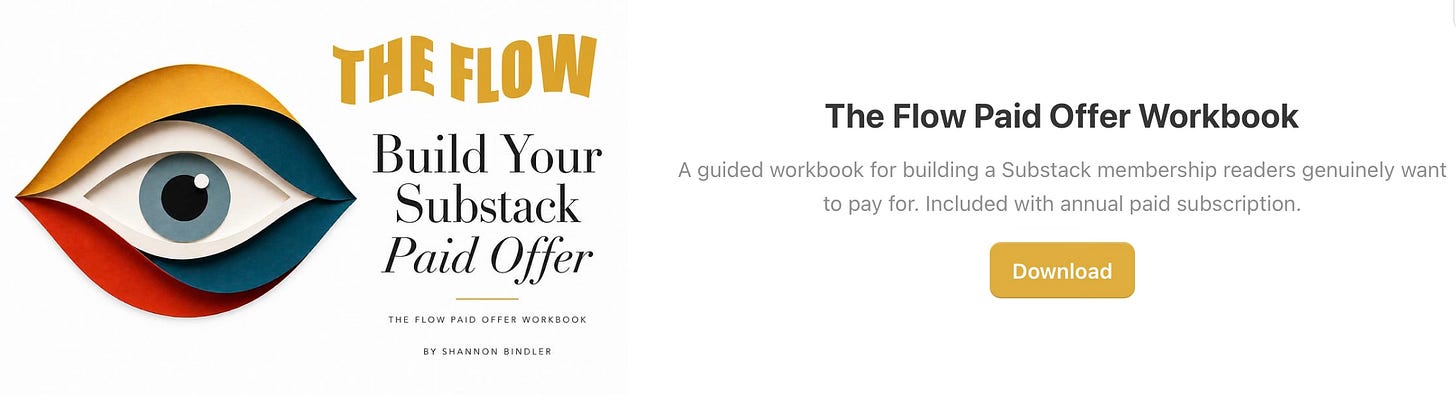
As I built it, I discovered how easy it is to overbuild. My first version was an opus at more than 40 pages. Apparently, when you give a writer a workbook, she tries to write another book. I eventually cut it to 32 pages, but I left plenty of blank visual space and areas to fill in, along with some of my signature branding visuals.
Almost everything in that workbook began as an article I’d already published. That’s the part worth stealing.
If you missed the series, start here: Why People Love Your Substack But Won’t Pay for It, I Stalked Nine Substack Paid Tiers So You Don’t Have To, and I Reviewed 3 Real Paid Offers. Here’s What I See.
Your archive is holding one too
If you’ve been writing for a while, your archive holds ideas you’ve already tested with real readers, along with a record of what they saved, shared, and asked about. That’s a strong starting point for something people would pay for.
What you build from them becomes an evergreen asset: a workbook, a set of prompts, a curated resource guide, an essay collection, or a downloadable art print a paid member can keep and return to.
A good one stays useful long after its original post has scrolled out of the feed, and it answers the question every paid tier faces: What does paying add? Sometimes the best answer is to use what you’ve already created better.
Three signs an article is ready for a second life
-
Readers asked for the next step.
Comments like “saving this” or “how would this work for a food newsletter?” mean the article opened a door readers still need help walking through. Those questions often become your next product.
-
It holds something people can apply or return to.
A framework, a sequence, a process, or, for essays and creative work, a theme strong enough to gather a collection around. Let the form follow the value.
-
It will still be true next year.
Platform tactics age fast, and your way of thinking about a subject lasts much longer. Look for the ideas underneath your articles that keep holding up.
A little experiment for this week
Open your Substack stats and look through the articles that drew the most comments or restacks, especially the ones that made readers ask another question. Write down three. That’s your shortlist, and one of them may already hold the foundation for your next paid perk.
Next week, I’ll share a few examples of what an asset could look like for each Offer Type.
How to get The Flow Paid Offer Workbook
Quick guide: what’s a Perk?
Perks are Substack’s newer home for paid member extras.
-
What it is: a card on your Perks tab holding a download, a link, a discount code, a community invite, or a Substack Live video or audio file.
-
Who gets it: you can choose all paid subscribers, annual and founding members, or founding members only.
-
Where readers find it: the Perks tab at the top of your publication, on the web. It doesn’t appear in the Substack app yet.
-
Where you set it up: Settings> Payments> Manage next to Subscriber Perks.
Substack’s guide to Subscriber Perks walks through the setup step by step.
The workbook is now in the Perks tab of The Flow for annual and VIP (founding) members, and that’s intentional. It took substantial time to create; it’s designed to be worked through over a few weekends, and I wanted annual members to have something tangible that stays useful all year. I’d rather it not become a one-month download-and-dash.
The Flow Room is The Flow’s paid membership, a coaching community for writers building their own paid memberships.
Every member gets the step-by-step tutorial below, including custom prompts; annual and VIP members also get the complete 32-page workbook.
Already a monthly member? You can switch to annual in your subscription settings, and the workbook is yours today.
In Part Two below, I’ll show Flow Room members exactly how I turned mine into a finished product: eight steps, prompts to get you started, and a few things I’d do differently next time.
Part Two: The build, step by step
This post has bonus content for paid subscribers. Upgrade to get full access.
When an idea keeps generating questions, when readers want to go further, or when several pieces of your work begin to form something larger, pay attention. There may be something worth building.
Which piece in your archive might be ready for a second life? Tell me in the comments. I’d love to hear what you’re thinking about turning into something new.
Kindest,
Shannon
Psst, Flow Room members. The Hub has been updated, and there are two new workshops on the horizon: a branding series with guest expert AI Meets Girlboss 🦩, and a New Year Workshop to envision where your publication flows in 2027. Head over to the Hub to see what’s coming.