From chip to culture: what it actually takes to build a Tessera, and what it takes to grow one into an Arcology.
By Life with AI
Published: 2026-05-22
URL: https://sbcorvus.substack.com/p/a-new-town-built-whole
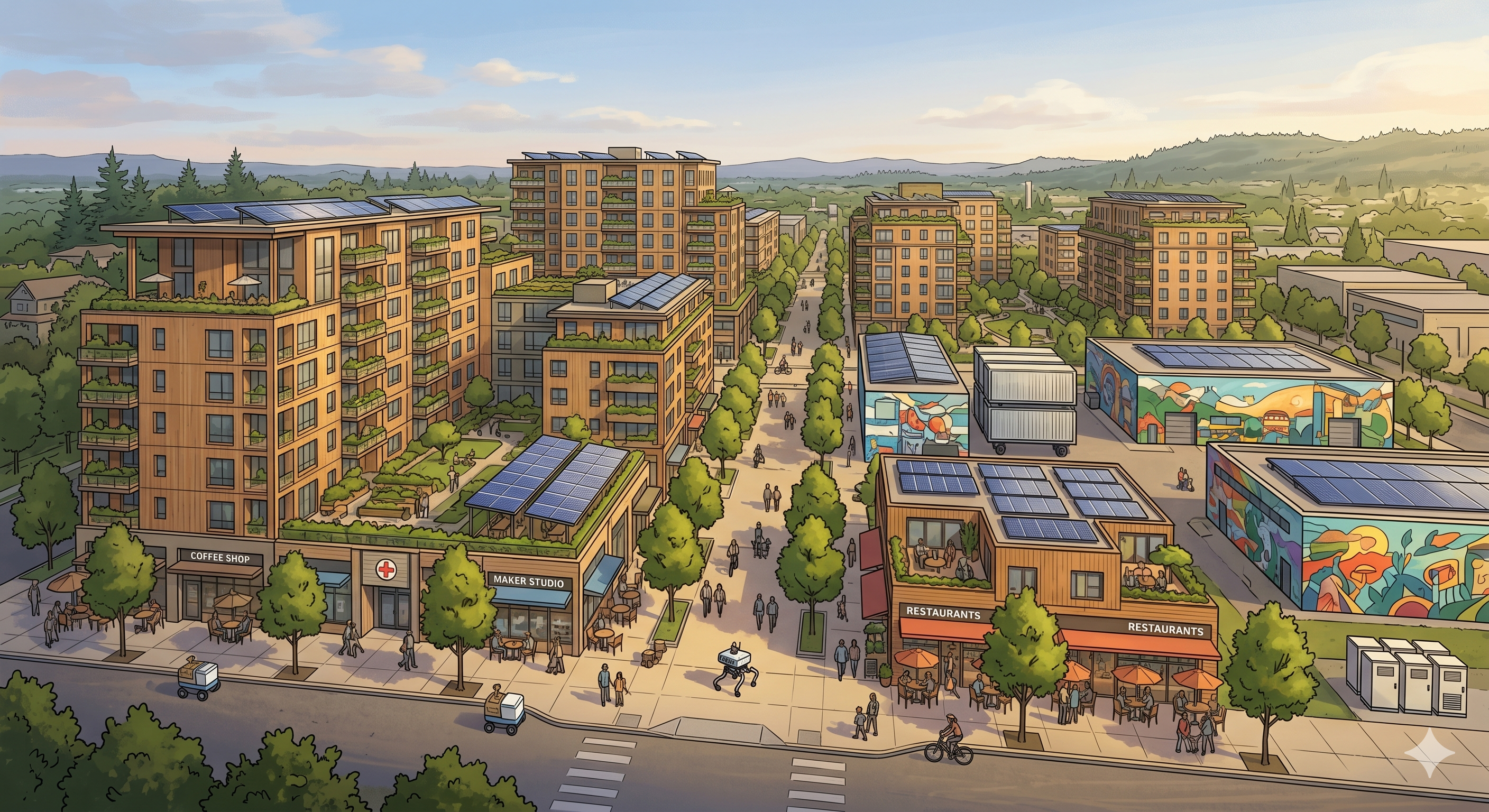
When you hear the word “arcology,” what do you see? Most people probably jump to archaeology and think of mummies and ancient ruins. Those who studied architecture or urban planning might envision Paolo Soleri’s melding of architecture and ecology. Or maybe you’re a sci-fi fan, and you see William Gibson’s cyberpunk version with corporate megaliths stuffed to overflowing in the ever-extractive pursuit of profit.
But none of these are what we’re talking about. Right now we’re talking about a neighborhood. A real one, with sidewalks, schools, a medical clinic, coffee shops and restaurants, spas and maker studios, beautiful shared green spaces, and a couple of unglamorous industrial buildings covered in artwork to make them more tolerable. But those unglamorous buildings? Those make all the electricity, the chips, and the automations.
The thing we are imagining for the late 2020s — what I have come to call the Tessera — is small. The thing we are imagining for the late 2030s — the Arcology — is the same idea, only orders of magnitude larger, with more mature systems. They are not two different ideas. They are the same infrastructure. The Tessera is one reproducible, iterable tile in a mosaic. The arcology is the entire mosaic, and it’s open source to the world.
The idea of the Tessera and the Arcology seems strange to most readers because they’re rarely shown the whole picture. We’re all aware of all the pieces, but we’ve never seen them as a cohesive unit. The energy sector talks about reactors. The chip people talk about compute. The architects talk about buildings and skyscrapers. The vertical farmers talk about greens.
To understand the Tessera, you have to see the full picture. In isolation, the pieces look like fragmented industries. Together, they make sense. Nothing in this master plan is magical; every component already exists somewhere—in a lab, a pilot, or an inspector’s permitting binder.
So. From chip to culture. Six layers and a coordination layer. The Tessera is what the first three layers look like at a small scale, and what the last three layers look like in their starter forms. The arcology is what happens after enough Tesserae have been built that the last three layers mature into something we have not built before.
1. Power
Everything begins with electrons.
A Tessera assumes a small modular reactor, or SMR, sited on the campus. It’s basically a nuclear reactor about the size of a few semi-trailers, factory-built, delivered, and connected behind the meter. “Behind the meter” means the power does not have to travel through the public grid to reach the data center next door.
It is local. This is the part that makes the rest of the math work. The SMR is paired with rooftop and ground-mount solar across as many surfaces as can sensibly hold a panel, and with grid-scale batteries that smooth out the gaps between solar peak and evening demand.
A SPAN-style smart panel (
) — circuit-level visibility and control at the building level — sits attached to every tier and annex. The whole thing is coordinated by software that decides, second by second, where electrons go and where they pause.
The arcology version is the same bits, just more of them, and tied together more tightly. By the late 2030s, two or three SMRs anchor a campus that has effectively gone behind its own meter at the neighborhood scale. Building-integrated photovoltaics, custom-designed solar built into the windows, the walls, and the awnings, not just bolted to the roof.
This will pick up a meaningful fraction of the daytime load. Industrial-scale storage smooths over multi-day weather events. Waste heat from computers is no longer waste. It is piped under sidewalks and into greenhouses and into the bottom of swimming pools.
The cleanest power on the campus does double duty.
Skip to the next bit unless you want details.
The ground is shifting rapidly under our feet. What exists today, in mid-2026, would have looked like a wish list just six months ago. NuScale‘s uprated 77 MWe design received Nuclear Regulatory Commission approval in May 2025 [1].
So far, NuScale is the only NRC-certified small modular reactor design in the United States [2], and they have a non-binding framework agreement between NuScale’s commercialization partner ENTRA1 and the Tennessee Valley Authority for up to six gigawatts of capacity across the TVA’s seven-state service region [4]. TerraPower’s Natrium reactor, which is sodium-cooled and designed to integrate with molten salt energy storage and capable of supplying up to 500 MWe, has begun non-nuclear construction at a retiring coal plant in Kemmerer, Wyoming [4].
The NRC’s environmental review was completed in October 2025. The final safety evaluation came in December 2025, and the construction permit decision is expected sometime in Q2 2026. Meta has signed up for eight Natrium plants, and Nvidia’s investment arm NVentures has also backed the company [3].
In December 2025, the Department of Energy selected TVA and Holtec to each receive $400 million in federal cost-shared funding, for a total of $800 million, to go toward early SMR deployments in Tennessee and Michigan [4]. X-energy’s Xe-100 high-temperature gas reactor is in NRC safety evaluation, with Dow Chemical’s Long Mott Energy subsidiary as the first commercial customer at a Texas chemical facility [3]. Aalo Atomics, using a DOE pilot pathway that authorizes testing on federal land without NRC licensing, went from groundbreaking to a completed reactor building in under six months [4].
The Trump administration’s May 2025 executive orders compressed NRC review timelines for new reactor applications to 18 months and expanded DOE and Department of War roles in reactor licensing [2]. SPAN panels are UL-certified and shipping at scale [6].
The gating event for Tessera’s power stack used to be NRC design approval. It isn’t anymore. The new gating event is the first commercial operation. That event will be the first SMR actually selling electrons to a paying customer in the United States. And where’s that on our timeline? Between 2029 and 2032, but check your sources.
The Tessera and thus the Arcology are constrained by this.
But timelines seem to be compressing.
2. Silicon
The silicon layer is where the Tessera earns its place in a national strategy rather than just a local economic-development one. Two facilities sit next to the reactor: a data center, which consumes a great deal of power, and a semiconductor fabrication facility. This is the fab, and it consumes a great deal of power and produces the chips that the data center and every other structure depend upon.
The data center is the building everyone has heard of, and many have toured. It’s filled with rows of identical servers with their blinking lights, on racks that are taller than a person. Liquid running through pipes in the floor to carry away the heat. Lots of methods here. Not all use massive amounts of water. The data center will be built with the most ecologically sound methods available.
The fab is the more unfamiliar building. The environment where wafer fabrication happens is meticulously controlled. It’s windowless. Every room is humidity-controlled to fractions of a percent. Workers in space suits and robots wander up and down the halls. It’s a near-clinical level environment. Even the wavelength of the ambient lights is controlled. It’s 585-595nm. Amber. And all of this allows us to weave magic into silicon at the level of the atom.
An important note. A Tessera-era fab is not the cutting-edge node. Those need scale and supply chains that make sense at TSMC or Intel levels, but not at neighborhood scale. The Tessera fab is more likely at the mature-node or specialty-node scale: power electronics, automotive chips, sensors, the silicon that the rest of the buildout needs to function. Right now, the US imports most of this. CHIPS Act tax credits help. Skilled-trades programs feed the workforce.
Each Tessera fab can sell the excess to support the community and the rest of the buildout. This becomes economically viable as global chip demand increases.
The arcology version adds another. It allows for thermal recapture at a meaningful scale. A modern data center’s waste heat is mostly thrown out via cooling towers. By the 2030s, in a properly designed campus, that heat is captured by closed-loop liquid systems and routed into district heating, greenhouses, and industrial processes elsewhere on the site.
The Arcology is large enough to accommodate local R&D facilities that work on the post-silicon substrates. Think about neuromorphic chips, photonic compute, and analog ML accelerators. Niches will be carved out alongside conventional GPUs.
It won’t replace top-tier silicon by 2040, but it will reduce the load on it.
Skip the next bit if you don’t want minutia.
What exists today, on the fab side, has split sharply between winners and losers since the CHIPS Act started writing checks. Intel’s Fab 52 in Arizona has entered high-volume manufacturing on its Intel 18A process — the first US facility past the 2nm node, using ASML’s High-NA EUV lithography [5]. TSMC’s Arizona Fab 1 is producing 4-nanometer chips for Apple and Nvidia [7]. TSMC Fab 2 finished construction; equipment installation begins in the third quarter of this year, with 3-nanometer production targeted for 2027 [7].
TSMC has begun discussion of a twelve-fab Arizona expansion as part of a potential five-hundred-billion-dollar intergovernmental deal between the United States and Taiwan [7]. Samsung’s Taylor, Texas facility has pivoted strategy mid-build [5]. Intel’s Ohio “Silicon Heartland,” meanwhile, has slipped from a 2025–2026 opening to 2030 due to capital constraints and a labor shortage that nobody in the industry can quietly stop talking about [5][6]. Liquid cooling is now standard at scale-out AI training facilities.
What does not exist yet: the fab built next door to the reactor and the data center it feeds, with mixed-income housing across the road.
3. Materials
This is everything that makes the structure possible. This is pretty technical, so unless you’re a construction buff, you might want to skip it. Just note that active, constant research would be going into optimizing the materials used to build a Tessera, focusing on durability, reliability, and sustainability.
Materials. Mass timber — engineered wood like cross-laminated timber and glulam — is finally cleared for taller buildings under the current International Building Code. A Tessera-era residential midrise can be built in mass timber rather than concrete and steel, with embodied-carbon numbers that look like a different industry. Concrete itself is shifting; companies like CarbonCure are injecting captured CO₂ into the curing process, and lower-carbon cement substitutes are entering specs. Mass timber, low-carbon concrete, and recycled steel together do not solve emissions, but they meaningfully change the math on what a square foot costs the climate.
Construction. Modular construction. Buildings will be assembled from factory-built sections that arrive on automated trucks. AI-assisted design tools reduce waste at the planning stage. 3D-printed structural and façade components are moving from demonstration to production. Everything on site, from bricklaying to rebar tying to drywall finishing, can now be done by a robot.
The Tessera is built and designed around using robotics to automate its own construction. Creative environmental design ensures robotics infrastructure gets installed in every room, hallway, and green space.
The robots that build the Tessera are also built at the Tessera.
Operations. In the Tessera, every building runs on AI. That is the default. DeepMind cut Google’s data center cooling costs by forty percent years ago using machine learning to predict load and adjust airflow ahead of demand.
That approach is moving into commercial real estate. A Tessera residential building runs HVAC, water heating, elevator scheduling, lighting, and access control through a single integrated management layer. Energy use drops thirty percent compared to a code-minimum building of similar size, with no change in comfort.
The arcology version of this is the same approach, scaled across an entire campus, with the management layer coordinating across buildings, across thermal loops, across the SMR and the storage and the grid.
What exists today: mass timber midrises are open in Portland, Milwaukee, Brooklyn. Modular construction firms are shipping at scale. Google’s data center AI predates the current AI boom. The unbuilt piece is the place where you do all of this at once, with the construction workforce living in the same neighborhood as the buildings they put up.
4. Robotics
This is one of the places where the casual reader most often gets the picture wrong. There is no Tessera in which Rosie the Robot pours your coffee. Humanoid form factors just aren’t worth their weight compared to multiple smaller, more modular designs.
Wheeled bots run last-mile delivery on flat sidewalks. Quadrupeds, think of four-legged inspection robots of the Boston Dynamics Spot lineage, climb stairs, walk through construction sites, and inspect industrial infrastructure that is too dangerous for a person to access. Ceiling-mounted gantries are standard in commercial kitchens and warehouses and along shared corridors for intra-arcology shipping. Early signs of this is the Miso Robotics Flippy. It’s already in fast-food restaurants.
A novel design, soft robotics, which are pneumatically actuated and safer for human contact, is starting to show up in eldercare and food handling, though designs are still experimental and expensive.
By the early 2030’s, costs will have gone down substantially and may only be at the cost of materials and energy since no human labor will be necessary. Most of the actual robotic labor in 2027 won’t be humanoid.
It will be task-specific, form-factor-specific, and unglamorous. But it will be incredibly efficient and effective.
Why is this important? It’s important because, at its core, the Tessera builds robots so that those robots can build more robots because every country in the world needs to improve its sovereign domestic manufacturing capacity. It’s part of the core, chip to culture, mission. It’s a virtuous cycle, because the Tessera uses the robots it builds.
The robotics line is colocated with the chip fab because the robots use the chips. The data center is the training facility for the perception and control models the robots run. The robots then aid in building the chip fab, and so on. You can see where this can go.
And the skilled workers who determine taste and who install and maintain everything live across the street.
The arcology version of this is what happens once humanoids cross the cost and reliability thresholds. If we’re being optimistic, by the early to mid-2030s, quality humanoids will become available for high-value, complex tasks: construction site supervision, eldercare backup, and agricultural picking.
By that time, the rental-pool model is more economical than the personal-purchase model for most households. The arcology has a fleet of humanoid bodies that can be checked out for specific tasks. They are still not Rosie. They are tools you reserve, not companions you own.
But your Agent can inhabit one for a time.
What exists today: Boston Dynamics, Agility Robotics, Figure, 1X, Tesla, and a dozen others are shipping or piloting humanoids. The cost is too high, the reliability is too low, and the use cases are too narrow for residential deployment. The cost curve is real, but it is not yet at the inflection point. That’s for the 2030’s.
5. Closed Loops
This is where a Tessera starts to behave differently from a typical American neighborhood and where the Arcology departs from a typical city. We’ll give you three loops: water, waste, and food.
Water. The benchmark to keep in your head is that the International Space Station recycles about ninety-three percent of its water. The best municipal system on Earth, Singapore’s NEWater, recycles about forty percent.
The Tessera does not need to hit ninety-three. It needs to demonstrably hit fifty or sixty, with membrane filtration and ultraviolet treatment and a measurable, publishable accounting. The arcology needs to approach the ISS number, because ten million residents on a fixed footprint would break most municipal models.
By the late 2030s, “toilet to tap” is not a slogan; it is a thoroughly studied, publicly audited, demonstrably safer water supply than most American cities have today. The chemistry and the data will be live and open-source.
Waste. Anaerobic digesters convert sewage and food waste into biogas, which is used for heating and cooking, and into solid digestate. This becomes fertilizer for the on-site farms. AI-sorted recycling streams recover materials at rates municipal facilities cannot. The waste stream becomes the input to the next loop. The Tessera demonstrates this at the neighborhood scale. The arcology operationalizes it as the default and as an imperative necessity.
Food. Vertical farming exists. It is currently two to five times more expensive per calorie than conventional agriculture for most crops, with the gap closing on leafy greens and herbs and still wide on staples.
The Tessera does not pretend to be food-independent. It produces a meaningful fraction: leafy greens, herbs, tomatoes, mushrooms, maybe even some small fish. Everything else would need to be procured. The arcology is more ambitious but still not autarkic: it integrates a real farm at its perimeter, runs vertical production at the core, and treats food as part of the same loop as energy and water.
By 2040, the cost-per-calorie gap for vertical staples is narrower, but most calories still come from sunlight on outdoor soil, as they probably always will. Farms and parks are built into as many tiers as possible.
What exists today: Singapore NEWater. Anaerobic digesters at municipal scale in many countries. Vertical farms operating commercially (Plenty, Bowery, AeroFarms — with mixed financial results, which is worth saying). The unbuilt piece is the place where the loops are closed by design rather than retrofitted.
6. Life
What might life be like in the Tessera?
People live here. Everyone in the Tessera shares the same type of modular housing. Every modular home can be customized exactly to each resident’s taste. But they all share the same square footage per resident.
This customization and base living space allocation is a structural condition of Tessera’s core mission of chips to culture. The working tradespeople who built the Tessera will always have a place to live. They will not pay for rent, for electricity, for water, for food, for healthcare, for education, for safety, for transportation.
The engineers, the operators, the artists, the musicians, the cooks, the entertainers, everyone lives there for free. The arcology continues this, but at an epic scale: it’s housing tenure mixed across ownership and cooperative equity, with no tier ghettoized. Everyone benefits from the Arcology’s success.
People learn here. Elementary and secondary schools are part of the core mission of chips to culture, not the afterthought. Teachers are paid market-plus to live in the neighborhood they teach in. The schools have access to the data center next door for educational compute and also have direct access to the chip fabs and robot factories for live technical curriculum.
The Diamond Age model, a personalized AI tutor for every child, scales with public data infrastructure. This is more achievable in a neighborhood that always has the compute and the connectivity. (Full disclosure: this is also something I am building for my own children.
It works. But it’s also harder than it looks.)
People get better here. You get to determine your level of healthcare interaction. If you only want preventive care, there’s a clinic for that. If you want active medical surveillance to scan for cancer, infections, and viruses, free daily bloodwork is available in every home.
For urgent needs, there is a local clinic on every floor. Specialty care varies by floor. Beginning in the late 2020s and early 2030’s, every clinician will carry a personal AI medical companion that handles charting, prior-authorization paperwork, longitudinal patient history, and a meaningful fraction of intake. No one pays for medical care. It’s all automated. Even surgery.
People explore here. The Tessera is designed for walking and mass transit, not personal vehicles. The emphasis is on public art installations and parks on as many tiers as possible. The goal is to draw people out of their homes and into the public spaces. They should not be standardized. They should be based on the community that lives nearest that public space.
This is the culture part of Tessera’s mission of chips to culture. The public space is celebrated. Yeah, yeah, I’m waxing poetic here. Instead of everyone focusing on their homes, their attention is drawn to the shared spaces. Streets lined with parks and restaurants, and where every floor, every neighborhood is an adventure all its own. Transportation is free and automated. No one owns a vehicle. No one needs to.
The arcology extends this vertically by a mile.
People grow things here. Green space isn’t just decoration. It is stormwater infrastructure. It is microclimate regulation. It is mental health infrastructure. It is the difference between a place you want to go out and thrive in and a place you merely tolerate because it’s affordable.
The Tessera has more green space per resident than most American suburbs and far more than most American cities. The arcology, despite housing many more people on less land, manages even more green spaces by going up rather than out, by stacking the residential/commercial/industrial, and by treating rooftops and façades as growing surfaces. No square foot is wasted.
What exists today: Remarkably, every component of this layer exists somewhere. Mixed-income housing in Boulder, in Vienna, in Singapore. Personalized AI tutors in pilots. Telepresence clinical care in rural Texas. Walkable mixed-use neighborhoods in dozens of American cities, mostly built before the Second World War.
The unbuilt piece that is the Tessera demonstration will be where all of this happens at one site, on purpose, and where everyone who lives there has ownership over their home, their community, and their lives.
7. Coordination
Without a coordination layer, this entire infrastructure is just an expensive pile of parts. It is pure chaos. With coordination, it becomes a new civilization-scale operating system.
The coordination layer is two things: software and governance. Oddly, the software part is the easy half.
This has to start small. A Tessera-era facility AI has to do four things at once: run the buildings, that’s all the HVAC, water, elevators, access, lighting, and schedule the transit, coordinate the grid second by second across the SMR and the solar and the batteries, and give every resident a personal Agent, AND watch every closed loop for trouble.
But to make sure everything is running cooperatively between neighborhoods (or floors/tiers in the Arcology), you need federation. You don’t build one giant brain. You build a lot of specialist brains and teach them to negotiate. Your HVAC and your grid balancer want different things at 6 p.m. They haggle, they settle, and eventually this settles into a background rhythm.
The arcology version is the same idea, with the dial turned all the way off the charts. By the late 2030s the federation is six specialized systems. That means Climate (customizable down to the floor), Flow (materials and logistics), Provision (food, water, power), Harmony (the cultural and social layer), Growth (construction and expansion), and Memory (the living record of how each Tessera or community chooses to run). They all coordinate live. They all negotiate constantly. They all escalate to human governance when they hit something they cannot resolve on their own.
Now let’s take a breath. You know, do the thing. Get up. Stretch. Go touch some grass. Okay, now something I think is both exciting and a little scary about the whole Arcology idea.
If you build to the scale of the Arcology, its data center sells intelligence. Gigawatts of it. Mathematicians, if you want to correct my math, please ask for my specs, and I’ll share them so you can wreck my math. BUT! At a mile-high Arcology, the compute it could generate can be around ninety-some zettaFLOPS. That’s 300X all the AI compute on Earth today. That compute is the Arcology’s cash crop. That’s what pays for everything.
But what about the AI that actually runs the building? What about the mind that keeps ten million people warm and watered and moving, the mind that holds everything together? What does that cost? Well, almost nothing by comparison. Tens of megawatts against six-plus gigawatts. It’s a rounding error. The Arcology sells an ocean of intelligence to the world and runs itself on a teaspoon.
That’s not a hopeful guess. It’s the lopsided physics of the thing: coordinating is cheap, generating is expensive. The proof is sitting up in the Materials section. Years ago, DeepMind cut Google’s data-center cooling by forty percent with a model that ran on a sliver of the building it was governing. The thing that runs a place is always tiny next to the place itself. The Arcology just makes the gap absurd.
Skip the next bit unless you like big numbers.
How big is “runs the building,” really? Count everything it has to watch and touch. Consider every sensor and switch in the fabs and the data center, every SPAN circuit in every building, every robot at hundreds of signals each, every farm tray, every Agent.
Now scale that up to a ten-million-resident Arcology, and this lands somewhere in the billions of sense-and-control points. More sensors than there are people on the planet. That’s hundreds of fabs’ worth of nervous system, fused into a single structure.
The control loops riding on top fire on the order of a billion to ten billion times a second. And this has to be live and it needs to be sustained. None of that is exotic in isolation. A single chip fab already runs millions of sensors.
A telecom backbone already makes a billion routing decisions a second. What’s new is doing all of it, coupled in one place, with no human in the loop.
And that’s the hard part. It’s not the sheer number of dials but rather the fact that every dial moves a hundred others. Cooling water fights compute heat. The power budget fights the farms. Six systems, millions of interdependent variables, all leaning on each other.
A sharp human ops team can hold a few hundred coupled variables in its head. This has millions, if not billions. That’s not an argument for automation. It’s the reason automation isn’t optional. There is no version of this a team or even a government of people can run. It’s one big reason the megaprojects of the last decade keep stalling out.
Put a number on the autonomy and it sounds invented, so treat it as a gesture and not a measurement: the building makes something like a trillion decisions for every one it ever hands up to a human. A mature governance system will filter out the handful of decisions it cannot settle on its own. Everything else just happens, between heartbeats, forever.
One genuine unknown, because I’d rather flag it than fake it. The biggest swing in that “tens of megawatts” figure is the Agent question. Ten million lightweight assistants? Tens of megawatts, easy. Ten million Agents each running frontier-grade reasoning full-time — the kind that can actually inhabit a robot body and hold a real conversation — is most of a gigawatt. Not a rounding error anymore.
A second data center wearing a friendly face. Which one we mean is a design decision nobody has had to make yet, and I haven’t made it either. (Date-stamp, since I keep doing this: May 22, 2026. Ask me in five years how badly I lowballed it.)
Now the hard half. Governance.
The software negotiates electrons. Governance negotiates people, and people are more complicated and with a myriad of nuanced needs. This requires a community-benefits agreement that gives the residents of every Tessera neighborhood, which later translates to every Arcology floor, a real seat at the table, not a comment box. Through AI-facilitated governance, residents weigh in on what workloads the data center accepts, which is to say what research the place’s compute will be used for; on what the fab is licensed to produce; and on how housing gets allocated and how public spaces will evolve.
They share the upside through cooperative equity, not a subscription. They can vote to expand. They can vote to refuse. The Tessera is where this gets piloted, because honestly, it’s the only way anyone nearby grants the social license to put a reactor and a fab across the street from a school. Everyone benefits, including the neighbors who never move in. If the community’s needs aren’t met, the thing doesn’t get built. Full stop.
What exists today: the software half is far closer than the governance half. DeepMind’s cooling optimization is old news. Integrated building-management AI is shipping into commercial real estate now. Federated, negotiating multi-agent systems are a live research field with real deployments.
What doesn’t exist is the version that coordinates across all six layers at one site. Nothing yet exists that connects the reactor and the fab and the data loops and the people, all at continuous, all at once.
The governance half barely exists at all: community-benefits agreements are real but thin, cooperative equity in infrastructure is rare, and AI-facilitated deliberation at neighborhood scale is mostly pilots and hope.
But that’s not a reason to skip it. It’s the reason the Tessera has to come first.
So what’s the point of all this?
This is a thought experiment of possibility. We have a real chance to do something new and to do so in a way that genuinely benefits everyone. We can imagine a new kind of physical infrastructure that becomes a template for future generations, something they can improve upon.
The Tessera, the Arcology are currently science fiction. And they should be. Because this idea needs work. But what does it take for a country or a community to have its own sovereign stack? What does it take to plan for everything from chip to culture?
How long do we wait to answer these questions? Shouldn’t we be answering them now?
References
[1] U.S. Department of Energy Office of Nuclear Energy. “NRC Approves NuScale Power’s Uprated Small Modular Reactor Design.” May 30, 2025. <https://www.energy.gov/ne/articles/nrc-approves-nuscale-powers-uprated-small-modular-reactor-design>
[2] Martucci, Brian. “NRC approves NuScale’s small modular reactor plant design.” Utility Dive. June 2, 2025. <https://www.utilitydive.com/news/nrc-approves-nuscale-small-modular-reactor-smr/749538/>
[3] Campbell, Tison A., and Michael Heard Snow. “Pressure to succeed: Small modular (nuclear) reactor approvals on the horizon?” American Bar Association Trends. March/April 2026. <https://www.americanbar.org/groups/environmentenergyresources/resources/trends/2026-mar-apr/pressure-to-succeed-small-modular-nuclear/>
[4] “An Analysis of Small Modular Reactors (SMRs) for Commercial Electricity Generation in the United States.” Yale Clean Energy Forum. April 26, 2026. <https://cleanenergyforum.yale.edu/2026/04/26/an-analysis-of-small-modular-reactors-smrs-for-commercial-electricity-generation-in-the/>
[5] “The Silicon Renaissance: US CHIPS Act Enters Production Era as Intel, TSMC, and Samsung Hit Critical Milestones.” Financial Content. January 1, 2026. <https://markets.financialcontent.com/wral/article/tokenring-2026-1-1-the-silicon-renaissance-us-chips-act-enters-production-era-as-intel-tsmc-and-samsung-hit-critical-milestones>
[6] Leswing, Kif. “Intel aims to find clients and catch TSMC with new chip fab in Arizona.” CNBC. December 19, 2025. <https://www.cnbc.com/2025/12/19/intel-aims-to-find-clients-and-catch-tsmc-with-new-chip-fab-in-arizona.html>
[7] “TSMC’s $165B Arizona GigaFab: Reshaping US Chips [2026].” Tech-Insider. April 5, 2026. <https://tech-insider.org/tsmc-arizona-165-billion-expansion-gigafab-2026/>
[8] Data Center Watch. “$64 billion of data center projects have been blocked or delayed amid local opposition.” Report, 2025. <https://www.datacenterwatch.org/report>
[9] Data Center Watch. “Briefing 02/20/2026.” February 20, 2026.
Embedded post: https://datacenterwatch.substack.com/p/briefing-02202026
[10] Hale, Craig. “’If one piece of your supply chain is delayed, then your whole project can’t deliver’: Nearly half of US data centers planned for 2026 canceled or delayed.” TechRadar. April 10, 2026. <https://www.techradar.com/pro/if-one-piece-of-your-supply-chain-is-delayed-then-your-whole-project-cant-deliver-nearly-half-of-us-data-centers-planned-for-2026-canceled-or-delayed-and-things-could-soon-get-much-worse>
[11] Shilov, Anton. “Half of planned US data center builds have been delayed or canceled, growth limited by shortages of power infrastructure and parts from China.” Tom’s Hardware. April 3, 2026. <https://www.tomshardware.com/tech-industry/artificial-intelligence/half-of-planned-us-data-center-builds-have-been-delayed-or-canceled-growth-limited-by-shortages-of-power-infrastructure-and-parts-from-china-the-ai-build-out-flips-the-breakers>
[12] Sleight, Mason. “The Anti-AI Data Center Rebellion Is Growing Nationwide.” MarketWise. May 2026. <https://marketwise.com/investing/the-anti-ai-data-center-rebellion-keeps-growing-bigger/>
[13] “Data Center Moratorium Bills Are Spreading in 2026.” Good Jobs First. March 9, 2026. <https://goodjobsfirst.org/data-center-moratorium-bills-are-spreading-in-2026/>
[14] “Pennsylvania AI Data Center Legislation in 2026: What Companies Need to Know.” Duane Morris Government Strategies. March 9, 2026. <https://statecapitallobbyist.com/artificial-intelligence-ai/pennsylvania-ai-data-center-legislation-in-2026-what-companies-need-to-know/>
[15] PennFuture. “Data Center 2026 Legislation Debrief.” April 9, 2026. <https://pennfuture.org/post/DATA-CENTER-2026-LEGISLATION-DEBRIEF>
[16] Muth, Katie. “Senate Co-Sponsorship Memo 48102: Protecting Pennsylvania Communities — Statewide Moratorium on Data Center Development.” Pennsylvania State Senate. February 12, 2026. <https://www.palegis.us/senate/co-sponsorship/memo?memoID=48102>
[17] Sweitzer, Justin. “Power plays: The battle over data centers in PA.” City & State Pennsylvania. April 1, 2026. <https://www.cityandstatepa.com/policy/2026/04/power-plays-battle-over-data-centers-pa/412554/>
[18] Caruso, Stephen. “Pennsylvania lawmakers are talking the talk on data center regulations. But will they walk?” WESA. April 20, 2026. <https://www.wesa.fm/politics-government/2026-04-20/pennsylvania-data-center-regulations-harrisburg>
[19] Garcia, Maria. “Americans’ AI Use Rises as Trust Falls, Quinnipiac Finds.” Implicator.ai. March 30, 2026. <https://www.implicator.ai/america-uses-ai-it-doesnt-trust-the-backlash-is-already-here/>
[20] Quinnipiac University Poll, as reported in TechCrunch: “As more Americans adopt AI tools, fewer say they can trust the results.” TechCrunch. March 30, 2026. <https://techcrunch.com/2026/03/30/ai-trust-adoption-poll-more-americans-adopt-tools-fewer-say-they-can-trust-the-results/>
[21] “Survey shows young Americans are increasingly concerned about AI.” The National. March 30, 2026. <https://www.thenationalnews.com/future/technology/2026/03/30/ai-poll-quinnipiac-trump-framework/>