Volume of AI is not the variable.
Published: 2026-06-16
URL: https://samonai.substack.com/p/the-teams-getting-10xd-arent-using
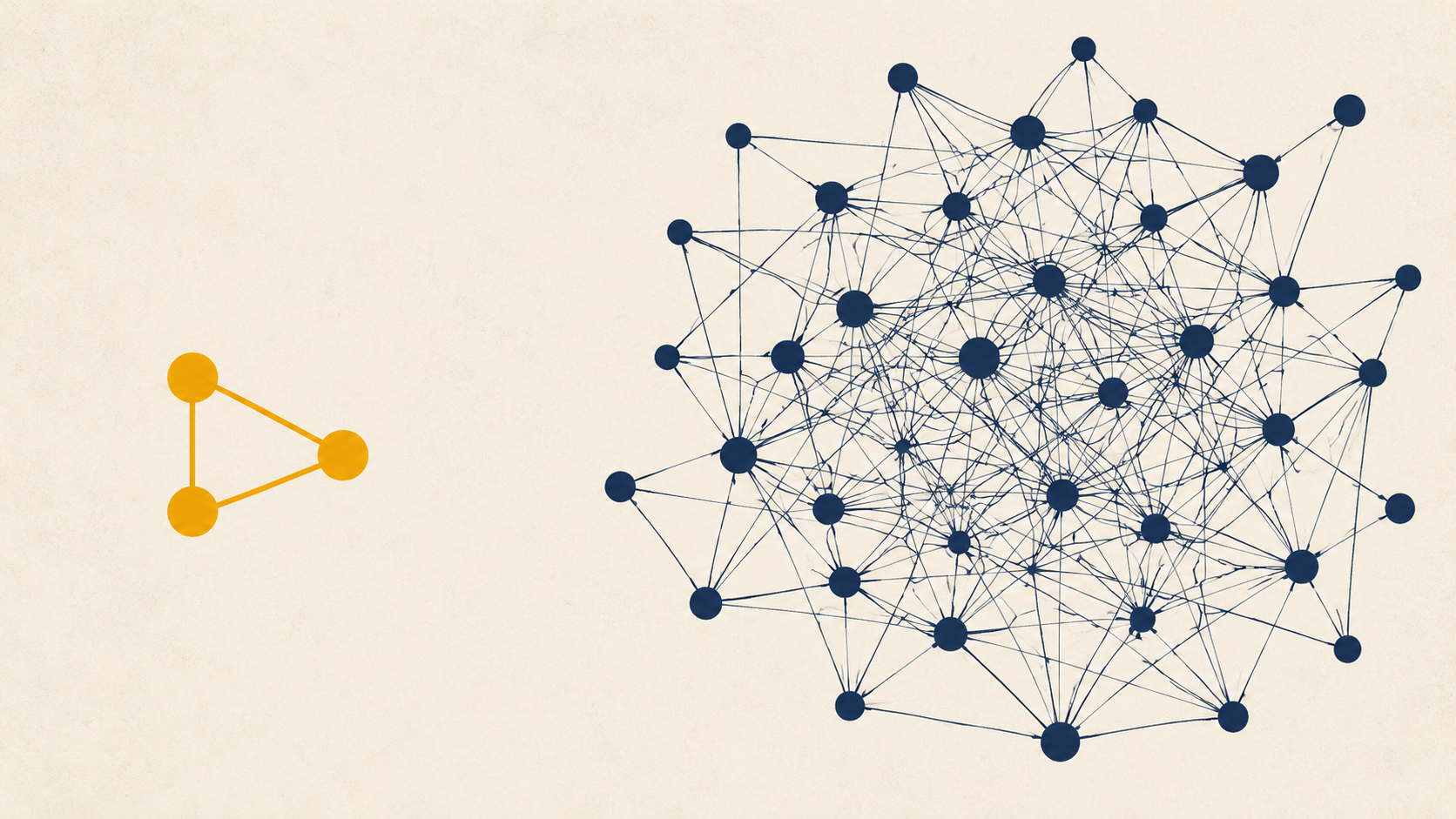
The teams getting 10x'd aren't using 10x more AI
The teams producing the outlier results right now are not the ones with the biggest AI stacks.
This surprises people. The mental model is that if a little AI helps, more should help more, and the teams pulling ahead must be running forty tools where you're running four. That isn't what I'm seeing.
The teams doing the disproportionate work — the two-person startups shipping what used to take fifteen people, the one marketer covering ground that used to need a department, the engineer whose output makes the rest of the team look slow — have narrow stacks.
One or two AI systems. Deep integration. Well-defined roles for each.
The variable is not how much AI. The variable is how tight the workflow is around the AI that's there.
What the 40-tool teams actually look like
I've spent the last year watching teams that adopted a maximum-coverage strategy: try every tool, adopt the ones that seem useful, accumulate. By month six, the typical profile looks like this.
Forty to sixty AI tools across the stack. Multiple overlapping subscriptions — three different writing assistants, four different meeting tools, two different code assistants. Nobody can produce a list of which tool handles which task, because the answer depends on which person you ask. Tools sit unused in half the team's accounts.
The CFO is looking at an invoice with nineteen line items and asking what the productivity lift is, and the answer from the team is some version of "AI is making us faster" without a number attached.
Ask any individual on the team what their day-to-day workflow looks like with AI, and you get a shopping list: "I use X for email, Y for research, Z for drafting, W for meeting notes, V for summaries." Ask them what's actually different about their output, and the answer is soft. Ask for a before-and-after on a specific deliverable, and it doesn't exist.
This is the kitchen-sink pattern. The failure mode isn't that the tools don't work. It's that AI exposure doesn't compound when the workflow around it is fragmented.
What the tight-stack teams actually look like
The teams pulling ahead look different. A representative profile, drawn from teams I've either worked with or observed closely:
One or two AI systems that matter. Usually a coding assistant and a model-based reasoning system, or a writing system and a retrieval system, or an agent framework tied to one specific backend. Everyone on the team uses the same two. Everyone knows what each is for.
A workflow designed around those tools, not bolted onto them. The coding team redesigned how code review works because their assistant changed the economics of first-draft review. The content team restructured their editorial pipeline so that model drafts get routed to a specific editor, not the original author, because the failure modes of first-draft-by-model are different from first-draft-by-human.
The product team threw out their old research template and replaced it with a spec the model can actually use.
Evaluation infrastructure. Not fancy. A spreadsheet in some cases. But there is a written definition of what "correct output" means for the most important uses, and someone checks the model's output against that definition on a regular cadence. When the model drifts or the prompt starts producing worse results, this is how they notice.
A feedback loop. When the model gets something wrong, the correction goes somewhere — a shared prompt file, a rules document, a version-controlled spec, a correction ledger. The mistake does not happen twice the same way. This is what compounds.
One to two tools, deeply integrated. Not four to forty, loosely used.
Why the compounding is uneven
The coverage-maximization strategy assumes AI benefit is additive. Use five tools, get five times the benefit of using one. But that's not how workflow lift works, and it's not how team output works.
The actual shape is closer to this: the first tool integrated deeply into a workflow produces most of the available lift. The second tool in the same workflow produces some. The third tool adds cognitive overhead — context-switching, tool-selection friction, credential management, integration debt — that often cancels the marginal benefit. Past a certain point, adding tools makes the team slower, not faster, because the dominant cost becomes the cost of choosing between them.
This maps to what I've watched. The teams with two well-integrated AI systems tend to outperform the teams with forty weakly-integrated ones, even on a per-seat basis. Spend isn't the signal. Integration depth is.
The specific pattern that works
I've started looking for a specific signature when I try to figure out whether a team is actually benefiting from AI or just paying for it. The signature has a few parts.
A workflow diagram that shows where the AI actually sits. Not an org chart. Not a tool list. A picture of how a piece of work flows from request to delivery, with the model's role marked explicitly. Teams that can draw this tend to be the ones getting real lift. Teams that can't draw it are usually running the kitchen sink.
A written spec for the model's job. "The model does X, within these constraints, and produces an output of shape Y." Not a prompt library. A spec. Teams that have this can catch regressions. Teams without it are at the mercy of whichever model update shipped last night.
A single person or small group that owns the integration. Someone whose job is to maintain the workflow — update the spec when the model changes, fix the prompts when they start producing bad output, retire tools that stopped earning their keep. Without this, the stack accumulates and decays simultaneously.
An evaluation set for the highest-stakes task. Even a small one. Ten examples with known-good outputs. A weekly or monthly check. Teams that run this catch silent quality drift. Teams that don't, don't.
A cost model that ties AI spend to output. Not "we spent X on AI this year." Something closer to "this agent handled Y tasks at Z cost per task, compared to W cost per task when a human did it." Teams that can produce this number get better decisions out of their stack. Teams that can't are flying blind.
You don't need all five. But I haven't seen a team pulling real outlier output with none of them.
What this changes about procurement
The implication for how teams should buy AI is not the one vendors want to hear. The rational move, given the shape of the compounding, is to consolidate early and integrate deep, not to pilot broadly and accumulate.
Pilot programs that evaluate forty tools in a quarter and then "adopt the top ten" are the wrong shape. What you get is ten shallowly-integrated tools, which produces less lift than two deeply-integrated ones. The correct move is usually to pick two to three tools based on a prior analysis of which workflows actually need them, and then invest the same calendar time into integration, workflow redesign, and evaluation infrastructure.
This is unpopular because it looks less active. Nobody gets promoted for running a tight pilot. Buying forty tools looks like progress. Integrating two tools deeply looks like nothing from the outside. But the output difference is visible in the deliverables.
The uncomfortable version of the observation
The teams getting the disproportionate results are often the ones that spent less on AI this year than their competitors did.
Not because they're austere. Because they made one or two bets, integrated them hard, built evaluation around them, and let the rest of the market accumulate SaaS invoices. They are compounding on a narrow base while their competitors are spreading thin across every new thing that ships.
The math on this is the same math that applies to any other operational investment. Depth of integration beats breadth of coverage. Specialization beats optionality. The cost of owning forty tools loosely is higher than most CFOs realize, and the benefit smaller than most COOs report.
If you could cut half your team's AI tools this week, which two would you protect?
— Sam