The broad labor data is calmer than the headlines. Corporate behavior has already moved.
By Sam Meyer
Published: 2026-05-28
URL: https://samonai.substack.com/p/the-ai-jobs-panic-is-already-working
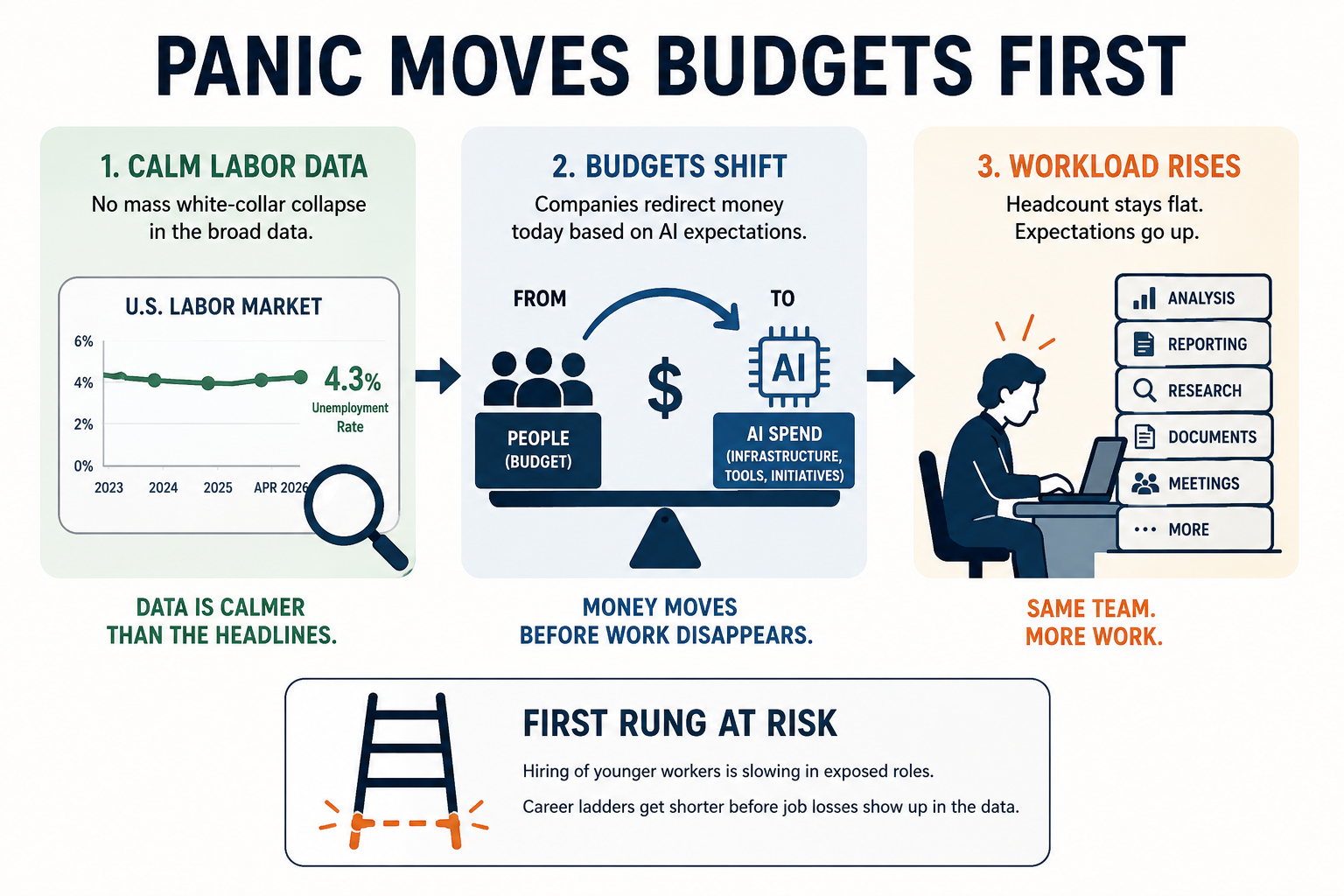
The panic can be wrong as labor economics and still right as a management force.
That is the crux. The broad data shows no mass white-collar collapse. Company behavior has already changed anyway.
The best reading of the evidence is uncomfortable in both directions. The doom story is ahead of the labor market. The skepticism story is behind the boardroom.
Start with the data. It is calmer than the headlines.
In April 2026, the Bureau of Labor Statistics reported that U.S. payroll employment rose by 115,000 and the unemployment rate held at 4.3%.¹ That is a slower, more fragile labor market than the post-pandemic boom. It is still a long way from a white-collar bloodbath.
The Yale Budget Lab reached the same broad conclusion in October 2025. Looking at the 33 months after ChatGPT’s release, it found no clear economy-wide employment shock from AI. Occupational mix was changing; the pace resembled earlier technology cycles. Measures of AI exposure, automation, and augmentation showed no clear relationship with employment or unemployment.²
That matters. If AI had already torn through knowledge work at scale, it should be visible somewhere outside LinkedIn grief theater. It should show up in unemployment, occupational mix, joblessness among exposed workers, wage pressure, quits, or hiring. So far, broad measures keep refusing to perform their assigned role in the apocalypse script.
Even the weak spots need precision. BLS says information employment has fallen by 342,000, or 11%, since its November 2022 peak.¹ That is real damage. It is also a sector story, a rate-cycle story, a post-pandemic overhiring story, a media story, and an AI story mixed together. Anyone assigning the whole decline to automation is doing horoscope economics with better fonts.
So the first claim is simple: current data leaves mass white-collar collapse unproven.
Good. Now the second claim.
The panic is already changing budgets.
The story moves money before the tool replaces work.
Challenger, Gray & Christmas reported that U.S. employers announced 83,387 job cuts in April 2026, up 38% from March. AI was the leading cited reason for the second month in a row: 21,490 cuts in April, 26% of the monthly total. Through April, AI had been cited for 49,135 cuts, about 16% of all 2026 job-cut plans.³
The load-bearing sentence in the Challenger report came from Andy Challenger: technology companies are citing AI spend and innovation, and “regardless of whether individual jobs are being replaced by AI, the money for those roles is.”³
That is the mechanism.
AI can take your budget before it replaces your job. A CFO can freeze headcount to fund infrastructure. A CEO can tell investors the company is becoming leaner through AI. A manager can avoid backfilling a role because the board expects productivity gains. A department can absorb workload because the official story says tools should have made everyone faster.
The automation may be partial. The implementation may be half-built. The measurable productivity gain may be missing. The headcount pressure still arrives on schedule.
This is the part the clean labor-market argument misses. Aggregate unemployment answers one question: are workers being thrown out of work at visible scale? It leaves a quieter question open: are companies using AI expectations to reset staffing norms, training pipelines, and workload baselines before the productivity math is proven?
That answer is clearly yes.
Adoption is real. Diffusion is uneven.
The Census Bureau’s Business Trends and Outlook Survey gives the needed guardrail. From December 2025 through May 2026, overall business AI usage hovered between 17% and 20%, with 20% to 23% of firms expecting use in the next six months.⁴ Larger firms were much further along: 37% of firms with at least 250 employees reported AI use, as did 32% of firms with 100 to 249 employees. Information and finance were higher still, at 39.7% and 33.9% as of May 3, 2026.⁴
That is early adoption with real institutional gravity. It is broad enough to affect management behavior. It is uneven enough to make mass-displacement claims sloppy.
The World Economic Forum’s 2025 employer survey shows the planning pressure. Across more than 1,000 employers covering 14 million workers, half expected to reorient their business in response to AI, two-thirds planned to hire people with AI skills, and 40% anticipated reducing workforce where AI can automate tasks.⁵ Survey forecasts often miss. Executive intention still matters because intention becomes budget, org design, and hiring policy.
Anthropic’s March 2026 labor-market report makes the same distinction at the task level. Theoretical exposure is much larger than observed workplace use. In computer and mathematical occupations, Anthropic estimates that 94% of tasks are theoretically reachable by LLMs, while Claude usage currently covers about 33% of tasks.⁶ The gap matters. Capability, deployment, redesign, and labor substitution are separate hurdles.
Anthropic found no systematic increase in unemployment for highly exposed workers since late 2022. It did find suggestive evidence that hiring of younger workers has slowed in exposed occupations.⁶
That is the pattern to watch: little movement in broad unemployment, more pressure in entry points, more pressure in budget allocation, more pressure in tasks that are easy to codify and verify.
The market is compressing in layers.
The task-job gap is the whole game.
The original OpenAI-linked labor exposure paper estimated that about 80% of U.S. workers could see at least 10% of their tasks affected by LLMs, and about 19% could see at least 50% affected. With software built around the model, the authors estimated that 47% to 56% of all U.S. worker tasks could be completed significantly faster at the same quality.⁷
That is a large number. It is also easy to abuse.
Task exposure measures time savings. Job replacement requires workflow redesign, data access, QA, exception handling, stakeholder trust, compliance signoff, budget changes, and accountability when the output is wrong.
This is why both lazy positions fail.
The panic side treats task exposure as headcount replacement. It skips the operating model.
The skeptical side sees no mass unemployment and treats the capability shift as noise. It skips the budget channel.
The stronger view holds both facts. AI can make meaningful slices of work faster while failing to replace a full role. Companies can still use those slices to justify fewer hires, higher output expectations, flatter teams, and weaker apprenticeship ladders.
That is how work changes before jobs disappear.
The entry-level problem is the real warning light.
Stanford Digital Economy Lab’s November 2025 working paper, “Canaries in the Coal Mine?”, found that early-career workers ages 22 to 25 in the most AI-exposed occupations experienced a 16% relative employment decline after generative AI adoption, even after controlling for firm-level shocks. More experienced workers in the same occupations remained stable or continued to grow. Declines were concentrated where AI is more likely to automate tasks, with adjustment happening mainly through employment instead of wages.⁸
That finding fits the mechanism. Junior work is often structured around codifiable tasks: drafts, summaries, data pulls, bug fixes, first-pass analysis, ticket handling, QA checklists, deck assembly. Those tasks are also how people learn.
So the risk has two layers: job loss and training loss.
If firms remove the first rung, they still need second-rung people later. Magic is a poor succession plan. So is pretending senior judgment appears because a model can summarize meeting notes.
The NBER call-center study shows the productive version of the same dynamic. A generative-AI assistant increased productivity by 14% on average and 34% for novice and lower-skilled workers, with minimal impact on experienced workers.⁹ That is the hopeful case: AI as a compression tool for learning. It helps weaker and newer workers climb faster.
The darker case uses the same productivity gain to reduce junior hiring. The tool captures the training task. The firm captures the margin. The worker never gets the reps.
This is the place where AI may be doing real labor-market damage while aggregate unemployment still looks normal.
The incentive structure explains the noise.
Companies have three incentives that all point in the same direction.
First, investors reward efficiency narratives. AI gives executives a clean story for reductions they may have wanted anyway.
Second, AI budgets compete with labor budgets. Cloud spend, model contracts, implementation teams, consultants, security reviews, data engineering, and workflow rebuilds come from somewhere. Often, they come from headcount.
Third, the uncertainty itself is useful. If no one knows exactly how much productivity should improve, managers can raise expectations without proving the math. “Use AI” becomes a floating performance standard. The worker carries the ambiguity. The all-hands deck gets the upside.
This creates a strange equilibrium. Firms can act as if AI displacement is happening before the evidence shows it at scale. Workers can feel the pressure before economists can measure it cleanly. Journalists can overstate the replacement story because it has visible anecdotes. Skeptics can understate the management story because it hides inside budgets, backfills, and hiring plans.
Everyone gets to be partly right. That is usually how bad decisions survive.
What serious preparation looks like.
Wrong move: chase the tool of the month and rebrand yourself as AI-enabled.
Better move: own a workflow end to end.
That means you can define the business problem before anyone hands you a model. You know what data matters. You can map the process. You can decide where AI belongs, where it needs human review, and where it creates unacceptable risk. You can measure quality. You can handle exceptions. You can explain the failure modes to someone who controls budget.
The safest person in an AI transition is rarely the person with the best demo reel. It is the person who can take ambiguous requirements, messy data, a half-working model, and a skeptical stakeholder, then ship a working system without creating a compliance incident or a hallucination scandal.
For workers, the move is practical:
Use the tools daily. Build taste through contact.
Stay close to revenue, risk, customers, and production. Reality corrects theory there.
Build artifacts that show full workflow ownership: input, model step, review loop, quality metric, exception path, audit trail, shipped output.
Learn enough data, automation, and systems thinking to stop being trapped inside one task.
If you are early-career, optimize for environments that still give you reps. A prestigious brand that automates away your apprenticeship is a polished dead end.
For companies, the move is colder:
Separate automation-proven reductions from budget-shift reductions.
Track whether AI savings come from tool productivity, process redesign, unpaid human overload, or quality degradation.
Measure exception rates, review load, customer impact, compliance incidents, and rework.
Preserve apprenticeship deliberately. If junior tasks disappear, create new training loops.
Stop using “AI transformation” as a universal solvent for every old restructuring plan.
The discipline: use the tools without surrendering to the fog.
The labor data says the broad collapse story is early. The layoff data says the management story is live. The research says the first rung of the career ladder may be the place where the damage shows up first.
The panic may be early.
The preparation is due.
No one is coming to save your job description.
Footnotes
- U.S. Bureau of Labor Statistics, “The Employment Situation - April 2026”, <https://www.bls.gov/news.release/empsit.nr0.htm>, released May 8, 2026.
- The Budget Lab at Yale, “Evaluating the Impact of AI on the Labor Market: Current State of Affairs”, <https://budgetlab.yale.edu/research/evaluating-impact-ai-labor-market-current-state-affairs>, October 1, 2025.
- Challenger, Gray & Christmas, “Challenger Report: April Job Cuts Rise 38% from March; YTD Cuts Down 50%”, <https://www.challengergray.com/blog/challenger-report-april-job-cuts-rise-38-from-march-ytd-cuts-down-50/>, May 7, 2026.
- U.S. Census Bureau, “AI Use at U.S. Businesses”, <https://www.census.gov/library/stories/2026/05/ai-use-businesses.html>, May 26, 2026.
- World Economic Forum, “The Future of Jobs Report 2025”, <https://www.weforum.org/publications/the-future-of-jobs-report-2025/digest/>, published January 7, 2025.
- Anthropic, “Labor market impacts of AI: A new measure and early evidence”, <https://www.anthropic.com/research/labor-market-impacts>, March 5, 2026.
- Tyna Eloundou, Sam Manning, Pamela Mishkin, and Daniel Rock, “GPTs are GPTs: An Early Look at the Labor Market Impact Potential of Large Language Models”, <https://arxiv.org/abs/2303.10130>, arXiv, revised August 21, 2023.
- Erik Brynjolfsson, Bharat Chandar, and Ruyu Chen, “Canaries in the Coal Mine? Six Facts about the Recent Employment Effects of Artificial Intelligence”, <https://digitaleconomy.stanford.edu/publication/canaries-in-the-coal-mine-six-facts-about-the-recent-employment-effects-of-artificial-intelligence/>, Stanford Digital Economy Lab, November 13, 2025.
- Erik Brynjolfsson, Danielle Li, and Lindsey R. Raymond, “Generative AI at Work”, <https://www.nber.org/papers/w31161>, NBER Working Paper 31161, revised November 2023.