The ones getting clients on Substack keep lists of people to check on. So I built a way to do it without all the copying and pasting.
By Rebecca Spitzer
Published: 2026-11-19
URL: https://rspitzer.substack.com/p/im-noticing-a-pattern-when-coaches
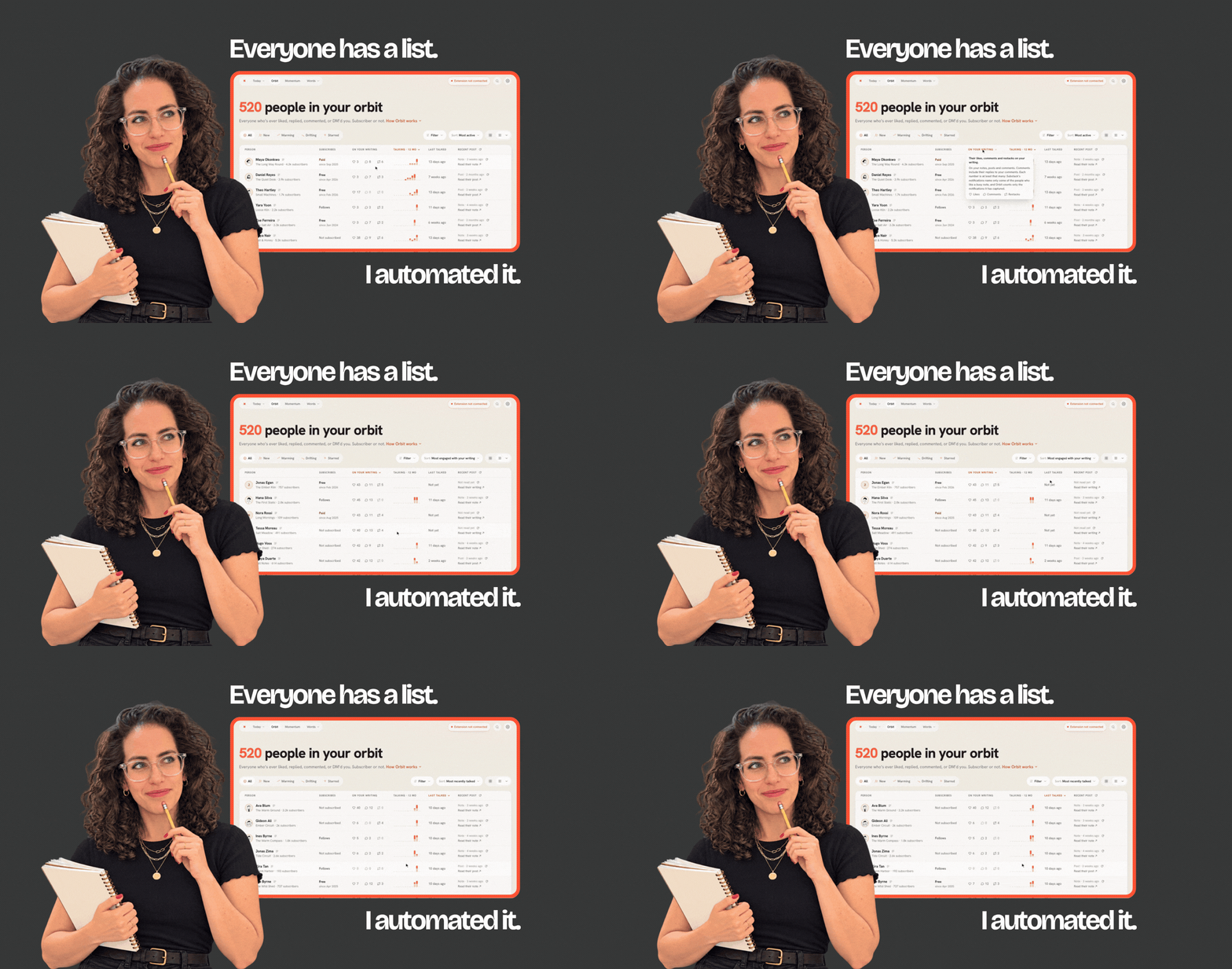
This feels almost out of pocket to say, but like so many of you, I’m building a business here on Substack.
Candidly, I came to Substack to reach - and learn from - potential customers.
And in the 11 months since, I’ve met SO many amazing people sharing their expertise and building something of their own.
Lately, I’ve been talking to a bunch of super smart coaches for ambitious, pivoting, business-building moms. And when they share their screens, I keep noticing the same thing.
They have The List.
A list of people they want to stay in touch with, and a system for making sure they actually do.
Sometimes it’s a spreadsheet.
When it’s not, it’s usually Notion.
And the more I see these lists, the more I talk to people, the more convinced I am that launching a business here has more to do with really getting to know 100 people than reaching 10,000 as quickly as possible.
Relationships are the foundation of our businesses, but it’s way too easy to lose track of who commented on your note yesterday, or whose DM you never answered, or who you haven’t seen in six weeks.
That’s why I built Orbit. It’s my encyclopedia of Substackers I can learn from, who can help me, who I can help, and... who I might sell to.
One of the first things I built was Daily Five.
Every morning, Orbit gives you five people worth reconnecting with, alongside their recent writing.
But a lot of coaches wanted to manage. the. whole. list - not just the five people a day that the Orbit algorithm thinks is most important.
So I built that too 😂
If you’re selling something on Substack, THIS is the habit that gets you customers.
Why do coaches keep a list of people to check on?
Because interacting with people is how you get readers and customers.
I learned about this list from .
He wrote up his whole daily system in My Substack Relationship System in 5 Minutes - a spreadsheet of the people he’s getting to know and the friends he wants to keep supporting, sorted by when he last connected.
With this system, I’m still adding new people, but I keep coming back to the people I actually want to know. The good relationships get more attention instead of constantly being replaced by whoever happens to show up in my feed.
That repetition creates familiarity.
You don’t just get to know people and wait for them to help you.
You help them.
Do that consistently, and you become someone people know, like, trust, and genuinely want to help.
Every day he visits about 10 people and leaves a real comment, a restack, or a DM if they already know each other.
Supporting them and NOT expecting anything back.
He didn’t buy from me because I ran him through a funnel.
He bought because I had shown genuine interest in him, there was real trust between us, and I clearly explained my offer when he asked.
And I swear it’s not just Rob - keeps the same kind of list in Notion. The people she’s getting to know, what they’ve talked about, where it’s going.
She told me - as if duh, Rebecca, it’s obvious - “all coaches have a system like this.”
That's when I realized Daily Five wasn't quite enough. I'd built a way to remind people who to check on, but what these coaches wanted was a way to manage The List themselves
Introducing Row View - or shall we call it Rob View?
How the Orbit “Row View” works
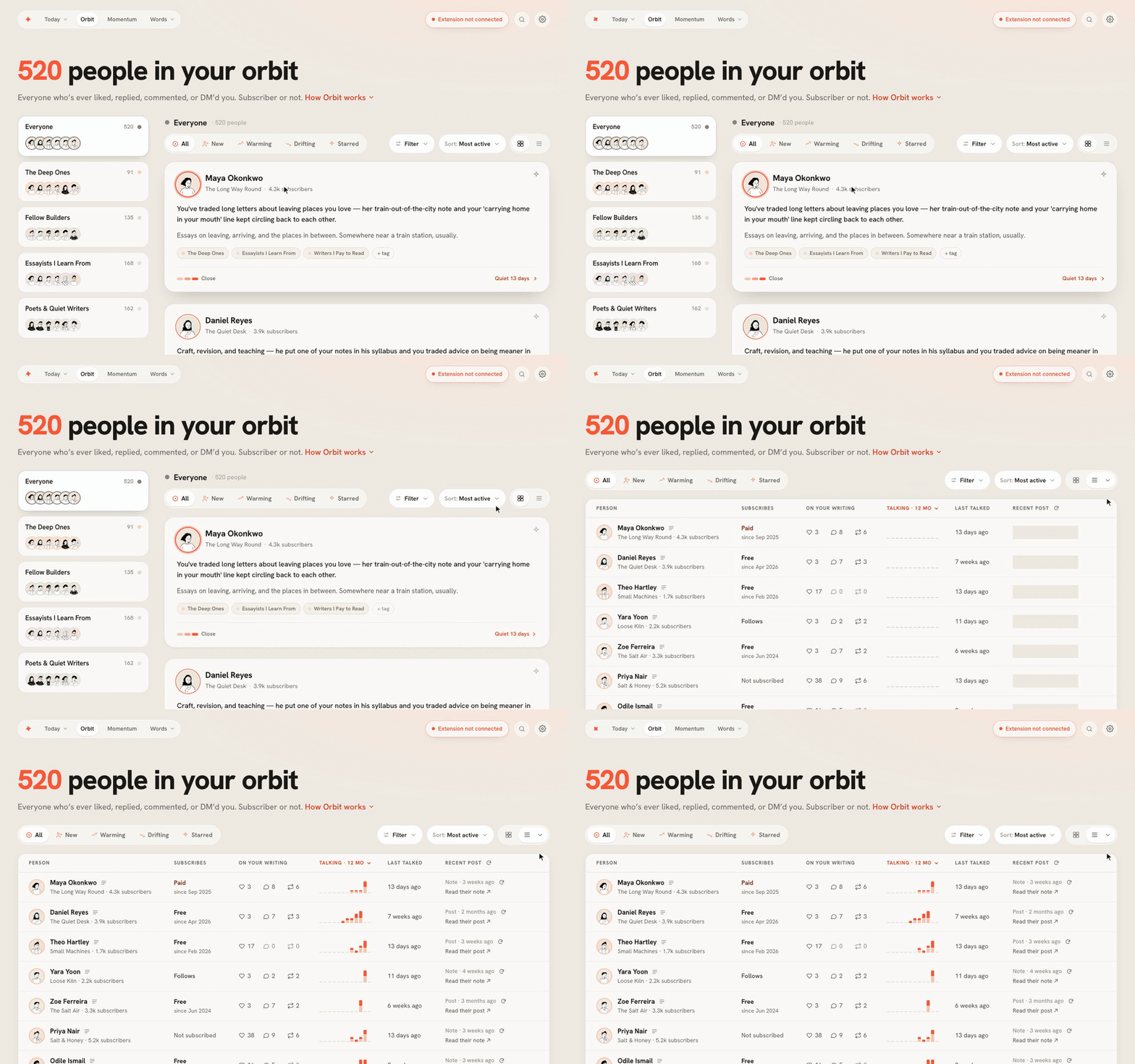
To toggle on the row view, go to the top right of all the people on Orbit, next to the filters. You'll see two little icons: squares and rows. Click the rows.
In the rows view, we hide the long summaries of your relationship - but you get something that looks a lot more like a spreadsheet. You can still get to ALL those details by clicking on a person’s name.
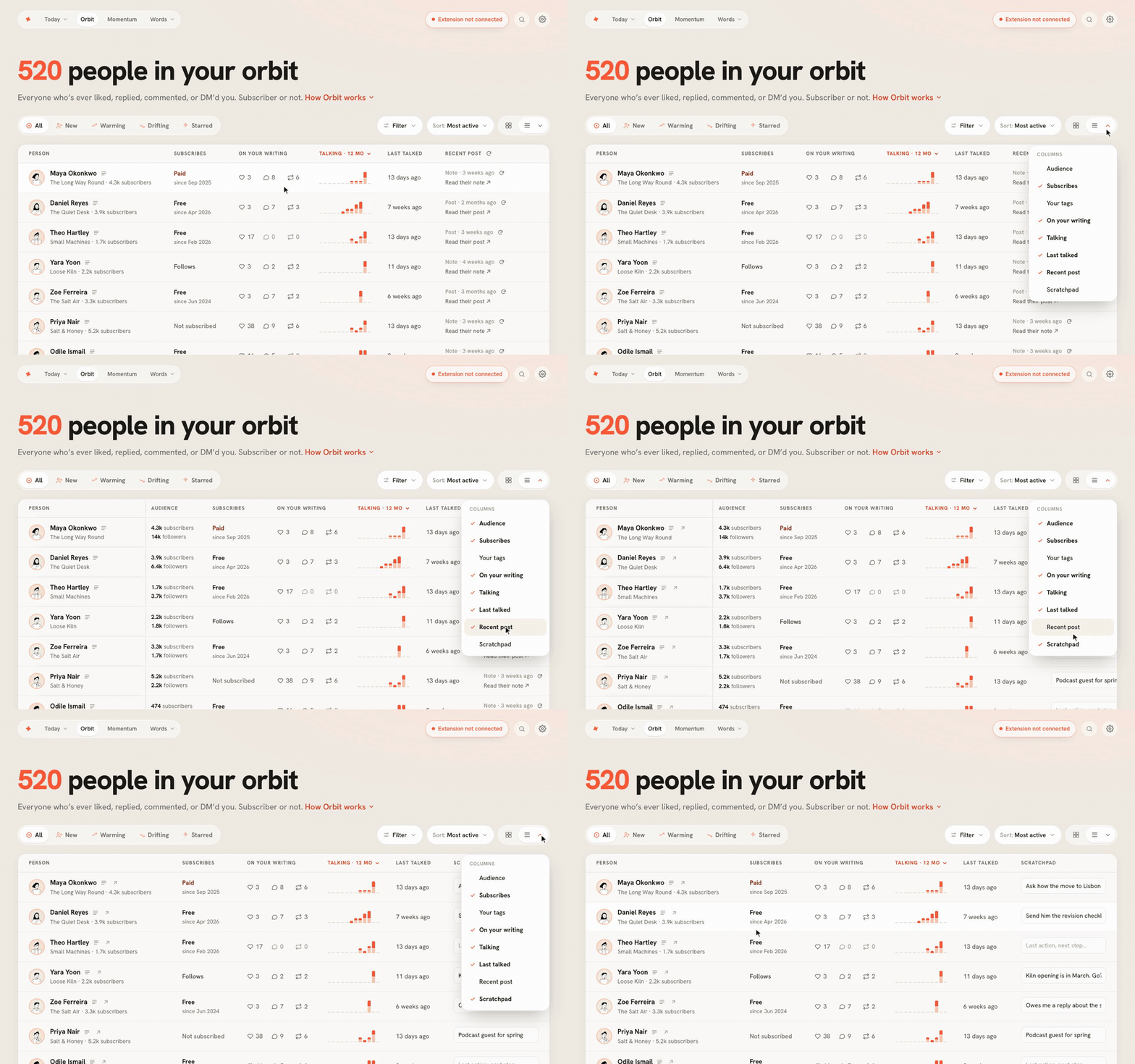
The little arrow next to the row icon controls what columns show up in the row view
- The size of their audience
- If they subscribe to you
- Tags you’ve added from Orbit, the Substack popup, or ChatGPT/Claude/Gemini
- Their likes, comments, and restacks of your writing
- How often you’ve talked in the last year
- When you last talked
- One of their recent posts
- A scratchpad for your notes!
Customizable to what you need to see.
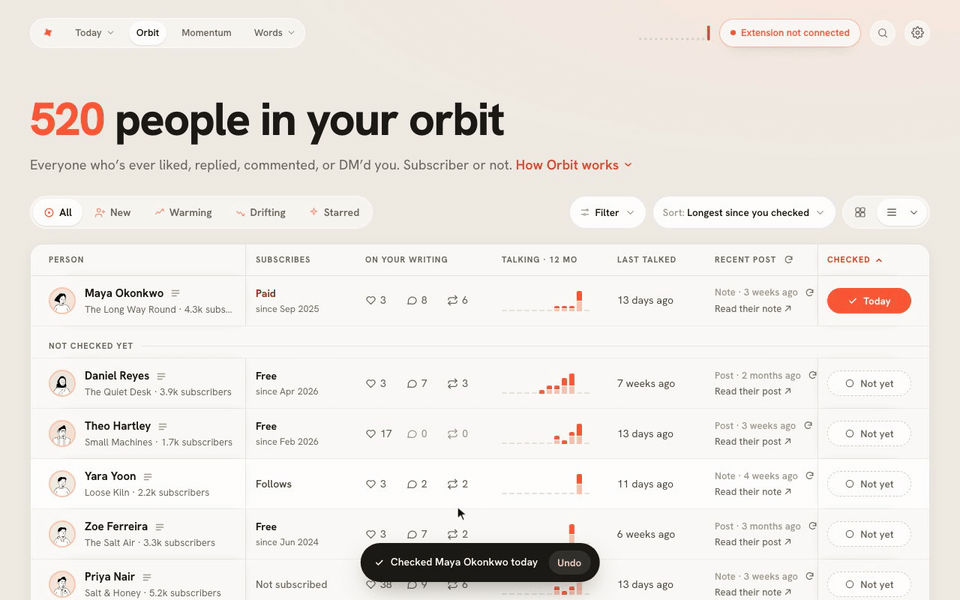
PLUS, a BONUS if you're serious about keeping track - go into settings and turn on “Checking on people” and you’ll see a checklist appear on the right side of the row view that you can sort by.
It’s completely manual by design - you have to click the button to check the person off. The button also shows up in the star menu you see within Substack.com when browsing, so you can check people off on the go, too.
You can filter to a tagged group, then sort by who's been checked on.
If you’re building a business on Substack, here’s how I’d set all this up:
- Tag your people. Clients, past clients, people you’d love to work with, peers you learn from. Add new friends as you go.
- Filter to one tag.
- Sort by when you last checked on them.
- Go read what the person at the top has been writing. Say something real. Check them off.
Tomorrow, the next person is at the top.
What’s wrong with a spreadsheet?
Nothing is wrong - people who built and manage their own spreadsheets tend to be very attached to them. (Ask me how I know… I work in EdTech.)
I know how hard it is to trust something that’s not the spreadsheet you control.
But ... a spreadsheet only knows what you copy into it. It doesn’t know who commented on your note yesterday. It doesn’t know you never answered that DM. Every Monday you’re copy and pasting your way back to the truth.
Orbit is like a spreadsheet but - it keeps itself up to date! No copy and pasting!
If you’re really attached to a spreadsheet, you could set up Claude or ChatGPT to reference Orbit and update a spreadsheet for you! DM me, I’ll show you.
Truly, I never use the default cards view any more with the summaries. I use this row view, and I use Orbit for ChatGPT and Orbit for Claude.
So … do you keep a list?
Is it a spreadsheet? Notion? Something else?
And how much time do you spend keeping it up to date?
Because I think the coaches are onto something here! Building a business on Substack isn't just about finding NEW people, but also about showing up for the people you've already found.
Introducing: Orbit.
If you’ve already got a List, Orbit can keep it up to date for you.
$12/month, no copying and pasting. 😉

Hi, I’m Rebecca 👋
I’m a tech leader and mom of two, writing about what works (and sucks) as I run a solo business in about two hours a day.
I help coaches, consultants, creators, and community builders who have deep expertise they want to bring to their audience.
Paid subscribers get:
- Full access to Orbit, for keeping track of who you’re meeting on Substack
- First dibs on Magpie, for bringing your expertise to your customers, clients, and cohorts when you’re not in the room
- My thinking on what you can build that people will actually USE
Wondering what to build for your business? How to use AI to get closer to your people, not further away? Let’s talk shop.