Everything I’ve built to help me remember people, keep up with conversations, and build relationships on Substack.
By Rebecca Spitzer
Published: 2026-10-03
URL: https://rspitzer.substack.com/p/what-the-heck-is-orbit
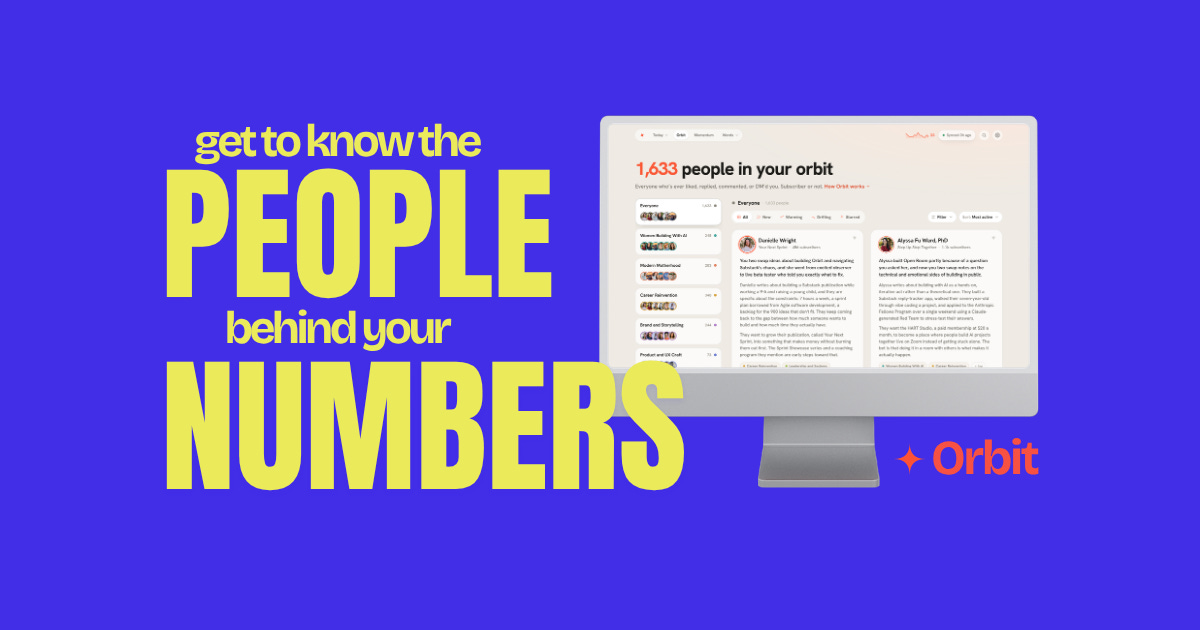
I have been talking about Orbit on here for months, but I have never actually put everything it does in one place.
So! What the heck is Orbit?
The short version:
Orbit helps you remember and grow the relationships you’re building on Substack.
I originally built it because I kept having so many good conversations with people here, but then completely losing track of who was who and what we talked about.
Did we already talk about the similarities in our cult-y big tech stories?
Did she mention she has kids the same age? And did we bond over how our kids like to eat tomatoes off the plants, or … was that someone else?
Are you the Emily I talked to about imposter syndrome?
I KNOW I talked to someone about pricing. Who was it?
Substack has SO many good people; the people who come here to write are so worth meeting.
It’s pretty bad, though, at helping you remember and maintain those relationships.
So the more people I met, the more ridiculous it felt that I checked my subscriber count every 10 minutes (just me?) but I couldn’t remember who those people were.
That’s where Orbit started.
Please subscribe if you’re building something of your own! I write about what I’m building, how I’m building it, and what I’m figuring out about work and freedom along the way.
Orbit remembers your people.
When you read on Substack, Orbit reads alongside you, building a picture of the people you actually interact with.
Not just Rebecca is subscriber #487.
More like: Who is she? Have we talked before? What have we talked about? What is she working on? When did we last talk? Is there something I said I’d come back to?
It pulls together conversations scattered across comments, replies and DMs, along with all the notes you want to remember yourself.
Because honestly - good conversations are easy to have.
Remembering all of them is not.
And memory is useful! I look stuff up all the time.
But pretty quickly I realized I didn’t want just an encyclopedia.
What I actually wanted was to be better at staying connected, and more intentional about meeting new people.
To participate.
Orbit helps me figure out who to talk to.
I believe pretty strongly that relationships are built in the comments.
And relationships are what builds your business.
At the same time… I can’t comment on every post I see, all the time, or read posts and comment on every new subscriber or every person I followed because I thought oh, she seems interesting, or every person I haven’t talked to lately, and every interesting stranger who keeps showing up in the same conversations I do.
It’s enough to make me not start commenting at all.
So every morning, Orbit gives me a Daily Five.
But it doesn’t just pick the five people that I talked to longest ago.
Orbit looks at what it knows about the people in my world (our conversations, how we know each other, what they’re working on, what they’re writing about now) and looks for a reason to talk today.
-
Maybe someone I used to talk to all the time just launched the thing she’s been building for four years.
-
Maybe someone I had one great conversation with just wrote about the exact thing we talked about.
-
Maybe there’s someone I’ve never talked to, but we keep showing up in the same conversations and clearly have something in common.
Orbit tells me why this person, why now, and gives me enough context to remember who they are before I go say hi.
Five places I might genuinely want to show up today. Because you don’t need to talk to EVERYONE! You just need somewhere to start.
And Daily Five isn’t the only way Orbit helps me notice people I might otherwise miss.
Welcome lets me actually look at my new subscribers and followers, what they’re all about, and whether we’ve already talked before - so I can decide who to reach out to.
Following reminds me who I chose to follow. Substack… why is it so hard to find and explore that list?! I’ve followed so many people thinking I like her, I want to know her and then immediately forgot and never saw them again.
Orbit helps me stop ghosting people.
When I first built a tool in Orbit to see comments I didn’t reply to, it found 388 unanswered replies.
I didn’t need 388 to-do items… but buried in there were questions I had meant to come back and write a thoughtful reply to! Comments I either never saw … or more likely, I read bleary-eyed in bed at 6AM and then promptly forgot about in the morning rush.
I am never going to be an Inbox Zero person, but I do want to be someone who follows through.
So Orbit’s Open Replies view lets me find things like:
-
They asked you something.
-
They wrote something long.
-
You haven’t liked it.
Because if you’re like me - you MEANT to answer!! But they don’t know that.
Oh, and I also altered the Substack Inbox - because we can’t mark DMs unread?! but I need to track messages. Needs reply. Waiting. Follow up. Done.
More about that here.
And then, somewhere along the way… Orbit presented an opportunity that I hadn’t originally built it around.
Remembering all my words.
Some of my best thinking on Substack is NOT in my posts. It’s buried in comments.
Someone asks me something, I type a response without overthinking it, and three weeks later I’m sitting down to write and thinking:
Wait. What did I say about freedom?
Where was that comment about pricing?
Didn’t I have a good line about subscriber count?
I already did the thinking… I just can’t get back to it.
So Orbit now keeps my notes, articles, comments AND replies too.
I can search them directly, or ask Claude or ChatGPT something like, What have I already written about freedom?
I don’t have to remember where I said it, because Orbit remembers.
Which brings me to the part of Orbit I’m actually most excited about.
I can ask Orbit questions.
Once Orbit knew my people, conversations, words and Substack data, I realized… wait.
What can I analyze now?
Not just how many subscribers did I gain?
but…
-
Before I left for vacation, who did I tell I’d call when I got back?
-
Who have I already talked to who might be a good design partner for this?
-
What have I already said about this idea?
-
Is my engagement actually improving, or am I just posting more?
-
Where is my growth actually coming from?
Orbit can connect to Claude or ChatGPT, so I can ask questions across information that normally lives in completely different places.
This is 2026, y’all - we can move beyond a dashboard that tells you what happened. Orbit + Claude or ChatGPT help you ask WHY.
Here’s a bunch more ways I use Claude and ChatGPT with Orbit.
Want to see your Orbit?
I’ve been building this in public for months, and finally - for the next week, you can actually TRY IT with your own Substack!!
Connect your account and see who Orbit remembers. Who you’ve talked to. Who’s drifting. What conversations you forgot. What you’ve said. What it notices that you don’t.
Orbit is a part of my paid subscription, $12/month.
And it’s free to try - through Friday, Oct 9 - with a 7-day trial.
postscript: What’s in a name?
I like to think of the intelligent, thoughtful people here on Substack like planets: each with our own gravity and momentum, orbiting each other, pulling in and out of each other’s space, building on each other’s ideas.
“I’m a creator and everyone else is listening” or “I’m a community host and everyone is in my room” are the wrong models.
We’re all orbiting each other. 💫
Please subscribe if you’re building something of your own! I write about what I’m building, how I’m building it, and what I’m figuring out about work and freedom along the way.