The real meaning of SpaceX and Elon Musk
By Rowland Manthorpe
Published: 2026-06-14
URL: https://rowlandmanthorpe.substack.com/p/the-machine-that-watches-the-world
Inevitably, the coverage of the SpaceX IPO was dominated by Elon Musk and his money. The world has its first trillionaire and a very peculiar one at that.
But while all this is important, it misses the true meaning of SpaceX, which is the world-historical change it is enabling. Something is happening in space that is profoundly shaping life on earth, especially in war.
This shift is the subject of my latest film.
I started reporting it after it became clear that the US was using AI in its attacks on Iran and, at first, I thought it was going to be a piece about artificial intelligence. But as I dug further, it became clear that AI was just one part of the picture. It was the “brain” of a much bigger machine.
A machine that is being built to watch the world.
This might sound overblown, but if you watch the film you’ll see that it isn’t. As a former White House and Pentagon official told me, the aim is to watch the world “without blinking” and be able to “close the kill chain” in minutes if not seconds. In US intelligence they call this capacity “constant stare”. And they are already on their way to achieving it.
Video is a team game so I couldn’t have made this without my brilliant colleagues, editor Minty Gow, producer extraordinaire Eleonora Chiarella and camera operators Charlie Brunskill and Raphael Rosenhagen.
Please do give it a watch.
A word on one part of the film: the final chapter on satellite capacity in the UK. This is another aspect of the question that was on everyone’s lips at London Tech Week last week – can the UK be “sovereign” in technology?
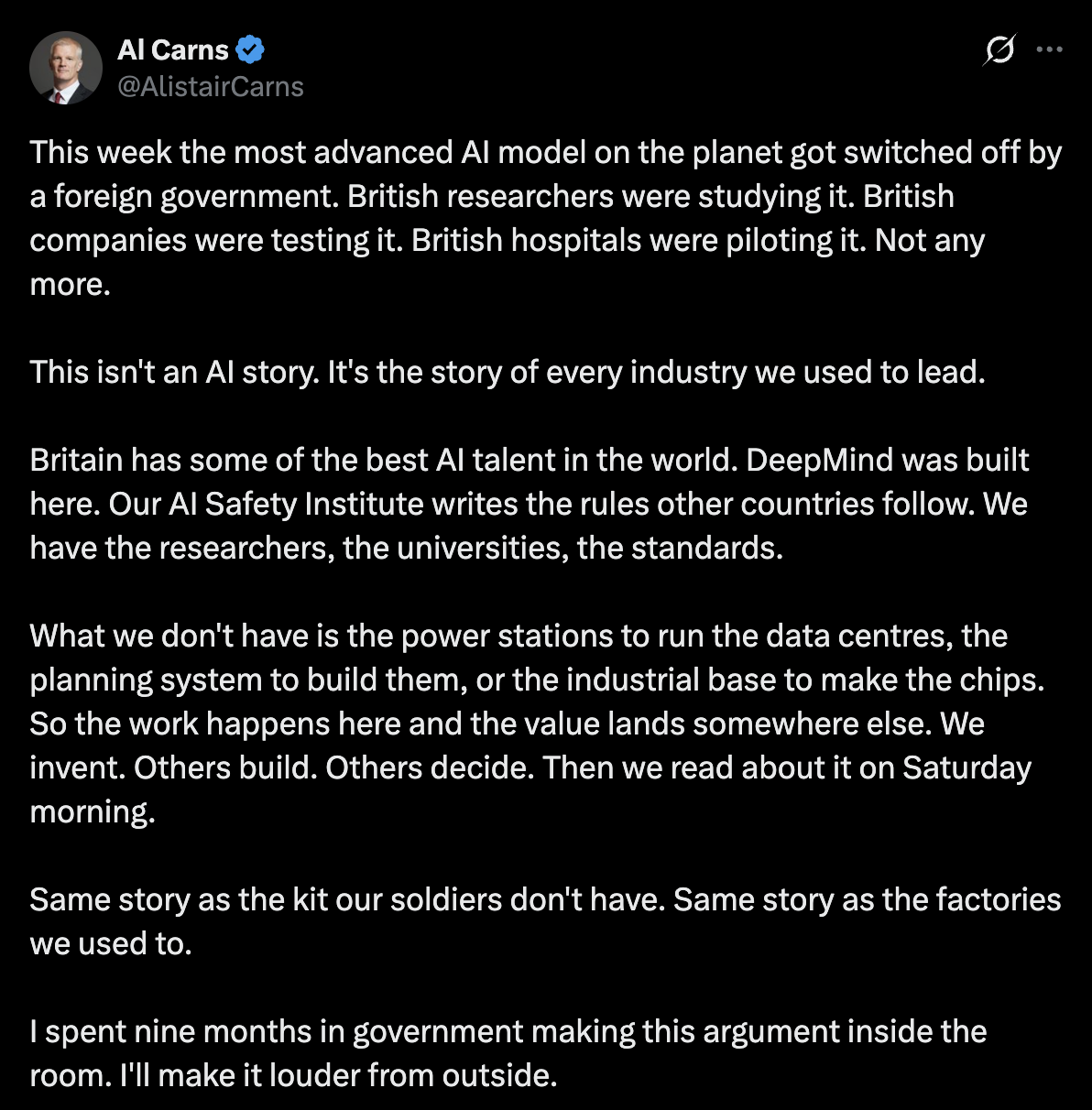
That question was put into sharp focus yesterday when Anthropic announced that it had been ordered by the US government to cut off access to its newest models for any foreign national, anywhere – both inside and outside the US. For Anthropic, this meant cutting off access even for its own foreign-national engineers. The only way to comply was to disable Fable 5 and Mythos 5 for everyone.
Anthropic say this is a misunderstanding and the issue may well be resolved in a few days or weeks. But to everyone outside the US the lesson is clear: you do not control your access to AI. There is a switch to your technology and it sits on a desk in Washington. As an American guest put it at a high-level dinner during the Greenland crisis when they were asked what would happen if European countries really tried to face down Trump: we’d just turn your tech off.
It’s not just in a crisis that this kind of dependency matters. This week a group of thinkers published a scenario called “Europe 2031”. (It says a lot about our current moment that this kind of “scenario” – essentially a short story drawing on real life – has become a key element in the conversation.) I don’t agree with everything in Europe 2031 but as a big picture summary it seems highly plausible. (It’s also very well written which makes a change). To give you a sample:
AI will keep getting more capable. There is no good reason to believe it will stop at human level. It will rearrange labour markets, security architectures, and the balance of power between continents. Europe is dependent and unprepared. If the ship is to be turned, it must be turned now.
The reaction to the news about Fable and Mythos shows that some UK politicians understand this, and some of the government’s recent announcements suggest it does too. Although they are often badged as “sovereign”, they are better understood as attempts to build up the UK’s leverage in key areas of the AI stack, including the number of companies at the frontier.
When the former head of MI6 Alex Younger was asked what he would like to be able to push back against the United States or China, he replied: “Twenty global-scale technology companies in Europe and the UK.” This is why, despite the concerns about “picking winners”, it is probably worth trying to give a helping hand to companies that have the potential to become trillion-dollar tech firms. The pay-off is just too late not to attempt it.
But as I’ve said before, the UK doesn’t have a “getting it” problem. It has a delivery problem. The defence investment plan “got it” too. But as this week’s resignations of the Secretary of Defence and the Armed Forces Minister show, that doesn’t matter when you can’t actually do it.
Thanks for reading. Subscribe for free to receive new posts and support my work.