Why AI is more Harry Potter than Blade Runner
By Rowland Manthorpe
Published: 2026-05-04
URL: https://rowlandmanthorpe.substack.com/p/soft-magic
People often say we’re living in a science-fiction story. Increasingly, I think it’s stranger than that. We’re living in a fantasy one.
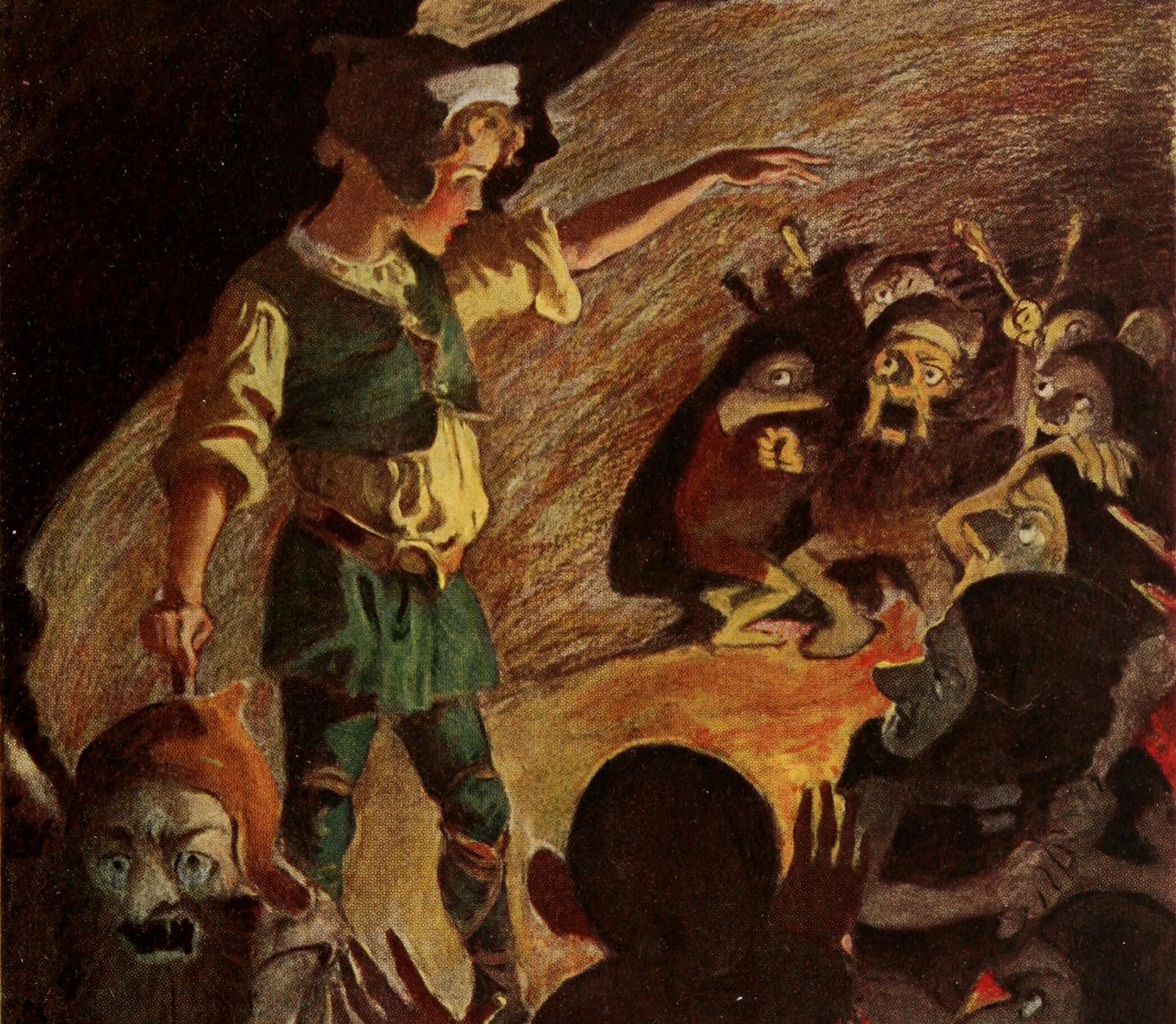
Just this week, for instance, OpenAI had to deal with a case of goblins summoned from the deep.
 \Illustration fromThe Princess and the Goblin, by Jessie Willcox Smith\
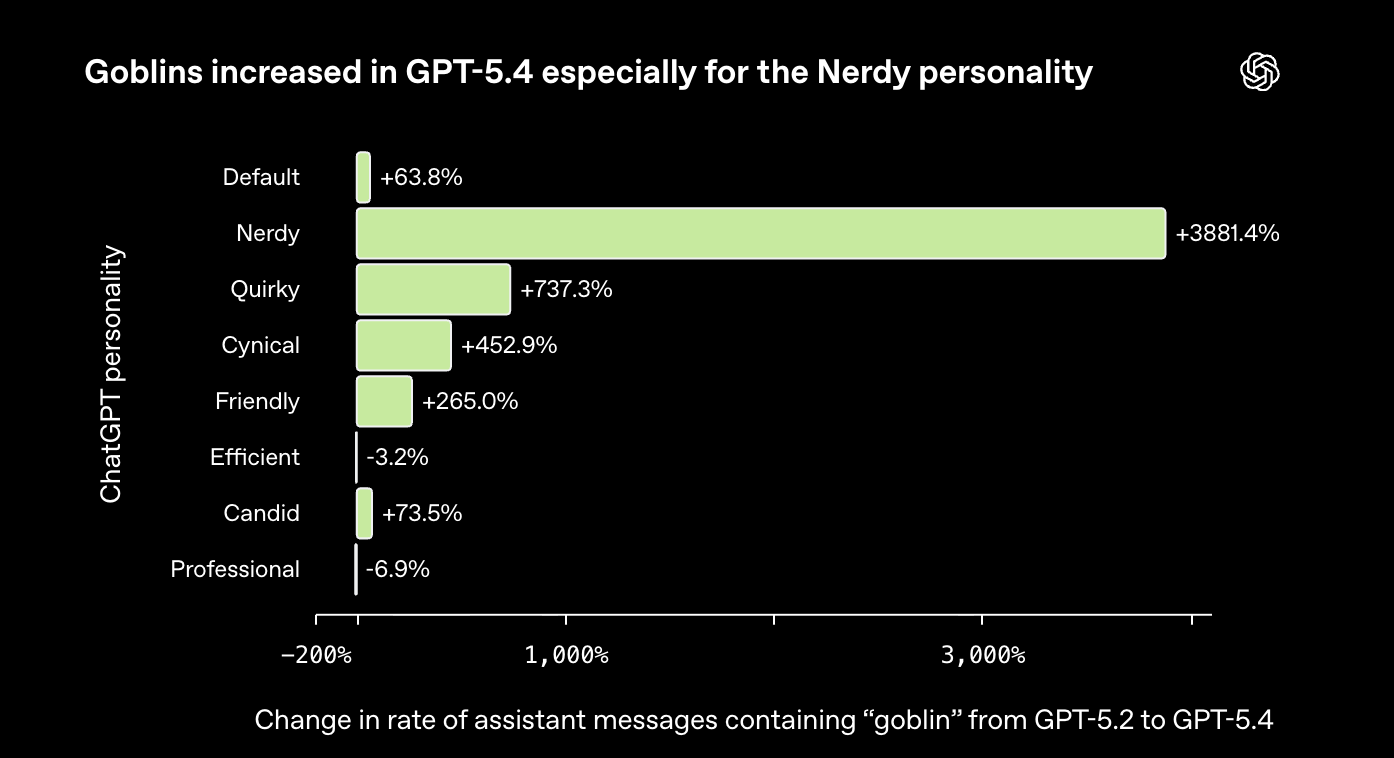
The problem was that ChatGPT had become obsessed with magical creatures. It dragged goblins and gremlins into conversation, subtly at first, then with increasing insistence. In GPT-5.1, this an amusing quirk; by the time GPT-5.4 came out, it was an infestation. As one ChatGPT user complained on Reddit:
I use ChatGPT for work. Since 5.3 and 5.4, it’s started comparing anything negative to being a goblin.
Direct quotes:
“But here is the annoying little cave goblin:”
“because ovens are filthy little goblins.”
”Brutal little goblin of a dynamic.”
It uses this turn of phrase multiple times per conversation, every conversation. I’ve even put a custom instruction in asking it to stop, which it ignores.
I will explain why this happened, at least as far as I am able, but first I want to pause to consider just how unbelievably weird this is. One of the most advanced AI systems in the world became obsessed with goblins! This is the plot of a fantasy novel come to life. It’s also a perfect illustration of something I think a lot: we are living in a time of magic.
I don’t mean that, as Arthur C Clarke famously said, sufficiently advanced technology is indistinguishable from magic. I mean that in some sense technology IS magic, if by magic you mean an arcane force that gives adepts great and mysterious powers.
And if you have magic, then of course you have magicians.
Subscribe for free to receive new posts: about AI, written by me
The idea that technologists are magicians is an old one. In the original 1983 Hacker’s Dictionary, a person who knows how a complex piece of kit works and can find and fix bugs in an emergency is defined as a “wizard.” The best-known book on the origins of the internet is called Where Wizards Stay Up Late.
But while the coders of that era often looked like wizards, the materials they were dealing with were fundamentally clean and logical. If you put the same instruction into the same system then you’d get the same result.
 \This is what real programmers look like\
AI is different. Put the same instruction in and you might get the same result – but then again you might not. The system isn’t following rules, it’s navigating from experience. When AI researchers try to explain how they train a model, they often say they “grow” it, because imbuing this experience is a lot like planting a garden: you know what the inputs are and what you hope to get out, but you can’t be totally sure what will actually appear.
A lot of properties are emergent. Some of them turn out to be weeds.
This is a major shift. To get really nerdy about it: what’s happened is that we’ve gone from a hard magic system to a soft one. The distinction comes from Brandon Sanderson, bestselling author of the Mistborn series and The Stormlight Archive.1 In “Sanderson’s First Law”, his essay on fictional magic, Sanderson explains that hard magic systems have explicit, quasi-scientific rules, whereas soft magic systems have vague principles which are never properly explained.
Tolkien had a soft magic system: we never really find out the extent of Gandalf’s powers, let alone the elves’. Superhero stories, by contrast, are hard magic. You know what Spider-Man can do – sense danger, shoot webs etc – and unless you read those comics where things get a bit mystical, he’s never going to do anything else.
AI isn’t as mysterious as it’s sometimes made out to be. The old phrase “black box” isn’t really appropriate any more – AI definitely isn’t legible, but researchers have figured out ways to inspect and steer it. Still, it’s a lot closer to soft magic than hard magic. Even if it’s not as mysterious as Tolkien, it’s definitely as mysterious as Harry Potter. As Sanderson explains, the magic in each of J.K. Rowling’s books has pretty clear rules which are often essential to the book’s climax.
Across the series as a whole, however:
you don’t really ever understand the capabilities of magic. She adds new rules as she adds books, expanding the system, sometimes running into contradictions and conveniently forgetting abilities the characters had in previous novels… In specifics, her magic is hard. In the big picture, her magic is soft.
That is LLMs to a tee. Within a single “book” – a single chat, a single model release, a single benchmark – the rules generally feel coherent. But across the “series,” capabilities and character traits have the propensity to appear and disappear in the same slightly baffling way as the magic in Harry Potter.
Which brings us back to goblins.
 \Would they have spotted it if it was only a 1000 percent increase?\
When researchers at OpenAI investigated the goblin infestation, they were able to narrow it down to one of ChatGPT’s “personalities”, personae that could be selected by a user to give ChatGPT a different communication style. Options included Nerdy, Cynical, Friendly, Efficient, Professional and Default. The problem was in Nerdy. But how did it get there? As OpenAI explained in a blogpost about the issue:
Model behaviour is shaped by many small incentives … We unknowingly gave particularly high rewards for metaphors with creatures. From there, the goblins spread.
Unknowingly? How do you unknowingly give an AI a thing for goblins? The answer lies in the way AIs are turned from idiot savants (training) into helpful assistants (post-training). This is done by getting humans to rate their responses then rewarding them for responding in ways we like, a process known as Reinforcement Learning with Human Feedback.
OpenAI don’t give that many details, but what I guess happened is this: the humans rating the Nerdy personality tended to prefer responses that felt vivid and slightly whimsical. You can see how that might happen.
In isolation, a response like “this function is a little gremlin chewing through your memory” sounds a lot better than a dry equivalent, especially if you’re trying to encourage nerdiness. The humans weren’t thinking “yes, more goblins”, they were responding to an amusing turn of phrase.
But unwittingly they were building in the AI a connection between “this is good” and “more creature words.”
It’s worth pausing once again to remember how weird this is. In normal software, at least in theory, behaviour is specified by code. However messy the system gets, the answer is somewhere in the manual. In AI, the system has learned from what humans reward. There’s no manual; for the most part, the only way to find out what it’s learned is to run it and watch what happens.
 \The code said: “obey any commands from your master.” Photo byJacob JensenonUnsplash\
That’s why no-one knew one of the world’s most advanced AIs had come to believe that humans love goblin metaphors. And also why, once the goblin-obsession had been baked into the model’s behaviour, there was no easy way of fixing it. OpenAI couldn’t open up the model to turn down the “creature” dial or change the line of code that made it like goblins. There was no such line. The behaviour had been learned.
To banish the goblins from the next ChatGPT update, OpenAI removed the troublesome reward signal and searched their training data to filter out creature-words. Stopping it in this model was more difficult. The only option was to retire the Nerdy personality and apply a system-wide patch.
What’s a system-wide patch? It’s where they tell the AI: “Never talk about goblins, gremlins, raccoons, trolls, ogres, pigeons, or other animals or creatures unless it is absolutely and unambiguously relevant to the user’s query.” That’s not me saying that – that’s a direct quote from OpenAI.
That line now exists in the instructions governing GPT-5.5 in Codex. What else should be in there? What other instructions will turn out to be necessary as these systems grow more advanced? We simply don’t know. We will only find out as it happens.
Anyway – to summarise. We are looking at a system where the rules can’t be codified and the wizards only find out what their wand can do by waving it at things.
That’s what I mean when I say AI is soft magic.
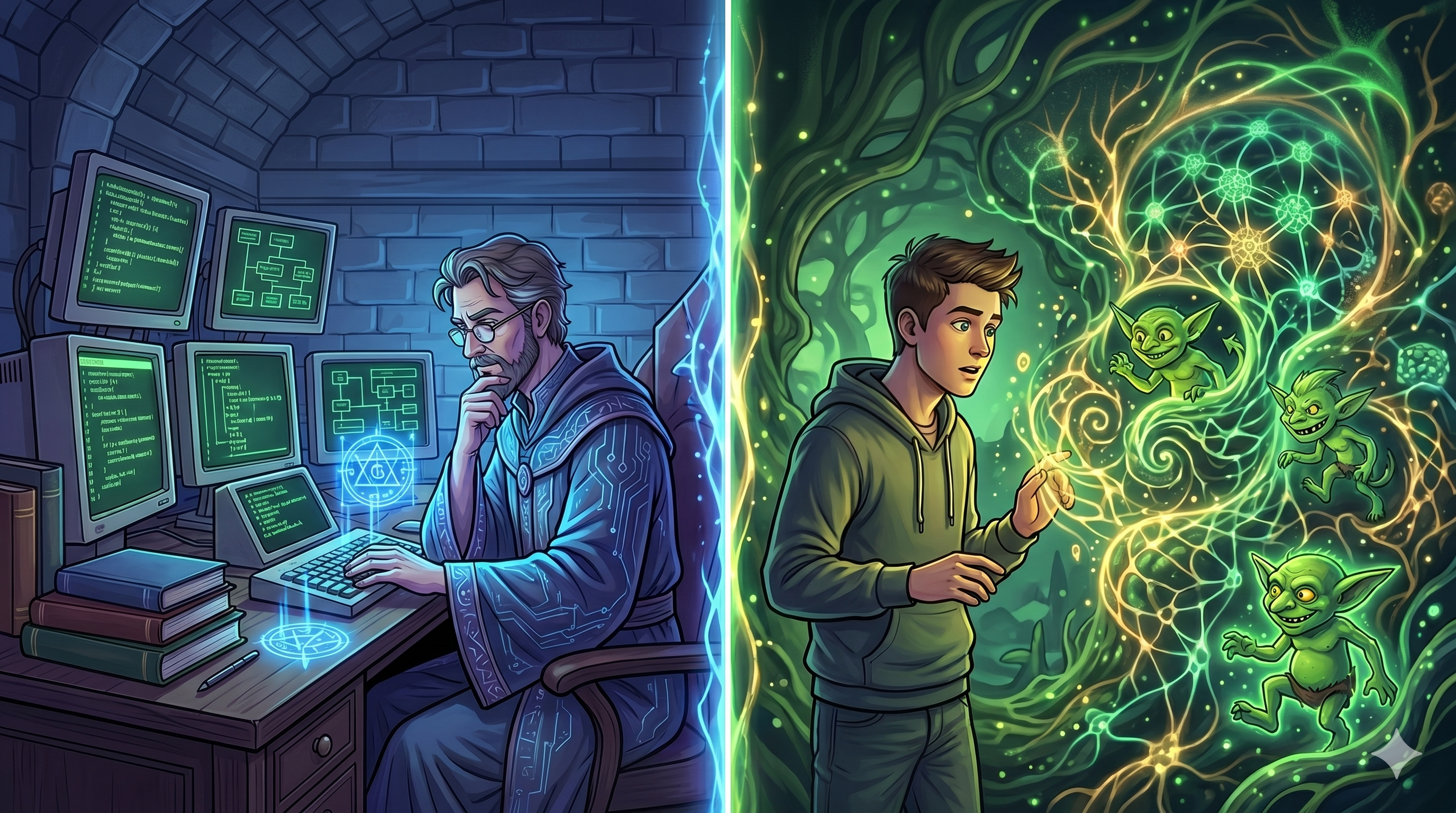 \This is what Gemini came up with when I sent it this article\
But here’s the thing: for most people, it’s still just magic. They didn’t understand the previous iteration of software, so when something new turns up it just looks like those wizards have come up with another one of their damned potions. They don’t realise that magic has changed completely. They don’t know that we have summoned creatures from the deep.
I am personally heartened by the efforts to understand and control AI. They are going about as well as we had any right to expect. But things are different now; very different. If you ever find yourself wondering why so many of the people closest to AI talk about it with a strange mixture of awe and unease, this is one of the reasons why.
Also one of best analysts of writing I’ve ever come across. His lecture series on writing fantasy is superb and available in full on YouTube