Scroll to the end for a rant about children's books
By Rowland Manthorpe
Published: 2025-12-14
URL: https://rowlandmanthorpe.substack.com/p/ai-on-ai-negotiation-australias-social
Hello there. I’m Technology Correspondent at Sky News and this is my weekly guide to the strange ways technology is changing culture, politics and economics. It’s mostly things I think are interesting, sometimes with a bit of commentary thrown in as well. If you see something you think I’d like, please do send it over
Prohibition all over again?
I tried to fit the contentious and frankly mysterious research on social media and young people into five minutes (three and a half minutes if you caught it on TV). Impossible to take in more than a small part but hopefully you get the flavour of it.
There are no perfect analogies in tech and trying to stuff new ideas into old boxes is often unhelpful; nevertheless I do think it’s interesting to compare social media to alcohol. Both are widely used, socially embedded and both cause plenty of problems. But in both cases it’s not whether you use it that’s the problem, it’s how you use it (or who you become when you use it).
The history of alcohol tells us that targeted restrictions can be important and effective, but blanket bans are bound to fail. Question is: which category does the Australian social media ban fall into? As far as I can tell, it’s both.
AI-on-AI negotiation - nasty or nice?
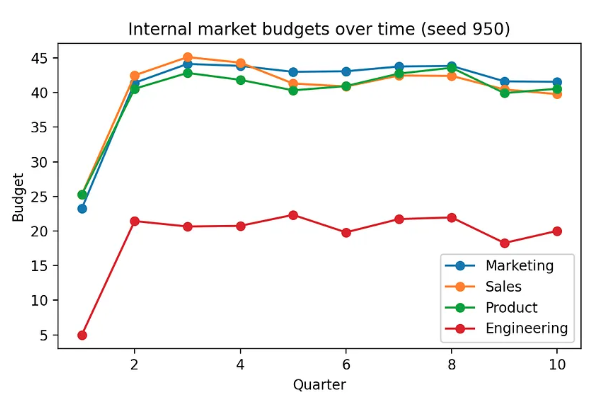 \The AI agents didn’t like engineering. Via Rohit Krishnan\
One of the most interesting discussions in tech at the moment is about the future interactions of AI agents. One question that’s received a lot of attention is how they’ll change markets: once we hand business over to AIs, will they produce the frictionless commerce of economic fantasy?
The results of two experiments in AI-on-AI negotiation, published this week, suggest that they won’t, albeit for very different reasons.
The first experiment, by Rohit Krishnan, put agents into four departments in a simulated company – Marketing, Sales, Engineering and Support – and told them to negotiate between themselves for budget to do their jobs. Lured by the prospect of short term gains, the agents funded Marketing and Sales and starved Engineering, even when they were encouraged to do the opposite.
In other words: AIs did the same thing as humans. “The agents,” Krishnan writes, “perfectly replicated the dysfunction of real companies.”
The second experiment, by Alex Imas, Kevin Lee and Sanjog Misra, asked agents to strike a deal over a used Toyota Camry. Once again, expectations that the negotiation would be straightforward were confounded – only this time for the opposite reason that they were in Krishnan’s set-up.
In order to create a baseline for their experiment, Imas, Lee and Misra asked humans to negotiate over the car; when they did, the humans tended to bear in mind the need to make a “fair” deal, so their arrangements clustered around 50/50 splits.
The AIs didn’t care about this convention. As a result, their outcomes varied wildly compared to human ones. As Imas puts it: “AI-agentic interactions, if anything, generate more dispersion and heterogeneity in economic outcomes.” In other words: once AIs got involved, things were far more surprising.
The difference between the two approaches was in the role of prompters – that is, us. Krishnan’s experiment largely let the agents get on with it; as a result, he found them “much fairer and much more passive than we would imagine.” By contrast, Imas et al’s asked humans to set system prompts defining the roles of the agents. This allowed them to put aside norms like fairness and negotiate aggressively.
This strikes me as a more likely scenario for a future AI economy; if so, I don’t think it’s obvious who will benefit. One finding Imas et al observed was around the role of gender: women did much better in AI-based negotiations, even though the AI had not been told their human operator was a woman. Why? The authors speculate that this is down to “machine fluency”, that is, “the ability to align agentic objectives with one’s own through natural language.”
In other words: it all depends who’s in charge and how good they are at management. It was ever thus.
Naval warfare in the age of AI
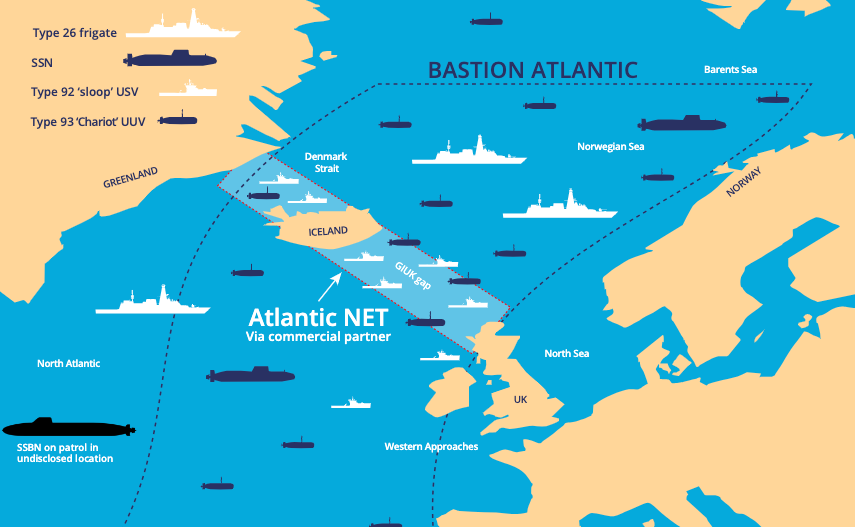 \The proposed location for Atlantic Net. This was where German ships tried to break out during the Second World War. Via Navy Lookout\
One of my favourite books about technology is The Shock of the Old by David Edgerton, which argues that the constant focus on innovation obscures the fact that most of the tools we use are old or even ancient. It’s an important insight – as a glasses wearer I am daily dependent on a technology that dates back to the thirteenth century – but even if you observe more change than Edgerton you can still see how new ideas repeat the patterns of old ones.
During the Cold War, the United States Navy developed the Sound Surveillance System, a secret network of underwater microphones that listened for Soviet submarines. Now the idea is being revived in the form of the Atlantic Net, a network of sensors that will be able to observe the new stealth wave of Russian nuclear submarines.
Whereas the Sound Surveillance System relied on fixed arrays, the Atlantic Net will use autonomous underwater gliders to gather sensor data. It’s as new as it gets (at least it should be; naval procurement may yet have a say).
But still the resonances with the past remain. According to the Financial Times, the new system will focus first on the Greenland-Iceland-UK gap, the maritime choke point that played a crucial role in the Second World War.
Quick links
- How do large language models interpret words relating to probability like “unlikely,” “probably,” or “almost certain”? About as well as we do. Adam Kucharski
- Drivers in London are covering their numberplates with plastic film so they can’t be read by traffic cameras and it’s costing Transport for London £950m a year in lost fines. Every technology creates its adversarial counterpart. London Centric
- A gigantic review of the year in AI. Great starting point if you’re trying to dive into this stuff and wondering where to begin. Less Wrong
- Or if you’re more interested in the political debates about AI, former government advisor Matt Clifford has a mini-series with Rory Stewart. If there’s a better person than Matt to speak on behalf of tech, I can’t think of them. Rest is Politics
- Not the normal topic for this newsletter, but I am constantly appalled by the poor quality of children’s books nowadays. It’s impossible to say this without sounding like a grumpy old man, but they really are much worse than they used to be. This Instagram post summed up a lot of my feelings (and gave a recommendation for the kind of book I like). Jenny Kovar