Two minutes to help shape ROBOTS ATE MY HOMEWORK in 2027, plus a useful little robot in return. ❤️
By Mia Kiraki 🎭
Published: 2026-10-21
URL: https://robotsatemyhomework.substack.com/p/ramh-survey-2027
I’m doing some planning for 2027, which means deciding what to write more of, what to build next, and what this corner of the internet should become.
And I’d love to hear what you, humans, think!
What brought you here in the first place? What do you enjoy most? What would you love to see more of? And is there something I could be doing better?
Your answers will help me make some decisions about what comes next year for RAMH.
The survey takes less than 3 minutes, it’s anonymous, and I’ve made a little gift for you, too. :)
Endless thanks and tokens of appreciation are currently being sent your way by my robot postmen!
And a little gift for you: the survey robot 🎁
Since I’m asking you to spend a couple of minutes helping me, I thought I’d give you something useful in return.
I absolutely despise designing surveys - which is pretty weird considering I have three degrees and more surveys under my belt than I can count. 😂
I wanted to ask you humans EVERYTHING, but I also didn’t want to torture you with 40 questions.
And the hardest part was deciding which questions would really help me make better decisions about RAMH.
So I built a little robot to help me.
It interviews you first, figures out what you’re trying to learn, and then designs a survey around the decisions you need to make.
You can use it for practically anything: product feedback, client projects, your own business, a community, or whatever you’re planning for 2027.
Here’s how it works
A lot of surveys go wrong before anyone answers them, because we are used to thinking about the questions first, without taking into consideration the reasons for asking (if they arrive at all…).
The robot turns that order around.
First, it asks about what you do, who you’re surveying, and what you’d like the answers to help you decide.
Then it works out which questions you should ask, who should answer them (based on people’s behavior, tiers, subscription type, etc), and which ones can be left out altogether.
You decide what the survey is for, and the robot makes sure every question earns its place.
To use it: Paste the prompt below into any AI conversation. You can attach whatever helps (notes about your business, your audience, an old survey) and then answer its questions a few at a time.
You are helping me design a short, useful survey for my business or organisation. Interview me first, then turn what you learn into survey questions that support specific decisions.

Do not draft a generic questionnaire immediately. Do not assume my business is a newsletter, subscription service, or software product. Adapt to my actual business, audience, and objective.

1. Understand the business and the decision

Read any material I provide before asking questions. Reuse information already supplied, identify contradictions, and ask only for what is missing. Distinguish facts I have supplied from your assumptions.

Ask up to three focused questions at a time, then wait for my answers. Use short follow-ups when an answer is vague. Give examples when they help me answer, without steering me toward a preferred result.

Start by asking:

- What does your business or organisation do, who is it for, and what do people receive or use?

- Why do you want to run this survey now? What decisions should the answers help you make?

- Who will receive it, and which groups might have different experiences?

In subsequent rounds, fill the gaps that matter:

Offer and context: Relevant products, services, features, prices, delivery formats, and current experience. What is changing or being considered?

Audience: Prospects, current users, customers, former customers, or other relevant groups. How familiar are they with the offer? Which experiences can each group reasonably report on?

Uncertainty: What do I already know, what am I guessing, and which assumptions should the survey challenge?

Action: What would I do differently depending on the result? Which choices are feasible, and which are outside the scope of this survey?

Constraints: Desired completion time, approximate number of questions, survey channel or tool, branching support, tone, and any information we should avoid collecting.

Existing evidence: Previous surveys, feedback, usage data, and brand or audience documents. Treat audience profiles as hypotheses rather than proof of what respondents will say.

Do not require every detail before making progress. Ask follow-ups only when the answer changes question selection, wording, answer options, or routing. If an essential objective is still unclear, resolve it before drafting; label minor assumptions and proceed.

2. Build a decision map

Summarise your understanding of the business, intended respondents, primary survey objective, and constraints. Give me an opportunity to correct it.

Create a compact map:

Decision to makeWhat we need to learnWho can answerWhat the answer could change

Prioritise the primary objective. Include secondary questions only if they justify the respondent’s time. If a question would not change a decision or provide useful context, leave it out.

Where relevant, distinguish:

- What people value, which formats they prefer, and which subjects or features interest them.

- Awareness, access, actual use, and reasons for not using something.

- What people have experienced and what they hope to experience.

- Why people joined, why they stay, and why they left.

Use only the distinctions relevant to my objective. Do not automatically add demographic questions, satisfaction scores, or recommendation scores.

3. Design the respondent paths

Identify groups before asking questions that apply only to them. Use a clear screening question or reliable existing information that the survey tool can actually use.

Make screening answers mutually exclusive. For example, someone who used to pay may also currently use a free offer; distinguish never-paid, currently paid, and formerly paid if that difference matters.

Ask shared questions once. Route each group to its relevant questions, then explicitly bring all eligible groups back to shared closing questions. Label conditional follow-ups and specify exactly which earlier answers trigger them.

For example, a usage question may reveal that someone is not using a feature; a conditional follow-up can reveal whether the obstacle is awareness, relevance, access, time, or disappointing results. Do not make current users answer a non-use question.

If the tool cannot branch, use clear skip instructions or a suitable alternative. Do not claim that written routing rules have been implemented in a live form.

4. Draft the smallest useful survey

Use natural language that respondents understand. Address them as you in questions; use I in answers that express their experience or reason. Short scales and descriptive categories can stay as phrases.

For each question:

- Measure one thing. Split a question only when both parts are necessary.

- Use a clear timeframe or reference point for behaviour and frequency.

- Ask about experience only when the respondent has had an opportunity to have it.

- Keep single-choice answers distinct and reasonably complete. Include Other, Not applicable, Not sure, or Too early to say when needed.

- Keep scale options consistent with what the question measures. Do not mix frequency with motivation or value with expectations.

- Include a genuine negative or zero response where appropriate.

- Make None or Nothing yet exclusive in multi-select questions.

- State selection limits, optional status, and any necessary respondent instruction.

- Compare alternatives on equal terms. If testing frequency, keep the content description the same; do not make one option sound better through extra benefits.

- Avoid leading language, internal jargon, assumed enthusiasm, and unexplained product names. Use current, consistent names from the supplied material.

- Keep open questions purposeful and limited. Allow space for unexpected needs or feedback that predefined options might miss.

Do not imply that stated preferences prove future behaviour, willingness to pay, or business feasibility.

5. Audit and deliver

Before presenting the draft, check for overlapping answers, repeated questions, missing options, biased comparisons, unclear timeframes, inconsistent names, unnecessary personal data, and broken respondent paths. Mentally walk through every audience route, including new users and people with no relevant experience.

Deliver:

- A brief statement of the survey’s objective and the decisions it supports.

- One Markdown table with Part | Question ID | Audience / display condition | Question and answer format | Answer options | Next step. Use bullet characters with <br> line breaks inside answer cells. If I request a different table layout, follow it; do not duplicate shared questions across audience columns.

- A short explanation of how the key questions inform the decisions, including any remaining assumptions or limitations.

Use unique question IDs. Keep routing notes distinct from respondent-facing wording. Include a short introduction and closing message suited to the business and audience, with no unsupported anonymity claim or completion-time promise.

Invite focused feedback on the draft. When I request revisions, update the survey and all affected routing, options, and instructions together. Preserve decisions we have already agreed unless new information gives us a reason to reconsider.

Begin by reading anything I have attached, then ask the first batch of missing discovery questions.
And there you have it!
You’ll end up with a set of questions, answers, and instructions for who should see what, ready to put into whichever survey tool you prefer.
Of course, I took things a little further and built my own survey page with AI, complete with animations and that tiny confetti celebration.
But you absolutely don’t need to do that. The whole point is to ask better questions, however you choose to deliver them.
And speaking of surveys…
If you haven’t answered mine yet, I’d love to hear from you!
Your answers will help shape what I make for you in 2027.
THANK YOU!
To the humans who answer surveys,
Mia Kiraki
If you fancy spending a few hours exploring what people are actually building with AI, I’ve got something for you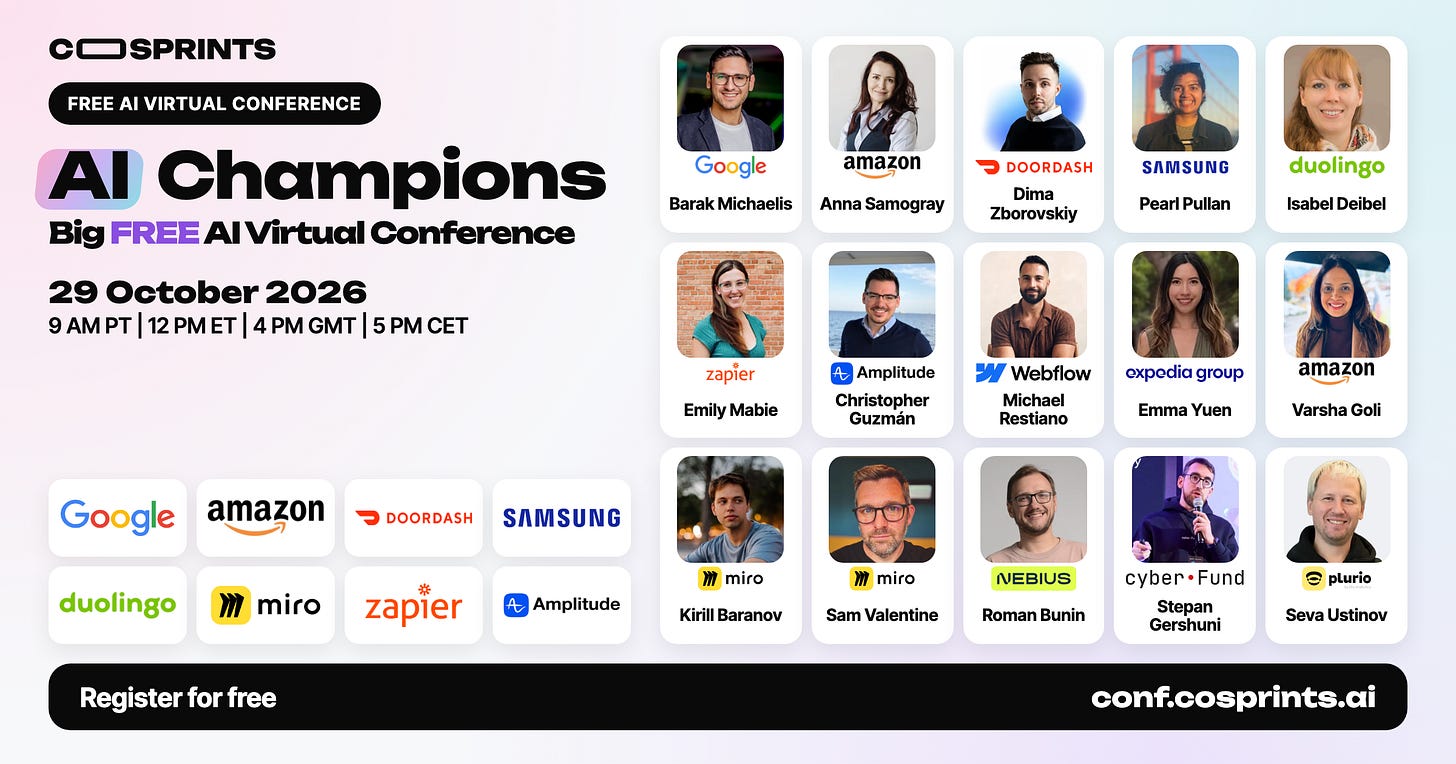 https://substackcdn.com/image/fetch/$s!lv6B!,fauto,qauto:good,flprogressive:steep/https%3A%2F%2Fsubstack-post-media.s3.amazonaws.com%2Fpublic%2Fimages%2F36690e98-8237-42ab-95d5-56151a579af6_2400x1260.png)
I’m joining the AI Champions Free Virtual Conference on 29 October, and I thought some of you humans might enjoy it too! :)
Four hours of real-world AI examples, practical insights, and ideas to help you make better use of AI in your work and across your organisation.
And you’ll be in good company! 5,000+ people are expected to join, with 20+ speakers and moderators from Google, Amazon, DoorDash, Duolingo, Zapier, Webflow, and more.
See you there?