What happens when millions of different histories start passing through the same AI intermediary.
By Mia Kiraki 🎭
Published: 2026-09-23
URL: https://robotsatemyhomework.substack.com/p/ai-writing-voice-sameness
Sometimes we’re four paragraphs into something before we’ve made up the person behind it in our minds, much like when we build our ideal image of a character from a book.
Let’s call them “Person Y.”
We never really see their face, but we notice all their quirks - we know what kind of company we’re in. Then we move to another completely different piece of writing, and surprise… We see Person Y again.
Some people love to call this slop, especially when it happens over and over again. Doesn’t matter if it’s human slop, or AI slop. Something seems recycled, and even though the ideas and thoughts behind the text look different, we get an uncanny feeling.
Language always arrives with company: references from the past, things we pick up from what we read, meanings we’ve learned to attach to certain words and ideas. So how much of what we call “our voice” was ever ours alone?
Now, another companion has also joined the room.
I’m delighted to invite you to a tête-à-tête. Please come in, let’s sit down and have a talk. The 19th century even built furniture for this.
A tête-à-tête (also called a confident) used to look like this: Attributed to John Henry Belter American or attributed to J. H. Belter & Co. 1850–60
Two seats at the sides facing opposite directions. One person, another person, and a conversation happening between them.
For the past few years, AI has been pulling up a third chair.
And it knows quite a lot about us by now because we’ve become very good at giving it information about us.
We have a habit of treating all the AI telltales like the em-dash and the “here’s what I mean”s as if stripping those off our communication would inevitably make us sound more like ourselves, less like AI. Better context can get you closer too, at least in theory.
Even then, the person communicating through this external, highly intelligent medium, still feels a little further away from our tête-à-tête.
Hi, I’m Mia. Welcome to ROBOTS ATE MY HOMEWORK.
Today, I want us to look at what makes writing feel like a person is actually there.
Come meet the robots. And me. :)
Join 2.8k+ humans figuring out how to use more AI without disappearing from the work.

Leave the human a turn
“writing is but a different name for conversation” ... “leave him something to imagine, in his turn.”
— Laurence Sterne, Tristram Shandy
When we communicate with actual people, we all take turns.
The same thing happens through written communication.
You post an article, someone reads it and comments on it, and you reply back. The exchange changes because two people bring a history to it. They remember what came before, misunderstand each other in particular ways, and carry old meanings into the next turn.
That history changes the way the next sentence lands, and this is important when we talk about what makes writing feel like it came from a particular person, rather than simply matching their “voice.”
Because some of what we recognise belongs to the person writing, while some of it has accumulated through everything their language has been in contact with.
A conversation grows its own language
When you talk to someone long enough, or read them often enough, your language starts getting weird. Together, and separately.
You now share similar phrasing, you borrow one turn of sentence from them and you love it so much that you keep using it. You once laughed at “that thing with the goat” and now it has become an inside joke that you can reference when the topic asks for it.
The goat has a technical sister. Susan Brennan and Herbert Clark asked people to name the same objects together and they gradually settled on shared descriptions.
These are called conceptual pacts.
A conversation between the same two people develops language that belongs partly to the relationship.
Bodies of work grow that kind of language too.
So can a reading life - spend long enough inside another writer’s sentences and they begin changing which turns of phrase feel possible to you.
Which is why I don’t think making someone recognisable in language can come entirely from information about the person writing (which, if you think about it, is mostly what the context we feed AI actually is: information about us).
Language carries history, like our favourite books, conversations we’ve had, people we’ve borrowed language from, arguments that changed our minds, jokes that acquired a second meaning. Some of that history belongs to the person. Some of it was created between people.
A first-time reader can know a surprising amount about you, while a returning reader knows what has happened between you.
And since I’m writing an essay about conversation, I thought I should probably let the other chair talk.
🪑 I asked the humans in our community chat what makes writing feel personal beyond tone of voice:
“I think lived experience is what makes it personal.” -
“It’s the shape of how someone’s mind connects things, and the stuff that keeps sneaking in uninvited no matter what they’re supposed to be writing about.” -
“It leaves room for the reader’s interpretation.” -
“Specificity + personality - someone’s lived experiences and unique point of view creating something that connects on an emotional level.” -
“Writing what feels true, not just writing what sounds good.” -
“It’s almost like the writing grabs you by the chin, turns your head, and says, ‘Hey, this is about you. Listen.’” -
“When the writing is a little rough, slightly unpolished, when you feel like you’re actually seeing how the person is forming their train of thought.” -
“The reader feels like the writer is speaking directly to them, like you’re having a good chat over a cup of tea in their living room.” -
“When it makes you laugh out loud because it is so clever. It’s usually an unexpected turn of phrase or sentence that does it.” -
“Noticing what’s going on around me and using words to say the things others are seeing too but maybe unable to articulate.” -
“I can recollect it and quote it here months after reading it.” -
The answers went everywhere: lived experience, recurring obsessions, specificity, rough edges, unexpected language, memory, recognition, and leaving enough room for somebody on the other side to do something with what you wrote.
These answers came from the ROBOTS ATE MY HOMEWORK community chat, where I regularly walk in with one question and leave with several things I hadn’t quite seen yet. ❤️
I started wondering whether some of these seemingly different answers had something underneath them in common.
Ten different people and one strange herald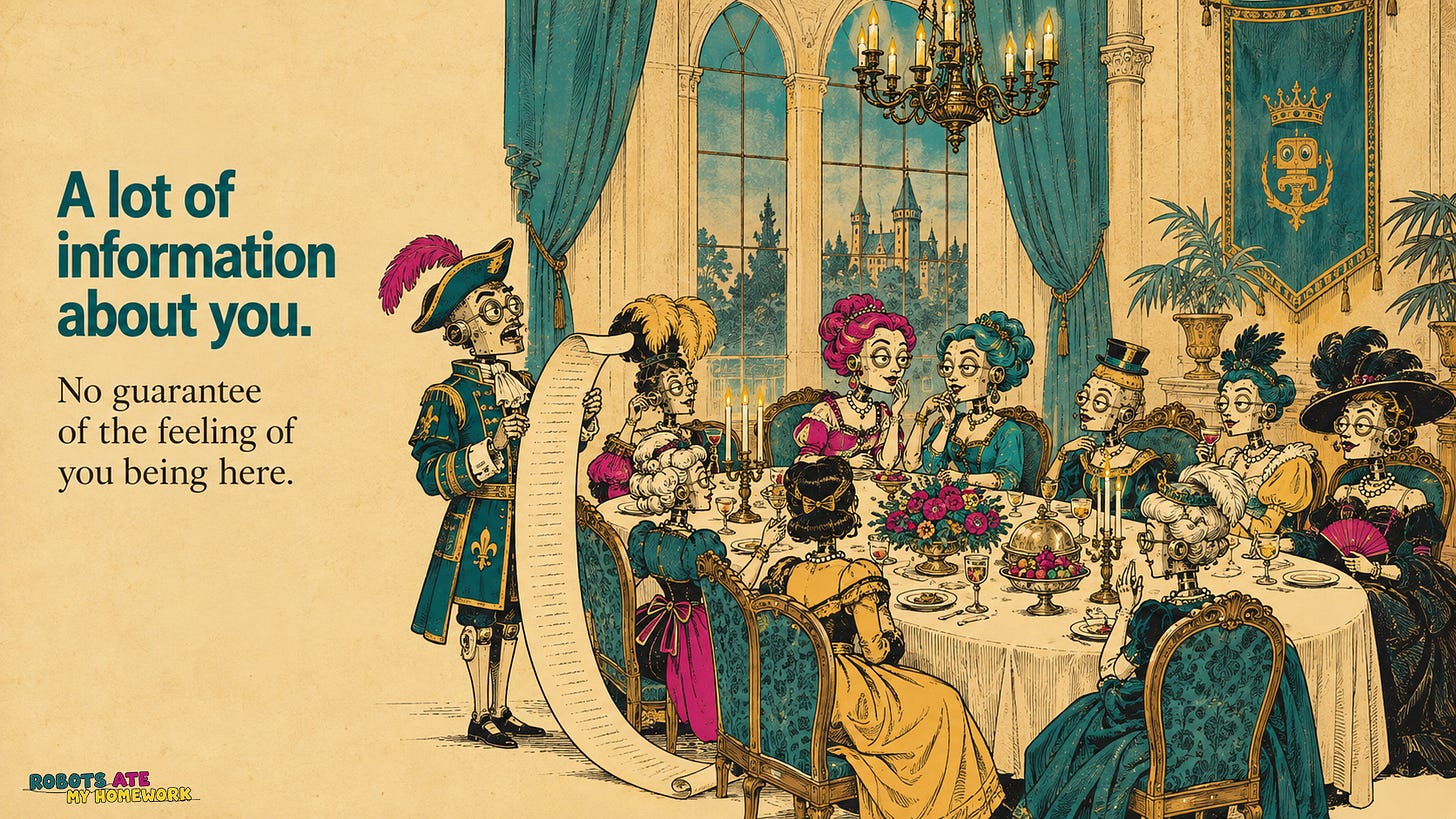

So, if some of what makes a person recognisable in language comes from what has happened around us and between us, I wanted to know whether the strange sameness I was noticing in Y was just me being fussy.
Looks like part of it is measurable.
As AI-assisted writing and communication become more common, the variation between people’s writing narrows. When people use LLMs to polish their own text, much of the original meaning survives, while some of the linguistic cues associated with differences between the people writing it become weaker.
Thoughts survive, of course. But some of the linguistic differences that help us recognise the person carrying those thoughts get weaker.
The ideas can still be yours while the language carrying them starts feeling less specifically yours.
This does NOT mean everyone who opens and uses AI instantly becomes one giant grey author.
But we can already see smaller shifts in the way language moves. In one study, Indian participants receiving AI suggestions moved more strongly towards American writing patterns. Some of what changed went beyond correcting grammar or swapping one cultural reference for another. The way people expressed themselves moved too.
Which brings me back to Y.
In retrospect, I think we’ve been looking for AI in the smallest possible places.
The words matter. The punctuation matters. The stock phrases definitely matter when you read the same one across 15 different posts from 15 different writers in under a week.
And that history belongs to the reader. The first time you encounter a certain rhythm or construction, it might sound wonderful. By the fifteenth, you’ve met Person Y.
Of course, we’ve always picked things up from what we’ve read - after all, that is part of how a voice gets made in the first place.
What feels different now is the sheer amount of very different writing passing through the same kind of intermediary before it reaches another person.
Let’s imagine ten of us arriving at dinner with ten different jobs, grudges, reading histories. We all have something to say, but the herald robot needs to deliver the message.
He delivers them all beautifully, and somehow the same voice carries across the hall.
AI is the herald who can know an extraordinary amount about you: the words you love, the references you return to, old pieces you’ve written, stories you’ve told, even the people whose work has shaped yours.
That is an enormous amount of information about you.
It still doesn’t guarantee the feeling of you being there.
Because a record of what shaped your language and the history of being shaped by it are different things.
What happens next carries the history
If knowing a huge amount of information about someone doesn’t guarantee the feeling of them being there, perhaps that feeling has something to do with movement: all that accumulated history changing the next sentence, the next idea, the next turn.
I scouted the internet for something that could explain that movement and found renga.
Renga is a Japanese form of linked verse written by multiple poets. 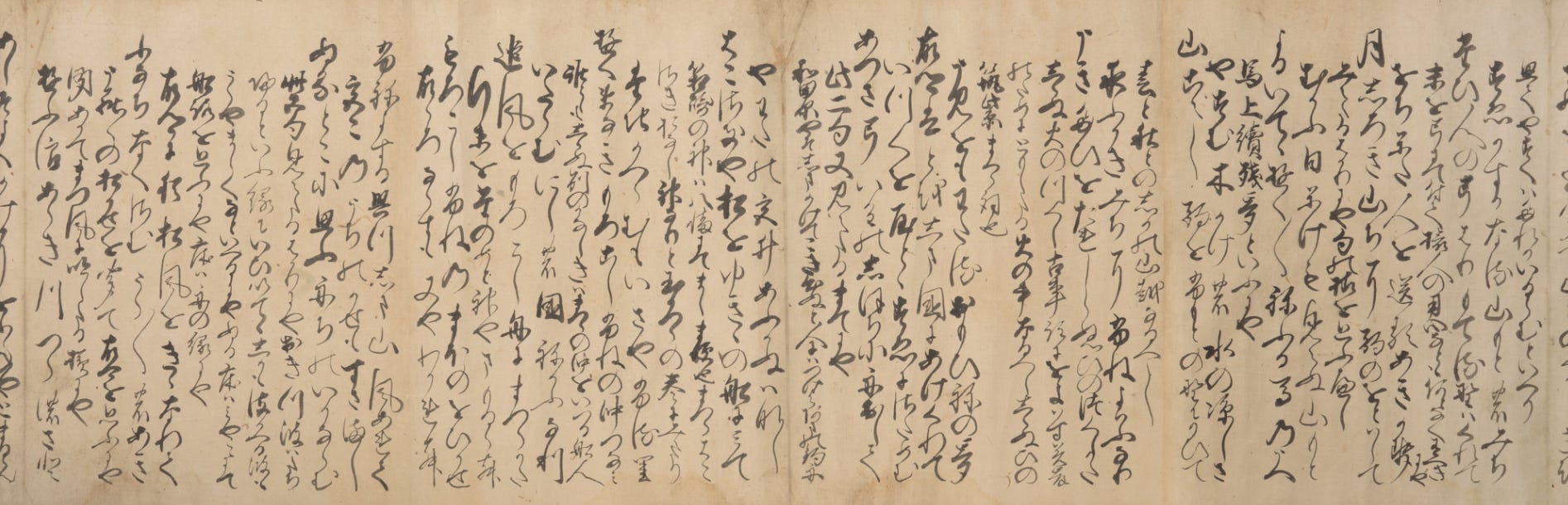 Manuscript Version of the “Travel” Section of the Linked Verse (Renga) Collection “Aged Leaves” (Wakuraba), compiled by Sōgi (1421–1502)
One poet writes a stanza and another follows. The link responds to what came immediately before. The shift keeps the poem from remaining inside everything that came before that.
Link AND shift.
The link says: I know what happened here before…
The shift says: and because that thing happened, I ended up somewhere different.
A voice profile struggles to document this. It can record the phrases you use, the punctuation you like, the references you return to, and it can even preserve pieces of the history behind them.
But language keeps moving because we do. We read something else. Someone answers us. An argument changes our mind. A phrase gets borrowed, an inside joke acquires another layer, a reader notices something we hadn’t noticed ourselves. All of it can leave residue in whatever comes next.
A finished piece hides a lot of history, so I have 3 robots to help you keep some of it ❤️
. ݁₊ ⊹ . ݁ ⟡ ݁ . ⊹ ₊ ݁.
The Room Assignment → establish your role and AI’s from the beginning, so the machine knows where its job ends.
Chain of Draft (🎁Premium) → after you finish a piece, get a provenance record of what came from you, AI, the exchange between you, and outside sources.
The Reader Turn (🎁Premium) → after you publish, turn reader comments and conversations into context you can carry into the next piece.
Want the whole robot library? ❤️ Subscribe to bring the full RobotsOS crew into the AI you already use.
The other chair
AI gets a chair in the room.
Just not in the second chair in the tête-à-tête. Whoever sits in there should answer you like a human, with answers that can change the conversation, and change you given enough time.
You and your body of work are one ongoing conversation, with a person (hopefully) at the other end. Person Y appeared when too many different histories started arriving dressed alike.
Protect the first.
Now, who do you read where you can feel the history between the writer and the reader?
To the people who changed the next turn,
Mia Kiraki

About the author and the robots...
Hi, I’m Mia. I’m an AI Narrative Architect and the human behind ROBOTS ATE MY HOMEWORK, a house of narrative, taste and AI, with the side doors left open.
I follow strange questions through books, theatre, language, culture and technology, then turn some of what I find into robots that can help you create, think, research, make and judge better.
Want to wander further?
🤖 Meet the robots → explore RobotsOS, my growing library of AI systems you can use inside the AI you already have.
🏠 New to the house? → start here and I’ll show you around.
❤️ Want the whole library? → Premium opens the rest of RobotsOS and helps keep this strange little house running.