Crackers, a lake, a bait ball, a salmon, a fish market, a friend; some tiempo.
By Rick Perlstein
Published: 2026-11-20
URL: https://rickperlstein.substack.com/p/lovely-day
Lovely day, yesterday. I started out wielding a scythe, hacking back my email inbox. A big part of my work comprises of notes I write to myself: ideas, riffs, reminders, scraps of evidence, articles to read, or file for later, or to let them disappear into the ether once I no longer need what they provide (like articles about what MAGAts I need no longer concern myself, as they had been voted out of office). By lunchtime—cheese on Mrs. Rickpedia’s homemade crackers—I completed this week’s big project: cleansing my inbox of what I no longer need, having now completed the manuscript of my book. Twenty or so left, all earmarked for airing on this here Substack in the next few days before I get the copy edits back and I head back into the woodshed to sand it down to near-final form—the version that will go out to reviewers. The rest is emails from before 2021: before when I started working on that book.

\….that which is known, roundabout Rickipedia HQ, as “cracker crack.”\
Then, since it was 60 degrees (global weirding can have its short-term advantages), I decided to try for a bucket list item, which is to say, to plop a Lake Michigan salmon in my bucket.

\Lake Michigan as seen from below at Midway Airport on Chicago’s South Side. Sculpture by Todd Slaughter (2001).\
Salmon were introduced into the tributaries of Lake Michigan in the late 1960s with the intention of curbing the populations of alewives, which washed up so thickly on the beaches in summer that they had to be cleared by bulldozers. 1967 was the worst year, but I can remember the stench and sight from my Milwaukee boyhood: one of those apocalyptic signs that everyone coming of age in the ‘70s can remember, death-fumes seeping up from basements due to killer clowns, death fumes seeping up from basements in places with ironic names like “Love Canal,” that sort of thing. Mrs. Rickipedia, but not me, remembers the news one week being full of fear from an incursion of “fecal greaseballs.” Those were the days.

As a fishery, Lake Michigan and its Chicago-area tributaries were slow to come back, as you can read in my first and only published piece of “outdoors” journalism, on the time some quarter century ago when the Bass Anglers Sportsman Society held the annual Super Bowl of fishing, the Bassmaster Classic, in Chicago:
Largemouth bass prefer “structure,” a word that usually refers to submerged tree trunks and wooden docks, not the deep-sixed automobile carcasses and industrial debris that competitors had to navigate farther south, along the factory-lined waterways of the Calumet River system. “It’s not the bucolic kind of fishing they learned in small towns,” the Trib’s Husar delicately put it. Meaning: That was where the kids were chucking the rocks, and where the abandoned buildings were, and the cargo ships, and the scrap-metal cranes.
Also, in the estimation of one angler: “It was the smelliest place to fish.”
But: things change. Things can get better. A useful reminder as we round into 2027, with political hope in our hearts. Then, the competitors had a hard time landing smallmouths of more than a pound and a half. (“These fish are so small they don’t even know they’re fish yet.”) Now, five-pounders are frequent, and when it comes to the salmon: well, roll with me down to the Lincoln Park boat basin not too far from where revelers at Abbie Hoffman’s “Festival of Life” first got clouted by cops during teh 1968 Democratic National Convention. Witness the biggest “bait ball” you’ve ever seen roar past the sea wall…
This is the spot!
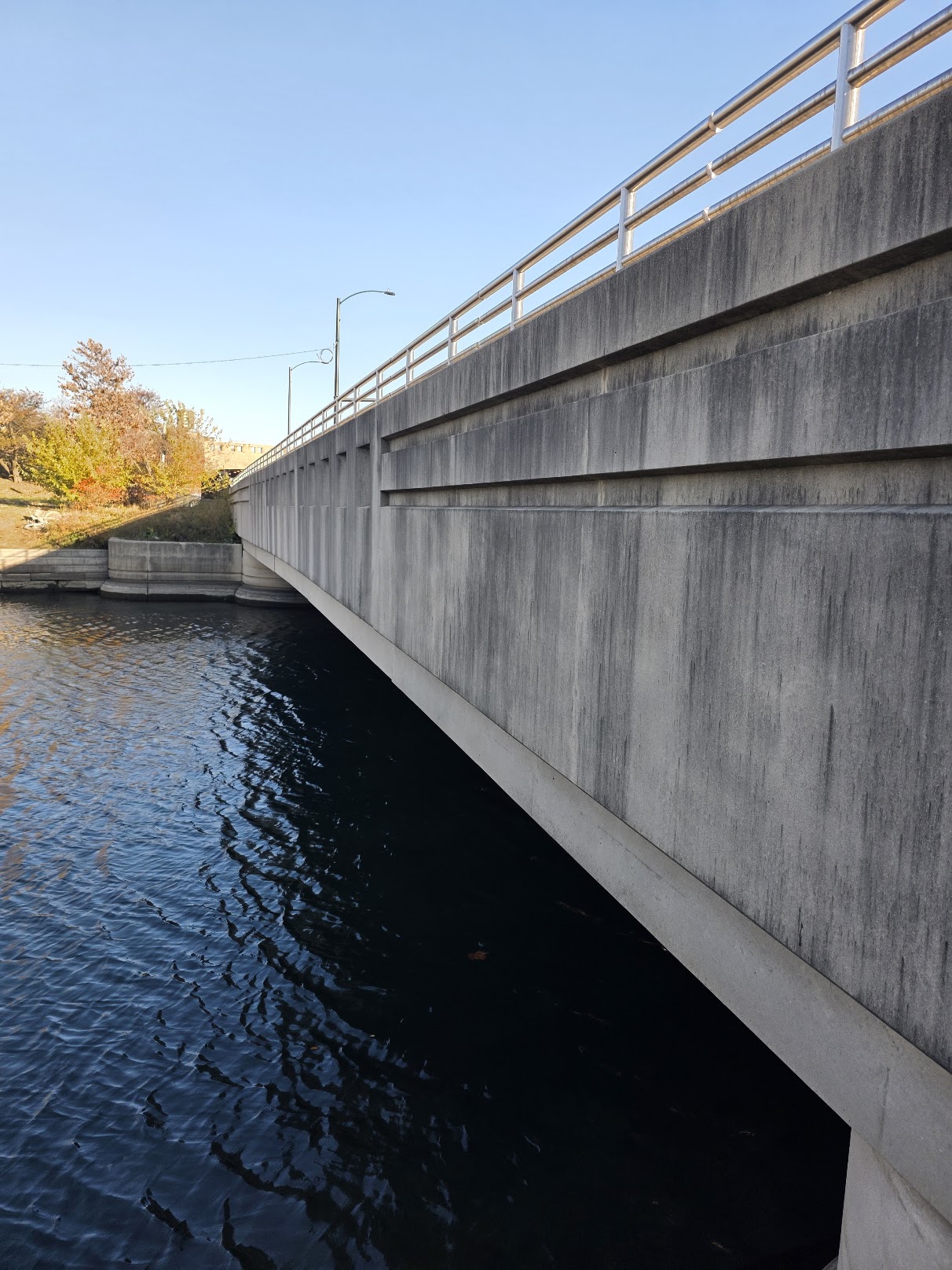
I stationed myself just south of the Fullerton bridge. Saw a brother of the angle rushing to the bridge with a salmon hanging from his shoulder, dashing to the cooler in his car to preserve his prize for delicious posterity, and he tells he he “snagged” it—a practice that is legal for a few weeks every November for fish who reach the dead end of the basin, probably too “spawned out” to live very much longer. That’s why I’m here, too, though with a rod and rewl: every fall at various near-shore sports like this, salmon are plentiful. He tells that that he’s only allowed to snag south of the bridge, but if I really want to find a monster, they’re school up on the north side, so that’s where I go—
…and where when, twenty minute later, after sighting several shifting shapes down below, THUMP: this guy, a coho, takes my pearl-colored fluke—the very same soft-plastic lure that enticed last week’s pike. Two new species in a week, both of them toothy and fine.
(The discolorations, I can assure those in the know, are not evidence of salmon “zombification,” as myself fellow members of the Chicago Salmon & Trout Shore Anglers feared, but gunk from my friend’s unhappy roll in some autumn leaves.)

Thereafter, she found her way into the proverbial bucket, of list fame, thereupon to abode for the nonce at Hagen’s Fish Market on Montrose, to be smoked up for Thanksgiving consumption.


Next adventure:
My friend Chris Nolte is a bass player. Soulful, smart, time like a seventeen-jewel Swiss watch, impeccable tone both on the pork chop and the dog house—a musical rock, the kind upon which one might build a very hip church. He had a gig. I arrived at the appointed location. It turned out to be a an impressive facility devoted to Afro-Caribbean art and culture, also with—to get you in the right mood—outstanding lechón asado; and, I was soon to learn, outstanding acoustics. The leader was a drummer Henry Cole, whose name I did not know, but whose playing I had probably did, as he has frequently recorded with greats like Miguel Zenon and Gary Burton. The evening is entitled “El Tiempo con Cole”: time with Cole. Cole was an outstanding companion to share time with. Starting with the moving dharma talk with which he introduced the final song (the gentle, wise tenor of his talk reminded me, if you know know know, the most soulful character in the most soulful TV show I’ve seen). He related the time his house in the Bronx burned down and he packed up what little he had left and moved to Puerto Rico, then how he spent a year closed up in a rom doing nothing but mourn, playing no music, and how hard that was, as he came to realize that he had always used music to ward off the pain of living; and then how he found his way back to the beach and the stars and the music—and to living, with all its pain and all its joy, and better music. That was what this song was about.
Then, the band, who had never played this music before, or played together before, brought a roomful of Chicago strangers together in joy. We and they, as you will hear, musicked together. We had a time.
On the day of Anthropic’s trillion-dollar IPO (I’m so old I remember a time when “IPO” was not a household word), it good to recognize what really matters.