Part II: Electric Blurbaloo
By Rick Perlstein
Published: 2026-05-28
URL: https://rickperlstein.substack.com/p/a-very-pulitzer-thurbsday-31b
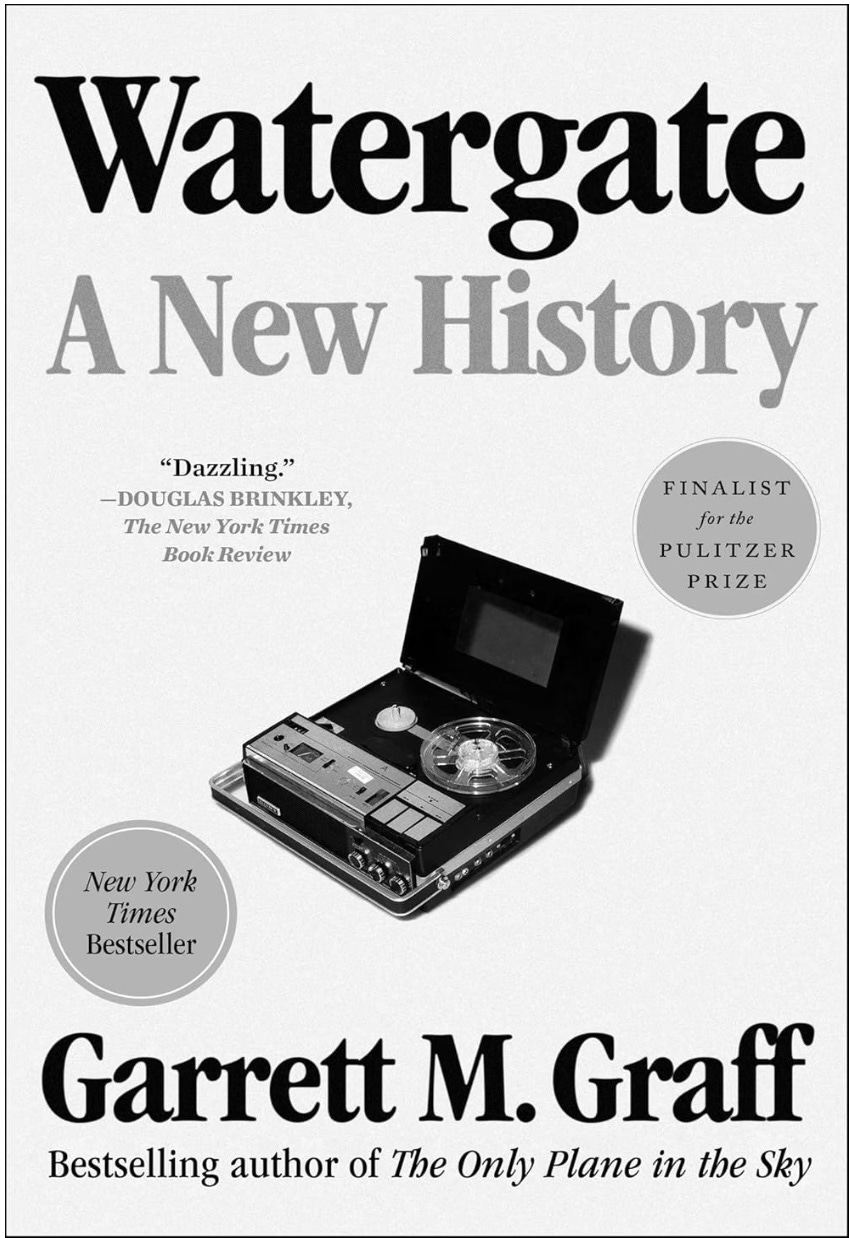
Last week, I noted my pride that Perlstein blurbee Jefferson Cowie won the 2023 Pulitzer Prize for history. This week, we recognize one of the two runners-up for that same prize—a fellow Perlstein blurbee! Two out of three aint’ bad, right?
Here’s what I said for the back cover of Garrett Graff’s Watergate: A New History:
“Garrett Graff aptly calls Watergate a 'Gordian knot of scandal.' This comprehensive, searching, yet elegant book untangles it more completely than any attempt so far. I learned a lot!"
Those who know my work know “I learned a lot!” is saying something. Watergate is at the center of two of my books, Nixonland and The Invisible Bridge: The Fall of Nixon and the Rise of Reagan. And, thing of it is, it’s more knotty than a Gordian knot: knots tied in knots, tied up into another set of knots. “Watergate” was a word signifying a group of corrupt events that happened, in secret, all through Richard Nixon’s first term, but only became understood as a “group of events” after one of those corrupt events—the burglary of Democratic National Committee office in June of 1972— stopped being secret, when the burglars got caught. Eventually, the word “Watergate also came to signify the work the president’s men, and also the president, did to cover up the existence of those events, and their ties to the White House—such as bribing those burglars to keep quiet in court. Meanwhile the word “Watergate” also signified the multiple overlapping and sometimes contradictory investigations, both journalistic and ones carried out within all three branches of government, each of those encompassing a complicated discourse about their jurisdictional legitimacy and proper processual course), that brought that skein of events into public awareness; and also, “Watergate” referred to all the actions Nixon did to sabotage those investigations—like trying to hold back the tapes in which many of those events were talked about, but which (he talking on those tapes) was not just evidence of past events, but also a real-time Watergate event to be discovered—like the time Chief of Staff Bob Haldeman said something on the tapes meant to create a record of his innocence during a discussion of how to cover up certain events, in the event those tapes did later become public, which they did. A cover-up of a cover-up, which in turn cued up another event: a count in his criminal indicment—an event about an event about an event about an event. Any given day, at the height of the public discussion of Watergate, serious news consumers had to (and, incredibly, did) keep all those levels of events straight in their head, in a constantly shifting sea of context. It was bewildering. Boiling it all down down into a single digestible narrative is like trying to summarize a Charlie Kaufman movie.
And yet, Graff accomplished that with greater aplomb than anyone before who’s attempted it. I admire him deeply for that; and also for what he does now.
Read his newsletter; it’s indispensable. I think of Garrett Graff as a journalistic unicorn: he does work that speaks with maximum accessibility in the idiom of normal Washington journalism; as a former editor of POLITICO Magazine and the Washingtontonian, that was his tribe. Simultaneously, he is one of the precious few escapes a the taint of that benighted tribe: its shallowness, its conformity, its sucking up, the banality, its #bothsides moral evasions. A spy in the house of normal, who never normalizes. A radical—his work gets to roots—who is all the more so precisely because he doesn’t appear to be one. He churns out books you can imagine getting sold in airports—like his recent book UFO: The Inside Story of the U.S. Government's Search of Alien Life Here—and Out There—who also can communicate to the kind of dude who buys books in airports about why, well, they need to be thinking about the possibility that the way politics works now may lead to the end of the world.
Here is how he did it in a “Fresh Air” interview from late 2023. Terry Gross called him back to an earlier one he did with her near the end of Trump’s first term about a POLITICO in which he warned people about the terrifying things Trump might might attempt to subvert democracy in his remaining weeks in office . Now that Trump was ramping up to his attempt to become president again, Gross asked, “So I'm wondering what you're thinking now about Trump and what happens if he does manage, in spite of all the indictments, to get reelected?”
“Let me give you an answer,” Graff began his reply, “that, unexpectedly, is going to connect to UFOs.”
“The scientists who work on SETI - the search for extraterrestrial intelligence - have this thing called the Drake equation. It’s an equation that is supposed to predict the number of intelligent civilizations out there and how many there are at any given time. The main variable scientists call L, which stands for the length of time that an advanced civilization lasts. To me, the challenge is L could turn out to be based on where humanity is heading, a pretty short number.
“And when you look around our world right now - you know, the challenges of technology and AI and misinformation and the challenges to democracy that Donald Trump poses, you know, the challenges of climate change - there’s no guarantee that human civilization is around for that much longer, and certainly not at a level where, you know, we would have the capability and the interest to explore the rest of the universe. So to me, you know, when I look at Donald Trump’s possible return to power, you know, what I’m thinking about right now is what it does to the L of, you know, American democracy and human civilization and how it could and almost certainly would accelerate the unwinding of, you know, modern American life.”
That is the kind of political journalism we need: stuff to get people thinking beyond the next election, to the stakes behind the whole thing. The Gordian knots inside the Gordian knots.