The life and times of these United States, according to Jefferson Cowie
By Rick Perlstein
Published: 2026-05-22
URL: https://rickperlstein.substack.com/p/a-very-pulitzer-thurbsday
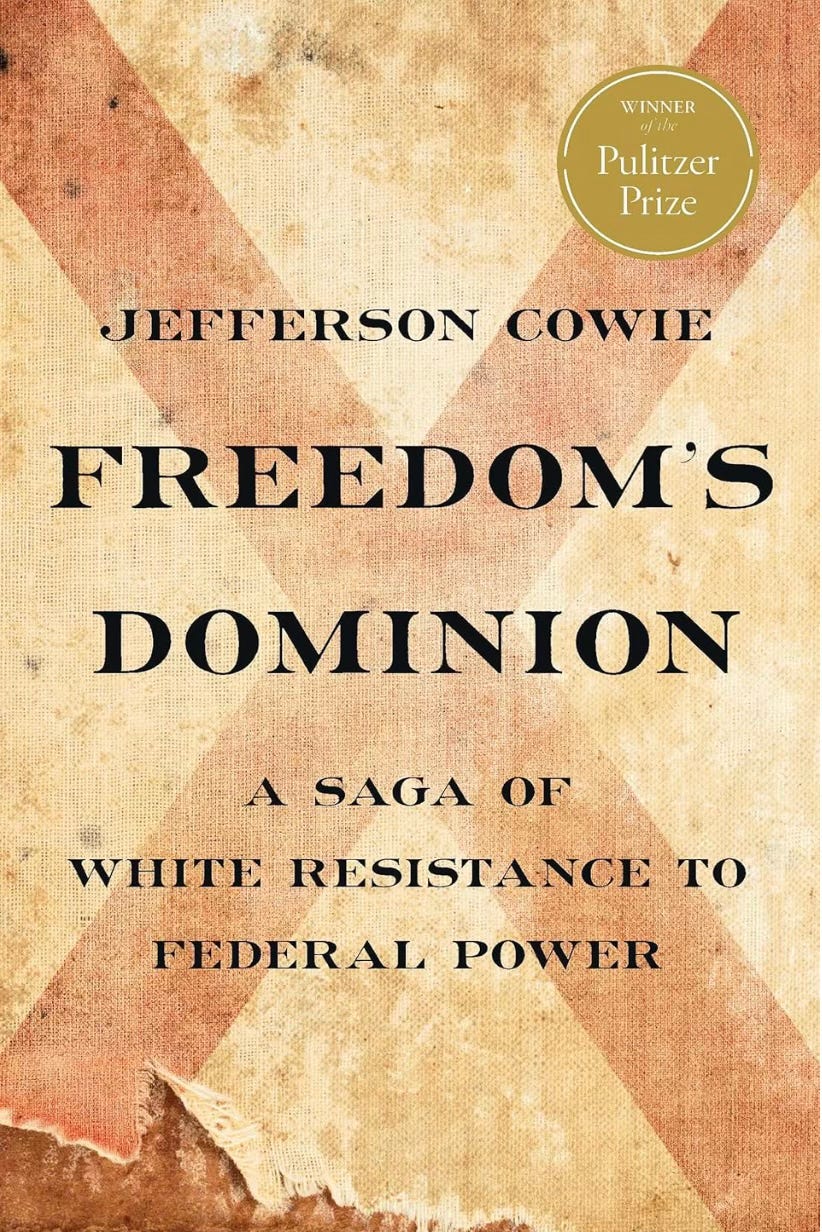
Three years ago in May, I enjoyed the delightful experience of one of my blurbed books winning the Pulitzer Prize for history. Here’s what the Pulitzer committee had to say about my friend Jefferson Cowie’s Freedom’s Dominion: A Saga of White Resistance to Federal Power:
*“A prize-winning historian chronicles a sinister idea of freedom: white Americans’ freedom to oppress others and their fight against the government that got in their way.
”American freedom is typically associated with the fight of the oppressed for a better world. But for centuries, whenever the federal government intervened on behalf of nonwhite people, many white Americans fought back in the name of freedom—their freedom to dominate others.
”In Freedom’s Dominion, historian Jefferson Cowie traces this complex saga by focusing on a quintessentially American place: Barbour County, Alabama, the ancestral home of political firebrand George Wallace. In a land shaped by settler colonialism and chattel slavery, white people weaponized freedom to seize Native lands, champion secession, overthrow Reconstruction, question the New Deal, and fight against the civil rights movement.
”A riveting history of the long-running clash between white people and federal authority, this book radically shifts our understanding of what freedom means in America.”*
And here’s what I said in my blurb:
"Jefferson Cowie has a knack for publishing instant classics: books that change historians' conversations. This is his most extraordinary yet. With eloquence and with brilliance, he delves deep into the annals of a specific place, Barbour County, Alabama, in order to excavate the foundations of America's darkest and most enduring story: how 'freedom' became a national alibi for cruelty, inequity, and reaction. As soon as I finished reading it, I wanted to start over and absorb it all over again."
Which is the honest-to-God truth.
A quick note about Jeff’s other instant classics:
• Capital Moves RCA’s Seventy-Year Quest for Cheap Labor (2000) tells the story of a company that started as a government monopoly—basically, a gift from the state to help rich people get richer with an exclusive contract to manufacture radios for World War I. Every time its workers got organized enough to credibly start demanding a bigger piece of that gift, however, RCA moved production to a place where workers were not organized: first from Camden, New Jersey to Bloomington, Indiana; then to Memphis, Tennessee; then finally to Ciudad Juarez, Mexico. At the time he wrote it, labor historians basically wrote two kinds of books: “community studies” that, often with a palpable air of special pleading, claimed to document a radical working-class consciousness deep in the 19th century that could be “recovered” by radical movements today; and, as he noted in the book’s introduction, books on labor in the 20th century where the “emphasis on culture and community all but disappears as economics, institutions, and the state takes center stage.” Capital Moves broke labor history out of that dualism.
• The Great Exception: The New Deal and the Limits of American Politics, was expanded from a 2008 essay Jeff co-wrote with his mentor the late historian Nick Salvatore, “The Long exception: Rethinking the Place of the New Deal in American History,” in which they wrote, “while liberals of the seventies and eighties waited for a return to what they regarded as the normality of the New Deal order, they were actually living in the final days of what Paul Krugman later called the ‘interregnum between Gilded Ages.’” In many ways, the book that came out of it is an old-fashioned kind of political history, covering sweep of the entire story of modern America, from the Civil War to its year of publication— Donald Trump’s big year, 2016. It treated what used to seem like the culmination of American history—the New Deal project to build a socially democratic state, and a multi-ethnic, pluralist society, as an exception to the main currents of America’s modern history, which was plutocratic and racist. Its most haunting claim was that the reason America was briefly able to break away from the rule of capital was that a rare window of working class political unity opened up by the end of mass immigration in 1924, when American workers finally, for once—and never again—became more focused on fighting their bosses than on fighting each other, along ethnic lines. In other words, because there were fewer immigrants to hate, immigrant-hate being the rocket fuel that American plutocrats use to maintain their rule.
• What to say about Stayin’ Alive: The Seventies and the Last Days of the Working Class? As I put it in a 2010 review essay on histories of the 1970s that I was reading to prepare my own The Invisible Bridge: The Fall of Nixon and the Rise of Reagan, “the only thing it resembles is itself.” It capture the feel of what it was like for working people to experience the New Deal Order transforming into something else: a zero-sum austerity game. A lot of its best stuff is about the popular culture—like his reading of Rocky as a plaint about affirmative action, where morally unworthy Black people, as represented by Apollo Creed, get all the spoils, and hard-working, humble white people like Rocky Balboa have to sacrifice everything just to get a shot.
Jeff’s next book? Born aloft by his Pulitzer, he’s s landed a gig as the biographer of Johnny Cash, with the cooperation (with complete editorial freedom) of the Man in Black’s family. It ought to be a humdinger.