By Mario G
Published: 2026-04-21
URL: https://realaivalue.substack.com/p/stop-building-agents-start-building
Recently, I’ve watched a company I work with ship an “agent infrastructure” for a problem that did not need it. We focused on the right problem, we identified the workflows that were taking 80% of team members time while only producing 20% of the value and prioritized accordingly.
But the engineers jumped into the opportunity of building a custom implementation using Lang-Graph, arguing for higher control of the inputs and outputs and custom abilities like RAG and custom context engineering. Six weeks of development followed by a chaotic testing phase, ultimately replaced by a well-organized folder with markdown files, some custom CLI tools and Claude Code, all put together in roughly 2 days.
The choice of where to apply AI was not wrong, bottlenecks are a worthy foe; what they did not understand is that agent harnesses have become a commodity and that building your own is like trying to extract ore from the ground. Sure, theoretically you can build the infrastructure to do it yourself, but why do so when there are already mining companies doing it 100x more efficiently than you could hope for.
Two layers, and only one of them is yours to own
In my experience the work of building AI agents tends to sit in one of two layers:
- The commoditizing layer: anything related to agent intelligence and mechanics. LLM models, orchestration frameworks, context management, tool contracts, MCP servers, CLI tools and execution environments. Basically, the arms, legs, body and brains of AI Agents. This stuff is getting better in base models and in managed products at a pace that makes most custom builds obsolete before they finish a six-month roadmap. Anthropic, OpenAI, and a dozen other platforms are competing to absorb this layer.
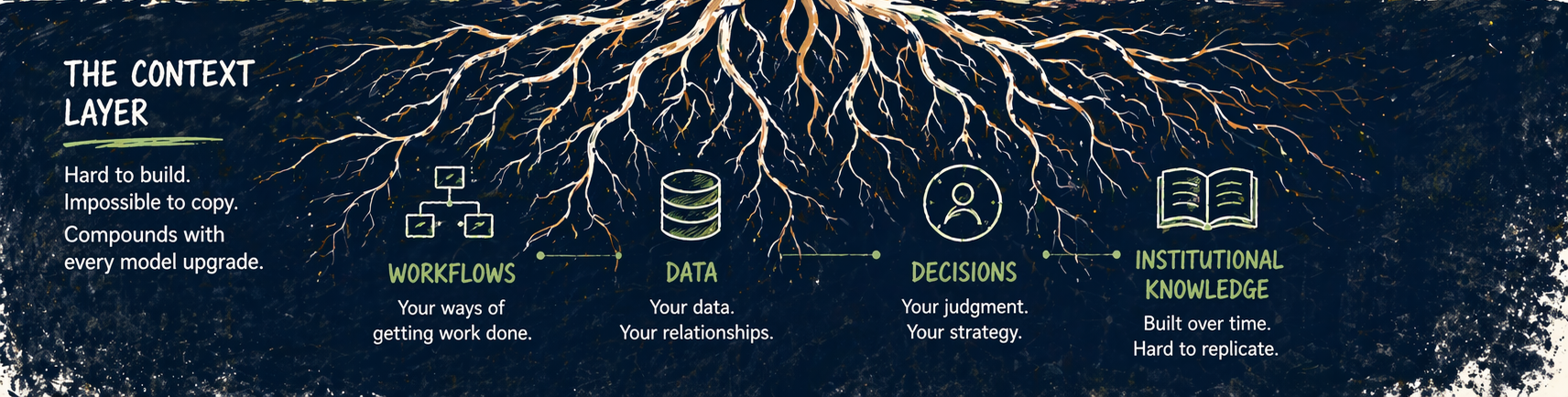
- The context layer: anything specific to you and your business. How your customers actually use your product, how your employees actually execute their work, the weird edge cases in your industry, your internal policies and values, your data, and ultimately, all the context that makes a generic model and harness behave like it understands your business. In practice the context layer encompasses your team/user skills, agent-readable documentation, business data, model memory policies and custom tools to connect to internal systems.
Three reasons the context layer is the only bet worth making
1) It survives every model and harness upgrade: A folder of well-structured markdown context does not care which model reads it. It does not care whether the harness is OpenCode, Claude Code, Cowork, or something that does not exist yet. This is the same for databases and even custom RAG pipelines that are unique to your business. If Anthropic ships a 3x smarter model tomorrow, your context gets 3x more useful.
2) The platforms are absorbing everything else: Look at what has shipped in the last twelve months. Claude Code has been getting increasingly better at self and prompt-based orchestration, rendering orchestration frameworks like n8n less and less useful.
The generalization of MCP and CLI tools has given it the flexibility to execute a wide variety of tasks inside and outside the terminal, and improvements in the models and context window length are decreasing the need for granular context management strategies.
The harness is the product; 9/10 times you don’t need to build your own.
3) Specificity compounds, generality decays: A generic agent that does a little of everything depreciates the moment the next model or harness release does it natively. A specific workflow built on your actual data, team’s decisions and customer results, accumulates value every time you use it.
The more you run a specific workflow, the more you understand what works and what doesn’t, the more memory you accumulate and the more value you are able to extract with less and less complexity and cost.
What does this mean in practice?
Investing in context can mean many things depending on what point of view you’re looking at it from, but in this article I want to briefly touch on what it means from the perspective of organizations and touch down to what it means for teams and practitioners that are looking to implement AI agents in their day to day.
For organizations
Investing in context means investing in at least three core investment areas that I believe should be part of any organization’s AI adoption strategy.
1) Make your organizational knowledge, data and internal systems AI-consumable: This is the foundational layer, exposing systems via APIs, structuring key knowledge, making data queryable and capturing institutional memory (decisions, past analyses, lessons learned). AI agents will only be as useful as the context they can access.
2) Enable teams to freely adopt AI while pushing for domain context creation: Avoid gating which AI tools people use; instead, invest in pushing teams to encode what is uniquely theirs: workflows, team projects, decisions, research frameworks and operational playbooks. Usually, the native way to do this will be through the creation of SKILLS and allowing team members to have a filesystem (sandbox, VMs, company codebase, etc.) to execute AI agents.
3) Embed a context trust and lifecycle governance strategy early on: Context without maintenance will become a liability. Skills and outdated processes that are AI-readable will end up degrading AI agents’ performance or will produce entirely wrong outputs. I believe this is likely the hardest pillar to implement and is still up for debate on the best way to do this, but I believe that at scale, this will largely require starting to manage context creation like software management: versioning, ownership, testing, auto-reviews and sunset policies will be an important part of this.
Of course, there is much more to an AI adoption strategy than these three principles, but I believe these are the most relevant when it comes down to investing in the context layer.
For Individuals
The biggest difference between using AI and being more productive with AI IS context management, so the main priority will always be to invest in context upfront.
1) Start with a folder: literally a folder on your machine or your cloud drive with your preferred harness (Claude, Manus, OpenCode, etc.). Inside it, an organized structure of markdown files describing the process you need to execute, the skills you want to apply, the business context it needs, and the outputs you expect. Point your harness at it by prompting it with instructions on the process and how to consume your instructions (markdown files).
This sounds easy, but it’s harder than it looks; proper understanding of how a harness works and its capabilities is required, but once you get going what you can build in a couple of days will amaze you.
2) Graduate to reusable patterns: once you have a reliable process, you can start turning the process docs into a small library of reusable patterns. This can be as simple as better documentation, but custom code and tools here are welcomed to further increase reliability and decrease the work the LLM does.
3) Know when to stop: 95% of the time this is where you can stop, but depending on your use case further expansion to a custom harness might be worth it.