On Networks
By Joseph Rosenbaum
Published: 2026-11-02
URL: https://professorsynapse.substack.com/p/three-names-for-one-dog
Build your own AI second brain
Before you go: my dog has three names in my second brain, and my AI knows they’re all the same dog. That isn’t luck. It’s a system, and it’s what we teach in our course, Your AI Second Brain: notes your AI can actually read, with connections you can actually check. The link’s below, and there’s a coupon code that goes along with it to get you a discount. I hope to see you there.
Join here: Your AI Second Brain
Reader discount: 50% off with code SECONDBRAIN2026 through December 31, 2026.
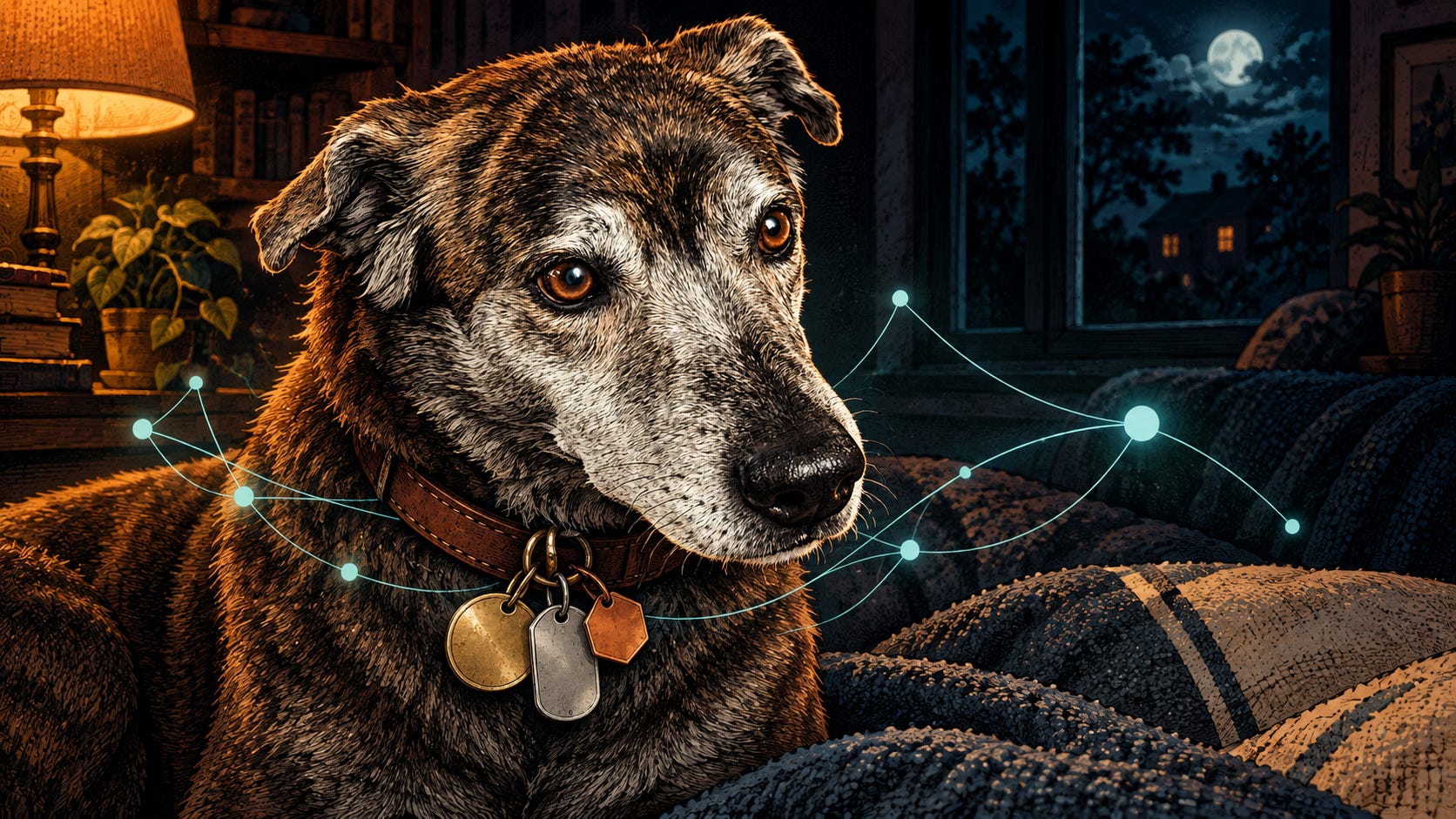
My dog has three names in my second brain.
Her name is Desi, short for Desiree. But a lot of my daily notes start out spoken, and the transcription keeps hearing “Jesse.” So for a while, part of her life was being recorded under the wrong name. Anyone searching my notes for Desi, including me and including the AI I use to search them, would miss it.
The fix was small. Desi has a note of her own, and tucked at the top of it is a short block of structured data that most readers would never see. It says three things. Desi, Desiree and Jesse are all the same dog. She has a permanent ID that doesn’t care what the transcription heard. And she’s connected to me, with the connection labeled: I’m her owner.
Three spellings, one dog, one named connection back to me.
There are 56 notes like this in my People folder now. My wife, my parents, my brother, my clients, our two dogs and two cats. Each one has an ID, a type and a list of relationships with names: spouse of, son of, founded, worked at. Some carry a confidence level. Some carry a short note explaining the connection.
Without quite planning to, I’ve built a graph of my own life. This series is about how I got there, and about the three hundred years of people who made the idea possible.
Nodes are easy
Everyone agrees that everything is connected. Neurons, friendships, citations, supply chains. “Network” has become one of those words that can mean almost anything.
Drawing the dots is the easy part. What makes a network useful is the line between two dots, and specifically what that line means.
“Joseph is connected to Sydney” tells you almost nothing. “Joseph is married to Sydney” tells you a lot. “Joseph worked at United Way, October 2017 to October 2023” tells you even more. It can also be wrong, and you can check it.
That last part is what I care about most in this series.
Two ways of knowing
A language model knows an enormous number of relationships too. Ask one who Euler was, where he worked and who he wrote letters to, and it will tell you. But none of those relationships are written down anywhere you can read. They’re spread across billions of numbers.
In 2022, a team led by Kevin Meng and David Bau showed they could find where a GPT model stored a single fact, that the Eiffel Tower is in Paris, and edit it so the model insisted the tower was in Rome. It was a remarkable piece of detective work. It also showed how hard that detective work is. Finding and changing one fact took a research paper.
The knowledge in my second brain is the opposite. It’s tiny, and every relationship in it sits in plain text. If it’s wrong, I can see it. If the AI reading my notes gets confused about who Jesse is, I can point to the line that fixes it.
Neither way of knowing is enough by itself. The model can read, write and reason in ways my notes never will. My notes can be checked in ways the model can’t. I think the interesting future is where the two overlap: machines that can use explicit maps, and people who can check them.
That’s an alignment question, the small version. Do you and the machine share a picture of the world, and can you tell when you don’t?
The route
Six more essays after this one: four steps from the math toward my own notes, a practical one, and a short one to pull it all together.
Graph Theory. It starts in 1736 with a puzzle about seven bridges, and a mathematician who thought it had little to do with mathematics. Leonhard Euler showed you can throw away almost everything about a place and keep only what connects to what. From there: the traveling salesman, problems that may never have a fast answer, and the idea at the heart of Google, that you matter if you’re connected to things that matter.
Network Science. What happens when the nodes are people. A psychiatrist who mapped which girls at a New York reform school wanted to live with whom. A mathematician who lived out of a suitcase. Letters passed hand to hand across America. And the finding that people often get jobs through acquaintances rather than close friends.
Knowledge Graphs. Giving edges names. Tim Berners-Lee’s dream of a web machines could read, Google’s 2012 shift to “things, not strings,” and the stubborn problem of knowing when two names point at the same thing. Desi and Jesse, at the scale of the internet.
Graph Neural Networks. How machines learn from structure itself, and why the transformer under every chatbot can be read as a graph network in which every word connects to every other word.
A Graph of My Own. The practical one. How I actually set up my second brain, why every entity gets a typed ID, which relationship types I use and which ones I regret, and how an AI walks the graph to answer questions about my life. You’ll be able to copy it.
The Shared Map. Back to where this essay started. What three hundred years of dots and lines teach about the map you and your AI keep together, what a named connection still can’t capture, and where I think this goes.
Why bother
Part of this is selfish. Desi was the warning. A transcription mishears one name, and a piece of my life ends up filed under someone who doesn’t exist. Search misses it. The AI misses it. A pile of notes, however well written, can’t fix that on its own. Notes that say plainly who’s who, and how they connect, can.
What I actually want is a second brain that the AI and I build together. I capture things as they happen: a conversation, a meeting, a thought on a walk with the dogs. The AI helps me file them, link them and find them again months later. That only works if we’re both working from the same map. A folder of loose notes isn’t a map. A network of named things and named connections is one we can both read, both add to and both fix when it’s wrong.
The bigger reason is that we’re handing more and more of our memory to machines. Assistants remember our preferences, our projects and our families. When a machine remembers something about you, where does that memory live, what shape does it have, and can you read it?
A named edge is the smallest piece of shared understanding that both sides can inspect. I don’t know yet how far that idea scales. I want to find out by building outward, from the bridges of Königsberg to the note about my own dog.
Nodes are cheap. The edges are where the meaning is.
Let’s start with seven bridges.
In Memoriam:
Our dog Desi passed last week. I wrote this series not expecting it to come so quickly…but life always had other plans. Rest in Peace, pup, we miss you 😔
Thanks for reading Meditations on Alignment! This post is public so feel free to share it.