Attention is All We Need
By Joseph Rosenbaum
Published: 2026-06-29
URL: https://professorsynapse.substack.com/p/5-scroll-holes
This is a paid post. If you find value in what I share, a paid subscription is the best way to support this work. That said, I never want cost to be the reason someone can’t read this, so if you need access, send me your email and I’ll add you.
Look at That!
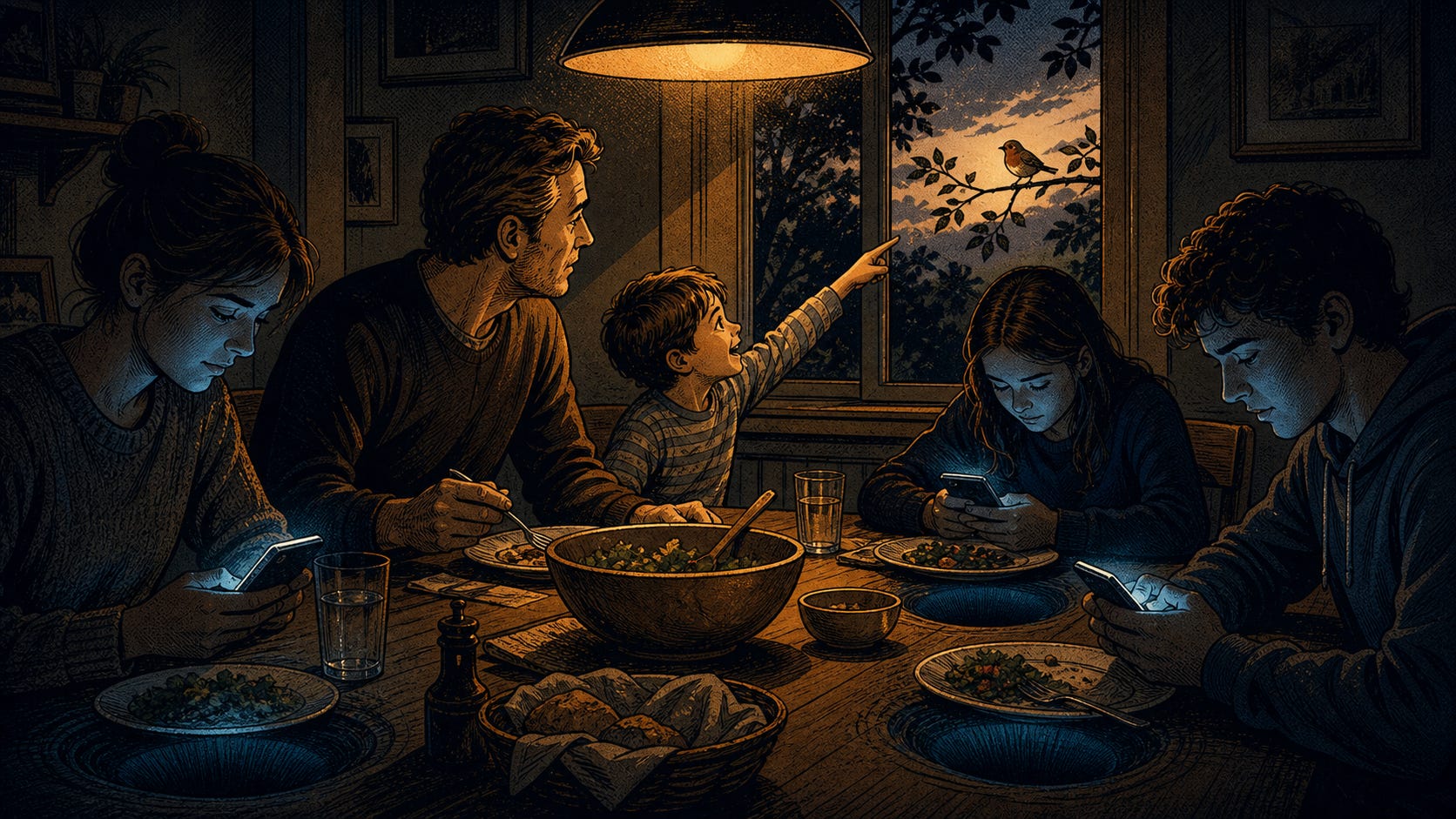
Watch a parent with a baby sometime. Not in the frantic moments of feeding or diaper changes, but in the quiet ones. The ones where the parent points at something, a bird on a branch, a dog across the street, a plane in the sky, and says those three unremarkable words: Look at that.
The baby looks. Not at the finger. At the bird.
This is one of the most important things a human being will ever do, and most parents have no idea it happened.
Developmental psychologists call it joint attention, and it typically emerges between nine and twelve months of age. Michael Tomasello, who has spent his career studying what makes human cognition different from that of other primates, considers it a kind of cognitive revolution. Before this moment, a baby can follow your gaze, sure. Other great apes can do that too. But around nine months, something new clicks into place. The baby starts to understand that you are looking at the bird on purpose. That you want them to see it too. That the two of you are, for a brief moment, sharing an experience of the same world.
And then the baby starts pointing back. You look at that.
This isn’t a cute milestone to write in a baby book. It’s the foundation of everything. Language acquisition depends on it: children learn what words mean by attending to whatever the adult is attending to while speaking. Theory of mind depends on it: understanding that other people have thoughts and perspectives different from yours begins with the realization that other people are looking at things on purpose. Empathy, shared meaning, cultural learning, the entire architecture of human social cognition starts here, in the space between two pairs of eyes and the thing they’re both looking at.
I’m belaboring this because it matters for what comes next. Attention, before it was something the tech industry learned to monetize, was something we gave to each other. It was relational. It was the mechanism through which we built trust, connection, and shared reality. A parent saying look at that to a child isn’t misdirection. It’s the opposite. It’s co-direction. It’s saying: this matters, and I want us to see it together.
The attention economy says something different. It says: look at this instead of at each other.