Attention is All We Need
By Joseph Rosenbaum
Published: 2026-06-22
URL: https://professorsynapse.substack.com/p/4-the-attention-merchants
This is a paid post. If you find value in what I share, a paid subscription is the best way to support this work. That said, I never want cost to be the reason someone can’t read this, so if you need access, send me your email and I’ll add you.
The Razr
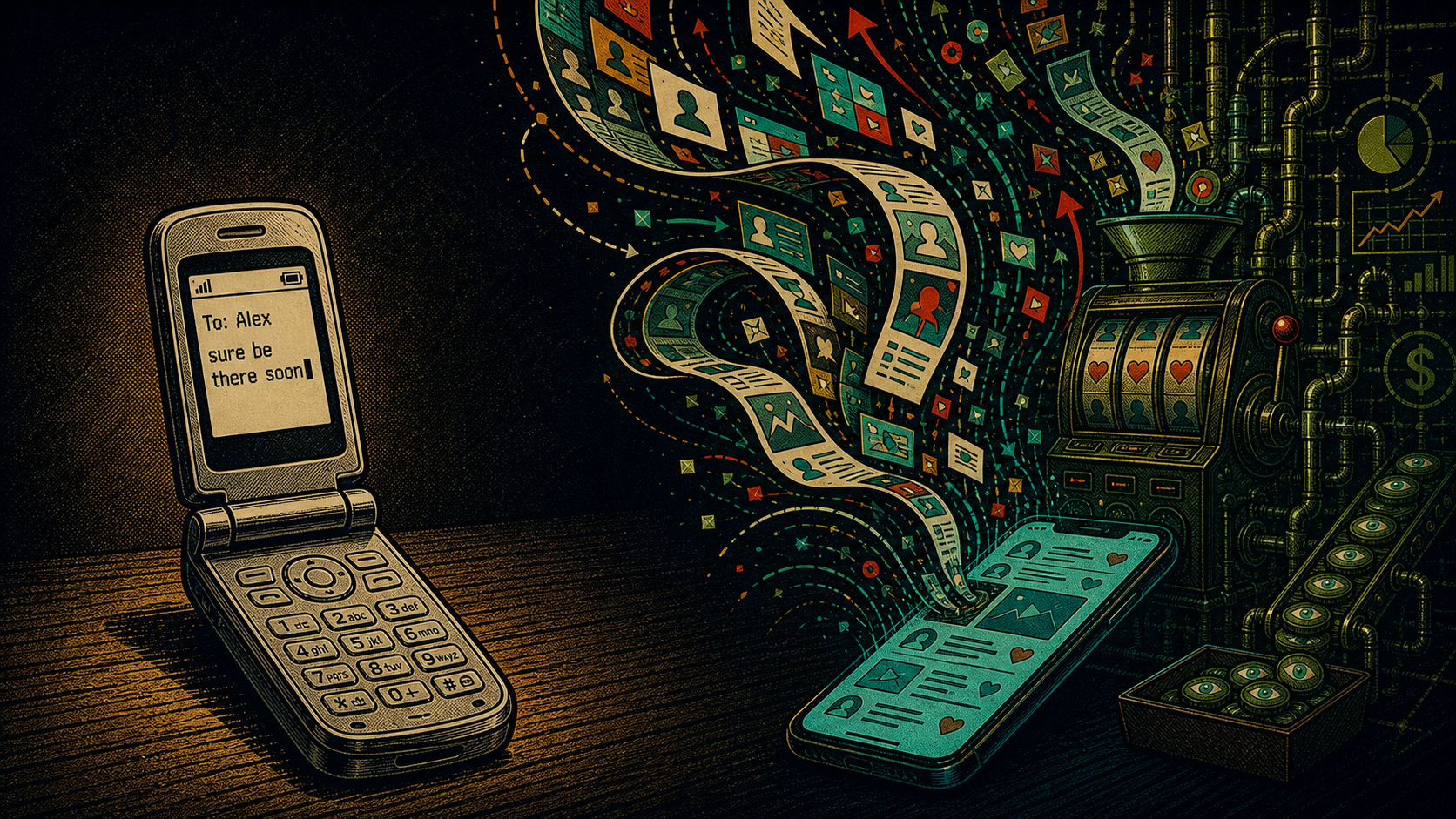
The phone I carried through most of my childhood was a Motorola Razr. Silver. Impossibly thin for its time. It had a satisfying snap when you closed it, a physical punctuation mark at the end of every conversation. You hung up on someone by folding the phone in half. There was something deeply final about it.
The Razr had no browser. No feed. No apps. Its screen showed you who was calling and the time, and that was more or less the extent of its ambitions. If you wanted to text someone, you had to use the number pad, tapping through the digits to reach the letter you needed.
The number 7 was P-Q-R-S. Want an S? Four taps. Want to write “sure”? That’s four taps, then two, then three, then two more. Writing a full sentence was an act of commitment. You didn’t text someone unless you actually had something to say, because the phone made you work for every letter.
At the time, that felt like a limitation. In retrospect, it was a kind of protection.
Because here’s what the Razr also didn’t do: it didn’t follow you into every quiet moment. It didn’t buzz with other people’s opinions while you were trying to think. It didn’t offer you an infinite feed of content calibrated to your psychological vulnerabilities. When you put it down, it stayed down. It left you alone.
I want you to remember something else, something that’s getting harder to access with each passing year: boredom. Actual boredom. Standing in line at the grocery store with nothing to do except stand there. Sitting in a waiting room with a six-month-old magazine and your own thoughts. Staring out a car window watching the landscape scroll by, with no soundtrack except whatever was happening inside your head.
That empty space used to be where thoughts formed. Where ideas drifted in sideways. Where you processed the day, or didn’t process anything at all, and that was fine.
The generation behind you has never known that space. They were born into the after. But you remember the before. And the question that hangs over this essay, that hangs over this entire series, is: what did we give up? And did anyone ask us first?