Prophets of Alignment
By Joseph Rosenbaum
Published: 2026-04-19
URL: https://professorsynapse.substack.com/p/4-the-experiment-that-was-stopped
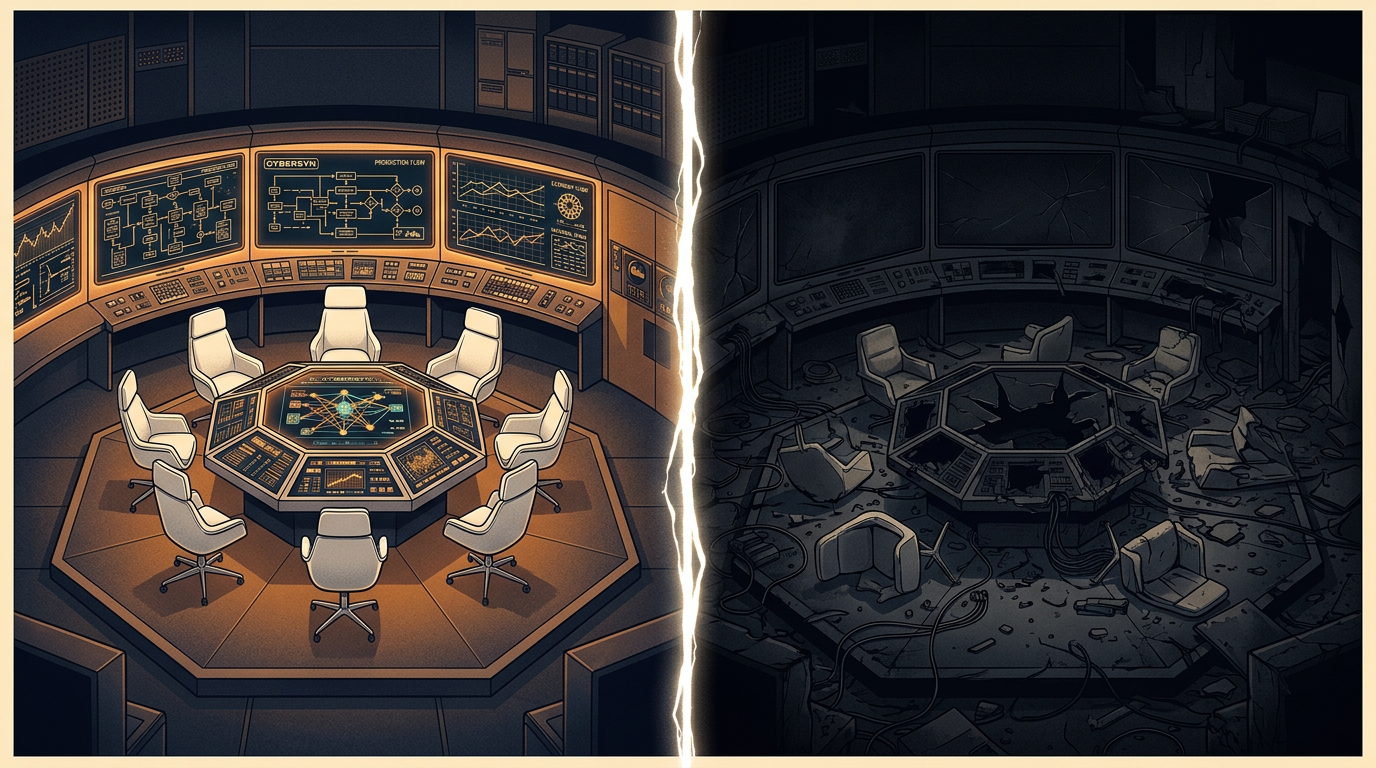
Santiago, Chile, 1972. Inside a building in downtown Santiago, there is a room that does not belong to 1972.
Seven white leather swivel chairs arranged in a hexagon. Screens covering three walls. Controls embedded in the armrests of every chair — buttons and dials, no desks, no paper, no standing presenters at a whiteboard. The room is designed to be operated from the chairs. Everything the people sitting in them need is in front of them or under their hands.
This is the Opsroom. It is entirely real. It is not from a film.
From here, a small team can see rapidly updated production reports from factories across Chile, transmitted over a national telex network, often on a daily basis: copper, textiles, transport, food processing, visualized as flow diagrams showing where the economy is performing inside normal parameters and where it is not.
The system was designed around exception reporting, escalating problems when local managers failed to resolve them in time. The factory continues to manage itself until it doesn’t, and then the center can intervene.
Beer would have called this System 3 and its 3-star audit channel, built at national scale. The Chileans who worked in it called it Cybersyn.
Meditations on Alignment is a reader-supported publication. To receive new posts and support my work, consider becoming a free or paid subscriber.
The story begins a year earlier, in 1971. Salvador Allende’s government has been in power for thirteen months. It has just nationalized a large portion of Chilean industry — copper mines, factories, utilities — and is now facing the problem that nationalization always creates: how do you coordinate an economy you have just taken responsibility for without recreating the command-and-control apparatus of Soviet central planning? Without crushing the autonomy of workers and local managers who know their operations better than anyone in Santiago ever will?
Fernando Flores was Allende’s Minister of Economy, a thirty-year-old engineer with ideas about organizational design and a willingness to try things that had never been tried before. He had read Beer. He invited him to Chile.
Beer arrived and saw immediately what the problem was, in cybernetic terms. The nationalized Chilean economy had enormous operational variety — thousands of distinct enterprises, each facing its own local conditions, its own workforce, its own supply chains. No central authority could have sufficient variety to manage all of that directly.
The attempt would fail exactly the way Ashby said it would fail: the regulator would be overwhelmed, the managed system would operate in the space between the regulator’s rules and reality, and the gap would fill with improvisation, corruption, and collapse.
Beer’s solution was not to build a central command system. It was to build a cybernetic one. Maximum operational autonomy at the factory level. A telex network that fed key production metrics to government mainframes. Economic models that processed the data and flagged anomalies.
The Opsroom to visualize the whole and support rapid decision-making when intervention was genuinely needed. And a design philosophy, borrowed directly from the VSM, that the center’s job was not to manage but to maintain coherence — to be System 5, holding the identity of the whole, while Systems 1 through 4 did their work at the levels where they actually belonged.
He also, characteristically, paid attention to the human side of the system in a way that the purely technical literature tends to skip. The Opsroom chairs were not arranged in a hierarchy. There was no head of table, no podium, no position of visual authority. Whoever sat in those chairs was supposed to be able to see the same information and contribute to the same decisions. The room was an embodied argument about how decisions should be made.
By 1973, Cybersyn existed as a working prototype at different stages of completion. The telex network connected hundreds of enterprises. The economic models were running. The broader Cybersyn network had been used during at least one real crisis, even though the Opsroom itself remained largely at prototype stage.
In October 1972, truckers organized by opposition groups launched a strike designed to strangle the Chilean economy. Roads were blockaded. Supply chains broke down. The Allende government was under serious pressure.
Cybersyn helped the government identify open routes, available trucks, and critical supply needs during the blockade. The telex network allowed the government to coordinate around the disruption rather than simply absorb it. The government managed to blunt some of the strike’s intended effects. The system had done, at least in part, what it was designed to do.
This is the moment the story should end, if this were a story about technology. Technology worked. Crisis resolved. The end.
It is not that kind of story.
On September 11, 1973, General Augusto Pinochet’s forces launched a coup. Military aircraft bombed La Moneda, the presidential palace. Allende died inside it. By the end of the day, the constitutional government of Chile had ceased to exist.
Beer heard the news in England. He could not work for months. He retreated eventually to a cottage in Wales, where he would spend much of the rest of his life, and tried to understand what had happened and what it meant.
The project was abandoned and key physical components, especially the Opsroom, were dismantled or destroyed after the coup. Project Cybersyn was removed from the historical record so thoroughly that most people who encountered it for the first time decades later assumed it was too strange to be true. It took until the 2000s, when scholars like Eden Medina began doing archival work in Chile, for the story to become widely accessible again.
There are two ways to read the history of Cybersyn, and both of them are true.
The first reading: a remarkable cybernetic experiment was destroyed by political violence before it could be fully evaluated. The system worked in the truckers’ strike crisis. It might have worked at scale. We will never know, because it was never allowed to run long enough to find out.
The second reading: one possible interpretation is that Cybersyn’s partial success made it politically more threatening, not less.
Cybersyn terrified people who had never looked at a telex machine. Not because of what it did, but because of what it implied. A national economy coordinated without command. Workers retaining operational autonomy while the government maintained systemic coherence. Control distributed rather than concentrated. The people at the local level running their operations. The people at the national level seeing anomalies and maintaining direction without micromanaging the people below them.
This is a description of a functioning viable system. It is also a description of an arrangement of power that many interests — domestic and foreign — found threatening. The CIA, which was actively working to destabilize the Allende government throughout this period, identified economic disruption as a primary tool.
A system that made the economy even partially more resilient to disruption may have been, from that perspective, an obstacle, though the direct causal link between Cybersyn specifically and the coup should not be overstated.
One way to read the reaction to Cybersyn is that the resistance was not primarily to the technology, but to the theory of power underneath it.
Beer had understood this, in the abstract, before he went to Chile. He had written about it in Designing Freedom, delivered as CBC Massey Lectures in the same year the coup happened. Cybernetics is a theory about where control should live. That makes it a political theory. And it has enemies — not irrational enemies, but enemies with specific interests in the current distribution of control and specific reasons to oppose any redistribution.
Every viable system requires an answer to the question: who is System 5? Who holds the identity, who sets the values, who defines what the system is ultimately for? In an organization, that might be a board or a founder or a culture that has accumulated over decades.
In a national economy, it is a government. In an AI system, to extend Beer’s framework to the present, it is whoever actually controls the training process and the deployment decisions, and that is a question we have not answered clearly.
That is who System 5 is, whatever the documentation says.
The lesson that most people take from Cybersyn is about technology: a visionary system ahead of its time, crushed by history. This is not wrong. But it is incomplete.
The deeper lesson is about the relationship between cybernetic design and political reality. Beer designed a system that gave workers more autonomy and governments better information while decentralizing control. Someone else — with different interests and different answers to the question of who should be System 5 — found that arrangement unacceptable and destroyed it.
This is not an anomaly. It is the normal condition of any attempt to redesign regulatory structure. Redesigning regulation means redesigning power. Every such attempt will encounter the resistance of the interests that benefit from the current design. The technical quality of the proposed system is largely irrelevant to that resistance. The truckers’ strike demonstrated that Cybersyn worked. The coup demonstrated that working was not sufficient protection.
Beer was not naive about this. He had warned about the electronic mafia. He had described, with uncomfortable precision, the ways that cybernetic tools could be used to increase control rather than distribute it. He knew the tools were neutral and that neutrality was not safety.
What he could not fully protect against — what no designer can fully protect against — was the gap between the system’s purpose as designed and the system’s purpose as deployed, in a political environment where the deployment decision was made by people with interests of their own.
POSIWID. The purpose of a system is what it does.
What Cybersyn did, in the end, was demonstrate a possibility and then be destroyed before that possibility could be fully tested. If we apply Beer’s own framework: that is what it did. That is its purpose, in the POSIWID sense, the purpose revealed by the outputs, not the purpose intended by the designers.
By most accounts, the experience in Chile marked Beer deeply. He continued to work, continued to write, continued to think. But Chile had shown him something about the distance between a correct theory and a functioning world that his earlier work had not fully confronted.
He suggested, in later reflections, that he had been naive, not about the cybernetics, which he believed had been sound, but about the political conditions under which sound cybernetics could survive. A theory of viable systems is also a theory of how viable systems can be killed. He had not weighted that theory heavily enough.
This is not a comfortable place to end an essay. It is the honest place.
The prophets in this series were not defeated by being wrong. Wiener’s warnings came true. Ashby’s law held. Beer’s system worked. What the story of Cybersyn adds to the series is the recognition that being right is not the same as being listened to, and that the most dangerous question in any system design is not “does this work?” but “who benefits if it doesn’t?”
Someone else, working in a different register and a different institution, had arrived at the same uncomfortable conclusion by a different route. He had spent years thinking about what it meant to observe a system you were inside, to design a thing you were part of, to try to be objective about a process that included you.
He had a name for the problem. He called it second-order cybernetics.