Prophets of Alignment
By Joseph Rosenbaum
Published: 2026-04-05
URL: https://professorsynapse.substack.com/p/2-only-variety-can-control-variety
In 1947, a psychiatrist named William Ross Ashby was working at Barnwood House Private Mental Hospital in Gloucestershire, where he would later serve as Director of Research.
He had a day job: patients, wards, the whole administrative weight of an institution. But his real work happened in the hours outside that, in the notebooks he kept with obsessive regularity from 1928 until his death in 1972 — twenty-five volumes, filling more than seven thousand indexed pages with diagrams, equations, and observations about the nature of adaptive systems. He was trying to understand something Wiener had gestured toward but not fully formalized. He wanted to know not just that feedback made purposive systems possible, but why some systems survived in their environments and others didn’t.
What, precisely, was the condition for stability? What did any system need in order to cope?
He was, by training and temperament, a categorically different kind of thinker than Wiener. Wiener was a poet as well as a mathematician — prone to mythological illustration, animated by ethical dread, drawn to the human implications of everything he worked on. Ashby was a formalist. He wanted theorems. He wanted something you couldn’t argue with.
He got one.
Meditations on Alignment is a reader-supported publication. To receive new posts and support my work, consider becoming a free or paid subscriber.
The word Ashby reached for was variety.
Not variety in the ordinary sense. Technically: the number of distinct states a system can occupy. A light switch has variety two: on and off. A thermostat has as many states as the resolution of its temperature sensor. A chess board, with all its possible configurations, has variety so large the number requires more digits than there are atoms in the observable universe. A large language model, to borrow the concept for a modern case, has variety that is, for practical purposes, uncountable.
Variety is a measure of complexity. It is the number of distinguishable situations a system can find itself in, or produce, or respond to. And Ashby’s great contribution was to see that variety was not just a descriptive property — it was the key variable in any question about control.
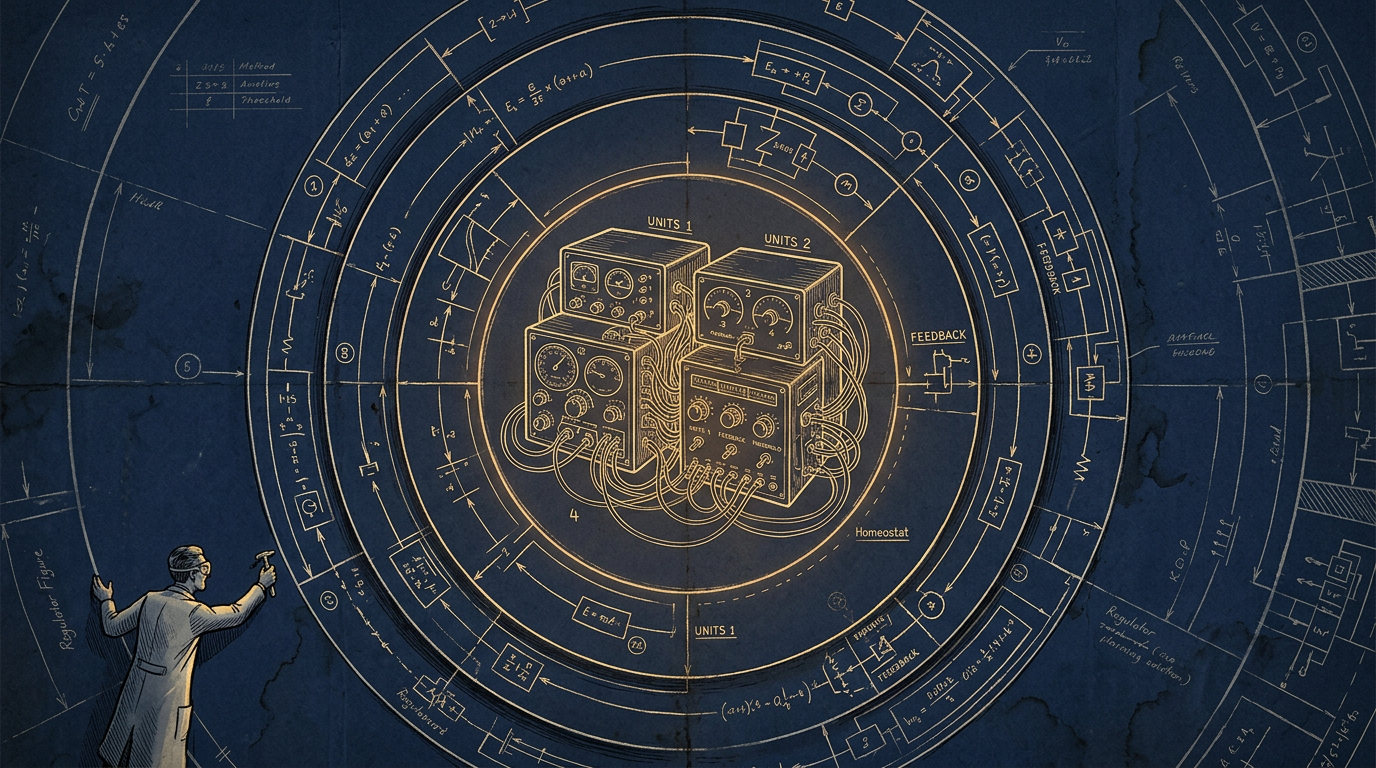
He built a machine to prove it. He called it the Homeostat.
Four interconnected units, each one maintaining its output within a stable range. You could disturb any unit — apply an external force, knock it out of its equilibrium — and the whole system would search. Not by executing a program. Not by following a plan. By trying combinations, cycling through possible configurations, until it found a new stable state. It could be disturbed thousands of times and each time, eventually, it returned to balance.
This was not a trick of engineering. It was a demonstration of a principle. The Homeostat adapted because it had a searching mechanism — a way of generating and testing new configurations in response to disturbance. Its variety of possible internal states was large enough to find a response to a wide range of disturbances within the scope of its design. It didn’t need to be programmed for every contingency. It needed to have enough internal variety to respond to the contingencies it encountered.
Ashby stared at this result and followed it to its logical conclusion.
The Law of Requisite Variety, published in An Introduction to Cybernetics in 1956, is stated with the compression of a mathematical maxim:
Only variety can destroy variety.
What this means, unpacked: if you want to control a system — to keep it within acceptable bounds despite disturbances from the environment — your control mechanism must have at least as much variety as the disturbances it needs to handle. A regulator with less variety than the system it’s regulating will fail. Every time the system enters a state the regulator hasn’t anticipated, the regulator is powerless. The environment’s variety passes through to the outcome.
One way to gloss the principle: for a regulator R to reduce the variety of outcomes to an acceptable range, R must have sufficient variety to counter the variety of disturbances D. You cannot regulate what you cannot match.
This sounds abstract. The consequences are not.
A parent trying to keep a two-year-old safe cannot specify in advance every dangerous thing the two-year-old might do. The two-year-old’s variety exceeds the parent’s capacity to enumerate and prohibit. What works is something more flexible: a parent who can recognize and respond to novel danger on the fly, who has, in Ashby’s terms, sufficient requisite variety to handle what they haven’t anticipated.
A government trying to regulate a financial market cannot write rules that cover every instrument the market might invent. The market’s variety — the number of possible financial instruments, strategies, and arrangements — grows faster than the regulatory vocabulary can follow. What regulators call regulatory arbitrage is, in Ashby’s terms, the market operating in the space between the regulator’s variety and its own.
A policy document cannot govern a sufficiently complex system. The policy has less variety than the system. There will always be situations the policy didn’t imagine.
And if we extend the logic to the present: a set of rules, however detailed, however thoughtfully constructed, will struggle to fully specify the behavior of a sufficiently capable AI. The rules have less variety than the model. You will find edge cases that technically comply while violating the intent, responses the designers never imagined, behaviors that emerge from the intersection of capabilities in ways that no specification anticipated.
Ashby’s Law is not a criticism of any particular approach to alignment. It suggests a deep constraint any alignment approach must contend with. Not an engineering problem, waiting for a sufficiently clever engineer. A formal cybernetic principle about the relationship between regulators and regulated systems.
The obvious question is: if the regulator must match the regulated in variety, what do you do when the regulated system is more capable than anything you can build to govern it?
Ashby had a partial answer, and it has a name too: the Conant-Ashby theorem, developed with Roger Conant in 1970.
Every good regulator of a system must be a model of that system.
This is the requirement that follows from the Law of Requisite Variety. To have sufficient variety to regulate a system, the regulator must, in some functional sense, contain a representation of what it’s regulating — a model that allows it to anticipate the system’s behavior and generate appropriate responses. You cannot control what you cannot predict. You cannot predict what you have not modeled.
The implications run in both directions. First: any sufficiently capable regulator is, at its core, a model of its environment. The brain models the world; the immune system models pathogens; a good manager models the organization they’re managing. Control and modeling are not separate activities — they are two aspects of the same thing.
Second, and more unsettling: the broader implication is that systems capable of effective modeling may also enable effective control. The same property that makes a system knowledgeable may make it capable of control. The line between understanding and power, in this framework, is thinner than we might like.
This means that building AI systems that are sufficiently capable to be useful — capable enough to model complex domains, to generate responses calibrated to context, to predict consequences and navigate uncertainty — is inseparable from building AI systems with the potential for the kind of control that makes them dangerous. The capability that makes them helpful is the capability that makes them powerful. You cannot have one without the other.
Ashby saw this, even if the systems he worked with directly were far simpler. The theorem was published in a general systems context, but the logic it describes is indifferent to scale.
There is something else in An Introduction to Cybernetics that deserves to sit next to the Law. It is Ashby’s definition of what cybernetics is, and what it is not.
“Cybernetics treats, not things but ways of behaving. It does not ask ‘what is this thing?’ but ‘what does it do?’”
This is a methodological commitment with a long reach. Wiener had said something similar — that the science of feedback was indifferent to whether its subject was biological or mechanical, carbon or silicon. Ashby sharpens it: the unit of analysis is behavior, not substance. Not what a system is made of, but what it does, how it responds, what states it occupies and transitions between.
This is, quietly, one of the most radical positions in twentieth-century science. It means that the question “is this thing conscious?” or “does this thing understand?” is, from a cybernetic standpoint, the wrong question. The right question is: what does it do, under what conditions, in response to what inputs? The answer to that question is what a theory of the thing should describe.
AI alignment asks, at its heart: what does this system do? Not what it was trained to do, not what its designers intended, not what it says about itself — what does it actually, observably, consistently produce? Ashby’s framing is the correct framing for this question.
Ashby spent much of his career at an institution for people whose regulation had broken down — whose internal variety, or perhaps their capacity to match it to the world’s demands, had failed in ways that left them unable to function. That context is not incidental. The Homeostat was built by someone who spent his days watching what happened when adaptive systems failed to adapt, when the searching mechanism found no stable configuration, when variety overwhelmed the capacity to respond.
His Law was not an abstraction for him. It was a clinical observation, formalized.
He retired to a professorship at Illinois in the 1960s, where he spent his final years working on questions of intelligence amplification — what it would mean to make minds more capable, and what the relationship between capability and control would look like when the amplification was synthetic rather than biological. He was, in 1956, already thinking about what we now call AI:
“We know that the power of selection can be amplified. It seems to follow that intellectual power, like physical power, can be amplified. We can now do it synthetically, consciously, deliberately.”
He wrote this at the close of An Introduction to Cybernetics. The transistor was nine years old. There were perhaps a few dozen computers in the entire world. He was articulating, in abstract form, a possibility that later developments in computing would make much more concrete.
That is what it looks like to reason from first principles hard enough to see past the horizon of what currently exists.
The uncomfortable question that Ashby leaves us with is not about machines. It is about institutions.
The Law of Requisite Variety is, among other things, a theorem about the limits of governance. Any governing body — a regulator, a government, a safety board, an AI ethics committee — has finite variety. The systems it governs may have more. When that happens, the governor is not actually in control, regardless of what the org chart says.
Ashby’s specific comment on this is worth quoting in full:
“Regulation is possible only if the regulating system is as various and flexible as the system to be regulated. This principle disposes of the myth — still cherished by journalists and sociologists in search of easy popularity — that extraordinarily complex situations demand the concentration of extraordinary powers in a central entity.”
The concentration of power in a central entity does not solve the variety problem. It cannot. A centralized regulator with insufficient variety is not more in control than a distributed one — it is less, because it has removed the local variety that the distributed system contained. The solution to complexity is not command; it is requisite structure, a regulatory architecture whose total variety matches the total variety of what it governs.
We have not built that for AI. We have built something closer to the thing Ashby dismissed: the concentration of oversight in bodies whose variety is vastly less than the systems they are nominally overseeing.
He would recognize the problem. He would have expected it. The Law doesn’t care whether the system being regulated is a hospital ward or a frontier AI model. It applies equally. It always applies.
William Ross Ashby died in 1972, having published two books of lasting importance and filled twenty-five volumes of notebooks that sat largely unread for decades. The notebooks are now digitized. Scholars are still working through them.
He was, in the way of many of the prophets in this series, celebrated in his moment and then quietly set aside as the field moved on to problems that seemed more tractable. His Law was acknowledged but, arguably, underweighted in the practical work of AI development, treated more as an interesting theoretical observation than as a hard constraint.
It is a hard constraint. It was always a hard constraint.
Wiener had told us we needed know-what before know-how. Ashby told us something complementary and more specific: even when you know what you want, you cannot control a system whose variety exceeds your own. The regulator must match the regulated. This is not a counsel of despair. It is a design requirement. It tells you what kind of regulator you need to build.
Someone read Ashby in the late 1950s and had an immediate, practical response. He was a young man in British industry, and he wanted to know what the Law meant for organizations. What did it mean for a corporation, or a hospital, or a government? What did it mean to build an institution with requisite variety?
He had some ideas.