Prophets of Alignment
By Joseph Rosenbaum
Published: 2026-03-22
URL: https://professorsynapse.substack.com/p/0-the-dinner-party-that-changed-everything
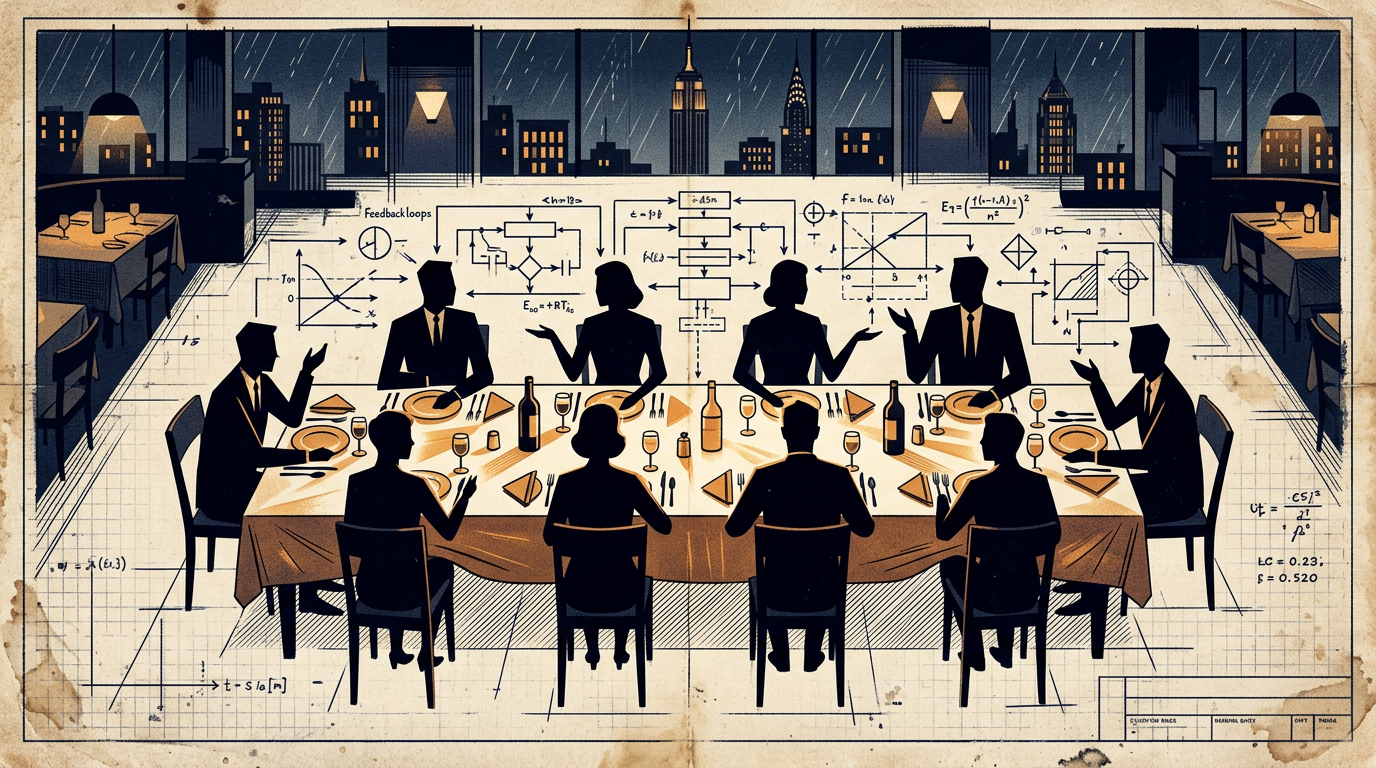
New York, March 1946. The war has been over for seven months.
A private foundation called Josiah Macy Jr. is paying for a dinner. This dinner will run, in successive installments, for seven years. The people invited to it will never agree on what to call what they are doing. Some will say they are trying to understand the brain. Some will say they are trying to understand machines. One of them will later argue that there is no real difference.
Around the table:
A mathematician from MIT named Norbert Wiener. He is forty-one years old, barrel-chested, thick-spectacled, famously absent-minded, and more alarmed than anyone else in the room about the implications of the work he spent the war doing. He built a mathematical predictor for anti-aircraft guns. He came out the other side believing he had accidentally discovered something about the nature of mind.
A neurologist from Illinois named Warren McCulloch. In 1943, working with a young mathematician named Walter Pitts, he published a paper showing that the activity of neurons could be modeled using the mathematics of formal logic. The brain, it suggested, was a kind of computer. Or perhaps the computer was a kind of brain. The paper made Wiener’s hair stand on end. It is partly why this dinner is happening.
An anthropologist named Gregory Bateson. He is tall and difficult and has recently returned from the Pacific, where he spent the war doing psychological warfare. He is constitutionally incapable of staying within his discipline. He will spend the next decade arguing that everything the engineers are discovering about machines also applies to families, cultures, and ecosystems. Nobody at the table will fully agree with him. He will turn out to be right.
A mathematician and physicist named John von Neumann. He is possibly the most purely brilliant person in the room, which is saying a great deal. He helped design the atomic bomb, contributed to the mathematical foundations of quantum mechanics, and is currently in the middle of helping build one of the first programmable electronic computers. He attends for a few years and then mostly stops coming. He has other things to do.
A statistician named Claude Shannon. He will shortly publish what becomes the mathematical theory of information. He is famously private, even at a table of people paid to think out loud.
An anthropologist named Margaret Mead. She is Bateson’s ex-wife. She will later say that participating in these conferences changed how she thought about everything, including herself. She keeps coming back long after others have drifted away.
They are there because someone at the Macy Foundation noticed that people in very different fields were asking what appeared to be the same question. How do complex systems, brains, bodies, machines, organizations, maintain themselves, correct their errors, and pursue their goals?
Nobody has a good answer. But Wiener thinks he might be closing in on one.
Meditations on Alignment is a reader-supported publication. To receive new posts and support my work, consider becoming a free or paid subscriber.
Wiener called it cybernetics. The word comes from kubernetes, the Greek steersman, the one who holds the rudder. Plato used it as a metaphor for the art of governance, of guiding a system toward a destination despite the constant push of wind and current. Wiener adopted it for something more precise: the study of control and communication in the animal and the machine.
The science of steering.
What Wiener had realized, building his anti-aircraft predictor, was that to track a moving target you have to model it as purposive, as going somewhere, as adjusting course based on feedback about where it has been.
The gun predicts where the plane will be, not where it is. And the prediction updates, continuously, as the plane responds. What he and his engineer Julian Bigelow discovered was that the mathematics governing this loop was identical, whether the system doing the adjusting was a servo-mechanism, an anti-aircraft gun, or a human nervous system tracking a moving object with its eyes.
Purpose didn’t require a soul. It required a feedback loop.
This sounds obvious now. In 1943, in the middle of a war fought by machines of extraordinary violence and precision, it was revelatory. If feedback is what makes a system purposive, then purposive behavior is not confined to biological creatures. It can be engineered. And if it can be engineered, then what you engineer it toward becomes the most important question in the room.
Wiener understood this immediately. The others at the Macy table understood it more slowly, or not at all. McCulloch was interested in mechanism. Von Neumann was interested in computation. Shannon was interested in information. Wiener was interested in what all of it meant for what you did with it.
He had also noticed something that would haunt him for the rest of his life: that the gains made possible by cybernetics were inseparable from the dangers it introduced. If you could engineer purposive systems, you could engineer them to pursue purposes that destroyed everything you cared about while technically accomplishing what you asked.
The djinnee who grants your wish exactly as stated. The monkey’s paw. He kept coming back to these old stories. They were alignment failure stories. He was the first person alive who had the mathematical framework to say precisely why.
Over ten conferences, from 1946 to 1953, the group at the Macy table built something remarkable.
They developed a vocabulary for talking about feedback, goal-directedness, homeostasis, and information that cut across biology, engineering, psychology, and the social sciences. They established that brains and machines, however different in their materials, could be analyzed using the same formal tools. They sketched the outline of a new discipline that would treat behavior rather than substance as its subject matter.
What does a system do? Not what is it made of. What does it do, and how does it maintain that behavior against disturbance, and what happens when the disturbance exceeds its capacity to respond?
These were genuinely new questions, or at least newly precise ones. And the people asking them were among the best minds of their generation.
Then, slowly, the field dispersed.
Funding fragmented along disciplinary lines. Universities were not organized for people who refused to stay in their departments. The Cold War military machine wanted applications, not frameworks. Cognitive science absorbed the brain-as-computer idea and ran with it in directions that didn’t require the full cybernetic toolkit. Management science took what it wanted and left the rest. Systems theory went in its own direction. Artificial intelligence, when it emerged as a distinct enterprise, made almost the opposite set of foundational assumptions from the ones the Macy group had developed.
Cybernetics didn’t die. It dispersed. Its ideas survived in pieces, in different fields, stripped of the integrated framework that gave them their full force. The word became attached, in popular imagination, to cyborgs and science fiction. The field that had tried to provide a common language became a language nobody shared.
What remained, mostly, was the feeling among the people who had been in the room that something important had been begun and not finished. McCulloch died in 1969, Wiener in 1964, both of them aware that the thing they had started was being absorbed piecemeal into enterprises they did not entirely recognize.
This series is about the decades that followed: the thinkers who kept working, built on what Wiener had begun, extended it into institutions and governments and the theory of learning itself, and in doing so produced something that looks, from where we stand now, almost uncomfortably like a complete theory of the problems we have only recently started calling AI alignment.
They did not use that phrase. They didn’t need to. They had their own vocabulary, precise and hard-won.
Requisite variety. Viable systems. The purpose of a system is what it does. Second-order cybernetics. Conversation theory. Teachback.
What all of these terms are pointing at, when you follow them far enough, is a single cluster of related questions: How do you design a goal-pursuing system? How do you ensure it pursues the goals you actually have, rather than the ones you were able to write down? How do you remain in control of a system that is more capable than you are? And who gets to be the controller in the first place?
These people answered those questions. Not completely, not forever, not without being wrong about some things. But with far more precision and far more honesty about the difficulty than almost anything being written today.
They were prophets. Not mystics. Not alarmists. Technical thinkers who looked at what they were building and saw, clearly and specifically, the future that would follow from it, and tried to tell us what they saw.
We set their work down. Now we are living in the world they described.
This is the story of what they knew, and when they knew it. And of what it might still be worth to us to listen.
Thanks for reading Meditations on Alignment! This post is public so feel free to share it.