By Tiger Capital Research
Published: 2026-08-05
URL: https://princetonchen.substack.com/p/spacexs-first-public-earnings-revenue
Daily Market Read I | Category: Space, Connectivity & AI Infrastructure | Date: August 5, 2026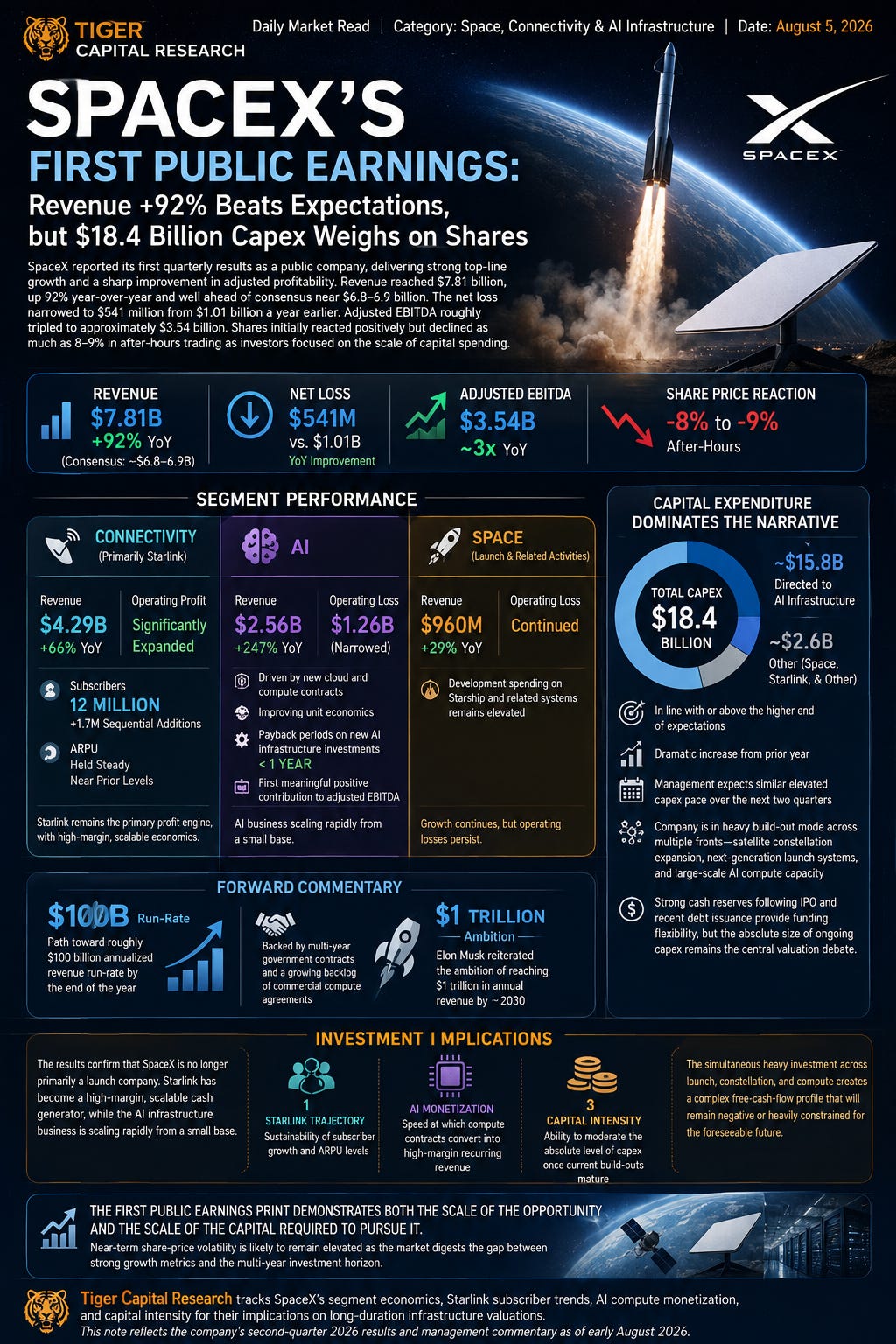
Tiger Capital Research
SpaceX’s First Public Earnings: Revenue +92% Beats Expectations, but $18.4 Billion Capex Weighs on Shares
SpaceX reported its first quarterly results as a public company, delivering strong top-line growth and a sharp improvement in adjusted profitability. Revenue reached $7.81 billion, up 92% year-over-year and well ahead of consensus near $6.8–6.9 billion. The net loss narrowed to $541 million from $1.01 billion a year earlier. Adjusted EBITDA roughly tripled to approximately $3.54 billion. Shares initially reacted positively but declined as much as 8–9% in after-hours trading as investors focused on the scale of capital spending.
Segment Performance
Connectivity (primarily Starlink) remained the primary profit engine. Revenue rose 66% to $4.29 billion, with operating profit expanding significantly. Subscribers doubled year-over-year to 12 million, with a strong sequential addition of roughly 1.7 million users. Average revenue per user held steady near prior levels.
AI delivered the fastest growth. Revenue increased approximately 247% to $2.56 billion, driven largely by new cloud and compute contracts. The operating loss narrowed to about $1.26 billion. Management highlighted improving unit economics and claimed payback periods on new AI infrastructure investments of less than one year. The segment also recorded its first meaningful positive contribution to adjusted EBITDA.
Space (launch and related activities) generated roughly $960 million in revenue, up 29%, but continued to post an operating loss as development spending on Starship and related systems remained elevated.
Capital Expenditure Dominates the Narrative
Total capital expenditure reached $18.4 billion in the quarter, with approximately $15.8 billion directed to AI infrastructure. This level was broadly in line with or above the higher end of expectations and represents a dramatic increase from the prior year. Management indicated that capital spending is expected to remain at a similar elevated pace over the next two quarters.
The combination of rapid revenue growth and extremely high reinvestment is characteristic of a company still in heavy build-out mode across multiple fronts—satellite constellation expansion, next-generation launch systems, and large-scale AI compute capacity. Cash reserves are substantial following the IPO and recent debt issuance, providing funding flexibility, but the absolute size of ongoing capex remains the central valuation debate.
Forward Commentary
Executives pointed to a path toward a roughly $100 billion annualized revenue run-rate by the end of the year, supported by continued Starlink subscriber growth and ramping AI cloud contracts. Longer-term, Elon Musk reiterated the ambition of reaching $1 trillion in annual revenue by around 2030. Near-term visibility is reinforced by multi-year government contracts and a growing backlog of commercial compute agreements.
Investment Implications
The results confirm that SpaceX is no longer primarily a launch company. Starlink has become a high-margin, scalable cash generator, while the AI infrastructure business is scaling rapidly from a small base. The simultaneous heavy investment across launch, constellation, and compute creates a complex free-cash-flow profile that will remain negative or heavily constrained for the foreseeable future.
Investors must weigh three variables: the sustainability of Starlink’s subscriber and ARPU trajectory, the speed at which AI compute contracts convert into high-margin recurring revenue, and the company’s ability to moderate the absolute level of capital intensity once current capacity build-outs mature. The first public earnings print demonstrates both the scale of the opportunity and the scale of the capital required to pursue it. Near-term share-price volatility is likely to remain elevated as the market digests the gap between strong growth metrics and the multi-year investment horizon.
Tiger Capital Research tracks SpaceX’s segment economics, Starlink subscriber trends, AI compute monetization, and capital intensity for their implications on long-duration infrastructure valuations. This note reflects the company’s second-quarter 2026 results and management commentary as of early August 2026.