By Tiger Capital Research
Published: 2026-08-03
URL: https://princetonchen.substack.com/p/markets-rebound-on-iran-de-escalation
Daily Market Read I | Category: Markets & Geopolitics | Date: August 3, 2026
Tiger Capital Research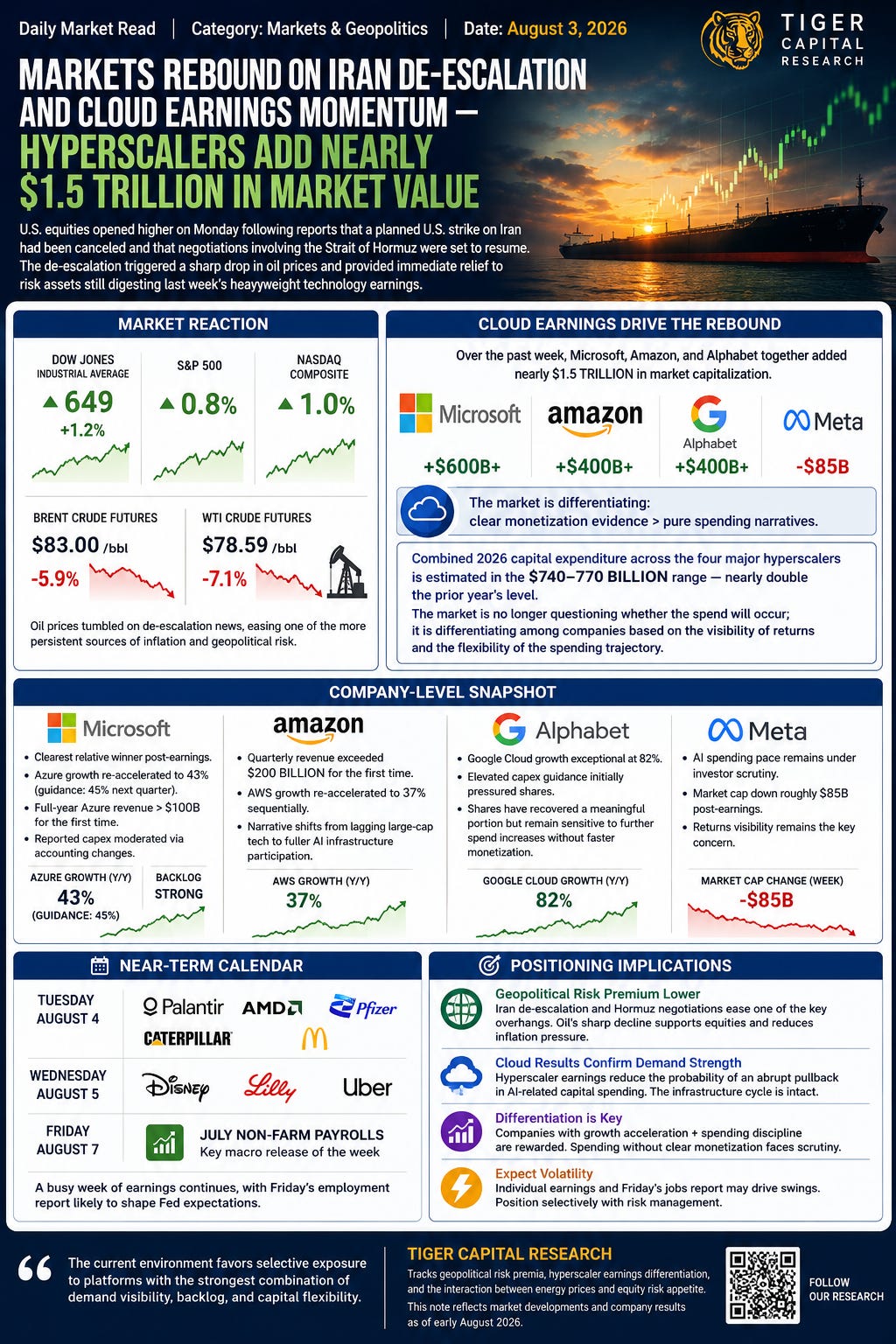
Markets Rebound on Iran De-escalation and Cloud Earnings Momentum — Hyperscalers Add Nearly $1.5 Trillion in Market Value
U.S. equities opened higher on Monday following reports that a planned U.S. strike on Iran had been canceled and that negotiations involving the Strait of Hormuz were set to resume. The de-escalation triggered a sharp drop in oil prices and provided immediate relief to risk assets still digesting last week’s heavyweight technology earnings.
Market Reaction
At the open, the Dow Jones Industrial Average rose approximately 649 points (+1.2%), the S&P 500 gained 0.8%, and the Nasdaq Composite advanced 1.0%. Brent crude futures fell nearly 6% to around $83 per barrel, while WTI dropped more than 7% to approximately $78.59. The decline in energy prices eased one of the more persistent sources of inflation and geopolitical risk that had weighed on sentiment in recent sessions.
Cloud Earnings Provide Deeper Support
Beyond the geopolitical relief, the more durable driver of the rebound remains the market’s reassessment of the major cloud platforms following their latest results. Over the past week, Microsoft, Amazon, and Alphabet together added nearly $1.5 trillion in market capitalization. Microsoft alone contributed more than $600 billion, while Amazon and Alphabet each added over $400 billion. Meta, by contrast, saw roughly $85 billion in market value erode as investors continued to question the pace and returns of its AI spending.
The contrast highlights the market’s current preference for clear monetization evidence over pure spending narratives. Microsoft’s Azure growth re-acceleration to 43% (with guidance of 45% for the next quarter) and its large contracted backlog provided the strongest proof point. Amazon’s AWS re-acceleration to 37% and the first-ever $200 billion quarterly revenue print reinforced the demand backdrop. Alphabet’s 82% Google Cloud growth demonstrated industry-wide strength even as elevated capital expenditure guidance initially pressured the shares.
Combined 2026 capital expenditure across the four major hyperscalers is estimated in the $740–770 billion range — nearly double the prior year’s level. The market is no longer questioning whether the spend will occur; it is differentiating among companies based on the visibility of returns and the flexibility of the spending trajectory.
Company-Level Snapshot
Microsoft remains the clearest relative winner in the post-earnings ranking. Shares recovered aggressively after the results, with the stock reclaiming levels well above the pre-earnings range. Azure’s full-year revenue surpassed $100 billion for the first time, and the combination of accelerating growth plus moderated reported capital expenditure (via accounting changes) addressed the two primary concerns that had weighed on the shares earlier in the year.
Amazon crossed a notable milestone with quarterly revenue exceeding $200 billion. The sequential acceleration in AWS growth helped shift the narrative from lagging large-cap technology name to one participating more fully in the AI infrastructure cycle.
Alphabet continues to trade the tension between exceptional Cloud growth (82%) and the scale of its capital commitments. The shares have recovered a meaningful portion of the post-earnings decline but remain sensitive to any further upward revisions in spending guidance without corresponding evidence of accelerating monetization.
Near-Term Calendar
This week’s focus shifts to a mix of earnings and macro data. Notable reports include Palantir, AMD, Pfizer, Caterpillar, and McDonald’s on Tuesday, followed by Disney, Eli Lilly, Uber, and others mid-week. The July non-farm payrolls report on Friday remains the key macro release and will influence near-term expectations around the Federal Reserve’s policy path.
Positioning Implications
The combination of reduced geopolitical risk premium and confirmed strength in hyperscaler demand has improved the near-term risk backdrop for equities. Oil’s sharp decline lowers one input into the inflation complex, while the cloud results reduce the probability of an abrupt pullback in AI-related capital spending.
That said, the market remains highly differentiated. Companies that can demonstrate both growth acceleration and some form of spending discipline continue to be rewarded. Those perceived as spending heavily without clear monetization paths face ongoing scrutiny. Volatility around individual earnings prints and Friday’s employment data is likely to remain elevated.
The broader AI infrastructure cycle is intact. The current environment favors selective exposure to platforms with the strongest combination of demand visibility, backlog, and capital flexibility rather than undifferentiated bets on the entire complex.
Tiger Capital Research tracks geopolitical risk premia, hyperscaler earnings differentiation, and the interaction between energy prices and equity risk appetite. This note reflects market developments and company results as of early August 2026.集成海报一张