By Tiger Capital Research
Published: 2026-08-02
URL: https://princetonchen.substack.com/p/microsofts-earnings-reversal-azure
Daily Market Read I | Category: Tech Earnings & AI Capex | Date: August 2, 2026
Tiger Capital Research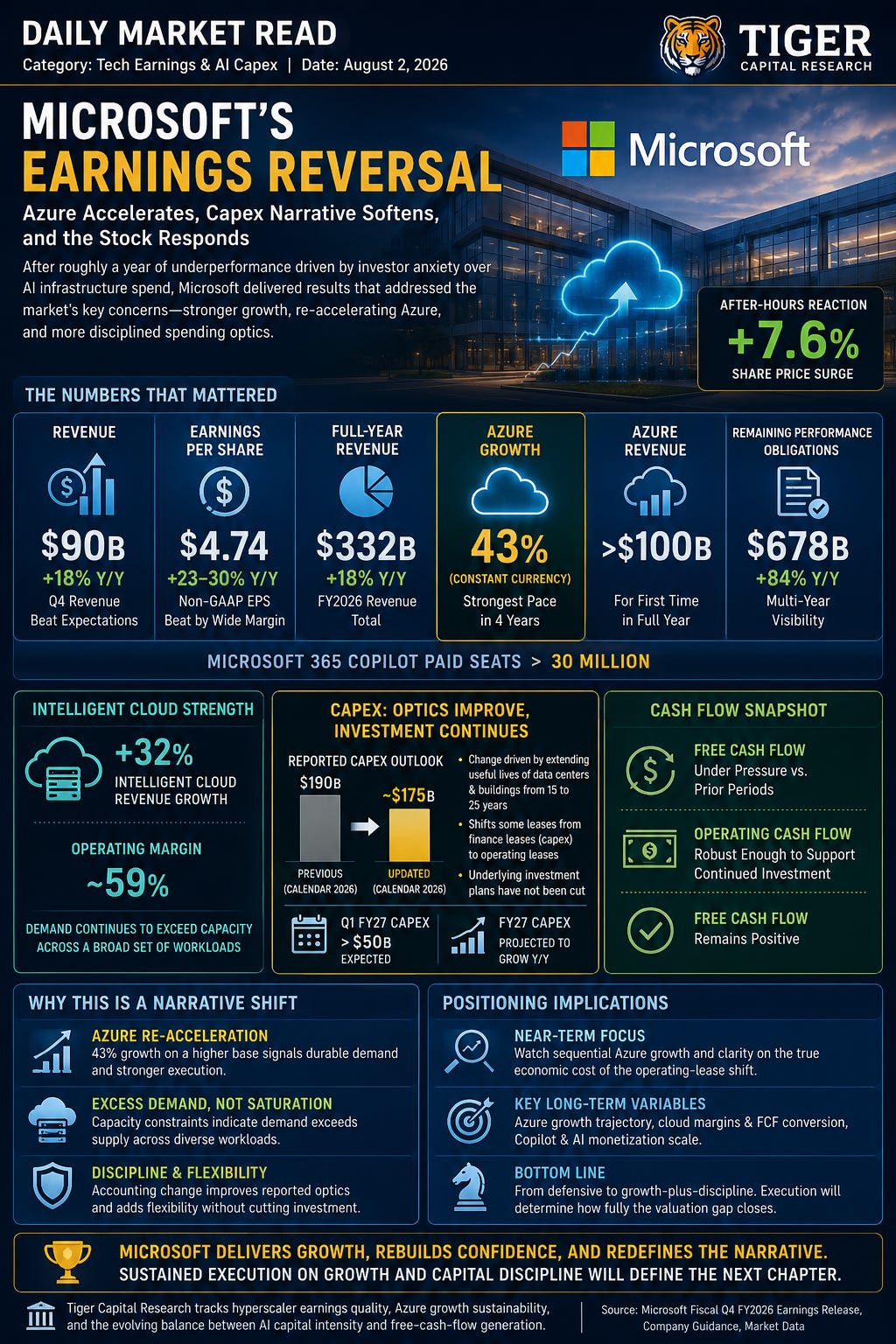
After roughly a year of underperformance driven by investor anxiety over the scale and returns of its AI infrastructure buildout, Microsoft delivered a set of results that directly addressed the market’s primary concerns. Fiscal fourth-quarter revenue and earnings beat expectations, Azure growth re-accelerated, and reported capital expenditure guidance was lowered through an accounting change. Shares rose sharply in after-hours trading as the combination of stronger growth and a more disciplined spending signal shifted sentiment.
The Numbers That Mattered
Revenue reached $90 billion, up 18% year-over-year. Non-GAAP earnings per share of $4.74 rose approximately 23–30% and cleared consensus by a wide margin. Full-year fiscal 2026 revenue totaled roughly $332 billion, up 18%.
Azure was the clear centerpiece. Growth accelerated to 43% (constant currency), the strongest pace in four years and well ahead of both prior guidance and consensus. Management guided the next quarter at approximately 45%. Azure revenue surpassed $100 billion for the full year for the first time. Remaining performance obligations rose 84% to $678 billion, providing multi-year visibility. Microsoft 365 Copilot paid seats exceeded 30 million.
Intelligent Cloud revenue grew 32%, with operating margins holding near 59%. Demand continued to exceed available capacity across a broad set of workloads rather than a narrow set of use cases.
Capex: Accounting Optics Versus Underlying Investment
Cash capital expenditures and total spend including finance leases came in slightly below expectations. More importantly, Microsoft adjusted its calendar 2026 reported capital expenditure outlook from $190 billion to approximately $175 billion. The reduction stems primarily from extending the estimated useful lives of data centers and buildings from 15 to 25 years, which shifts a portion of future leases from finance leases (counted in capex) to operating leases (not counted in the same way).
Management was explicit that underlying investment plans have not been cut. First-quarter fiscal 2027 capital spending is still expected to exceed $50 billion, and full-year fiscal 2027 spending is projected to grow year-over-year. The company also disclosed substantial future data-center lease commitments that have not yet commenced. The accounting change improves the reported optics and introduces greater flexibility, but it does not eliminate the heavy capital intensity of the AI cycle.
Free cash flow remained under pressure relative to prior periods due to the elevated spend, yet operating cash flow stayed robust enough to support continued investment while keeping free cash flow positive.
Why This Constitutes a Narrative Shift
For much of the past year Microsoft traded as one of the weaker large-cap technology names, weighed down by concerns that AI spending would pressure free cash flow without a clear path to commensurate returns. The latest quarter provided three simultaneous counters: Azure growth re-accelerated on a higher base, capacity constraints still point to excess demand rather than saturation, and management demonstrated willingness to adjust the structure and reported magnitude of spending.
The market’s positive reaction reflects relief that the worst-case “spend without returns” scenario is not the base case, at least for now. It does not mean the capital cycle is over. It does mean the burden of proof has shifted slightly back toward the bulls on the question of whether Microsoft can convert infrastructure investment into durable, high-margin growth.
Positioning Implications
Near-term, the stock is likely to remain sensitive to sequential Azure prints and any further clarity on the true economic cost of the operating-lease shift. Longer-term investors should continue to monitor three variables: the trajectory of Azure growth as the base expands, the evolution of cloud gross margins and free-cash-flow conversion, and the pace at which Copilot and other AI products scale from seats into broader usage-based monetization.
Microsoft has moved from a defensive posture in the eyes of many investors to one that again offers a clearer growth-plus-discipline combination. The year of relative underperformance created a valuation gap; the latest results begin to close the credibility gap on execution. Sustained delivery on both growth and capital discipline will determine how fully that gap is closed.
Tiger Capital Research tracks hyperscaler earnings quality, Azure growth sustainability, and the evolving balance between AI capital intensity and free-cash-flow generation. This note reflects Microsoft’s fiscal fourth-quarter results and the subsequent market reassessment as of early August 2026.