By Tiger Capital Research
Published: 2026-07-31
URL: https://princetonchen.substack.com/p/tesla-weighs-china-separation-amid
Daily Market Read I | Category: Tesla & Corporate Strategy | Date: July 31, 2026
Tiger Capital Research
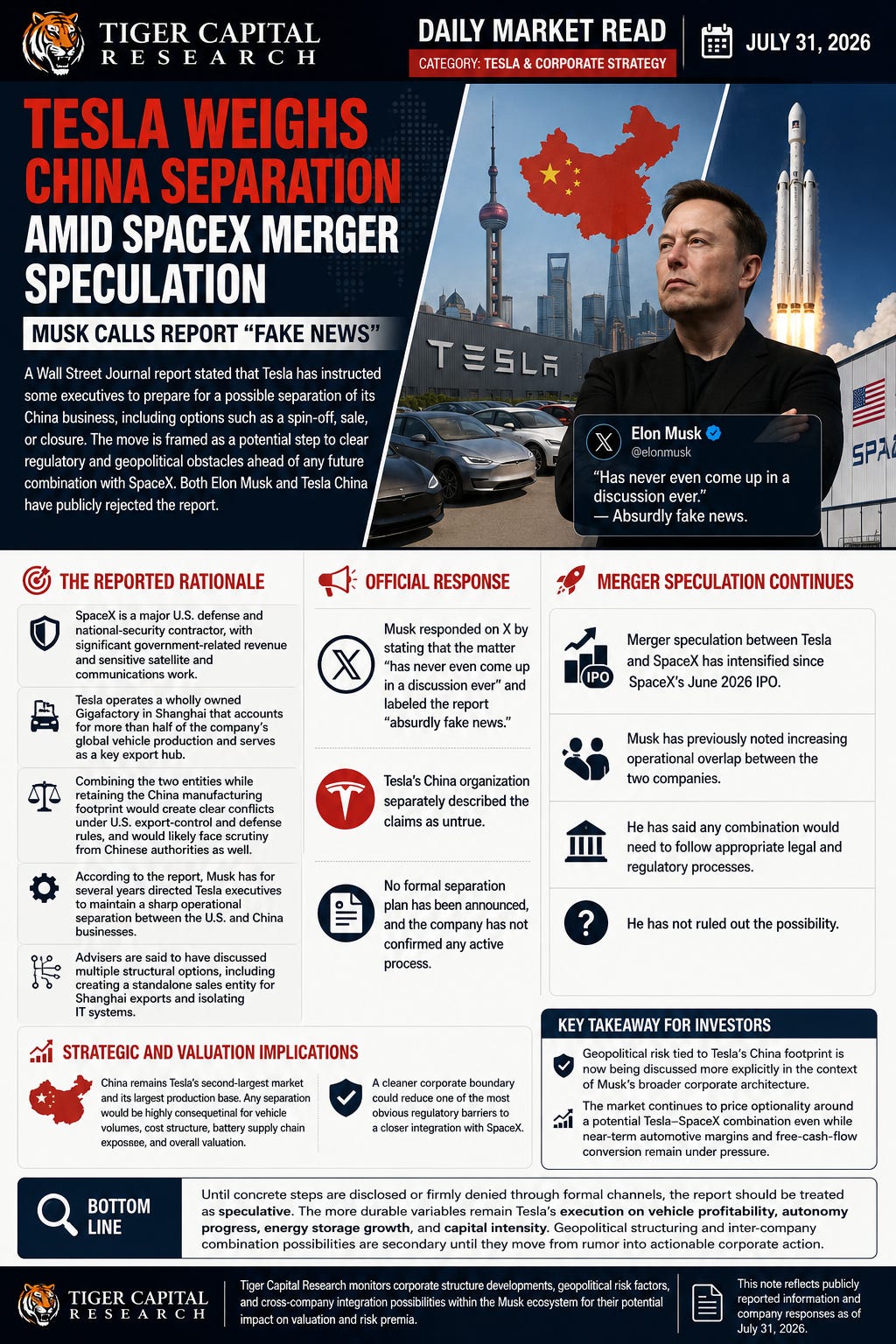
A Wall Street Journal report stated that Tesla has instructed some executives to prepare for a possible separation of its China business, including options such as a spin-off, sale, or closure. The move is framed as a potential step to clear regulatory and geopolitical obstacles ahead of any future combination with SpaceX. Both Elon Musk and Tesla China have publicly rejected the report.
The Reported Rationale
SpaceX is a major U.S. defense and national-security contractor, with significant government-related revenue and sensitive satellite and communications work. Tesla, by contrast, operates a wholly owned Gigafactory in Shanghai that accounts for more than half of the company’s global vehicle production and serves as a key export hub. Combining the two entities while retaining the China manufacturing footprint would create clear conflicts under U.S. export-control and defense rules, and would likely face scrutiny from Chinese authorities as well.
According to the report, Musk has for several years directed Tesla executives to maintain a sharp operational separation between the U.S. and China businesses. The stated goal was to ensure that, in the event of severe geopolitical disruption, the U.S. side of Tesla could continue operating independently. Advisers are said to have discussed multiple structural options, including creating a standalone sales entity for Shanghai exports and isolating IT systems.
Official Response
Musk responded on X by stating that the matter “has never even come up in a discussion ever” and labeled the report “absurdly fake news.” Tesla’s China organization separately described the claims as untrue. No formal separation plan has been announced, and the company has not confirmed any active process.
Merger speculation between Tesla and SpaceX has intensified since SpaceX’s June 2026 IPO. Musk has previously noted increasing operational overlap between the two companies and has said any combination would need to follow appropriate legal and regulatory processes. He has not ruled out the possibility.
Strategic and Valuation Implications
China remains Tesla’s second-largest market and its largest production base. Any separation would be highly consequential for vehicle volumes, cost structure, battery supply chain exposure, and overall valuation. At the same time, a cleaner corporate boundary could reduce one of the most obvious regulatory barriers to a closer integration with SpaceX.
For investors, the episode highlights two overlapping issues. First, the geopolitical risk embedded in Tesla’s China manufacturing footprint is now being discussed more explicitly in the context of Musk’s broader corporate architecture. Second, the market continues to price optionality around a potential Tesla–SpaceX combination even while near-term automotive margins and free-cash-flow conversion remain under pressure.
Until concrete steps are disclosed or firmly denied through formal channels, the report should be treated as speculative. The more durable variables remain Tesla’s execution on vehicle profitability, autonomy progress, energy storage growth, and capital intensity. Geopolitical structuring and inter-company combination possibilities are secondary until they move from rumor into actionable corporate action.
Tiger Capital Research monitors corporate structure developments, geopolitical risk factors, and cross-company integration possibilities within the Musk ecosystem for their potential impact on valuation and risk premia. This note reflects publicly reported information and company responses as of July 31, 2026.集成海报