By Tiger Capital Research
Published: 2026-07-31
URL: https://princetonchen.substack.com/p/microsoft-posts-strong-beat-and-signals
Daily Market Read II | Category: Tech Earnings & AI Capex | Date: July 31, 2026
Tiger Capital Research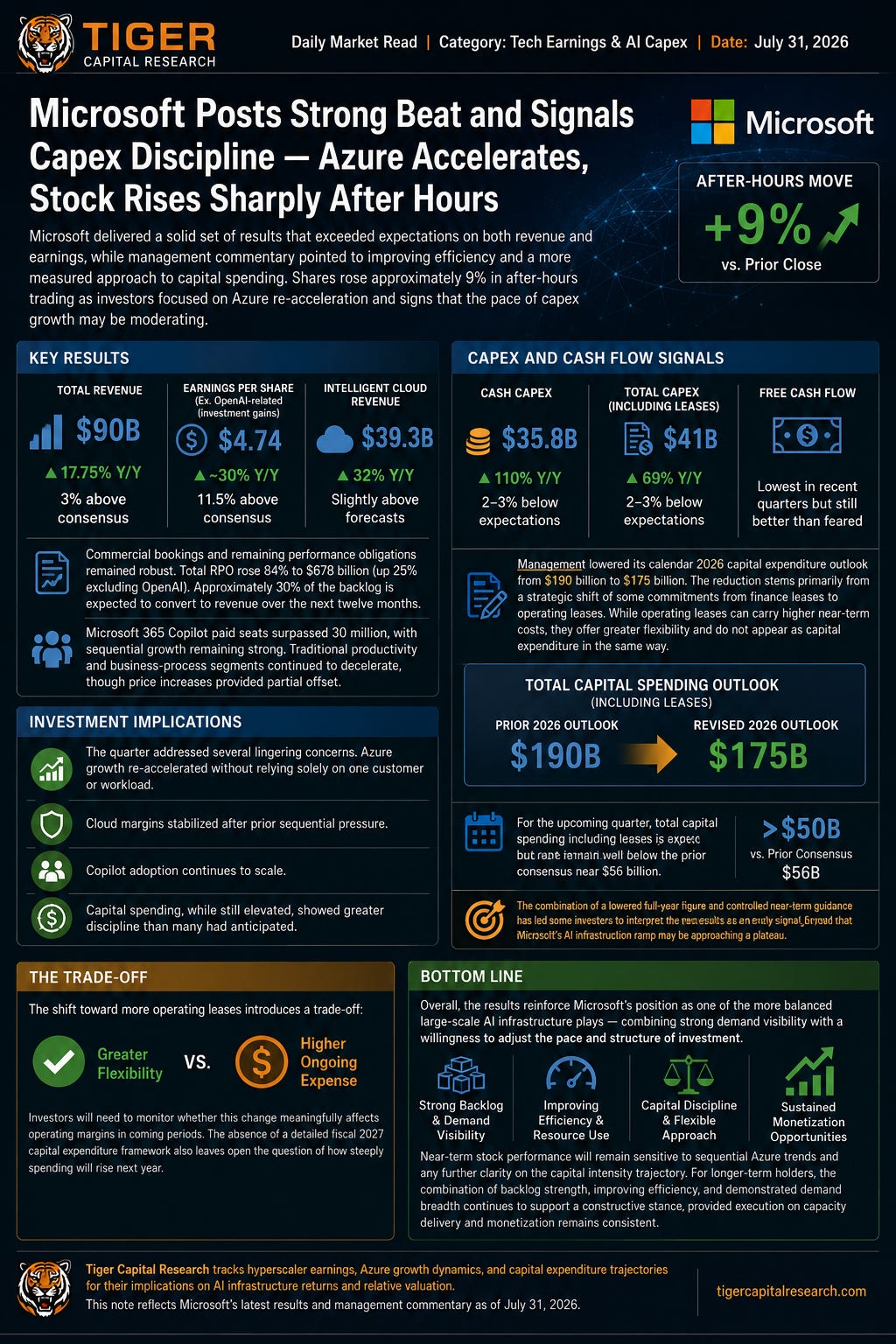
Microsoft delivered a solid set of results that exceeded expectations on both revenue and earnings, while management commentary pointed to improving efficiency and a more measured approach to capital spending. Shares rose approximately 9% in after-hours trading as investors focused on Azure re-acceleration and signs that the pace of capex growth may be moderating.
Key Results
Total revenue reached $90 billion, up 17.75% year-over-year and 3% ahead of consensus. Earnings per share came in at $4.74, up nearly 30% and 11.5% above expectations (excluding OpenAI-related investment gains).
Intelligent Cloud revenue was $39.3 billion, up 32% and slightly ahead of forecasts, with an operating margin of 59.3%. Azure growth accelerated to 43%, beating expectations by roughly four percentage points. Management attributed the outperformance to broad-based demand across workloads, improved CPU and GPU resource efficiency, and faster delivery of new capacity that was quickly absorbed by customers.
Commercial bookings and remaining performance obligations remained robust. Total RPO rose 84% to $678 billion (up 25% excluding OpenAI). Approximately 30% of the backlog is expected to convert to revenue over the next twelve months.
Microsoft 365 Copilot paid seats surpassed 30 million, with sequential growth remaining strong. Traditional productivity and business-process segments continued to decelerate, though price increases provided partial offset.
Capex and Cash Flow Signals
Cash capital expenditures were $35.8 billion, up 110% year-over-year. Including finance leases, total spend reached $41 billion, up 69%. Both figures came in 2–3% below expectations. Free cash flow was $21 billion — the lowest in recent quarters but still better than feared relative to peers and consensus.
More significantly, management lowered its calendar 2026 capital expenditure outlook from $190 billion to $175 billion. The reduction stems primarily from a strategic shift of some commitments from finance leases to operating leases. While operating leases can carry higher near-term costs, they offer greater flexibility and do not appear as capital expenditure in the same way.
For the upcoming quarter, total capital spending including leases is expected to exceed $50 billion but remain well below the prior consensus near $56 billion. The combination of a lowered full-year figure and controlled near-term guidance has led some investors to interpret the results as an early signal that the steepest phase of Microsoft’s AI infrastructure ramp may be approaching a plateau.
Investment Implications
The quarter addressed several lingering concerns. Azure growth re-accelerated without relying solely on one customer or workload. Cloud margins stabilized after prior sequential pressure. Copilot adoption continues to scale. And capital spending, while still elevated, showed greater discipline than many had anticipated.
The shift toward more operating leases introduces a trade-off: greater flexibility at the potential cost of higher ongoing expense. Investors will need to monitor whether this change meaningfully affects operating margins in coming periods. The absence of a detailed fiscal 2027 capital expenditure framework also leaves open the question of how steeply spending will rise next year.
Overall, the results reinforce Microsoft’s position as one of the more balanced large-scale AI infrastructure plays — combining strong demand visibility with a willingness to adjust the pace and structure of investment. Near-term stock performance will remain sensitive to sequential Azure trends and any further clarity on the capital intensity trajectory. For longer-term holders, the combination of backlog strength, improving efficiency, and demonstrated demand breadth continues to support a constructive stance, provided execution on capacity delivery and monetization remains consistent.
Tiger Capital Research tracks hyperscaler earnings, Azure growth dynamics, and capital expenditure trajectories for their implications on AI infrastructure returns and relative valuation. This note reflects Microsoft’s latest results and management commentary as of July 31, 2026.集成海报