By Tiger Capital Research
Published: 2026-07-29
URL: https://princetonchen.substack.com/p/sk-hynix-posts-record-operating-profit
Daily Market Read I | Category: Semiconductors & Memory Cycle | Date: July 29, 2026
Tiger Capital Research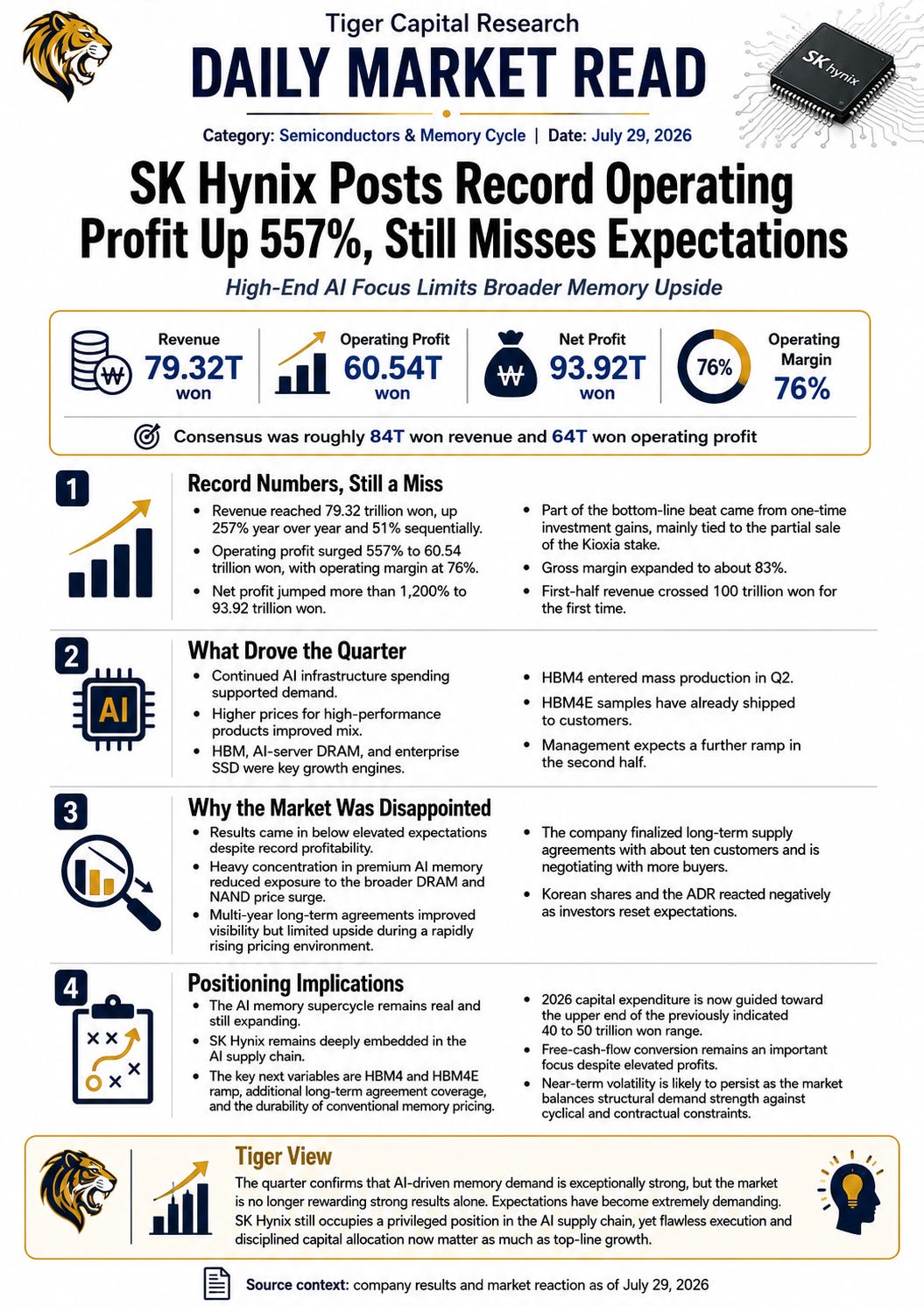
SK Hynix reported second-quarter results that set new highs across the board yet fell short of elevated market expectations, triggering a sharp negative reaction in both the ADR and Korean shares. The numbers underscore the strength of the AI-driven memory cycle while highlighting the trade-offs of the company’s heavy concentration in high-bandwidth memory.
Record Numbers, Still a Miss
Revenue reached 79.32 trillion won, up 257% year-over-year and 51% sequentially. Operating profit surged 557% to 60.54 trillion won, lifting the operating margin to 76%. Net profit jumped more than 1,200% to 93.92 trillion won, though a large portion of the bottom-line beat came from one-time investment gains, primarily related to the partial sale of the Kioxia stake.
Both the top line and operating profit came in below consensus (roughly 84 trillion and 64 trillion won, respectively). Gross margin expanded to approximately 83%. First-half revenue crossed 100 trillion won for the first time.
Management attributed the sequential improvement to continued AI infrastructure spending, rising prices for high-performance products, and a richer mix of HBM, AI-server DRAM, and enterprise SSD. HBM4 entered mass production in the second quarter and will ramp further in the second half; HBM4E samples have already been shipped to customers.
Why the Market Was Disappointed
Two structural factors limited the upside relative to peers. First, SK Hynix’s outsized exposure to premium AI memory meant it captured less of the broader conventional DRAM and NAND price surge that benefited competitors more evenly. Second, a growing portion of volume is now covered by multi-year long-term agreements with differentiated pricing. These contracts improve visibility and reduce cyclicality, but they also cap near-term upside when spot and contract prices are rising rapidly.
The company said it has finalized long-term supply agreements with approximately ten customers and continues negotiations with additional major buyers. Management remains constructive on demand into the second half and guided 2026 capital expenditure toward the upper end of the previously indicated 40–50 trillion won range.
Positioning Implications
The results reinforce that the AI memory supercycle is real and still expanding. Absolute profitability and margins are at levels rarely seen in the industry. At the same time, the miss and subsequent share-price weakness illustrate how high the bar has become. When a company delivers 557% operating-profit growth and still disappoints, it signals that expectations had fully priced in the most optimistic scenario.
For investors, the key variables going forward are the pace of HBM4/HBM4E volume ramp, the terms and coverage of additional long-term agreements, and whether conventional memory pricing remains supportive enough to offset any moderation in the rate of AI-related ASP gains. The rising capital-expenditure plan also means free-cash-flow conversion will remain a focal point even as absolute profits stay elevated.
SK Hynix continues to occupy a privileged position in the AI supply chain. The latest quarter shows both the power of that position and the market’s demand for flawless execution against increasingly ambitious forecasts. Near-term volatility is likely to persist as investors recalibrate the balance between structural demand strength and the cyclical and contractual constraints now visible in the numbers.
Tiger Capital Research tracks memory pricing, HBM supply dynamics, and long-term agreement coverage for their implications on cycle duration and relative valuation across the semiconductor complex. This note reflects company results and market reaction as of July 29, 2026.