By Tiger Capital Research
Published: 2026-07-23
URL: https://princetonchen.substack.com/p/morgan-stanley-sees-50-upside-in
Daily Market Read I | Category: Tech & AI Capex | Date: July 23, 2026
Tiger Capital Research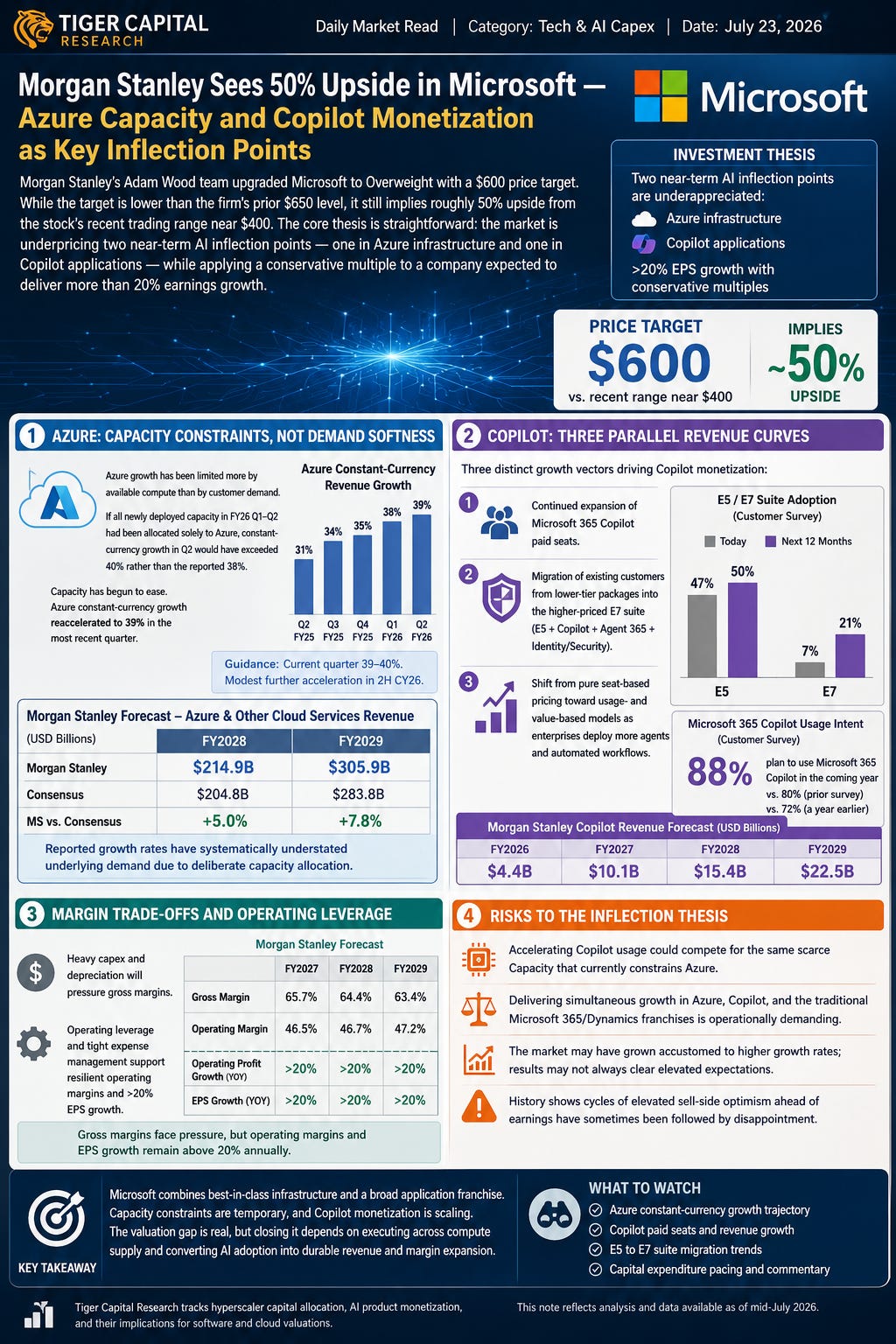
Morgan Stanley’s Adam Wood team upgraded Microsoft to Overweight with a $600 price target. While the target is lower than the firm’s prior $650 level, it still implies roughly 50 percent upside from the stock’s recent trading range near $400. The core thesis is straightforward: the market is underpricing two near-term AI inflection points — one in Azure infrastructure and one in Copilot applications — while applying a conservative multiple to a company expected to deliver more than 20 percent earnings growth.
Azure: Capacity Constraints, Not Demand Softness
Microsoft’s Azure growth has been limited more by available compute than by customer demand. New processors are allocated across external Azure customers, Microsoft 365 Copilot, GitHub Copilot, internal R&D, and other first-party products. CFO Amy Hood previously illustrated the constraint clearly: if all newly deployed capacity in fiscal 2026 first and second quarters had been allocated solely to Azure, constant-currency growth in the second quarter would have exceeded 40 percent rather than the reported 38 percent.
Capacity has begun to ease. Azure constant-currency growth reaccelerated to 39 percent in the most recent quarter. Management guided the current quarter at 39–40 percent and expects modest further acceleration in the second half of calendar 2026. Morgan Stanley forecasts Azure and other cloud services revenue of $214.9 billion in fiscal 2028 and $305.9 billion in fiscal 2029 — 5 percent and 7.8 percent above consensus, respectively. The firm’s view is that reported growth rates have systematically understated underlying demand because of deliberate capacity allocation decisions.
Copilot: Three Parallel Revenue Curves
The second inflection centers on Copilot’s evolving monetization model. Morgan Stanley identifies three distinct growth vectors:
1 Continued expansion of Microsoft 365 Copilot paid seats.
2 Migration of existing customers from lower-tier packages into the higher-priced E7 suite, which bundles E5, Copilot, Agent 365, and identity/security capabilities.
3 A gradual shift from pure seat-based pricing toward usage- and value-based models as enterprises deploy more agents and automated workflows.
Survey data supports the upgrade path. Currently, 47 percent of respondents use E5 and only 7 percent use E7; the firm expects these figures to rise to 50 percent and 21 percent over the next twelve months. Separately, 88 percent of surveyed customers plan to use Microsoft 365 Copilot in the coming year, up from 80 percent in the prior survey and 72 percent a year earlier. On this basis, Morgan Stanley projects Copilot revenue expanding from $4.4 billion in fiscal 2026 to $22.5 billion in fiscal 2029.
Margin Trade-Offs and Operating Leverage
Heavy capital spending and associated depreciation will pressure gross margins. Morgan Stanley has reduced its gross margin forecasts to 65.7 percent in fiscal 2027, 64.4 percent in 2028, and 63.4 percent in 2029. Operating margins, however, are expected to remain resilient at 46.5 percent, 46.7 percent, and 47.2 percent over the same period, provided Microsoft continues to manage operating expenses tightly. The firm projects both operating profit and EPS growth remaining above 20 percent annually through the forecast horizon.
Balancing Risks and Positioning Implications
The optimistic case is clear: capacity constraints are temporary, Azure demand remains robust, and Copilot is transitioning from a seat product into a broader platform monetization opportunity. The risks are equally visible. Accelerating Copilot usage could compete for the same scarce capacity that currently constrains Azure. Delivering simultaneous growth in Azure, Copilot, and the traditional Microsoft 365/Dynamics franchises is operationally demanding and may not satisfy a market that has grown accustomed to higher growth rates. Past cycles of elevated sell-side optimism ahead of Microsoft earnings have sometimes been followed by disappointment when results failed to fully clear elevated bars.
For long-term holders, the central question is whether Microsoft remains the highest-quality large-scale software franchise with durable competitive advantages in both infrastructure and applications. As long as that characterization holds, temporary capacity bottlenecks and margin trade-offs are manageable. Near-term price action, however, will likely remain sensitive to sequential Azure growth prints, Copilot seat and revenue metrics, and any commentary on capital expenditure pacing.
Investors should treat the Morgan Stanley upgrade as a constructive data point rather than a definitive signal. The valuation gap between current multiples and projected earnings growth is real, but the path to closing that gap depends on Microsoft successfully balancing competing demands for compute while converting AI product adoption into measurable revenue and margin expansion. Monitoring the next few quarters of Azure growth trajectory and Copilot monetization metrics will provide the clearest read on whether the inflection thesis is materializing.
Tiger Capital Research tracks hyperscaler capital allocation, AI product monetization, and their implications for software and cloud valuations. This note reflects analysis and data available as of mid-July 2026.