By Tiger Capital Research
Published: 2026-07-21
URL: https://princetonchen.substack.com/p/bofas-hartnett-flags-extreme-bullishness
Daily Market Read II | Category: Market Sentiment & Contrarian Signals | Date: July 20, 2026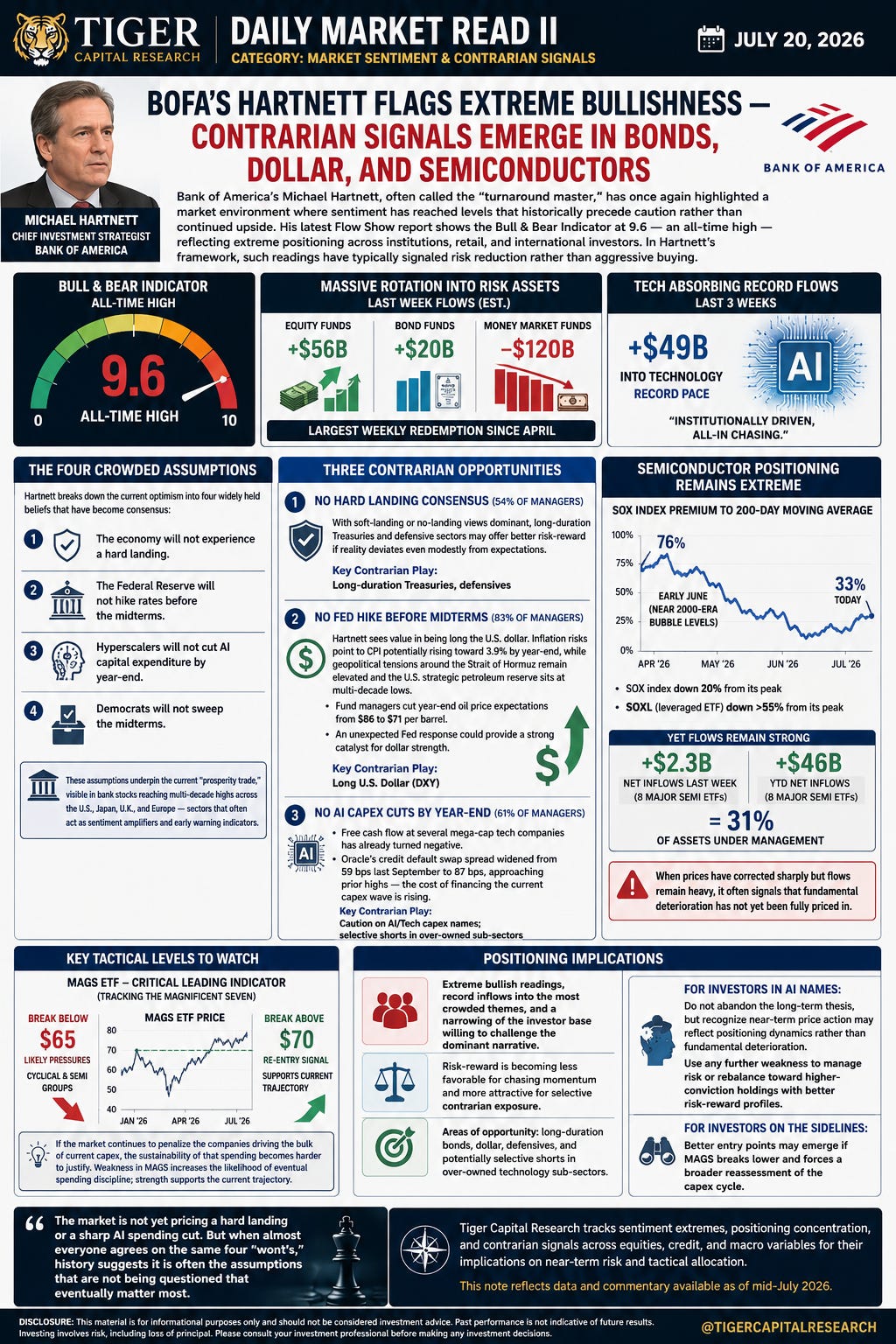
Tiger Capital Research
Bank of America’s Michael Hartnett, often called the “turnaround master,” has once again highlighted a market environment where sentiment has reached levels that historically precede caution rather than continued upside. His latest Flow Show report shows the Bull & Bear Indicator at 9.6 — an all-time high — reflecting extreme positioning across institutions, retail, and international investors. In Hartnett’s framework, such readings have typically signaled risk reduction rather than aggressive buying.
Last week alone, equity funds saw net inflows of approximately $56 billion, while bond funds attracted about $20 billion. At the same time, money market funds experienced outflows of nearly $120 billion — the largest weekly redemption since April. This represents a rapid shift of cash into risk assets, with technology names absorbing an extraordinary $49 billion over the past three weeks, a record pace. Hartnett describes this as “institutionally driven, all-in chasing.”
The Four Crowded Assumptions
Hartnett breaks down the current optimism into four widely held beliefs that have become consensus:
• The economy will not experience a hard landing.
• The Federal Reserve will not hike rates before the midterms.
• Hyperscalers will not cut AI capital expenditure by year-end.
• Democrats will not sweep the midterms.
These assumptions underpin the current “prosperity trade,” visible in bank stocks reaching multi-decade highs across the U.S., Japan, U.K., and Europe — sectors that often act as sentiment amplifiers and early warning indicators.
When positioning becomes this one-sided, Hartnett argues, contrarian opportunities arise. He highlights three specific areas:
1 No hard landing consensus (54% of managers): With soft-landing or no-landing views dominant, long-duration Treasuries and defensive sectors may offer better risk-reward if reality deviates even modestly from expectations.
2 No Fed hike before midterms (83% of managers): Hartnett sees value in being long the U.S. dollar. His rationale centers on inflation risks — current trends point to CPI potentially rising toward 3.9% by year-end, while geopolitical tensions around the Strait of Hormuz remain elevated and the U.S. strategic petroleum reserve sits at multi-decade lows. Notably, fund managers have lowered their year-end oil price expectations from $86 to $71 per barrel, suggesting the market is underpricing the tail risk of renewed inflation pressure. An unexpected Fed response could provide a strong catalyst for dollar strength.
3 No AI capex cuts by year-end (61% of managers): Hartnett points to two concerning signals. First, free cash flow at several mega-cap technology companies has already turned negative. Second, credit markets are showing strain — Oracle’s credit default swap spread has widened from 59 basis points last September to 87 basis points, approaching prior highs. This indicates that the cost of financing the current capex wave is quietly rising.
Semiconductor Positioning Remains Extreme
The semiconductor complex illustrates the crowding problem vividly. The SOX index premium to its 200-day moving average has collapsed from 76% in early June (near 2000-era bubble levels) to just 33% today. The index itself is down 20% from its peak, while the leveraged SOXL ETF has fallen more than 55%. Yet positioning has barely budged. The eight major semiconductor ETFs saw net inflows of $2.3 billion last week alone and $46 billion year-to-date — equivalent to 31% of their assets under management. When prices have already corrected sharply but flows remain heavy, it often signals that fundamental deterioration has not yet been fully priced in.
Key Tactical Levels to Watch
Hartnett identifies the MAGS ETF (tracking the Magnificent Seven) as a critical leading indicator. A break below $65 would likely pressure the broader cyclical and semiconductor groups. Conversely, a sustained move above $70 could serve as a re-entry signal. The logic is straightforward: if the market continues to penalize the companies driving the bulk of current capex, the sustainability of that spending becomes harder to justify. Weakness in MAGS increases the likelihood of eventual spending discipline; strength supports the current trajectory.
Positioning Implications
The current environment features classic signs of late-cycle sentiment: extreme bullish readings, record inflows into the most crowded themes, and a narrowing of the investor base willing to challenge the dominant narrative. While this does not guarantee an imminent reversal, it does suggest that risk-reward is becoming less favorable for chasing momentum and more attractive for selective contrarian exposure — particularly in areas where consensus has become most one-sided (long-duration bonds, dollar, defensives, and potentially selective shorts in over-owned technology sub-sectors).
For investors already positioned in AI-related names, the message is not to abandon the long-term thesis but to recognize that near-term price action may continue to reflect positioning dynamics rather than fundamental deterioration. Using any further weakness to manage risk or rebalance toward higher-conviction holdings with better risk-reward profiles remains a prudent approach. Those sitting on the sidelines may find better entry points if the MAGS level breaks lower and forces a broader reassessment of the capex cycle.
The market is not yet pricing a hard landing or a sharp AI spending cut. But when almost everyone agrees on the same four “won’ts,” history suggests it is often the assumptions that are not being questioned that eventually matter most.
Tiger Capital Research tracks sentiment extremes, positioning concentration, and contrarian signals across equities, credit, and macro variables for their implications on near-term risk and tactical allocation. This note reflects data and commentary available as of mid-July 2026.