By Tiger Capital Research
Published: 2026-07-20
URL: https://princetonchen.substack.com/p/semiconductor-volatility-broadens
Daily Market Read I | Category: Semiconductors & Volatility | Date: July 20, 2026
Tiger Capital Research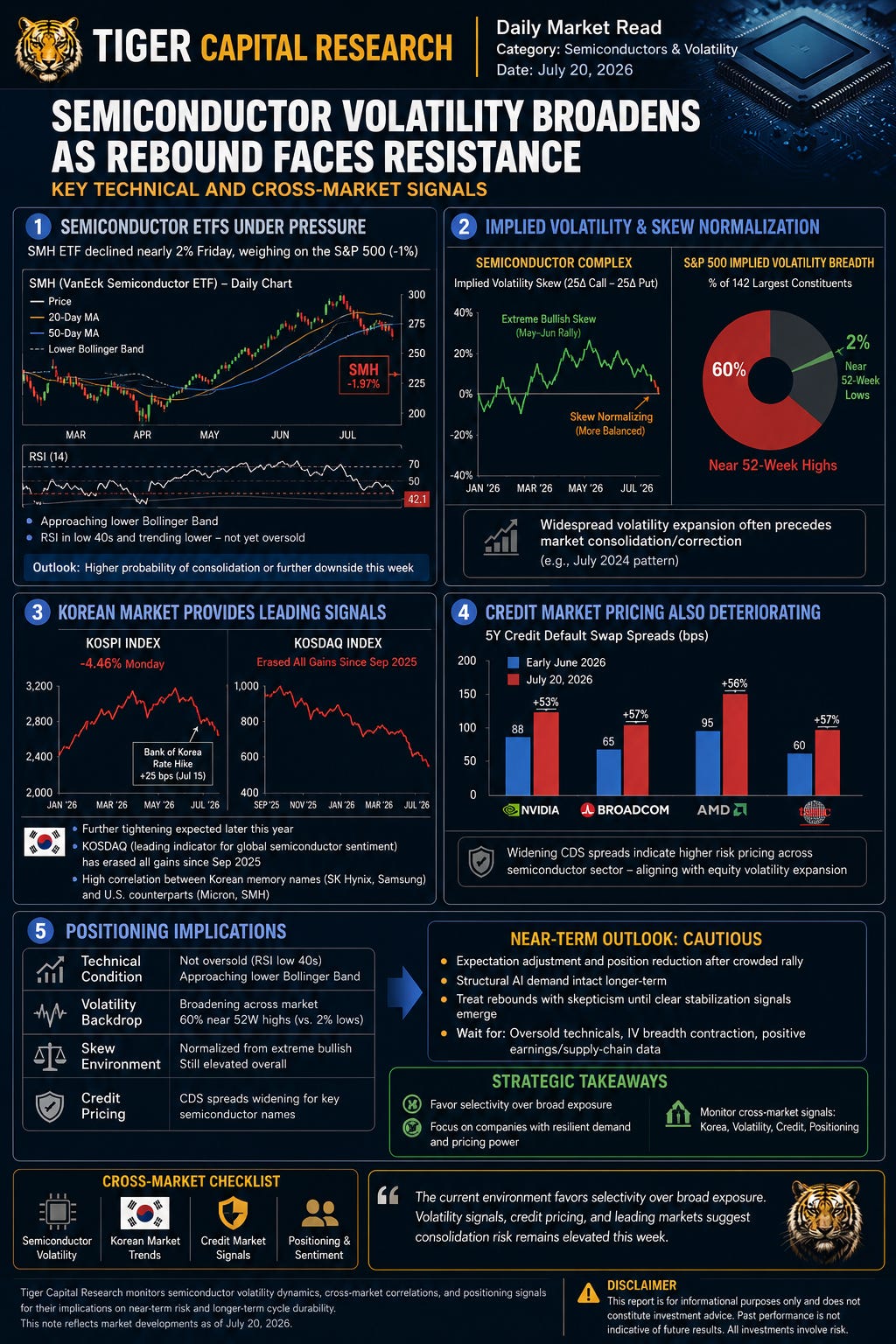
The semiconductor sector extended its recent weakness last Friday, with the SMH ETF declining nearly 2 percent and contributing to a roughly 1 percent drop in the S&P 500. While the index has approached the lower Bollinger Band, the relative strength index remains in the low 40s and continues to trend lower, indicating that the group is not yet technically oversold. This setup increases the probability of further consolidation or downside pressure this week rather than an immediate relief rally.
Implied Volatility and Skew Normalization
A notable development is the shift in implied volatility dynamics. While overall implied volatility across the semiconductor complex remains elevated, the volatility skew has moved away from the extreme bullish positioning that characterized the May–June rally. This normalization reflects a more balanced risk environment and suggests that the one-sided momentum chase that dominated earlier in the summer has largely dissipated — a healthy, if uncomfortable, cooling process.
At the broader market level, implied volatility has expanded significantly. Among the 142 largest S&P 500 constituents, approximately 60 percent now show implied volatility near 52-week highs, while only 2 percent sit near lows. Historical patterns indicate that such widespread volatility expansion often precedes periods of market consolidation or correction, as seen in July 2024 when rising volatility breadth ultimately gave way to a reversal in the index itself.
Korean Market Provides Leading Signals
Developments in Korea reinforce the cautionary tone. The KOSPI fell 4.46 percent on Monday following the Bank of Korea’s 25-basis-point rate hike on July 15, with further tightening expected later this year. The KOSDAQ index, which has historically served as a leading indicator for global semiconductor sentiment, has now erased all gains since September 2025 after a sharp multi-week decline. Given the high correlation between Korean memory names (SK Hynix, Samsung) and their U.S. counterparts (Micron, SMH), sustained weakness in the Korean market adds downside pressure to the global chip complex.
Credit Market Pricing Also Deteriorating
Credit default swap spreads for key semiconductor companies — including Nvidia, Broadcom, AMD, and TSMC — have widened, indicating that the market is pricing in higher risk across the sector. This development aligns with the equity volatility expansion and suggests that the recent pullback is not merely a technical correction but reflects growing concern over both cyclical and structural risks in the AI supply chain.
Positioning Implications
The combination of non-oversold technical conditions, broadening volatility, normalized but still-elevated skew, and deteriorating credit pricing points to a cautious near-term outlook for semiconductor stocks. While the longer-term structural demand for AI-related compute remains intact, the market is currently in a phase of expectation adjustment and position reduction following an extended period of crowded positioning.
Investors should treat any near-term rebound attempts with skepticism until clearer signs of stabilization emerge — either through oversold technical readings, a meaningful contraction in implied volatility breadth, or positive confirmation from upcoming earnings and supply-chain data. The current environment favors selectivity over broad exposure, with particular attention to companies that can demonstrate resilient demand and pricing power even as macro and sentiment headwinds persist.
Tiger Capital Research monitors semiconductor volatility dynamics, cross-market correlations, and positioning signals for their implications on near-term risk and longer-term cycle durability. This note reflects market developments as of July 20, 2026.