By Tiger Capital Research
Published: 2026-07-14
URL: https://princetonchen.substack.com/p/fed-governor-waller-turns-hawkish
Daily Market Read II | Category: Fed Policy & Market Reaction | Date: July 14, 2026
Tiger Capital Research
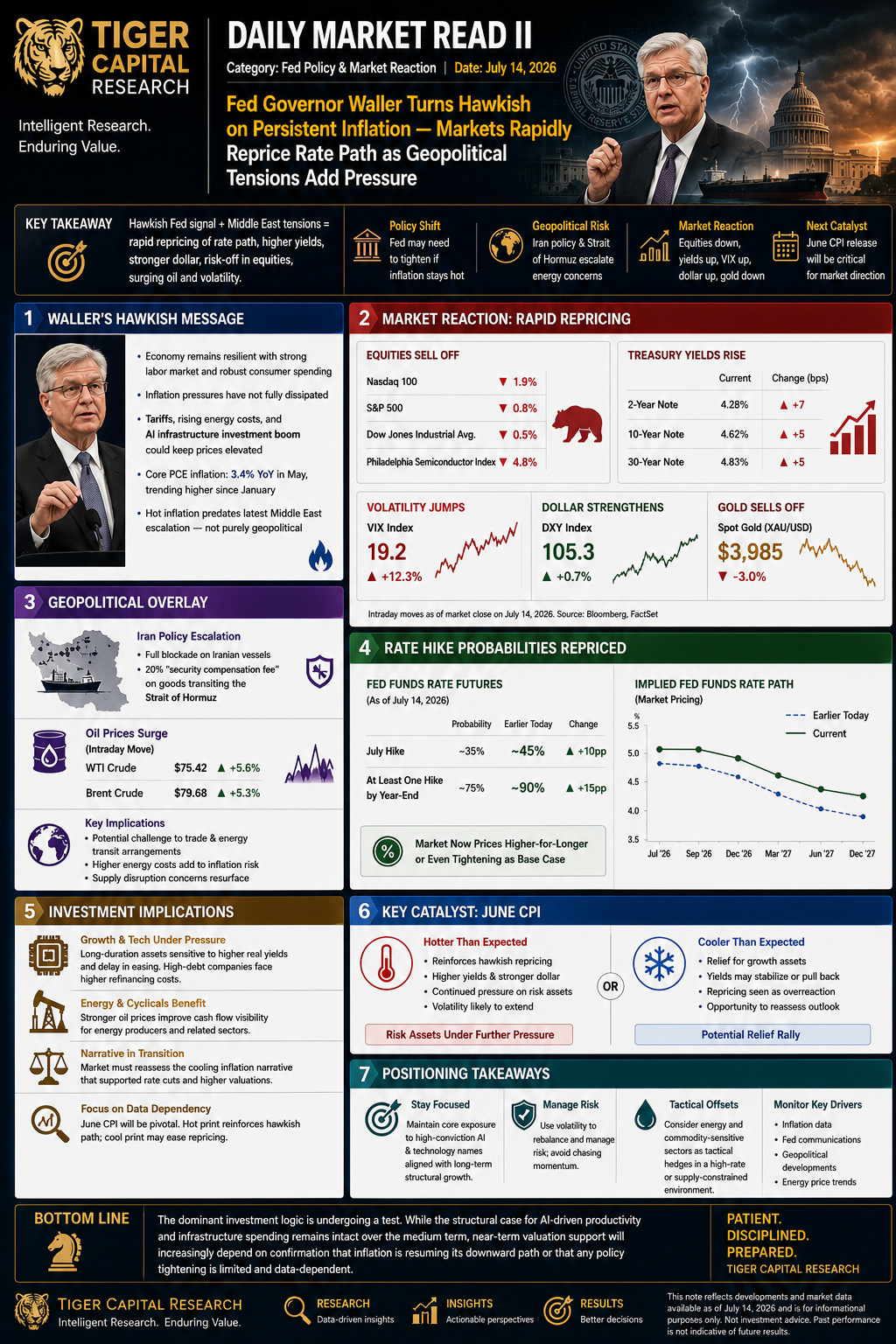
Federal Reserve Governor Christopher Waller delivered unexpectedly hawkish remarks on Monday, warning that persistently hot core inflation data could force the FOMC to consider tightening monetary policy in the near term. The comments triggered an immediate and sharp repricing across asset classes, with US equities selling off, Treasury yields rising, and commodity and volatility measures moving in tandem with heightened geopolitical risk in the Middle East.
Waller noted that the economy remains resilient with a strong labor market and robust consumer spending. However, he expressed concern that inflation pressures have not fully dissipated. He highlighted tariffs, rising energy costs, and the investment boom tied to AI infrastructure as potential drivers keeping price pressures elevated. Core PCE inflation stood at 3.4 percent year-over-year as of May and has been trending higher since January — a move that predates the latest escalation in Middle East tensions and therefore cannot be dismissed as purely geopolitical.
Markets reacted swiftly. The Nasdaq 100 fell nearly 2 percent at one point, the S&P 500 declined around 0.8 percent, and the Dow Jones Industrial Average slipped about 0.5 percent. The Philadelphia Semiconductor Index dropped close to 5 percent as growth-sensitive technology names came under pressure. Treasury yields climbed across the curve, with the 10-year note rising more than 5 basis points toward 4.62 percent and the 2-year note advancing roughly 7 basis points to 4.28 percent.
Geopolitical Overlay Intensifies the Shift
President Trump’s statements on Iran added another layer of uncertainty. The administration signaled a return to stricter enforcement, including a full blockade on Iranian vessels and consideration of a 20 percent “security compensation fee” on goods transiting the Strait of Hormuz. Markets interpreted this as a potential challenge to existing trade and energy transit arrangements, pushing oil prices sharply higher. WTI crude broke above $75 per barrel and Brent approached $80, with both benchmarks gaining more than 5 percent intraday.
The combination of hawkish Fed rhetoric and geopolitical risk drove volatility measures higher, with the VIX rising more than 12 percent. The dollar strengthened while gold sold off sharply, falling around 3 percent and briefly breaking below the $4,000 per ounce psychological level for the first time since early July.
Interest-rate futures quickly adjusted. The probability of a July rate hike rose to approximately 45 percent (from around 35 percent earlier in the day), while the odds of at least one hike by year-end climbed toward 90 percent. The bond market is now embedding a higher-for-longer or even tightening path in the base case.
Investment Implications
The episode underscores how quickly the dominant market narrative can shift when inflation data and policy signals diverge from prior expectations. For much of the past year, the prevailing framework assumed cooling inflation would allow rate cuts and easier financial conditions, supporting higher valuations for growth assets. Waller’s remarks challenge that assumption directly.
Technology and other long-duration growth stocks are particularly sensitive to any sustained rise in real yields or delay in expected easing. High-debt companies could also face higher refinancing costs if the policy path steepens. In contrast, traditional energy names stand to benefit from stronger oil prices and improved cash-flow visibility.
Near-term focus will center on the upcoming June CPI release. A hotter-than-expected print would likely reinforce the hawkish repricing and extend pressure on risk assets. A cooler outcome could provide relief and allow markets to reassess whether the recent move was an overreaction.
Positioning should account for the possibility of continued volatility around data releases and geopolitical headlines. Maintaining exposure to high-conviction AI and technology names remains consistent with the longer-term thesis, but investors may benefit from using any further weakness to manage risk or add selectively rather than chasing momentum. Energy and other cyclical areas sensitive to commodity prices could serve as tactical offsets in a higher-rate or supply-constrained environment.
The dominant investment logic is undergoing a test. While the structural case for AI-driven productivity and infrastructure spending remains intact over the medium term, near-term valuation support will increasingly depend on confirmation that inflation is resuming its downward path or that any policy tightening is limited and data-dependent.
Tiger Capital Research monitors Federal Reserve communications, inflation dynamics, and geopolitical influences on energy and risk assets for their implications on sector rotation and valuation frameworks. This note reflects developments as of July 14, 2026.