By Tiger Capital Research
Published: 2026-07-14
URL: https://princetonchen.substack.com/p/contradictory-signals-sell-side-sentiment
Daily Market Read I | Category: Market Sentiment & AI Outlook | Date: July 14, 2026
Tiger Capital Research
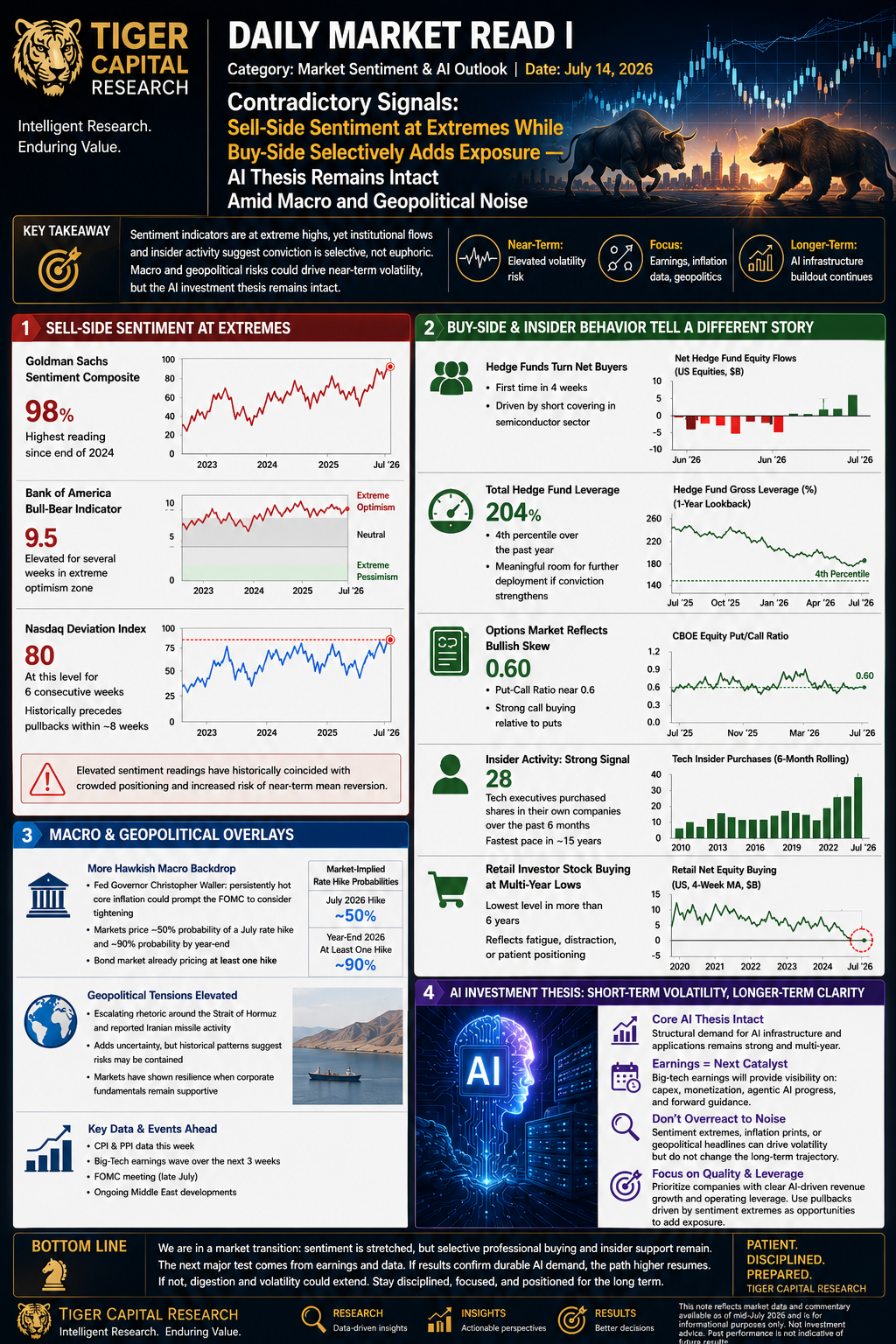
Market sentiment indicators have reached levels that historically precede short-term cooling, yet several buy-side and insider metrics suggest underlying conviction remains selective rather than euphoric. This tension sets up a period of volatility as investors digest upcoming inflation data, corporate earnings, and geopolitical developments in the Middle East.
Goldman Sachs’ sentiment composite index stands at 98 percent — the highest reading since the end of 2024 — reflecting broad-based optimism across institutional, retail, and international investors. Bank of America’s bull-bear indicator has remained elevated near 9.5 for several weeks, a zone that often coincides with crowded positioning and elevated risk of near-term mean reversion. A proprietary Nasdaq deviation index has sat at 80 for six consecutive weeks, a threshold that in the past has preceded pullbacks within roughly eight weeks.
Buy-Side and Insider Behavior Tell a Different Story
Hedge funds turned net buyers of US equities last week for the first time in four weeks, primarily through short covering in the semiconductor sector. Total hedge fund leverage has risen to 204 percent, which sits at just the 4th percentile over the past year — leaving meaningful room for further deployment if conviction strengthens. The options market also reflects bullish skew, with the put-call ratio near 0.6, a level consistent with strong call buying relative to puts.
Insider activity adds another layer of support: 28 technology executives have purchased shares in their own companies over the past six months, the fastest pace in approximately 15 years. In contrast, retail investor stock buying has slowed to its lowest level in more than six years, potentially reflecting fatigue from recent semiconductor volatility, distraction from other events, or a more patient approach ahead of year-end positioning.
Macro and Geopolitical Overlays
The macroeconomic backdrop has turned more hawkish in the near term. Federal Reserve Governor Christopher Waller delivered comments that markets interpreted as less dovish than expected, noting that persistently hot core inflation data this week could prompt the FOMC to consider tightening. Middle East tensions have pushed the probability of a July rate hike to around 50 percent and a year-end hike to roughly 90 percent according to market pricing, with the bond market already embedding at least one move.
Geopolitical developments remain fluid. Escalating rhetoric around the Strait of Hormuz and reported Iranian missile activity have added uncertainty, though historical patterns in similar cycles suggest risks may be contained rather than spiraling. Markets have shown resilience to such noise when underlying corporate fundamentals remain supportive.
AI Investment Thesis: Short-Term Volatility, Longer-Term Clarity
Despite the near-term crosscurrents, the core AI investment narrative continues to hold. Attention now turns to the upcoming wave of big-tech earnings, which should provide updated visibility on capital expenditure plans, monetization progress, agentic AI developments, and forward guidance. These updates are expected to serve as the next major catalyst for the sector.
Short-term volatility driven by sentiment extremes, inflation data, or geopolitical headlines does not alter the structural direction of AI infrastructure and application buildout. Investors are advised to maintain patience and avoid overreacting to near-term noise. Positioning should remain focused on companies demonstrating clear paths to AI-driven revenue growth and operating leverage, while using any sentiment-driven weakness as an opportunity to add exposure at better levels.
The current environment features classic signs of a market in transition: elevated sentiment readings coexist with selective professional buying and insider support, while macro and geopolitical factors introduce tactical volatility. The resolution of this tension will likely depend on whether upcoming earnings and data confirm the durability of AI demand or reveal early signs of digestion in capex cycles.
Tiger Capital Research tracks sentiment indicators, institutional flows, and AI-related corporate developments for their implications on near-term volatility and longer-term positioning. This note reflects market data and commentary available as of mid-July 2026.