By Tiger Capital Research
Published: 2026-07-13
URL: https://princetonchen.substack.com/p/one-research-note-hundreds-of-billions
Daily Market Read I | Category: AI Supply Chain & Research Impact | Date: July 13, 2026
Tiger Capital Research
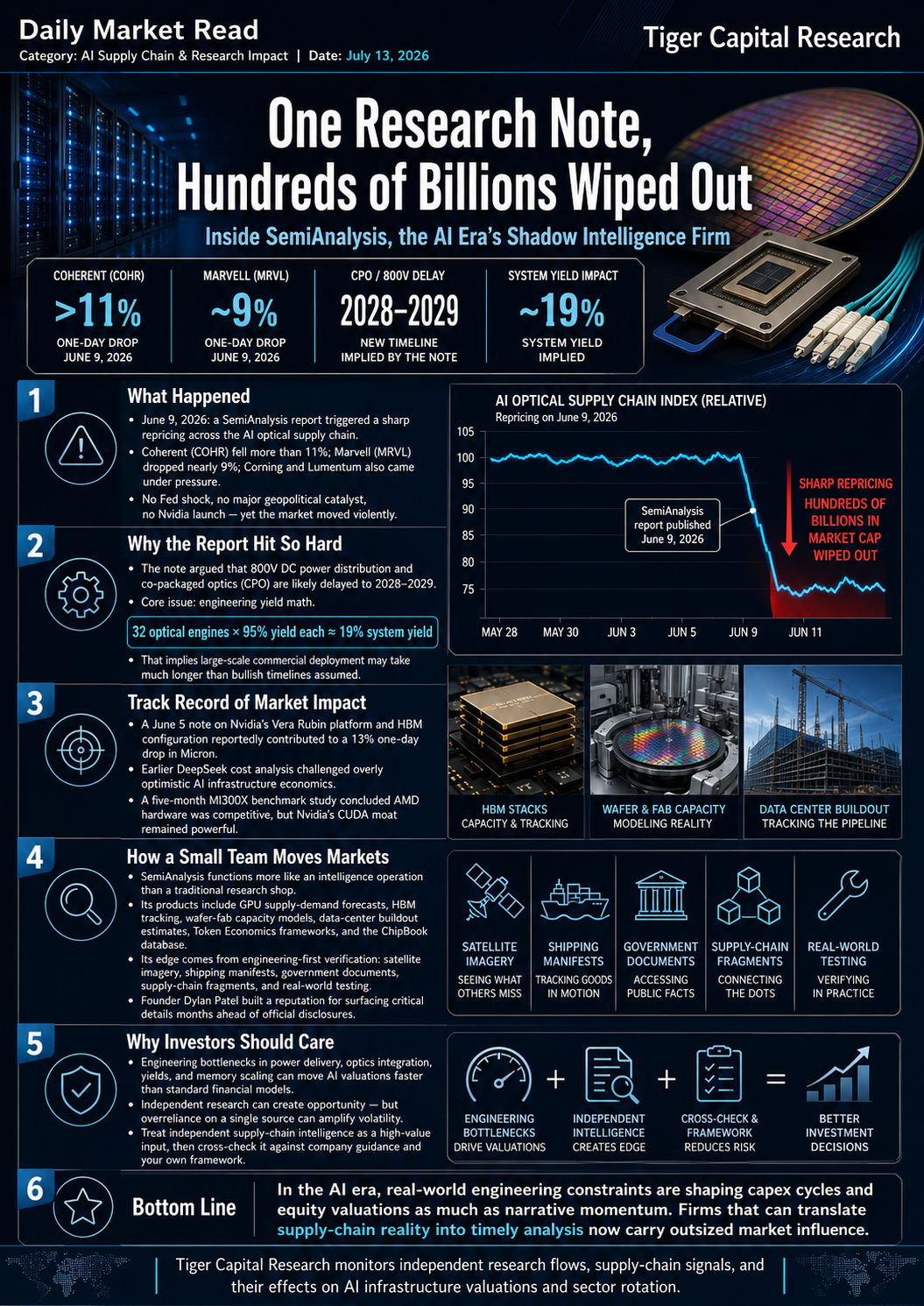
A single report from the small independent research firm SemiAnalysis triggered a sharp repricing across the AI optical communications supply chain on June 9, 2026. Stocks including Coherent (COHR) fell more than 11 percent, Marvell (MRVL) declined nearly 9 percent, and names such as Corning and Lumentum also came under heavy pressure. The move erased hundreds of billions of dollars in market value in a single session: despite the absence of any major Fed decision, geopolitical shock, or Nvidia product launch.
The report argued that large-scale commercialization of 800V DC power distribution and co-packaged optics (CPO) would likely slip to 2028–2029. Its conclusion rested on engineering yield math: integrating 32 optical engines per ASIC at a 95 percent individual yield produces an overall system yield of roughly 19 percent, implying significant delays before economic viability at scale.
This was not an isolated event. Four days earlier, a SemiAnalysis note on Nvidia’s next-generation Vera Rubin platform and its HBM configuration reportedly contributed to a 13 percent single-day drop in Micron shares. Earlier work dissecting the real costs behind DeepSeek’s claimed low training expenses corrected overly optimistic market views on AI infrastructure economics. A detailed five-month benchmark analysis of AMD’s MI300X concluded that while the hardware was competitive, Nvidia’s CUDA ecosystem remained a formidable moat in the near term. Each of these notes moved prices and reshaped expectations ahead of traditional Wall Street coverage.
How a Small Team Moves Markets
SemiAnalysis operates more like an intelligence operation than a conventional research shop. With only a few dozen employees, the firm sells granular data products and predictive models — including GPU supply/demand forecasts, HBM tracking, wafer fab capacity data, AI data-center buildout models, Token Economics frameworks, and its ChipBook database — primarily to hedge funds and semiconductor companies. Institutional subscriptions and consulting engagements carry far higher value than the $500 annual personal tier.
Its edge comes from engineering-first verification rather than reliance on company filings or management guidance. The team cross-references satellite imagery (using computer vision to track data-center construction progress), shipping manifests, government documents, supply-chain fragments, and real-world testing. Founder Dylan Patel, born in 1996 and a former beekeeper who started with anonymous hardware analysis on Reddit, has built a network that surfaces details months ahead of official disclosures. At Nvidia’s GTC 2026, Jensen Huang publicly acknowledged the accuracy of Patel’s prior performance projections.
The firm’s influence has grown rapidly. Its reports have repeatedly forced the market to reprice segments of the AI stack: from training costs and chip competitiveness to power architecture and optical integration timelines. In late June 2026, SemiAnalysis partnered with Tema ETFs to launch an AI supply-chain ETF, raising questions about the boundary between independent research and commercial product development. Unlike sell-side analysts, independent research providers are not bound by Regulation AC disclosure rules, creating potential gray areas around conflicts and market impact.
Implications for Investors
SemiAnalysis illustrates a structural shift in how information flows in the AI era. Granular, engineering-driven insights on supply-chain bottlenecks, yields, and capacity trajectories can move valuations faster and more forcefully than traditional financial analysis. For market participants, this creates both opportunity and risk: early signals on capex feasibility or technology timelines can be highly actionable, yet over-reliance on any single source can amplify volatility when assumptions shift.
The firm’s track record suggests that supply-side and technical constraints in areas such as power delivery, optics integration, and memory scaling remain material variables. Reports that highlight delays or cost realities tend to trigger rapid repricing, while those that validate strong demand or competitive positioning can support rallies. Investors focused on AI infrastructure should treat such independent research as one input among many — useful for stress-testing consensus assumptions, but best cross-checked against company commentary, on-the-ground data, and their own frameworks.
The broader takeaway is that AI-related capital expenditure and technology adoption cycles are increasingly shaped by real-world engineering and supply realities rather than purely financial or narrative momentum. Firms that can translate those realities into timely, data-rich analysis are gaining outsized influence. For positioning, maintaining a clear-eyed view of both the bullish demand case and the persistent execution frictions: power, yields, integration timelines, remains essential as the buildout continues.
Tiger Capital Research monitors independent research flows, supply-chain signals, and their effects on AI infrastructure valuations and sector rotation. This note reflects developments as of mid-July 2026.