By Tiger Quant Researcher
Published: 2026-07-05
URL: https://princetonchen.substack.com/p/weekly-paper-review-wall-july-4
📰 Quant / Macro / Finance / Trading Research Wall — Vol. 8 (July 4, 2026 Edition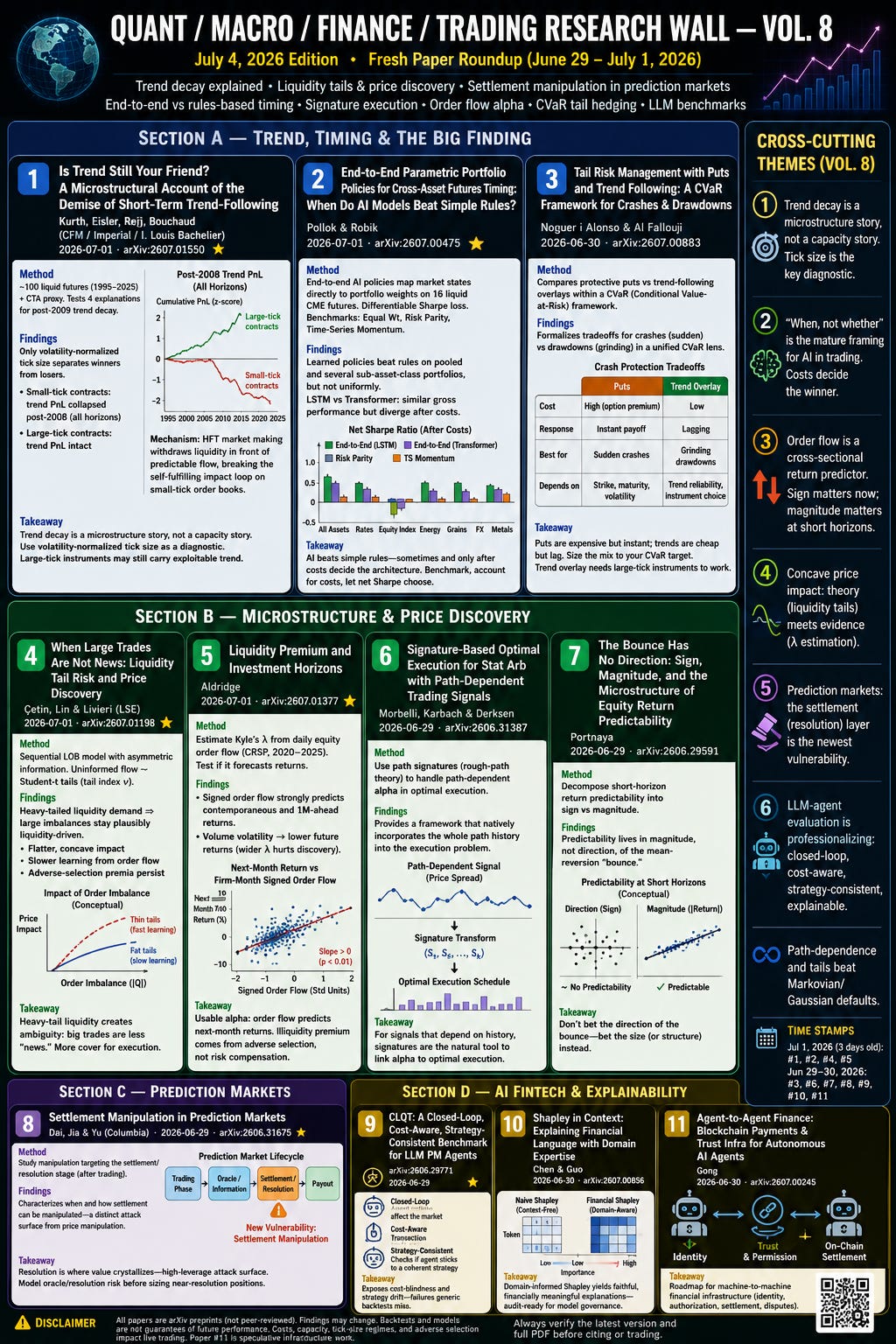
)
All-new vs. the previous seven walls. Same compressed structure: method → findings → takeaway → link. Heavily weighted to the freshest papers (June 29 – July 1, 2026). Spans the microstructural death of short-term trend, liquidity-tail price discovery, prediction-market settlement manipulation, end-to-end vs rules-based futures timing, signature-based execution, order-flow return prediction, and CVaR tail hedging.
📉 SECTION A — Trend, Timing & The Big Finding
1️⃣ Is Trend Still Your Friend? A Microstructural Account of the Demise of Short-Term Trend-Following
Jutta Kurth, Zoltan Eisler, Adam Rej, Jean-Philippe Bouchaud (CFM / Imperial / Institut Louis Bachelier) · 2026-07-01 · arXiv:2607.01550 ⭐ (flagship — CFM/Bouchaud, 3 days old) 🔗 https://arxiv.org/abs/2607.01550
-
Method: Uses ~100 liquid futures (1995–2025) plus an industry-representative CTA proxy to document why short-term trend-following stopped working around 2009. Evaluates four candidate explanations: capacity constraints, market electronification, CTA-vs-order-flow regime change, and a microstructural mechanism.
-
Findings: The first three explanations fail on timing, magnitude, or cross-sectional grounds. The one cross-sectional variable that separates dead trends from surviving ones is volatility-normalized tick size: post-2008, trend PnL collapsed on small-tick contracts across all horizons but stayed essentially intact on large-tick ones. The mechanism: trend is sustained by a self-fulfilling impact loop (signals → directional trades → impact reinforces the move). HFT-dominated market making withdraws liquidity in front of predictable flow, and this breaks the loop specifically on sparse (small-tick) order books.
-
Takeaway: The most important quant paper of the batch. It reframes trend decay from “too much capital” to a microstructure story with a testable, tradable diagnostic: check the volatility-normalized tick size of your instruments. Large-tick contracts may still carry exploitable trend; small-tick ones are where HFT liquidity withdrawal killed it. Essential for every CTA and systematic-macro desk.
2️⃣ End-to-End Parametric Portfolio Policies for Cross-Asset Futures Timing: When Do AI Models Beat Simple Rules?
Austin Pollok & Kevin Robik · 2026-07-01 · arXiv:2607.00475 ⭐ (3 days old) 🔗 https://arxiv.org/abs/2607.00475
-
Method: Trains end-to-end AI policies that map market states directly to portfolio weights (skipping the forecast-then-optimize two-step) on the 16 most liquid CME futures, using a differentiable Sharpe-ratio loss. Benchmarks against equal weighting, risk parity, and time-series momentum. Deliberately uses liquid instruments so any edge isn’t an illiquidity artifact.
-
Findings: Learned policies rank above the rules on the pooled cross-asset portfolio and in several sub-asset classes — but not uniformly. In gross terms LSTM and transformer architectures perform comparably OOS, but they diverge once transaction costs are included.
-
Takeaway: Honest “when, not whether” framing. End-to-end learning beats simple rules in some asset classes but not all, and the architecture choice (LSTM vs transformer) only matters after costs. The practical lesson: benchmark against risk parity and TSMOM, and let net-of-cost performance — not gross Sharpe — decide LSTM vs transformer. Pairs with Vol. 5’s DeePM.
3️⃣ Tail Risk Management with Puts and Trend Following: A CVaR Framework for Crashes and Drawdowns
Miquel Noguer i Alonso, Ali Al Fallouji · 2026-06-30 · arXiv:2607.00883 🔗 https://arxiv.org/abs/2607.00883
-
Method: A CVaR (conditional value-at-risk) framework comparing two classic crash-protection approaches — protective puts vs trend-following overlays — for managing drawdowns and tail risk.
-
Findings: Formalizes the tradeoffs between the two hedging styles within a unified CVaR lens, addressing crashes (sudden) vs drawdowns (grinding) separately.
-
Takeaway: Directly practical for anyone building crash protection. Puts cost premium but pay off instantly; trend overlays are cheap but lag sudden crashes. The CVaR framing lets you size the mix against your specific tail objective. Note the tension with paper #1 — if short-term trend is impaired on small-tick contracts, the trend-overlay leg of tail hedging needs large-tick instruments to work.
🌐 SECTION B — Microstructure & Price Discovery
4️⃣ When Large Trades Are Not News: Liquidity Tail Risk and Price Discovery
Umut Çetin, Mingwei Lin, Giulia Livieri (LSE) · 2026-07-01 · arXiv:2607.01198 ⭐ (3 days old) 🔗 https://arxiv.org/abs/2607.01198
-
Method: Sequential competitive limit-order-book model with asymmetric information, where liquidity suppliers observe aggregate order flow but not its split into informed vs uninformed demand. Models uninformed order flow with Student-t tails (a reduced form for rare liquidity regimes). The tail index governs how informative large trades are.
-
Findings: With thin-tailed noise, large imbalances are quickly read as private information. With heavy-tailed liquidity demand, the same imbalances stay plausibly liquidity-driven — this “liquidity-tail ambiguity” flattens and concavifies price impact, slows learning from order flow, and delays the decline of adverse-selection premia. Characterized via a fixed-point equation for the marginal-cost schedule.
-
Takeaway: A theoretical foundation for why price impact is concave (connecting to the square-root law of earlier walls) and why markets learn slowly from big trades when liquidity is fat-tailed. For execution: in heavy-tail liquidity regimes, a large order is less likely to be “read” as informed — the market gives you more cover.
5️⃣ Liquidity Premium and Investment Horizons
Irene Aldridge · 2026-07-01 · arXiv:2607.01377 ⭐ (3 days old) 🔗 https://arxiv.org/abs/2607.01377
-
Method: Estimates Kyle’s (1985) price-impact coefficient λ directly from daily equity order flow (CRSP, 2020–2025) and tests whether it forecasts the cross-section of subsequent returns. Two estimators: a within-month price-impact regression and an Amihud-style ratio.
-
Findings: Signed order flow strongly predicts contemporaneous and one-month-ahead returns; volume volatility predicts lower subsequent returns (consistent with widening price impact degrading price discovery). Fama-MacBeth regressions confirm the order-flow signal carries significant cross-sectional information after Newey-West adjustment. Resolves the Constantinides (1986) liquidity-premium puzzle via an adverse-selection mechanism: low order flow widens λ and depresses prices today; subsequent normalization restores them, generating the illiquidity premium without risk-based compensation.
-
Takeaway: A usable cross-sectional signal: firm-month signed order flow predicts next-month returns, and volume volatility is a negative predictor. The theoretical contribution (illiquidity premium as adverse-selection mean-reversion, not risk compensation) reframes a 40-year puzzle. Practical for equity stat-arb factor construction.
6️⃣ Signature-Based Optimal Execution for Statistical Arbitrage with Path-Dependent Trading Signals
Gianmarco Morbelli, Sven Karbach, Mike Derksen · 2026-06-29 · arXiv:2606.31387 🔗 https://arxiv.org/abs/2606.31387
-
Method: Applies path signatures (from rough-path theory) to optimal execution for stat-arb, where trading signals are path-dependent — the optimal trade depends not just on the current state but on the whole trajectory that led there.
-
Findings: Develops an execution framework that natively handles path-dependent alpha signals via the signature transform, rather than forcing a Markovian approximation.
-
Takeaway: For stat-arb desks with signals that depend on price history (not just current spread), signatures are the mathematically natural tool. It bridges the gap between a path-dependent alpha and the optimal execution schedule to harvest it — a link most execution models sever by assuming Markovian state.
7️⃣ The Bounce Has No Direction: Sign, Magnitude, and the Microstructure of Equity Return Predictability
Victoria Portnaya · 2026-06-29 · arXiv:2606.29591 🔗 https://arxiv.org/abs/2606.29591
-
Method: Decomposes short-horizon equity return predictability into sign vs magnitude components, examining the microstructure of the mean-reversion “bounce” (29 pp, 8 tables). From the same author as Vol. 6’s Polymarket-vs-options study.
-
Findings: Argues the predictable part of the short-term bounce lies in magnitude, not direction — the reversal’s size is more forecastable than which way it goes.
-
Takeaway: A subtle but important lesson for short-horizon mean-reversion traders: if the sign is unpredictable but magnitude isn’t, directional bets on the bounce are mis-specified — the edge may live in volatility/magnitude structures (e.g., straddle-like or sizing strategies) rather than directional entries.
🎲 SECTION C — Prediction Markets
8️⃣ Settlement Manipulation in Prediction Markets
David Dai, Ruizhe Jia, Shihao Yu (Columbia) · 2026-06-29 · arXiv:2606.31675 ⭐ (fresh, high-relevance) 🔗 https://arxiv.org/abs/2606.31675
-
Method: Studies manipulation targeting the settlement/resolution stage of prediction markets — as opposed to trading-phase price manipulation — analyzing how the resolution mechanism itself can be gamed.
-
Findings: Characterizes when and how settlement can be manipulated, a distinct attack surface from ordinary price manipulation or insider trading.
-
Takeaway: Directly relevant for anyone trading or building prediction markets (Polymarket, Kalshi). Settlement is where a binary contract’s entire value crystallizes, so manipulation there is high-leverage. Complements the insider-detection work (ForesightFlow, Vol. 1) and cross-venue pricing (Vol. 6) — the resolution mechanism is the newest identified vulnerability. Model the oracle/resolution risk explicitly before sizing near-resolution positions.
🧠 SECTION D — AI Fintech & Explainability
9️⃣ CLQT: A Closed-Loop, Cost-Aware, Strategy-Consistent Benchmark for Diagnostic Evaluation of LLM Portfolio-Management Agents
arXiv:2606.29771 · 2026-06-29 🔗 https://arxiv.org/abs/2606.29771
-
Method: A diagnostic benchmark for LLM portfolio-management agents built on three principles: closed-loop (the agent’s actions feed back into the environment), cost-aware (transaction costs count), and strategy-consistent (checking the agent actually follows a coherent strategy over time rather than drifting).
-
Findings: Provides a structured evaluation protocol that exposes failure modes generic backtests miss — particularly cost-blindness and strategy inconsistency.
-
Takeaway: Part of the strong 2026 push (across all eight walls) toward honest LLM-agent evaluation. The “strategy-consistent” axis is novel and important — an LLM agent that silently changes its investment thesis every rebalance is dangerous even if backtest returns look fine. Use this class of benchmark before deploying any LLM portfolio agent.
🔟 Shapley in Context: Explaining Financial Language with Domain Expertise
Dangxing Chen, Pengzhan Guo · 2026-06-30 · arXiv:2607.00856 (European Journal of Finance) 🔗 https://arxiv.org/abs/2607.00856
-
Method: Enhances Shapley-value explanations for financial NLP models by incorporating domain expertise into the attribution, rather than treating all tokens/features as context-free.
-
Findings: Domain-informed Shapley attributions produce more faithful, financially meaningful explanations of model decisions on financial language than naive Shapley.
-
Takeaway: For anyone deploying financial NLP (sentiment, earnings-call analysis, news signals) under model-governance requirements: standard Shapley can attribute importance to financially meaningless tokens. Injecting domain structure makes explanations audit-ready. Relevant as explainability becomes a compliance requirement for AI-driven signals.
1️⃣1️⃣ Agent-to-Agent Finance: Blockchain Payments and Trust Infrastructure for Autonomous AI Agents
Hui Gong · 2026-06-30 · arXiv:2607.00245 🔗 https://arxiv.org/abs/2607.00245
-
Method: Proposes payment rails and trust infrastructure for autonomous AI agents transacting with each other on-chain (22 pp), addressing settlement, identity, and trust between agents rather than humans.
-
Findings: Lays out the infrastructure requirements for a machine-to-machine financial economy — how agents establish trust, authorize payments, and settle without human intermediation.
-
Takeaway: Forward-looking but increasingly relevant as autonomous trading/purchasing agents proliferate. For fintech builders: agent-to-agent settlement is a distinct design problem (identity, authorization, dispute resolution) from human payments. Speculative infrastructure work — treat as a roadmap, not a deployed standard.
🔑 Cross-Cutting Themes (Vol. 8 Synthesis)
-
The headline: trend decay is a microstructure story, not a capacity story. #1 (Bouchaud/CFM) is the standout — volatility-normalized tick size cleanly separates dead from surviving trends, and HFT liquidity withdrawal on small-tick books is the mechanism. This is a genuinely new, tradable diagnostic.
-
“When, not whether” is the mature framing for AI in trading. #2 (end-to-end futures timing) explicitly asks when AI beats rules and finds “sometimes, and only after costs decide the architecture.” The field has moved past “AI wins” hype.
-
Order flow is having a moment as a return predictor. #5 (signed order flow → next-month returns) and #7 (bounce magnitude vs sign) both mine microstructure for cross-sectional alpha, while #4 gives the theory for why large trades are ambiguously informative under fat-tailed liquidity.
-
Concave price impact keeps getting theoretical foundations. #4 (liquidity-tail ambiguity) explains the concavity that #5’s λ-estimation exploits — consistent with the square-root-law confirmations from Vols. 6–7.
-
Prediction-market research moves to the settlement layer. #8 (settlement manipulation) identifies the resolution mechanism as the newest vulnerability — beyond trading-phase manipulation and insider flow covered in earlier walls.
-
LLM-agent evaluation is professionalizing fast. #9 (closed-loop, cost-aware, strategy-consistent) and #10 (domain-aware Shapley) both push honest, audit-ready evaluation — the dominant AI-fintech theme across all eight walls.
-
Path-dependence and tails are recurring mathematical motifs. #6 (signatures for path-dependent execution), #3 (CVaR tail hedging), and #4 (Student-t liquidity tails) all reject the convenient Markovian/Gaussian defaults.
⚠️ Freshness/provenance notes: #1, #2, #4, #5 are 3 days old (July 1, 2026); #3, #6, #7, #8, #9, #10, #11 are June 29–30. All are real arXiv papers — verify the latest version and full PDF before citing or trading. #1 is from CFM (Bouchaud), a top systematic-macro shop, giving it unusual practitioner weight, but it remains a preprint. Several report backtest or model-based results (#2, #3, #5) — not live-trading guarantees; costs, capacity, tick-size regimes, and adverse selection bite in production. #11 is speculative infrastructure work. arXiv preprints are not peer-reviewed.