By Tiger Capital Research
Published: 2026-07-05
URL: https://princetonchen.substack.com/p/two-near-term-risks-one-structural
Daily Market Read II | Category: US Equities & AI | Date: July 5, 2026
Tiger Capital Research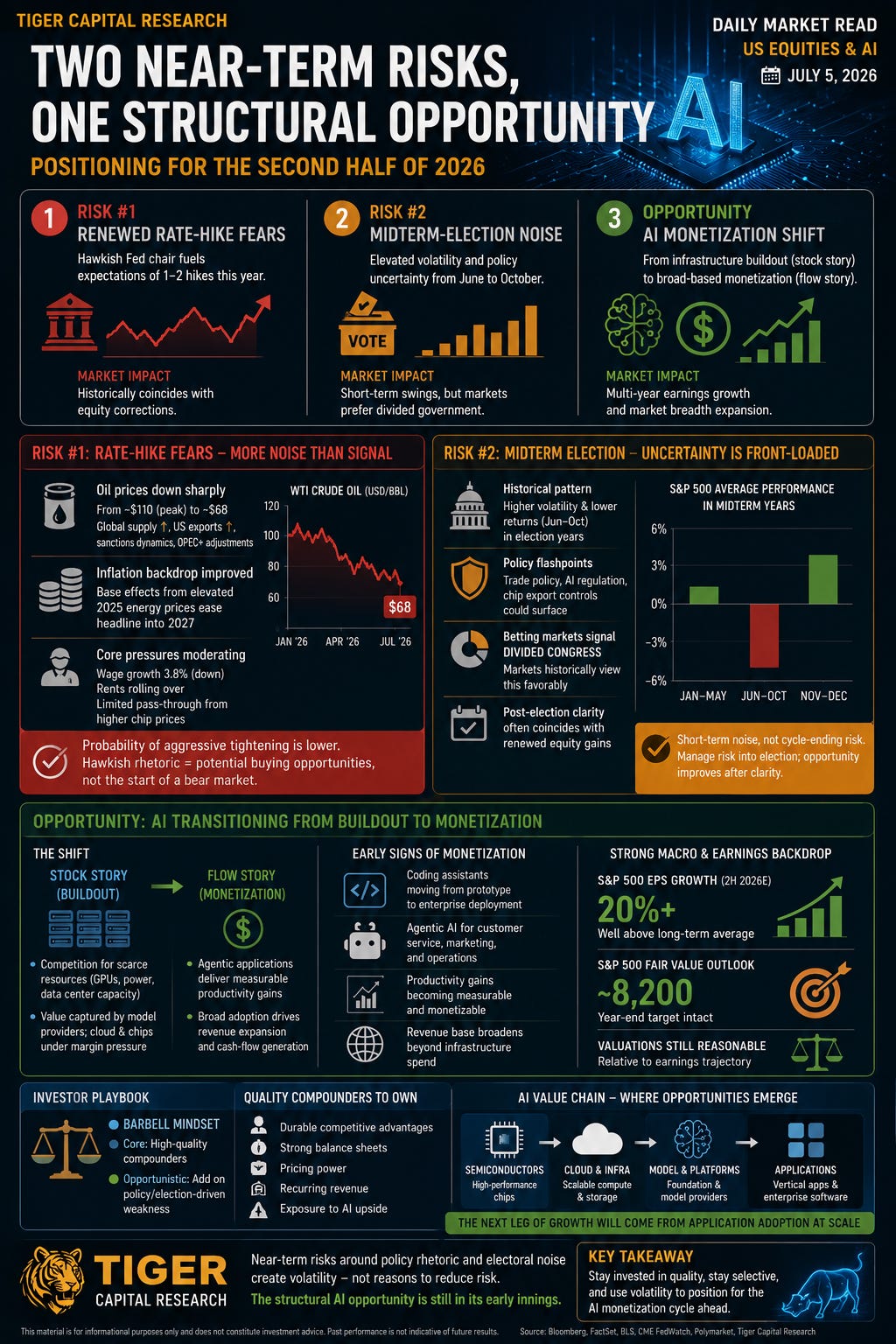
Markets enter the second half of 2026 with two prominent sources of volatility and one clear, multi-year tailwind. The first two, renewed rate-hike fears and midterm-election noise, are largely noise layered on top of a fundamentally constructive setup. The third, the transition of artificial intelligence from infrastructure buildout to monetization, represents the more durable driver of earnings growth and market breadth.
On monetary policy, the appointment of a new Fed chair perceived as hawkish has revived expectations of one or two rate hikes this year. Historical precedent shows that tightening cycles often coincide with equity corrections. However, the inflation backdrop has improved more than the initial rhetoric suggests. Oil prices have fallen sharply from their conflict-driven peak near $110 to around $68, with global supply increasing through higher U.S. exports, relaxed sanctions dynamics, and OPEC+ adjustments. Base effects from last year’s elevated energy prices should further ease headline readings into 2027. On the core side, wage growth has moderated to 3.8 percent, rent measures are rolling over, and the direct pass-through from higher chip prices to consumer inflation appears limited. Taken together, these factors reduce the probability of aggressive tightening. Any volatility triggered by hawkish commentary is more likely to present buying opportunities than to mark the start of a sustained bear market.
Midterm elections add a second layer of short-term uncertainty. Historical patterns show elevated volatility and softer average returns between June and October in election years as both parties campaign and policy proposals proliferate. Trade policy, AI regulation, and chip export controls could all surface as flashpoints. That said, current betting markets point to a divided Congress, which markets have historically viewed favorably because it limits the scope for extreme legislation. The period of maximum uncertainty is front-loaded; post-election clarity has often coincided with renewed equity gains. While the next few months warrant tighter risk management, the election itself is unlikely to derail the broader cycle.
The more important development lies in artificial intelligence. The trade to date has largely been a “stock” story, competition for scarce resources such as GPUs, power, and data-center capacity, rather than a “flow” story of broad-based demand expansion. Downstream model providers have captured most of the early value, while cloud operators have seen limited incremental revenue relative to rising costs, and semiconductor demand has remained heavily dependent on a handful of large-cap spenders. This dynamic is beginning to shift. Agentic applications capable of delivering measurable productivity gains (coding assistants being the clearest near-term example) are moving from prototype to deployment. When adoption scales, the revenue base broadens beyond infrastructure spend and the investment case moves from scarcity pricing to cash-flow generation.
For investors, the implication is straightforward. In a market still dominated by resource-constrained positioning, the highest-conviction approach is to own businesses with durable competitive advantages that can compound through both the infrastructure and application phases. Broad exposure via quality indices remains a pragmatic alternative for those who prefer not to pick individual winners. Macro tailwinds are also supportive: corporate earnings are expected to grow above 20 percent in the second half of the year, well above the long-term average, with AI-related productivity gains contributing to the upside. Valuations for the S&P 500 remain reasonable relative to this earnings trajectory, with year-end targets around 8,200 still intact.
Near-term risks around policy rhetoric and electoral noise should be treated as tactical rather than strategic. They create volatility that can be used to add exposure at better prices rather than reasons to reduce risk. The structural opportunity in AI monetization, by contrast, is still in its early innings and favors patient capital. The second half is therefore best navigated with a barbell mindset: maintain core positions in high-quality compounders while using any policy- or election-driven weakness to scale into the parts of the market where the transition from buildout to cash flow is most advanced.
Tiger Capital Research tracks the interplay between monetary policy signals, electoral cycles, and technological monetization for their effects on positioning and risk management. This note reflects market developments and data available as of early July 2026.