By Tiger Capital Research
Published: 2026-06-26
URL: https://princetonchen.substack.com/p/cloud-providers-under-pressure-as
Daily Market Read II | Category: Sector Read | Date: June 25, 2026
Tiger Capital Research
Micron’s strong fiscal Q3 results have intensified scrutiny on the capital expenditure dynamics across the AI supply chain. While memory makers are enjoying robust pricing power and visibility, the hyperscalers: Microsoft, Google, Amazon, and Meta, are increasingly being viewed as the squeezed segment of the AI buildout.
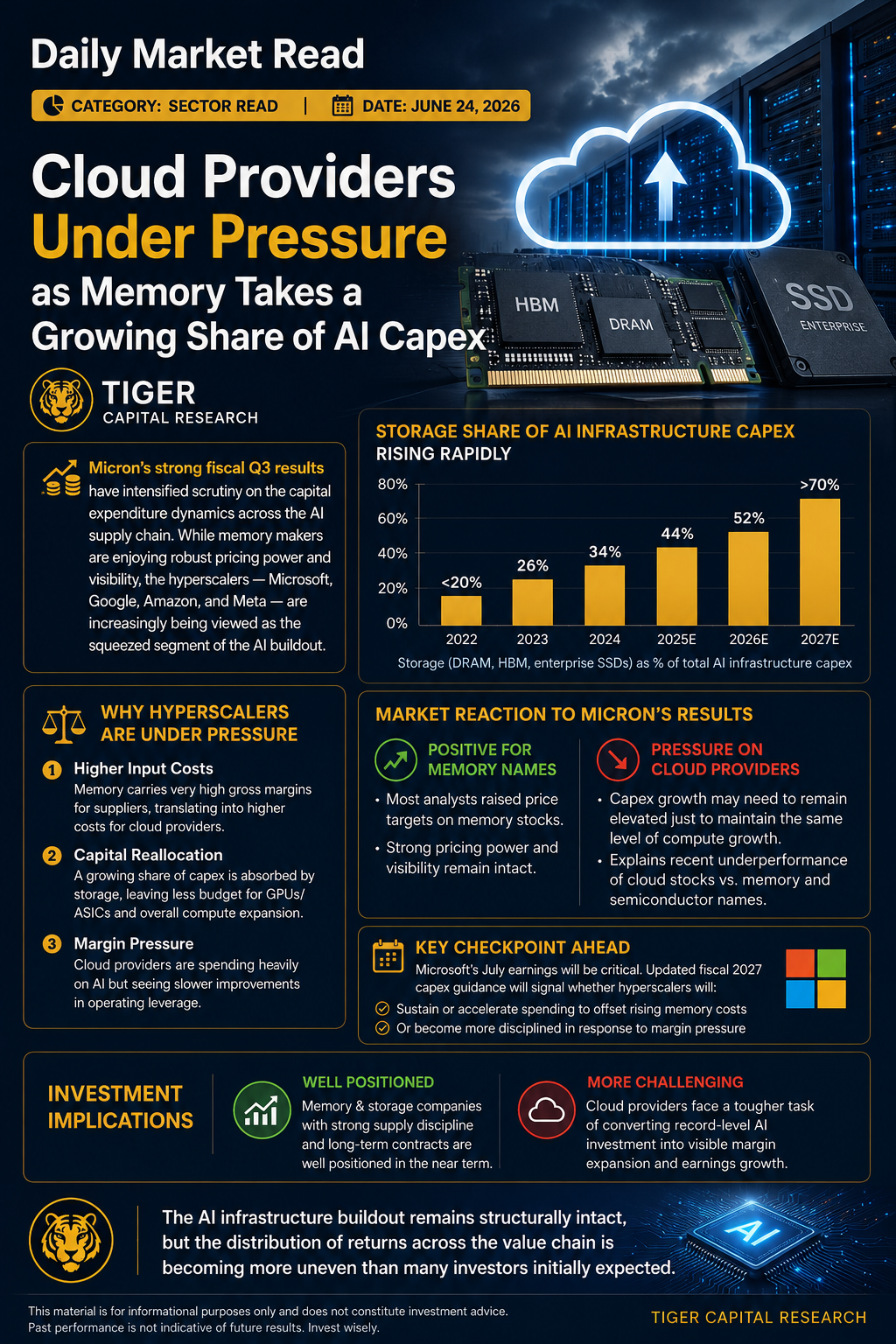
The core issue is the shifting composition of AI-related capital spending. Storage (DRAM, HBM, and enterprise SSDs) has seen its share of total AI infrastructure capex rise sharply, from under 20% in 2022 to an estimated 52% in 2026, with some projections suggesting it could exceed 70% by 2027.
This reallocation means that a larger portion of every incremental dollar spent by cloud providers is flowing to memory suppliers rather than to compute, networking, or other areas that directly expand overall AI capacity.
This dynamic creates margin pressure on the hyperscalers in two ways. First, memory currently carries very high gross margins for suppliers, which translates into higher input costs for cloud companies.
Second, if a growing share of the budget is absorbed by storage, less capital may be available to accelerate GPU/ASIC deployments or to expand overall compute capacity at the previously expected pace. The result is that cloud providers are spending heavily on AI but seeing slower-than-hoped-for improvements in operating leverage.
Bank research following Micron’s results has generally reinforced this view. While most firms raised price targets on memory names, several highlighted that hyperscaler capex growth may need to remain elevated simply to maintain the same level of compute growth, given the rising cost share of memory. This helps explain why cloud stocks have underperformed memory and semiconductor names in recent months despite strong overall AI demand.
Looking ahead, Microsoft’s July earnings will be an important checkpoint. The company is expected to provide updated guidance on fiscal 2027 capital expenditure, which will offer the clearest signal yet on whether hyperscalers intend to sustain or even accelerate spending to offset the rising memory cost burden, or whether they will become more disciplined.
For investors, the current environment suggests a continued bifurcation within the AI ecosystem. Memory and storage companies with strong supply discipline and long-term contracts remain well positioned in the near term.
In contrast, cloud providers face a more challenging task of converting record-level AI investment into visible margin expansion and earnings growth. Until there is clearer evidence that overall compute capacity is scaling fast enough to justify the spending, pressure on hyperscaler margins and valuations is likely to persist.
The AI infrastructure buildout remains structurally intact, but the distribution of returns across the value chain is becoming more uneven than many investors initially expected.
Tiger Capital Research makers are